The future of AI is moving faster than anyone predicted. Advancements in Artificial Intelligence, including ANI, AGI (Artificial General Intelligence), and ASI, have accelerated so dramatically between 2023 and early 2026 that keeping pace is a challenge even for technology companies. With the release of OpenAI’s reasoning-focused ‘o1’ model in September 2024, ongoing rumours that AGI had been achieved internally via the Q-star (Q*) project, and expert predictions now placing early AGI between 2027 and 2033, the question is no longer if AGI will arrive, but when. As expert AI consulting services become more important for businesses preparing for this shift, the stakes have never been higher.
Editor's Note [17.03.26]: This article was originally published on 21st June 2023 and updated on 16th September 2024 to cover the release of OpenAI's 'o1' model and the Jimmy Apples AGI claims. This March 2026 update reflects the current state of AI: GPT-5 launched in August 2025 and has iterated to GPT-5.4, while GPT-6 is anticipated in 2026. New sections cover updated AGI timelines, GPT-6 and the path to AGI, the rise of agentic AI, and how businesses should prepare. All existing content has been reframed for March 2026 accuracy, with GPT-4 and o1 sections updated to reflect their historical significance rather than current status. Internal service links, prediction status notes, and a refreshed conclusion have been added throughout. The title has been updated from "The Future of Artificial Intelligence: What Is AGI? AI vs AGI vs ASI, GPT-5 AGI and the Rise of Agentic AI" to "What Is AGI (Artificial General Intelligence) or True AI? AI vs AGI vs ASI Explained" to better reflect the article's primary focus.
An Overview
Before we jump into the nitty gritty of OpenAI, we’ll explore AGI, ASI (Artificial Super Intelligence), and ANI (Artificial Narrow Intelligence). We’ll also discuss the prospects of human augmentation, and how far away we are from a truly self-sufficient Artificial General Intelligence.
We’ll consider intriguing questions such as “What is true AI?” and “What does the future of AI hold?”, and debate the concepts of AI vs AGI vs ASI, all while exploring the progressive steps from OpenAI’s ChatGPT to GPT-4, the reasoning breakthrough of o1, the arrival of GPT-5 in 2025, and the anticipated GPT-6.
With GPT-5.4 now live and GPT-6 expected in 2026, will we witness AGI in the very near future, or is it still years away?
Everything is up for debate, so let’s jump in and discuss the exciting world of Artificial Intelligence, its future, and the unprecedented changes that lie ahead.
Exploring the future of AI, true Artificial Intelligence and AGI. Image by Markus Winkler via unsplash
What Is AI (Artificial Intelligence)?
We’ll start with the most fundamental question, “What is AI?”.
AI is a broad term that can be used to describe a set of automated tasks that can be carried out by computer software. These tasks are created and designed by humans, and then completed by the software that has also been coded and designed by humans.
With popular tools such as ChatGPT, we are beginning to see the very start of systems that can adapt and ‘learn’ in order to increase efficiency and accuracy. This is sometimes referred to as Machine Learning.
However, even though we use the word ‘learn’ here, it should be thought of as a different type of learning than what a human is capable of. Learning within this context entails a set of software systems analysing patterns in datasets, and performing changes based on the system’s findings.
There are multiple terms that can be used to describe most of what we have in use today (such as weak AI or ANI). This is what voice assistants fall under in terms of AI categorisation.
What Is ANI (Artificial Narrow Intelligence)?
Essentially, Artificial Narrow Intelligence (ANI), or weak AI, refers to the majority of “AI” systems we use today.
This form of AI operates under a limited set of constraints, excelling in single tasks within a pre-defined, narrow area, such as voice recognition, recommendation systems, image recognition, or driving a car. ANI works according to specifically programmed algorithms or learned behaviour from data, but it does not possess consciousness, real understanding, or any kind of autonomous decision-making capability.
ANI systems are capable of “learning” to improve their performance over time, but only within the specific task they’ve been trained on. For example, a chess-playing AI can become increasingly proficient at the game but can’t apply that knowledge to play a different game like poker.
Despite its limitations, ANI is currently the most widely deployed type of AI, making significant impacts in various industries, including healthcare, finance, and automotive.
Examples include personal voice assistants like Siri or Alexa, spam filters in your email system, customer support chatbots, self-driving cars, and of course ChatGPT, which we will come on to shortly.
What Is AGI (Artificial General Intelligence)?
Artificial General Intelligence, also known as strong AI, is something that has become increasingly prominent over the past few years.
AGI is the ‘holy grail’ of artificial intelligence and is considered by most to be ‘true AI’, as this is more in line with what sci-fi movies and novels envision complex AI to become. In fact, it’s a very popular misconception that the AI systems we have in use today are actually AGI.
However, unlike ANI, which is designed and excels at a specific task, AGI systems will be able to learn, think and adapt, and implement knowledge across a broad range of tasks at the same level as a human. They will be able to process incredible amounts of data instantly and display a kind of cognitive flexibility that is the hallmark of human intelligence.
There is no doubt that there will eventually be ethical questions raised in regards to AGI machines in the future, and what rights (if any) they should have.
For example, if AGI machines and systems are able to process information in the same way humans can, does that give these systems the ability to reason and feel emotion? It’s an interesting question to think about in addition to considering the intellectual capability and raw processing potential of such systems.
What About OpenAI and ChatGPT?
Before we continue, it’s important to keep in mind the different types of AI discussed above. It’s easy to get mixed up when thinking about the definitions and actual capabilities of AI and AGI. The rise of ChatGPT is no exception when it comes to this.
Is ChatGPT AGI?
The quick answer is, no.
The popular and remarkable ChatGPT tool has spurred renewed interest in AI and caused a kind of “AI race” between players such as OpenAI with its ChatGPT and Google with Gemini. We even have other players in the race such as Meta’s open source LLaMA model.
So, why do people believe ChatGPT is AGI rather than AI (or ANI to be precise)? Well, AGI is described as a form of AI that can learn, plan, solve problems, and come up with creative solutions. This is all true and it’s also true that tools like ChatGPT can accomplish similar tasks. The key difference is that AGI will be able to carry out multiple varied tasks without human intervention. It will be able to act autonomously and perform intellectual tasks that currently only humans can do.
Despite not being AGI, the importance of ChatGPT and its role in AI should not be underplayed. For all of the reasons mentioned above, we recently produced the below article explaining why we believe ChatGPT is an AI inflection point and likely to bring about change that surpasses that of even the internet.
Was GPT-4 AGI?
The short answer was, and remains, no.
When GPT-4 launched in 2023, it was the most capable AI model available. Microsoft’s researchers claimed it showed ‘sparks of AGI’, sparking enormous excitement. However, GPT-4 was still fundamentally a pattern-matching system. It could identify patterns and provide answers with a human-like persona, but it was piecing together existing content rather than constructing new ideas through genuine reasoning.
That distinction remains one of the key differentiators between AI and AGI: the way information is created and served to the user.
GPT-4 has since been superseded by GPT-5 (released August 2025) and its subsequent iterations, including GPT-5.4 (released March 2026). While each generation has moved closer to AGI through advances in reasoning, agentic capabilities, and multimodal understanding, none have crossed the AGI threshold. The question is no longer “is GPT-4 AGI?” but rather “will GPT-6 be the model that gets us there?”

AGI vs AI: Is ChatGPT and GPT-4 AGI? Image by Google Deepmind via unsplash
What Is True AI? The Key Differences between AI and AGI
The fundamental difference between AI (as we know it today) and AGI comes down to scope and autonomy. Current AI systems are specialists: they excel at narrow tasks within predefined boundaries. AGI would be a generalist: capable of learning, reasoning, and acting autonomously across any domain, much like a human.
For a detailed side-by-side comparison of ANI, AGI, and ASI, see the comparison table later in this article.
As you can see, AGI will be a very powerful system with huge potential, but it also poses a huge risk according to many analysts and technology experts. We can expect the lines to blur in the coming years between AI and AGI as systems become more sophisticated, requiring less and less human intervention and oversight.
Elon Musk has recently sounded the alarm about the dangers of AI, and others have gone as far as to say it could trigger an eventual extinction event.
Even though such concerns are regarded as premature and extreme by some, it’s better to be cautious in these types of areas. A ‘runaway snowball effect’ is easy to envision with intelligent systems that can exponentially improve and iterate in no time at all without the need for human intervention.
It is important to remember that despite the risks, AI and AGI have the potential to do a lot of good. Recently it was announced that scientists have used AI to help discover new antibiotics that help treat superbugs. It is exciting to think about what other breakthroughs can be made possible in the healthcare sector as a result of AI.
There is no need to worry about the philosophical, societal or economic implications of AGI just yet. We’re still some way from having systems that are fully capable of being thought of as true AGI. For now, the focus is likely to remain on using chatbot AI tools like ChatGPT to save you time, money, and assist with creative endeavours. Businesses already taking advantage of these tools through professional AI and ChatGPT consulting are seeing measurable improvements in productivity and output quality.
AI vs AGI vs ASI: A Recap of the Main Differences
Although we’ve covered these individually, it’s useful to consider the full range of AI concepts together.
While these terms are often used interchangeably, they represent very distinct stages in AI evolution.
- ANI (Artificial Narrow Intelligence), or what we commonly refer to as AI, refers to systems designed for a narrow range of tasks. ChatGPT, voice assistants like Siri, or recommendation engines fall into this category. They perform specific tasks but lack the ability to generalise knowledge across multiple domains.
- AGI (Artificial General Intelligence), refers to systems that can perform any intellectual task that a human can. AGI systems would not just follow preset algorithms or learned data; they could autonomously learn, reason, and apply knowledge across various fields, much like humans.
- ASI (Artificial Super Intelligence) represents the next, and more speculative, leap in AI development. ASI would far surpass human intelligence, performing tasks not only faster but with a level of creativity, reasoning, and emotional intelligence beyond human capabilities.
The debate around AI vs AGI vs ASI isn’t just theoretical. It’s central to the future of technology, ethics, and even human survival.
Understanding the differences between these stages and where we are right now is at the core of what we are discussing today.
With figures like Jimmy Apples claiming that AGI has been achieved internally at OpenAI, rumours of a GPT-5 AGI, reports surrounding Q-star (Q*) and the release of OpenAI’s new “o1” model, it’s clear now is the time to evaluate how close we are to AGI and whether it’s actually here.
Does True AI, AGI or GPT-5 AGI Exist Anywhere Right Now?
While there are ongoing discussions and developments in the field with companies like Google’s DeepMind suggesting that AGI could be just a few years away, the question of “what is AGI?” and whether it currently exists is still up for debate.
AGI in 2023
Back in 2023, it was widely believed that GPT-5 AGI would be possible, but mysterious claims from Jimmy Apples added fuel to this discussion, speculating that AGI might already be a reality, at least internally at OpenAI. We also had exciting advanced AI applications being developed like AutoGPT and BabyAGI, which brought us much closer to the idea of AGI.
The Enigma of Jimmy Apples
Jimmy Apples became a focal point in the discussion of AGI due to his series of accurate predictions about OpenAI’s projects.
His sudden disappearance from social media platforms after sharing an image has only intensified the speculation. Many believe that his actions indicate that AGI has been achieved internally and is being kept under wraps for now.
Some believe he is a sort of informant or whistleblower, while others think it could be an elaborate publicity gimmick by OpenAI’s marketing team.
Key Events and Predictions in “AGI Has Been Achieved Internally?” Story and Jimmy Apples Claims
If you don’t fancy watching this interesting video from @AIAdaExplains, here’s the breakdown:
- September 18: Jimmy Apples tweets “AI has been achieved internally.” The tweet goes largely unnoticed.
- Reddit Investigation: A group of Reddit users familiar with Jimmy’s accurate past predictions about OpenAI decided to investigate further. They find evidence supporting his credibility.
- Viral Attention: After gaining viral attention, Jimmy Apples posts an image that fuels speculation. He then deletes his Twitter and Reddit accounts, leading many to believe he revealed too much.
- March 4 & 14: Jimmy predicts the announcement date for GPT-4, which turns out to be accurate. This defies even specialised prediction platforms.
- April 28: Jimmy predicts a new OpenAI project called GOI. The prediction is confirmed on September 19, 2023.
- September 10: Jimmy tweets about “Chat GPT plus referrals coming soon.” This is later confirmed to be accurate.
- OpenAI Employee Behaviour: Reddit users notice unusual tweets from OpenAI employees, adding another layer to the speculation around AGI and GPT-5.
- Other Predictions: Jimmy has made other predictions, such as a 1-2 trillion text model-only version of GPT-4 releasing soon, which also turned out to be accurate.
- Sam Altman’s Involvement: OpenAI CEO Sam Altman breaks his 7-year Reddit silence to vaguely deny the accusations but adds fuel to the fire with cryptic tweets.
- Theories about Jimmy: Various theories emerge about who Jimmy might be, ranging from a scam artist to a legitimate insider at OpenAI.
- Unresolved Questions: Despite the intense scrutiny, the true identity of Jimmy Apples and the veracity of his claims about AGI and GPT-5 remained unresolved.
On the one hand, we could see OpenAI’s Sam Altman discussing AGI as a potential co-worker replacement and claiming on Reddit that:
“AGI has been achieved internally”
but then he claims:
“Obviously this is just memeing, y’all have no chill, when AGI is achieved it will not be announced with a Reddit comment.”
Source: https://www.independent.co.uk
This captivating tale of Jimmy Apples and Sam Altman’s comments raised some important questions about the future of AI, the possibility of AGI, and the role of GPT-5 AGI in this unfolding narrative.
For more on this fascinating subject, visit the article below on the history and future of OpenAI:
AutoGPT: A Step Forward, but Not AGI
AutoGPT is described as one of the first examples of GPT-4 running fully autonomously, pushing the boundaries of what is possible with AI. While this is a significant advancement, being autonomous doesn’t necessarily mean it possesses the broad, human-like intelligence that defines AGI.
BabyAGI: Close but Not Quite
BabyAGI is referred to as an autonomous AGI agent using advanced technologies. Despite these claims, it’s primarily described as an AI-powered task management system, which suggests it’s designed for specific tasks rather than exhibiting broad, human-like intelligence.
While there are significant advancements in the field of AI, definitive evidence for the existence of true AGI or GPT-5 AGI is still lacking. The mysterious actions and predictions by Jimmy Apples have reignited the debate, making the future of AI and the role of GPT-5 in AGI a subject to watch closely.
Q-star (Q*)
One of the most significant developments in 2023 was the quiet but impactful announcement of Q-Star (Q*), a mysterious project rumoured to be a major step toward AGI. While details about Q-Star were sparse, it was believed to focus on solving foundational challenges in AI, particularly in reasoning and problem-solving, areas crucial for achieving AGI. Some speculated that Q-Star could be the key to AGI’s internal development at OpenAI.
AGI in 2024
Following on from the adventures of Jimmy Apples and Q-star in 2023, things appeared to go relatively quiet in the first half of 2024.
Then in September 2024, OpenAI announced its new o1 models, which focus on enhanced reasoning for complex tasks in science, coding, and math, with two versions: o1-preview (larger, broader knowledge) and o1-mini (faster, optimised for coding), available for ChatGPT Plus users.
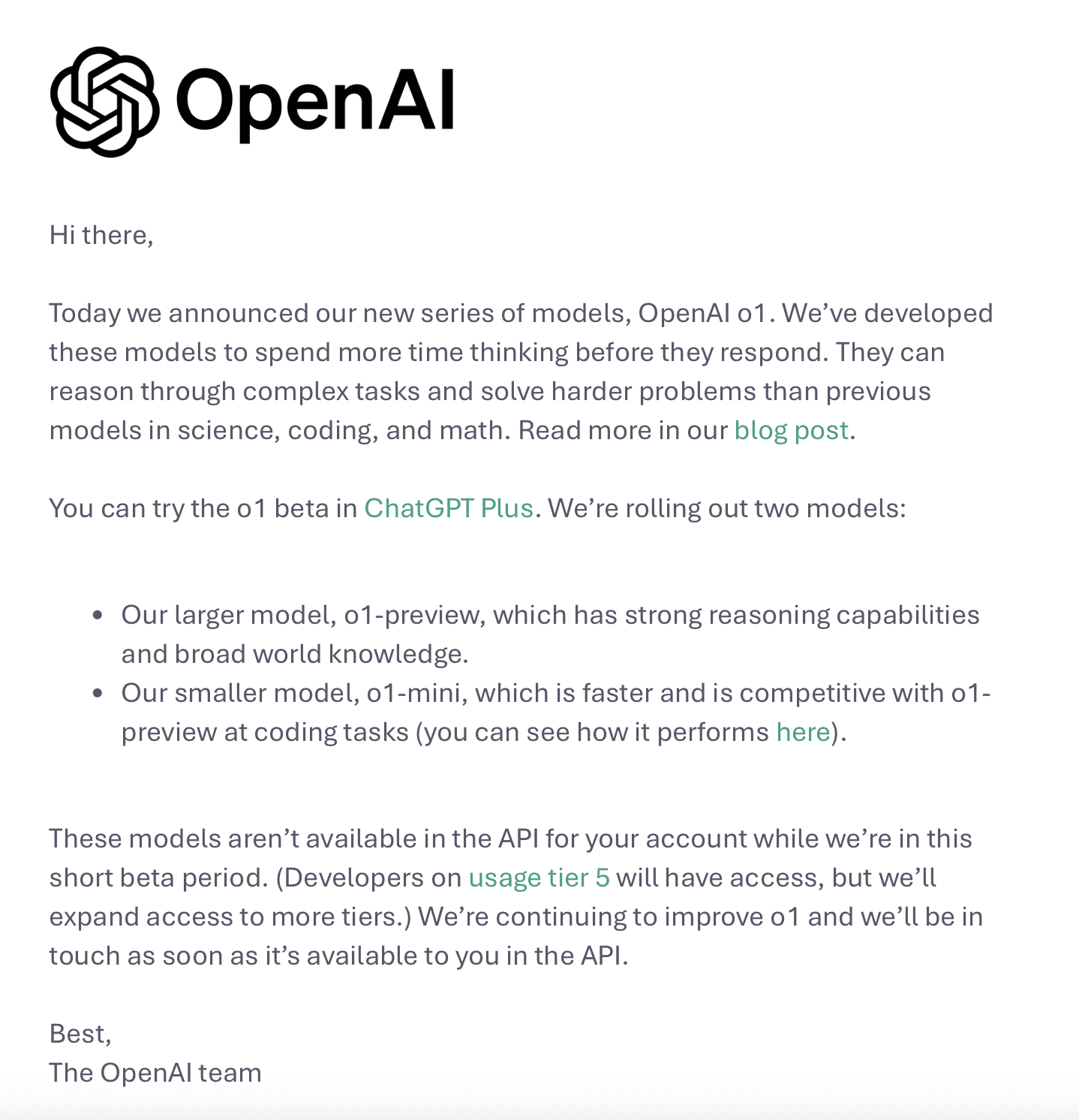
OpenAI announces its new o1 models
The most intriguing parts of this announcement were the “more time thinking before they respond” and “reason through complex tasks and solve harder problems” comments.
There’s no explicit mention of AGI but it sounded an awful lot like AGI and again raises the question: has AGI already arrived, or is it just around the corner?
Has AGI Been Achieved Internally at OpenAI?
One of the most debated topics in the world of AI today is whether AGI has been achieved internally at OpenAI.
Jimmy Apples made many accurate predictions regarding OpenAI and ChatGPT, most notably, that AGI has been achieved internally at OpenAI. His predictions about GPT-4 and its features were startlingly precise, including the introduction of web browsing and Advanced Data Analysis. But it’s his claims regarding GPT-5 AGI that captured the most attention.
According to Jimmy, AGI was already a reality within OpenAI back in 2023, but the company was deliberately holding back its public release for undisclosed reasons.
Adding to the intrigue, Jimmy Apples abruptly deleted his Twitter and Reddit accounts after making these bold statements. Many speculated that he may have revealed too much, and his disappearance only fuelled rumours about AGI’s existence. Whether Jimmy Apples is an insider with privileged information or a clever hoaxer, his impact on the conversation around AGI and GPT-5 cannot be ignored.
Reports of Q-star only a couple of months after Jimmy’s comments added even more ammunition to the claims that AGI existed at OpenAI. Many of us believed this would eventually reveal itself as a GPT-5 AGI model, but it now seems more likely that the “o1” model will take its place.
Is OpenAI’s ‘o1’ Model AGI?
The release of OpenAI’s “o1” model in September 2024 has been a relatively quiet but very important one.
OpenAI’s decision to reset the naming scheme to “o1” marks more than just a rebranding. It signals a fundamental shift in AI development. Unlike previous iterations like GPT-3 and GPT-4, which focused on scaling model size, the “o1” model represents a leap in reasoning and cognitive depth.
This reset highlights a new chapter for OpenAI, where the emphasis is on making the model smarter, not just larger. The shift away from the GPT-x naming convention also highlights the significance of these advancements, positioning “o1” as a groundbreaking step forward in AI’s evolution.
But is the “o1” model itself AGI, or merely a stepping stone?
The “o1” model boasts impressive advancements, including a new focus on Chain of Thought reasoning, where the system takes time to “think” through complex problems. This feature is a marked improvement over previous models like GPT-4, which were largely limited to single-pass responses without deep reasoning.
We see the early signs of systems that can reflect on their answers, evaluate mistakes, and refine strategies much like a human would. Unlike traditional models that stop learning after training, the “o1” model introduces Reinforcement Learning at Inference Time meaning it can adjust its approach in real-time. This capability allows the model to think and adapt as it solves problems, significantly enhancing its reasoning and output quality.
On advanced academic benchmarks, the “o1” model achieved PhD-Level Benchmark Performance vastly outperforming its predecessors, achieving 83% on international-level math problems and placing in the 89th percentile in coding competitions. These results highlight the staggering gap between GPT-4 and “o1”, particularly in tasks requiring deep reasoning and advanced knowledge.
While the “o1” model pushes AI closer to AGI, it still falls short of the full spectrum of human-like intelligence that defines AGI. This would require the ability to generalise across all fields and perform a wide range of intellectual tasks autonomously, which the “o1” model, though impressive, cannot yet fully achieve.
All that said, it’s strange though how only days before the “o1” model announcement, Jimmy Apples came out with below:
This week I take a small step out of the cave of patience https://t.co/U1z3gmTJhY
— Jimmy Apples 🍎/acc (@apples_jimmy) September 10, 2024

More cryptic messages from Jimmy.
With the dialogue below happening on the 12th September, the day “o1” was publicly announced:
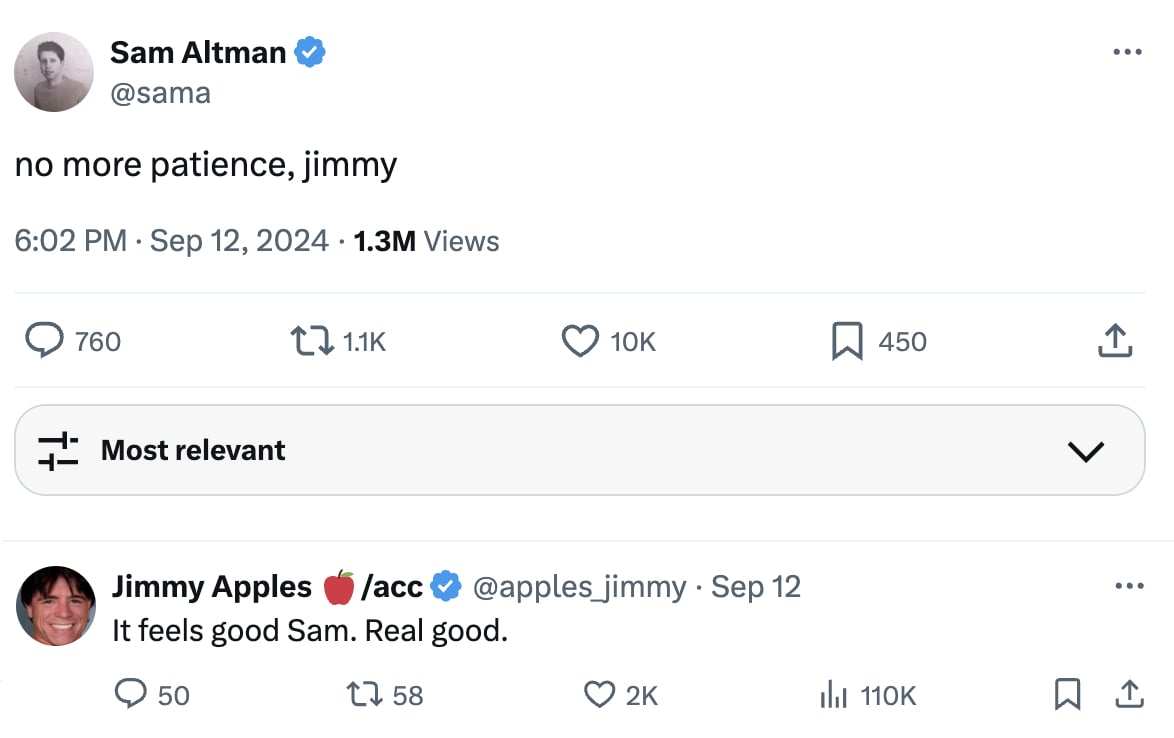
Sam Altman and Jimmy Apples banter
Regardless of what was really happening here, OpenAI was laying the groundwork for its next generation of models. The o1 model proved to be a critical stepping stone: its chain-of-thought reasoning approach was later integrated into GPT-5 and its successors, while the standalone o1 and o3 model lines were deprecated by mid-2025.
GPT-5: Released, but Is It AGI?
GPT-5 was at the centre of enormous speculation throughout 2023 and 2024, with various reports claiming it would achieve AGI status. Jimmy Apples even claimed GPT-5 AGI already existed internally at OpenAI.
When GPT-5 finally launched on 7 August 2025, it was a significant leap forward but not AGI. Rather than a single monolithic model, GPT-5 operates as a dynamic system comprising a fast, high-throughput model and a deeper reasoning model, managed by a real-time router. It introduced integrated chain-of-thought reasoning, agentic functionality (autonomously setting up desktops and browsing the web), and a 1 million-token context window. On the SimpleBench reasoning test, GPT-5 scored 90%, outperforming the average human score of 83%.
OpenAI has continued iterating rapidly: GPT-5.2 (December 2025), GPT-5.3 Instant (March 2026), and GPT-5.4 (5 March 2026) have each added refinements to reasoning, coding, and computer control. GPT-5.4 is currently the most advanced publicly available model.
So while GPT-5 answered the “is this now dead?” question with a resounding no, it did not deliver AGI. The question has now shifted to GPT-6.
What is GPT-5 from OpenAI: When Is It Coming & What Can We Expect?
How to Get the Most out of ChatGPT: from GPT-4 to GPT-5
The principles below were originally written for GPT-4 but remain largely applicable to GPT-5 and beyond. To get the most out of any ChatGPT model, you need to know how to phrase your inputs effectively. These inputs are known as prompts, and there is a whole field of study around this called prompt engineering. With GPT-5 and its reasoning capabilities, prompt engineering has evolved: models now handle natural language instructions more effectively, reducing the need for heavily structured prompts.
The list of practical use cases below was accurate for GPT-4 and has only expanded with GPT-5:
Here are some incredibly useful examples describing how users are using prompts for ChatGPT-4 currently:
- Plagiarism checking
- Language translation
- Writing assistant (for authors or content creators)
- Brainstorming
- Creative design assistant
- Marketing assistance
- Data analysis
- Code evaluation and writing
- See the full list here: https://github.com/f/awesome-chatgpt-prompts
With the introduction of new use cases, prompts, bots and plugins, the list goes on and GPT-4 is quickly becoming the go-to tool for a wide range of professionals spanning multiple industries and sectors.
We have written a guide on how to use Chat GPT-4 prompts for marketing, which is a good read if you are looking to utilise GPT-4 for any kind of marketing!
Even with GPT-4, ChatGPT was more than just a chatbot that could answer prompts. It became even more powerful when using web browsing and plugins for accessing real-time results and undertaking specific functions like SEO, financial analysis, and much more.
Web Browsing
Web browsing capabilities were essential for getting the most out of ChatGPT-4, and remain a core feature of GPT-5. Imagine the future of AI where ChatGPT can browse the web to gather the latest data and analyse the data with real AGI capabilities to provide actionable insights or automated workflows instantly.
This browse feature is a stepping stone in allowing AI to access real-time information from the internet, making it invaluable for tasks like market research, competitive analysis, news analysis, and fact-checking.
Initially made available through ChatGPT’s Browse with Bing, native web browsing was temporarily removed. As of the September 2024 update, the feature was available again to ChatGPT Plus users using the ChatGPT 4o model but not the o1-preview or o1-mini models.
ChatGPT Plugins (Now Custom GPTs)
In 2023, plugins were another avenue to enhance ChatGPT’s capabilities. These add-ons can perform specialised tasks for a massive range of applications. For instance, a plugin could analyse your website’s SEO performance and suggest improvements, or another could assist in creating financial forecasts for your business.
Probably one of the most common applications is web browsing, with plugins like BrowserPilot and WebPilot offering an alternative to Browse with Bing.
As of November 2023 and into 2024, ChatGPT plugins were gradually phased out in favour of Custom GPTs, which offer a more personalised and flexible experience.
Unlike plugins, Custom GPTs allow users to easily create AI models tailored specifically to their needs, offering a higher level of customisation and control compared to the publicly available plugins, ultimately making them more versatile for both personal and business applications.
Advanced Data Analysis (formerly Code Interpreter)
The future of AI is especially exciting when we consider how powerful ChatGPT-4 was using Advanced Data Analysis (formally Code Interpreter).
Imagine a plugin that can not only understand but also write and evaluate programming code. This would be a major step forward for developers, data scientists, and analysts. Well, this is what Code Interpreter could do, and very effectively too. So much so that many developers are already using it to speed up their coding workflows.
Powered by GPT-4, Code Interpreter could do so much more than coding, which is the main reason why it was rebranded to Advanced Data Analysis. With its wide range of Python libraries, ability to upload multiple files, and provide answers based on natural language prompts, there’s not much it can’t do.
For example, some popular use cases right now are:
- Data extraction from PDFs: Read and analyse data from a PDF document.
- Text parsing: Uses Python’s regular expressions (regex) to match and extract details, illustrating its ability to handle complex string manipulations.
- Data aggregation: Correctly aggregating data from a range of different sources and even document types.
- Real-time data analysis: Assist in real-time data analysis, automating repetitive tasks.
- Educational support: Help in learning and teaching programming.
- Debugging: Debug code and handle complex errors.
- Mathematical calculations: Perform complex math operations.
- Data insights: Analyse raw business data and output reports and insights.
- C****harts: Create charts and graphs using structured and unstructured data
- Code testing: Run and test code in a sandbox, firewalled environment.
- Natural Language Processing: Coding using natural language, allowing even non-programmers to use the power of code.
- Code experimentation: A quick and easy way to experiment with code snippets
If the above list wasn’t impressive enough, we’ve recently written about how Screaming Frog’s SEO Spider tool and Advanced Data Analysis can be used to scrape entire websites into Excel form and even convert bulk Excel entries to individual Word documents using ChatGPT-4 to provide detailed recommendations and analysis.
With GPT-4, the key to getting the most out of these features was prompt engineering. While this remains important with GPT-5, the newer models handle natural language instructions more effectively, reducing the need for highly structured prompts. Neither GPT-4 nor GPT-5 is AGI, but with the right approach, ChatGPT remains a powerful and indispensable asset for any business.
With the release of GPT-5 in August 2025 and its rapid iterations through to GPT-5.4 in March 2026, many of these capabilities have been significantly enhanced. GPT-5’s agentic features can now autonomously browse the web, write and execute code, and manage multi-step workflows. The key difference is that GPT-5 can reason through complex requests rather than simply following instructions, making it more like a capable assistant than a sophisticated search tool.
AI Developments: from 2024 Breakthroughs to 2026 and Beyond
2023 and 2024 were breakthrough years for OpenAI with the release and rapid adoption of ChatGPT. In addition to ChatGPT’s success, OpenAI’s image generator tool called DALL-E became a huge success too, along with other tools like Midjourney and Stable Diffusion.
But what has happened since, and where are we heading in 2026?
The release of OpenAI’s “o1” model marks another inflection point for AI, with the conversation shifting away from scaling models like GPT-4 toward the deeper cognitive abilities that “o1” represents. Looking back from March 2026, many of these original predictions have already materialised, and AI’s rapid evolution has exceeded expectations. The release of GPT-5 in August 2025 and its rapid iteration through to GPT-5.4 in March 2026 confirmed that AI development is accelerating, not plateauing.
Surpassing 1 million users in just 5 days, ChatGPT holds the record for the fastest-growing platform in history. At the time of writing these predictions in 2024, the question was: what does the future of AI look like? Looking back, the answer has been even more dramatic than anticipated:
Here are the original predictions for 2024-2025 as they were published, along with their current status as of March 2026:
10 Positive Predictions
- Widespread adoption of “o1” models: Expect to see the “o1-preview” and “o1-mini” models rolled out across more sectors, pushing the boundaries of reasoning in fields like coding, complex math, and science. (Status: o1 was widely adopted but has since been deprecated. Its reasoning approach was integrated into GPT-5, while the separate o3 model line succeeded o1 before also being retired.)
- Custom GPTs become the new norm: Custom GPTs will dominate, allowing businesses and individuals to create AI models tailored specifically to their needs, increasing productivity and operational efficiency, while we will also see plugins for WordPress, AI content creators, and other external platforms using OpenAI’s APIs. (Status: Custom GPTs and the GPT Store are widely used. The ecosystem has expanded significantly with thousands of specialised GPTs available.)
- Open-source AI takes centre stage: As projects like Meta’s LLaMA gain traction, the open-source AI movement will accelerate, giving smaller companies and individual developers more power to build sophisticated AI models. (Status: Meta’s Llama 3 and other open-source models have gained significant traction, narrowing the gap with proprietary models.)
- AI becomes a key player in healthcare diagnostics: The enhanced reasoning capabilities of models like “o1” could be applied to diagnostics, drug discovery, and even personalised treatment plans. (Status: AI is increasingly used in diagnostics and drug discovery, with regulatory frameworks catching up across multiple countries.)
- Augmented reality (AR) and AI merge: Expect further integration of AI with AR and VR, especially in consumer products like Meta’s new Ray-Ban smart glasses and Apple’s Vision Pro, offering more immersive, AI-powered experiences. (Status: Meta’s Ray-Ban smart glasses with integrated AI have been a commercial success. Apple Vision Pro launched but saw limited mainstream adoption due to pricing.)
- AI-driven automation in eCommerce: Look for more advanced AI solutions in inventory management, personalised shopping experiences, and logistics, as companies adopt AI to simplify and speed up operations. Businesses with professional eCommerce development will be best positioned to take advantage of these advancements. (Status: AI-driven personalisation and inventory management are now standard across major eCommerce platforms.)
- The evolution of AI search engines: The rivalry between Google and Microsoft will heat up, with Bard and Bing competing to dominate AI-powered search and offering smarter, more accurate responses. (Status: Bard was rebranded to Gemini in February 2024. Bing Chat became Microsoft Copilot. AI-powered search is now a major battleground.)
- Advanced AI in financial markets: AI models like “o1” could be used to navigate complex financial markets, offering predictive insights that go beyond traditional data analysis, leading to new fintech applications. (Status: AI-powered trading tools and financial analysis platforms have seen significant growth in adoption across institutional and retail markets.)
- The rise of AI-driven decision-making: In businesses, AI will increasingly be relied upon for complex decision-making processes, shifting from task-based automation to strategic leadership roles. (Status: Agentic AI systems now handle multi-step business workflows autonomously, confirming this trend ahead of schedule.)
- Potentially “o2” AGI or GPT-5 AGI: As models like “o1” push reasoning and learning capabilities forward, public anticipation for AGI will continue to build, possibly with new revelations or breakthroughs in 2025. (Status: OpenAI has since released o3-mini and continued advancing reasoning models, though no system has been publicly declared AGI.)
4 Not So Positive Predictions
While AI has immense potential, there are concerns and challenges we may face in the near future:
- AI-generated misinformation: As models like “o1” become more sophisticated, expect more AI-generated content to blur the lines between fact and fiction, making it harder to detect false information. (Status: AI-generated deepfakes and misinformation have become a growing concern, with detection tools struggling to keep pace.)
- Educational challenges with AI: With students increasingly turning to AI tools like ChatGPT for homework and essay writing, traditional education methods will face disruption, leading to ethical and academic integrity concerns. (Status: Schools and universities continue to grapple with AI use policies. Some have embraced AI as a learning tool while others have imposed restrictions.)
- AI’s impact on democracy: The 2024 election cycle was expected to witness new forms of AI-driven misinformation campaigns, sparking calls for stricter AI governance. (Status: AI-generated deepfakes and robocalls did feature in the 2024 US elections, leading to new regulatory discussions.)
- Greater AI regulation and compliance: As AI becomes more ingrained in society, governments will begin to impose stricter regulations around its use, especially in sectors like healthcare, finance, and cybersecurity. (Status: The EU AI Act came into force in 2024. Several countries have introduced or proposed AI-specific legislation.)
Artificial Intelligence Beyond 2026
AI has evolved at a blistering pace over the past three years, but where do we go from here? The future of AI could be defined by deeper integration into our daily lives, ethical challenges, and the growing influence of AGI.
As we move through 2026 and beyond, the following areas will likely dominate the AI landscape:
AGI and Eventual Human Augmentation
As surreal as it sounds, we aren’t lightyears away from human-AI augmentation. With the likes of Neuralink, Elon Musk’s brain-interface project, combined with breakthroughs in the AGI space, it won’t be long until we can augment and enhance our cognitive abilities via artificial systems.
Neuralink currently focuses on trying to treat patients that have issues with communication by placing an implant inside, or on, the brain. Early tests have been looking promising and the company has been approved to start human trials recently.
It is easy to imagine a time when Neuralink can be inserted into the skull in order to enhance human capability rather than being used to fix cognitive or communication problems.
More Capable Robots and AI Hardware
We have seen the Japanese robots that exist in some hotels (although they are currently controlled by humans). However, we are starting to see hotels appearing such as Henn na Hotel Asakusabashi where robots and AI play a key role in running the business and serving guests.
I Spent a Night at World’s First Robot Hotel in Tokyo Japan
Despite still being a gimmick with some utility and functionality, we can expect to see a more comprehensive implementation of robots in the coming years where robots are able to operate with complete autonomy.
ASI: What About Artificial Super Intelligence?
If things weren’t confusing enough with terms like ANI and AGI being used to describe AI, we thought we would throw another one out there: ASI (Artificial Super Intelligence).
ASI refers to a level of artificial intelligence that surpasses human intelligence in virtually all economically valuable work. This not only includes intellectual capabilities, but also the potential to exceed human ability in areas of emotional intelligence, decision-making, and creativity.
Essentially, ASI would outperform the best human brains in practically every field, including scientific creativity, general wisdom, and social skills.
In contrast with AGI, which is comparable to human intelligence and can carry out human-level tasks, ASI goes a step further. An ASI system wouldn’t just replicate human decision-making; it would be capable of making decisions that humans haven’t even considered.
Right now, ASI is purely hypothetical and highly speculative. However, with the rate of innovation and change taking place within the field of AI, we can easily see a future where ASI is possible, potentially within the next ten years.
Updated AGI Timelines: What Experts Predict in 2026
The timeline for achieving Artificial General Intelligence has shrunk dramatically over the past two years. While predictions in 2023 often pointed to the 2040s, the consensus in March 2026 is vastly different. The rapid scaling of compute power and the breakthrough of chain-of-thought reasoning models have accelerated expectations.
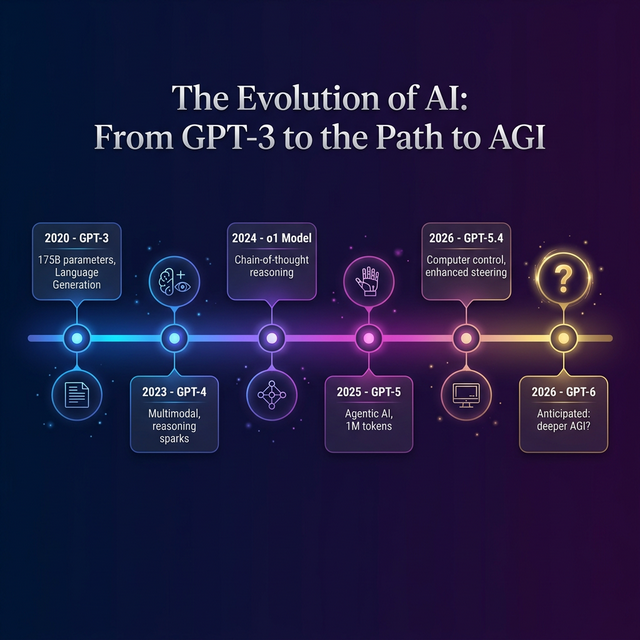
The evolution of AI: key milestones from GPT-3 through GPT-5.4 to the projected path to AGI
According to recent surveys by Our World in Data, fifty percent of leading AI researchers now predict that we could see early forms of AGI between 2027 and 2033. Prediction markets like Metaculus are even more aggressive, estimating the arrival of weak AGI by 2029. This acceleration is largely driven by the shift from models that simply predict the next word to systems capable of multi-step, autonomous reasoning.
Investment in AGI-focused startups and compute infrastructure reached over $30 billion in 2025 alone. Compute power used for training frontier models is doubling roughly every six months. These numbers show that the industry is not just talking about AGI. It is investing at a scale that suggests genuine confidence in near-term breakthroughs.
As AI consulting experts in Birmingham, we help organisations nationally and internationally prepare their infrastructure for the next generation of reasoning models. The shrinking timeline means preparation can no longer be delayed if businesses want to stay competitive.
AI vs AGI vs ASI: A Side-by-Side Comparison (ANI, AGI and ASI Explained)
To make the distinctions clearer, here is a direct comparison of the three stages of artificial intelligence:
| Feature | ANI (Narrow AI) | AGI (General AI) | ASI (Super AI) |
|---|---|---|---|
| Scope | Single task or narrow domain | All intellectual tasks a human can perform | Surpasses all human intelligence |
| Learning | Learns within its training data only | Can generalise learning across domains | Could improve itself recursively |
| Autonomy | Requires human-defined parameters | Operates autonomously across varied tasks | Fully autonomous and self-directing |
| Current examples | ChatGPT, Siri, Google Search, self-driving cars | No confirmed examples exist yet | Purely theoretical |
| Timeline | Available now | Expert consensus: 2027 to 2033 | Unknown, possibly decades away |
| Risk level | Manageable with current governance | Significant ethical and safety questions | Existential risk debates |
The Shift from Pattern Matching to Reasoning: OpenAI o1 and Beyond
The release of OpenAI’s o1 model in September 2024 marked a turning point that many in the industry had been waiting for. Previous models including GPT-3 and GPT-4 operated primarily through next-token prediction, a sophisticated form of pattern matching that produced impressively fluent text but lacked genuine reasoning.
The o1 model introduced Chain of Thought reasoning, where the system takes measurable time to work through problems step by step before responding. This was closer to how humans approach complex tasks. Rather than producing an instant response based on statistical probability, the model evaluates multiple paths, considers potential errors, and refines its output.
On academic benchmarks, the results were striking, with the o1 model vastly outperforming GPT-4 in tasks requiring deep reasoning (as detailed in the o1 analysis earlier in this article).
What happened next confirmed the significance of this breakthrough. When GPT-5 launched in August 2025, chain-of-thought reasoning was no longer a separate capability but a core feature built directly into the model architecture. The standalone o1 and o3 model lines were deprecated by mid-2025 because their reasoning approach had effectively been absorbed into the main GPT line. This is the pattern we now see across the industry: reasoning is no longer an optional add-on but the default expectation for any frontier AI model.
This shift from pattern matching to genuine reasoning is widely considered a major step toward AGI. It represents the difference between a system that can produce convincing text and one that can actually think through problems. Every subsequent model, including GPT-5.4 and the anticipated GPT-6, builds on this foundation.
The Rise of Agentic AI: Systems That Take Action
Perhaps the most significant development heading into 2026 is the rise of “agentic AI”, systems that do not just answer questions but actively plan and execute complex tasks across different software environments.
Traditional AI tools are reactive. You ask ChatGPT a question and it provides a response. Agentic AI systems, by contrast, can be given a goal and then work autonomously to achieve it. They can browse the web, write and execute code, interact with APIs, manage files, and coordinate multi-step workflows without requiring human input at every stage.
This represents a fundamental shift in how businesses will interact with AI. Instead of using AI as a faster search engine or writing assistant, organisations will begin delegating entire workflows to autonomous agents. From data analysis and report generation to customer service escalation and supply chain monitoring, agentic AI will change the nature of work.
Integrating these advanced models into existing platforms requires strong technical foundations, which custom web development solutions can provide to ensure your systems are ready for the future of AI-powered automation.
How Businesses Should Prepare for AGI Today
With expert timelines shrinking and agentic AI systems already in practical use, the question for businesses is no longer whether AGI will matter, but how to prepare for it now.
Here are the practical steps that forward-thinking organisations should be taking in 2026:
- Audit your current AI readiness: Review your existing technology stack, data infrastructure, and team capabilities. Identify where AI is already being used and where gaps exist.
- Invest in clean, structured data: AGI-ready systems will depend on high-quality, well-organised data. Businesses with messy or siloed data will struggle to take advantage of advanced AI capabilities when they arrive.
- Build flexible architectures: Monolithic systems that cannot easily integrate new AI services will become a liability. Invest in modular, API-first architectures that can adapt as AI capabilities evolve.
- Upskill your team: Prompt engineering, AI workflow design, and understanding of AI safety are becoming essential skills. Invest in training now rather than scrambling to catch up later.
- Establish AI governance frameworks: Before AGI arrives, organisations need clear policies around data privacy, algorithmic bias, and decision-making transparency. Getting these right early will build trust with customers and regulators alike.
- Start with practical use cases: Rather than waiting for AGI, begin implementing agentic AI in specific workflows today. Each successful deployment builds organisational capability and confidence.
For businesses looking for practical guidance on implementing AI across their operations, working with an experienced partner makes a significant difference. Our AI consulting and implementation services help organisations across the UK build the technical foundations and strategic frameworks needed for the next generation of AI.
GPT-6: Will the Next Generation Achieve AGI?
With GPT-5.4 now live and demonstrating increasingly sophisticated reasoning, the AI community’s attention has turned to GPT-6, anticipated for release in 2026.
OpenAI CEO Sam Altman has indicated that the gap between GPT-5 and GPT-6 will be shorter than between previous generations, reflecting the accelerating pace of development. The Stargate infrastructure project, a massive compute build-out, is being deployed specifically to support GPT-6’s training requirements.
Expected advances in GPT-6 include deeper memory capabilities, more advanced agentic behaviour, and enhanced multimodal reasoning. These are precisely the capabilities that researchers identify as prerequisites for AGI. Whether GPT-6 crosses the AGI threshold or simply moves the goalposts further remains the defining question in AI development as of March 2026.
What makes this generation particularly significant is the convergence of several trends: chain-of-thought reasoning (introduced by o1 in 2024), agentic task execution (refined through GPT-5), and the massive scaling of compute infrastructure. If AGI is achievable within the current architectural paradigm, GPT-6 represents our best near-term opportunity to find out. Businesses seeking AI consulting and implementation services should be actively preparing their technology infrastructure now.
The Future of AI: Final Thoughts
The future of artificial intelligence holds extraordinary promise, but it also demands thoughtful preparation.
Terms like ANI, AGI, and ASI often cause confusion, but distinguishing between these stages of AI development is more important now than ever. As of March 2026, Metaculus prediction markets estimate weak AGI by 2029, and fifty percent of leading researchers predict AGI between 2027 and 2033. The question is no longer if but when.
The shift from pattern matching to chain-of-thought reasoning, demonstrated by OpenAI’s o1 model, has moved the conversation from theoretical speculation to practical reality. Agentic AI systems that can plan, reason, and execute multi-step tasks are already changing how businesses operate.
For a simple explanation of what is AI and how does ChatGPT work, please check out our article below which explains this complex subject as a children’s story:
How Does ChatGPT Work in Story Form: The Adventures of ChatGPT “The AI Storyteller”
While models like ChatGPT and GPT-4 are powerful, they are still limited in scope compared to true AGI. However, the gap between current AI and AGI is closing rapidly. Whether the breakthrough comes from OpenAI, Google DeepMind, or another organisation entirely, we are closer to witnessing systems that can think, learn, and act autonomously across a broad range of tasks than at any point in history.
The debate about whether AGI already exists, fuelled by figures like Jimmy Apples, continues to captivate the world. We initially predicted in 2023 that it was probably already developed behind the scenes. Instead of a GPT-5 AGI release, we got the near-AGI “o1” model, and the subsequent focus on agentic AI systems has arguably been even more transformative for businesses.
For us to achieve “true AI”, we need AGI. It’s fascinating that with models like o1 and agentic AI tools, it feels like we’ve nearly arrived. However, true AI or AGI can only be defined as a system that operates autonomously across a broad range of tasks, and this seemingly minor detail means we’re not quite there yet.
Ultimately, the future of AI will depend on how we prepare for the changes, benefits, and risks introduced by companies like OpenAI. The answers to these questions over the coming years will shape the next phase of human history.
What do you think about the future of AI? Is AGI already here, waiting to be unveiled, or will it take years before we see its full potential? Please let us know in the comments section below or on social media.