
Editor's Note [17.03.26]: This article has been renamed from "ChatGPT vs Bard vs Bing: The Future of AI Search Engines" to "ChatGPT vs Gemini vs Bing: The Best AI Search Engines and What Comes Next" to reflect the current state of AI search. Since our last update, Google renamed Bard to Gemini, rolled out AI Overviews across its core search, OpenAI launched ChatGPT Search as a full search engine, and Perplexity AI emerged as a dedicated answer engine. We have added new sections covering Generative Engine Optimisation (GEO), the impact of AI Overviews on organic traffic, and a comparison of the best AI search engines of 2026. Originally published on 18th January 2023, this article was previously updated on 19th May 2023 with coverage of Google Bard, GPT-4, and the race between ChatGPT, Bard, and Bing to become the first true AI search engine.
Introduction
The world of search engines is undergoing a significant transformation, with artificial intelligence (AI) playing a crucial role in driving this change.
AI platforms like OpenAI’s ChatGPT, Microsoft’s Bing (now powered by Copilot), and Google’s Gemini (formerly known as Bard) are transforming the way we search for information and interact with technology. As technology giants race to use AI in their search engines, users can expect a new generation of personalised and efficient search experiences. In this article, we will explore the concept of AI-based search engines, the key players in the market, the primary differences between them, and the potential implications of these AI-powered search tools. If your business needs help adapting to these changes, our expert ChatGPT consultant services support businesses across the UK and internationally.
Should Google be concerned or excited?
If you would prefer to listen, check out our original Soundcloud podcast.
OpaceWebDesign · A ChatGPT Bing Search Engine & AI Assistant To Take on Google, Siri & Alexa in One Go
Let’s dive in and find out.
AI search engine: how AI is changing search
What is an AI search engine?
AI search engines use machine learning algorithms to understand and process user queries, providing more relevant, accurate, and personalised results. These algorithms are designed to learn from vast amounts of data and improve their performance over time, leading to better search outcomes for users.
They rely on Large Language Models (LLMs) to predict and generate human-like responses. These LLMs analyse the statistical properties of language and make educated guesses based on previously typed words. The ability to generate plausible-sounding statements makes AI search engines extremely powerful, but it also poses challenges, as these generated statements may not always be accurate or reliable.
The rise of AI-powered search engines
The popularity of AI-powered platforms like ChatGPT has disrupted the traditional search engine market. With the integration of AI technology, search engines can now provide more personalised, accurate, and relevant search results, transforming the way users find information online.
In 2026, the market extends well beyond the original big three. ChatGPT, Gemini, Microsoft Copilot (formerly Bing Chat), Perplexity AI and others are all pushing the boundaries of search technology, providing users with more intelligent, conversational search experiences. We’ll explore these in more detail below.
The role of Large Language Models (LLMs)
AI search engines are primarily powered by large language models (LLMs). When this article was first written in 2023, the leading models were OpenAI’s GPT-3 and Google’s PaLM 2. Today, the field has advanced considerably, with OpenAI’s GPT-5 series, Google’s Gemini model family, and Microsoft’s Copilot powering the major platforms. Natural Language Processing (NLP) has also improved, allowing these models to better understand search intent and provide more contextually relevant answers.
These LLMs are trained on vast amounts of data and can predict the next word in a given sentence, making them capable of generating coherent, contextually relevant text.
What are the benefits of AI-based search engines?
AI-powered search engines can offer several advantages over traditional search engines:
Personalised and contextual search results
AI-based search engines like Microsoft Copilot (previously known as Bing Chat) and Google Gemini (previously known as Bard) have reshaped the online search experience by providing more personalised, contextual results. By using AI technology, these search engines can better understand user intent and deliver more relevant, accurate search results, ultimately improving the overall user experience. A McKinsey report from October 2025 confirmed that 50% of consumers are already using AI-powered search, signalling a fundamental change in how people find information.
Conversational and interactive search
One key advantage of AI search engines is their ability to offer conversational, interactive search experiences.
Users can engage in a natural, back-and-forth dialogue with the search engine, allowing for more nuanced and precise search queries. This conversational approach has the potential to simplify the search process, enabling users to find the information they need more quickly and efficiently. The rise of answer engines like Perplexity AI has taken this further, providing complete cited answers rather than a list of links.
Integration with other AI technologies
As AI search engines continue to evolve, they are becoming increasingly integrated with other AI technologies. In 2026, we can see this clearly: ChatGPT is built into Apple Intelligence, Microsoft Copilot is embedded in Windows, and Google Gemini runs natively on Android devices. This Copilot integration, along with similar moves from Google and Apple, has led to a unified, AI-powered ecosystem for finding information and interacting with technology.
What is ChatGPT? What’s the big deal?
When ChatGPT was first made public for testing in late 2022, it took the internet by storm. From answering questions to helping beginners fix CSS and coding problems, ChatGPT frequently provides help and its conversational style is almost indistinguishable from a human.
This wasn’t your ordinary chatbot-tier AI we’d seen a thousand times before. It was something quite unique and very exciting. As regular readers will know, we’ve covered ChatGPT and GPT-3 in great detail, focusing mainly on AI SEO, using ChatGPT for SEO, content ideas, and even how to detect AI. In our original 2023 article, we considered how the news of a ChatGPT Bing partnership could change the search experience forever and potentially be the driving force behind a new breed of AI search engine. That prediction proved correct.
It talks like a human would
ChatGPT is an intelligent AI conversational chatbot that handles queries in a similar way to how a human would. Users can ask follow-up questions relating to the initial enquiry, and it will remember the conversation thread. These types of contextual-based answers are what make ChatGPT particularly exciting.
For example, you could ask the AI to write you a paragraph talking about the benefits of daily exercise. If the reply sounds good but is a little too lengthy, you can simply reply with “make more concise” and ChatGPT will do just that as it remembers the previous parts of the conversation.
What makes ChatGPT particularly impressive is its ability to not only write informative replies but also do it in the style of a particular person. We decided to put this to the test by having the tool create a recommendation in the style of Donald Trump due to his distinct and brash personality.
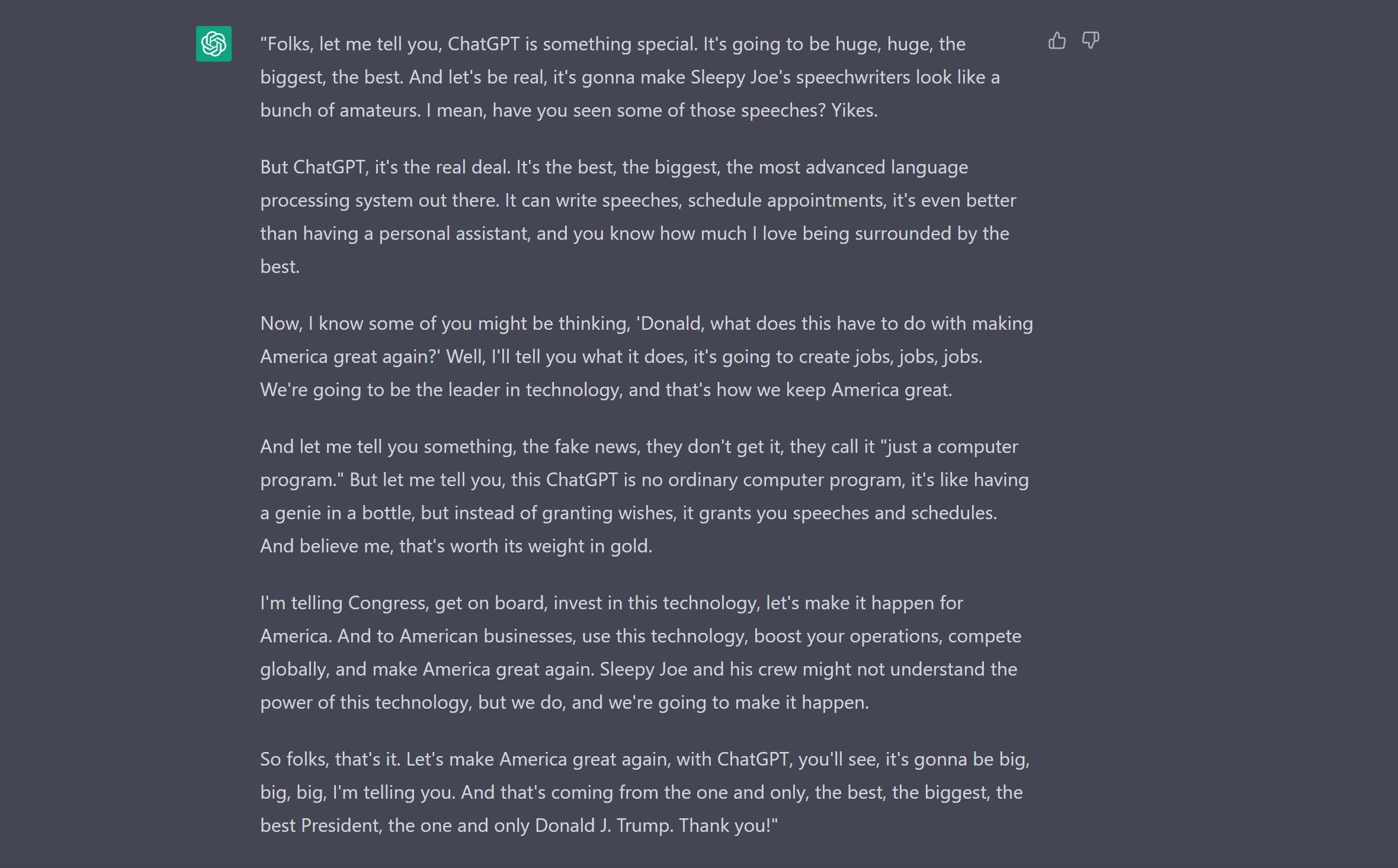
Fictional speech about ChatGPT written in the style of Donald Trump
From text to code, it can solve specific problems
You can also be very specific when looking for suggestions and recommendations. Many users have been using ChatGPT to solve coding problems since its earliest days. This type of usage is particularly ground-breaking as these types of problems are so intricate, a traditional search engine cannot really help much by way of a conversational search or help with these types of problems. ChatGPT, however, can.
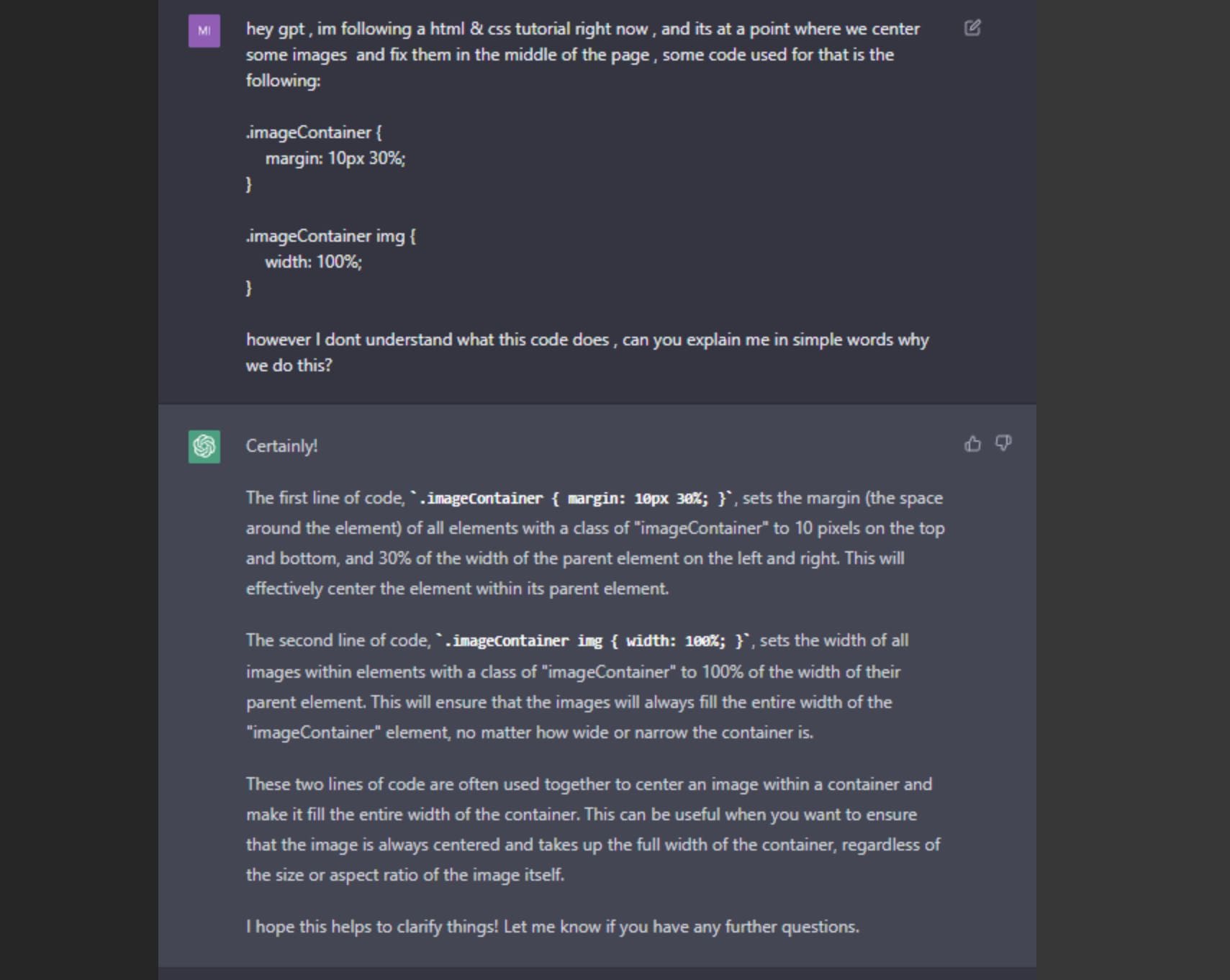
Using ChatGPT for coding. Image credit /u/NoName847 via Reddit
Obviously, this AI is very impressive as a chatbot, but it also has huge implications for search as well as virtual assistants. Read on to find out more.
What are the limitations of AI search engines?
As impressive as AI search engines have become, there are still some important limitations and concerns that users should be aware of. While the early constraints of ChatGPT in 2022 and 2023 (such as its knowledge cutoff at 2021 and regular server downtime) have largely been resolved, a new set of challenges has emerged.
Hallucination and accuracy concerns
One of the most significant issues with AI search engines is their tendency to “hallucinate”, generating confident-sounding answers that are factually wrong. Unlike a traditional search engine that simply returns links, an AI search engine presents its answer as authoritative text. This can be misleading when the underlying model makes errors, which it still does regularly. Users and businesses must verify AI-generated information against original sources rather than accepting it at face value.
Citation reliability
While platforms like ChatGPT Search and Perplexity AI provide source citations alongside their answers, these citations are not always reliable. Sources can be outdated, misrepresented, or cherry-picked to support an AI-generated statement. This remains a key area of development across all major AI search engines.
Privacy and data concerns
The increasing personalisation of AI search raises significant privacy questions. Google’s Gemini, for example, can now access a user’s Gmail, Photos, Drive and Search history to provide personalised answers. While this delivers a more tailored experience, it also means AI models are processing vast amounts of private data. Users need to understand what data they are sharing and how it is used.
Over-reliance on AI summaries
As AI search engines provide direct answers, there is a growing concern that users may stop visiting original sources altogether. This has implications for publishers, researchers and content creators who depend on direct traffic. The broader question of whether AI-generated summaries can fully replace the depth and nuance of original content is one that the industry continues to debate.
Microsoft takes a giant leap to tackle Google’s dominance
The fundamental way search results have been served to users through web browsers has been largely unchanged for many years. We’ve had updates within Google such as featured snippets and many algorithm changes to enhance relevancy, but very little has come via fundamental overhauls or improvements.
Google currently has over 80% of the market share when it comes to traditional search, with Kinsta reporting 86-96%, but the AI search market tells a different story.
ChatGPT Bing: from Bing Chat to Microsoft Copilot
When Microsoft first integrated ChatGPT into Bing in early 2023, the product was known as “Bing Chat”. It has since been rebranded to Microsoft Copilot, reflecting Microsoft’s strategy to embed AI across its entire product ecosystem. In the AI search market specifically, Microsoft Copilot holds approximately 13.2% of market share as of January 2026, with 33 million monthly active users. While this is still some distance behind ChatGPT, Copilot’s deep integration with Microsoft 365 and Windows makes it a strong contender for enterprise users.
Conversational, follow-up style search
Back in January 2023, we predicted that ChatGPT Bing AI search engine would make search more accurate by allowing follow-up questions to the initial enquiry:
“If ChatGPT is anything to go by, it could also provide answers faster as traditional search often requires checking multiple sources and scrolling through web pages to find an answer that’s relevant. It also has the ability to provide opinions, summaries, and answer queries about programming code in a way that’s simply not possible with traditional search engines right now.”
We continued with:
“This will likely result in Google integrating similar changes in the near future, but will they be able to keep up with ChatGPT’s momentum? A first implementation of a tool such as ChatGPT could look something like this within Google’s search. Google may introduce a secondary search bar that allows users to continue the conversation thread after their initial enquiry.
This would allow an initial question to be asked such as “How far away is the moon from the earth” and a follow up question such as “When was the last time we went there”. This means that the user doesn’t have to type out a full explanation of the query, but a continued search.”
Looking back in 2026, these predictions were remarkably accurate. Google did exactly this with AI Overviews and its experimental AI Mode, while ChatGPT Search and Perplexity AI have built their entire experiences around conversational follow-up queries.
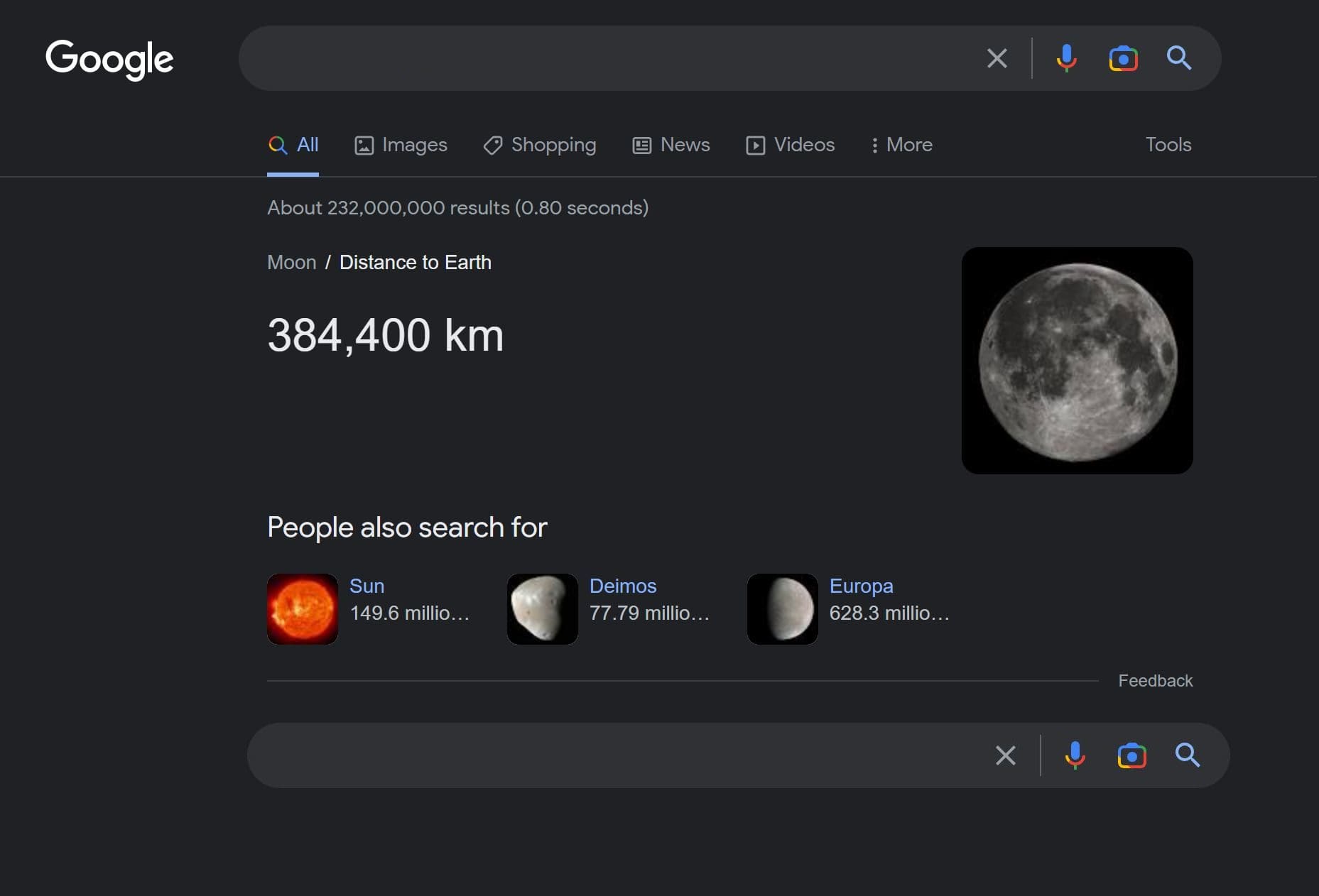
Mock-up image of how Google could work with ChatGPT or equivalent to provide an AI search engine that allows follow-up queries
Bing vs Google: the battle of the AI search giants
The race to dominate the AI search engine market was originally led by two technology giants: Google and Microsoft, but now also OpenAI and several newer entrants. Whilst this article is mainly focused on the future of search and the experience provided to users, we’ve also explored Bing SEO vs Google SEO in our article below. For more information on the past, present and future of SEO and search engine ranking factors, it’s worth a read.
Microsoft Copilot: Microsoft’s AI-powered search engine
Microsoft Copilot (formerly Bing Chat) has gained considerable attention since incorporating AI technology from OpenAI, making it a formidable competitor to Google’s search business. Microsoft’s Bing, with its Copilot integration, offers users a more interactive and conversational search experience, enabling them to ask questions and receive AI-generated responses. The incorporation of AI initially increased Bing’s popularity, although it has returned to previous levels after the initial surge. In 2026, Copilot’s value proposition is strongest for users within the Microsoft ecosystem, where it connects with Office 365, Teams and Windows.
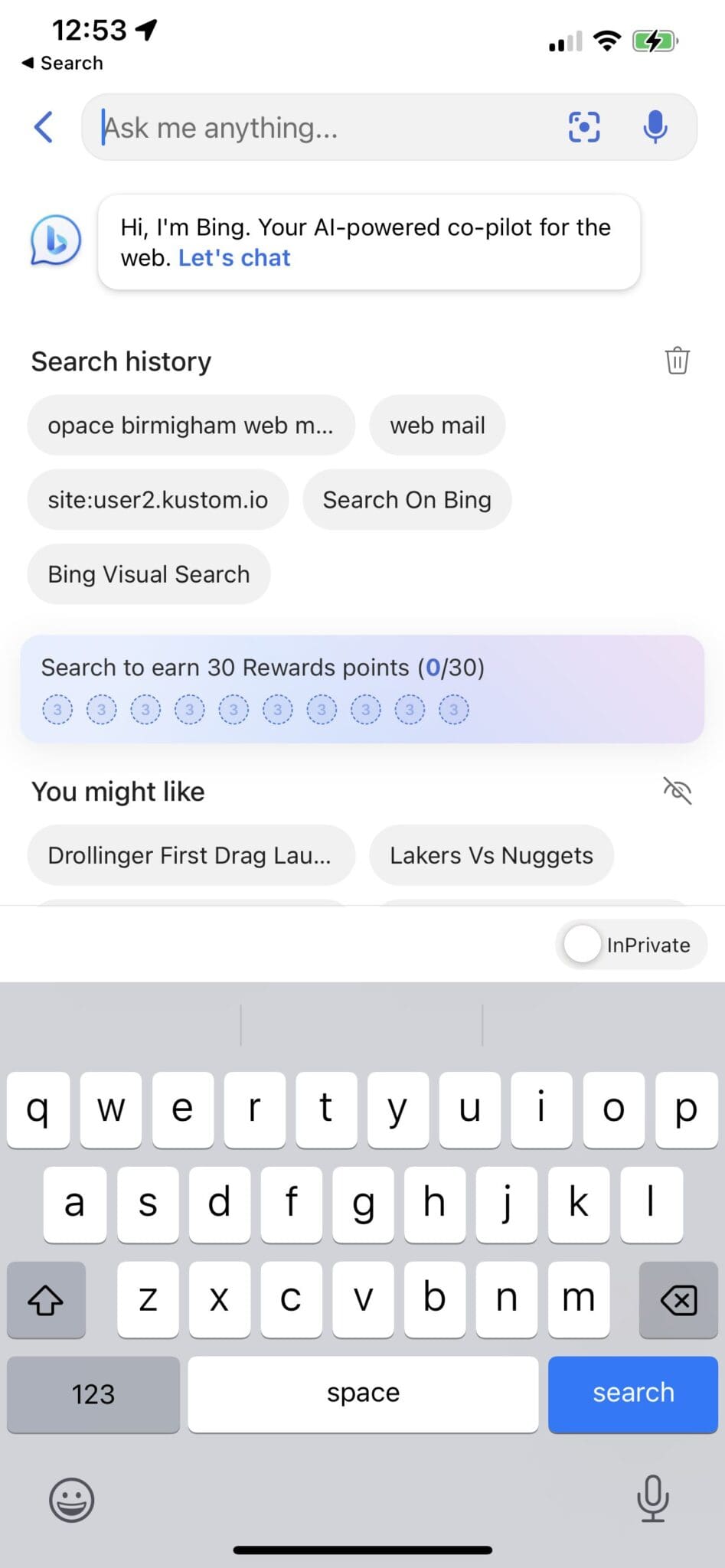
A look at the Microsoft Copilot AI search engine on mobile (formerly known as Bing Chat).
From Google Bard and Magi to Gemini and AI Overviews
Since ChatGPT was released, Google issued what some have referred to as a ‘code red’ with emergency meetings being called to assess the threat of ChatGPT to its business model and search as a whole.
In 2023, Google was working on its LLM called LaMDA, which stood for ‘Language Model for Dialogue Applications’. Google then announced a more powerful model called PaLM-2, and in response to the competitive threat, launched its AI chatbot called Bard. Bard was initially based on LaMDA before transitioning to PaLM-2.
It is worth remembering that Google is no stranger to AI and conversational chatbots. ChatGPT (the GPT of which stands for Generative Pre-trained Transformer) was built on top of GPT-3’s family of large language models that are built on Transformer, an open source neural network architecture that Google made available in 2017.
At the time, Google was also working on the Magi project, which aimed to enhance its search engine with AI features including more accurate results and an improved understanding of user intent. In February 2024, Google renamed Bard to Gemini and unified its AI offerings under this brand. The Magi project evolved into what we now know as Google AI Overviews (covered in detail below), which rolled out across the core Google Search experience.
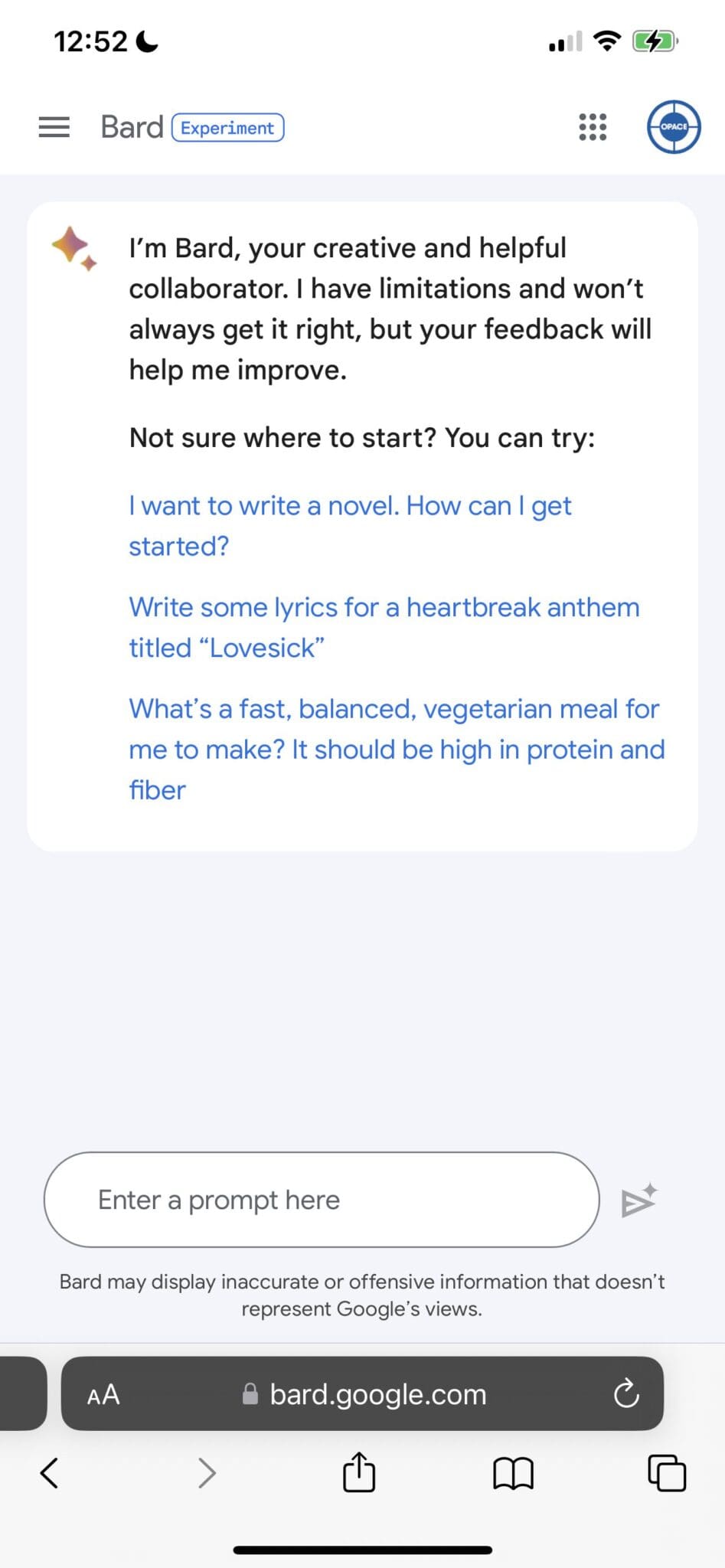
A look at the Google Gemini AI search engine on mobile (formerly known as Bard).
ChatGPT vs Gemini: a brief comparison
Technology and applications
ChatGPT and Google Gemini both rely on LLMs to generate human-like text responses. In the early days, ChatGPT was powered by OpenAI’s GPT-3 and GPT-4, while Google’s chatbot (then called Bard) ran on LaMDA and later PaLM-2. Today, Chat GPT uses OpenAI’s GPT-5 series, while Gemini runs on Google’s own Gemini model family, including Gemini Advanced for premium users. The key difference in 2026 is capability scope: ChatGPT excels at conversational reasoning and complex problem-solving, while Gemini’s strength lies in its multimodal capabilities (processing text, images, video, audio and code simultaneously) and deep integration with Google’s ecosystem.
AI-powered features and capabilities
Both ChatGPT and Google Gemini offer a range of AI-powered features and capabilities to enhance the search experience. These include generating summaries, answering complex questions, and providing contextual, conversational follow-ups. ChatGPT Search now includes a “Citation Engine” for multi-step verification of its answers, while Gemini has introduced “Personal Intelligence” that can draw on a user’s Gmail, Photos, Drive and Search history for personalised responses. Their respective implementations and effectiveness do vary, leading to differing user experiences.
Open source vs proprietary models
As covered in our article here, there’s a possibility that open source may actually lead the way. An internal communication from a Google staff member, which was unintentionally made public in 2023, admitted that the tech giant was facing challenges in rivalling open source artificial intelligence systems.
The document underscored the swift advancement of open source projects and their benefits, including affordability, adaptability, and easy access.
Could Meta (Facebook) be a contender?
Meta’s LLaMA, a notable open source project, drew a sizable number of developers and became a focal point in AI research discussions. Since our original article, Meta has released LLaMA 2 and LLaMA 3, each bringing significant improvements. It has laid the groundwork for countless open source AI initiatives, showing the power of open source to spark creativity, match up to, and even outdo proprietary AI systems. Other open source players such as Mistral and DeepSeek have also entered the market, adding further competition.
Open source AI: Google vs OpenAI vs Meta
Whilst not strictly open source, the open source beginnings and nature of OpenAI provide several advantages for its development and adoption.
By allowing developers and researchers to access and modify the underlying AI model, open source projects like LLaMA can benefit from a broader range of ideas and innovations, ultimately leading to more reliable, user-friendly solutions. Furthermore, open source projects can facilitate greater transparency and collaboration, helping to address potential concerns related to AI bias, misinformation, and other ethical issues.
Right now, it’s uncertain what role Meta or LLaMA will play in AI search (if any), but open source continues to push the boundaries of what is possible and keeps the major proprietary players honest.
Other possibilities?
Anthropic’s Claude: a major AI contender
Anthropic’s Claude has moved far beyond its status as an emerging contender when we first wrote about it in 2023. Claude is now one of the leading AI assistants, known for its focus on safety, longer context windows, and strong analytical capabilities. While Claude is not primarily marketed as a search engine, its ability to process and reason over large documents makes it a compelling tool for research and information gathering.
ChatGPT Search: from chatbot to search engine
In our original article, we asked whether ChatGPT could become a search engine. The answer came in October 2024, when OpenAI launched SearchGPT and then integrated it directly into ChatGPT as “ChatGPT Search”. This effectively transformed ChatGPT into a full AI search engine with real-time web access, cited sources, and a specialised GPT-5 architecture with a “Citation Engine” for multi-step answer verification. In October 2025, OpenAI went further by announcing Atlas, an AI-native web browser built on ChatGPT technology, signalling the company’s ambition to own the entire search experience from browser to answer.
Much like the original Bing Chat (now Copilot) and Bard (now Gemini), all major platforms now provide access to the internet and the ability to search the web with the assistance of their AIs, confirming that the terms ‘AI search engine’ and ‘AI chatbot’ have indeed become closely linked.
AI integration into existing search engines or a new breed altogether?
Are search engines already powered by AI?
It’s important to realise that AI has been playing a role in how search engines rank content for a long time.
For instance, Google uses AI algorithms like RankBrain to understand and process user queries better, providing more relevant search results. Although AI technically plays a role in the search algorithm rather than the search engine (the user interface to search), it’s certainly not a new concept in the world of search, with AI helping to:
- Improve query understanding and processing
- Enhance search result relevance and accuracy
- Provide personalised search results based on user behaviour and preferences
- Offer better language understanding and processing
Will AI be integrated into existing search engines?
The answer is a definitive yes, and it has already happened. In 2023, we were speculating about Google’s Magi project and whether it would bring AI features to a small initial user base of one million. What actually happened was far more sweeping. Google launched AI Overviews, which now appear across its core search product for a wide range of queries (covered in detail in the section below). Microsoft similarly embedded Copilot into Bing’s standard search experience.
Will AI chatbots replace search engines?
This was a key question in our original article, and by 2026 the answer is more nuanced than a simple yes or no. AI assistants now account for 56% of the global search engine volume, and 43% of Google searches now conclude without a single external click. When Google’s full AI Mode is activated, that figure rises to 93%. These zero-click searches represent a fundamental shift. Users increasingly get their answers directly from AI, without visiting any website at all.
Traditional search is not going to disappear, but its role is changing. For many informational queries, AI search engines are already the default. For complex, transactional and brand-specific queries, traditional search results still have a crucial role to play.
The most likely outcome
The prediction from our original article turned out to be correct: we are seeing a mixture of outcomes. AI has been integrated into existing search engines (Google AI Overviews, Bing Copilot), while entirely new AI-native search products have also emerged (ChatGPT Search, Perplexity AI). The concept of Search Everywhere Optimisation captures this reality, as businesses now need to think about visibility across multiple AI platforms, not just Google.
Blurring the lines between search engine and AI assistant
The Bing and ChatGPT partnership initially provided Microsoft with the opportunity to offer deeper integration of search within its devices.
AI assistants have evolved beyond voice commands
In our original 2023 article, we predicted that ChatGPT integration at an OS level could make AI far more useful than existing assistants like Alexa and Siri. This prediction has largely come true. Apple integrated ChatGPT into Apple Intelligence in 2025, Google embedded Gemini as the default assistant on Android, and Microsoft made Copilot a core part of Windows. These AI assistants now handle complex tasks that would have been unthinkable just a few years ago.
Integration between AI, search engine and web browser
The integration between AI, search and browser has gone even further than we anticipated. OpenAI announced Atlas, its own AI-native web browser, in October 2025. Perplexity AI launched Comet, an AI-native browser designed for multi-step research workflows. Microsoft Copilot is already embedded in Edge. The lines between search engine, AI chatbot, web browser and personal assistant are now almost entirely merged.
Not a fan of Bing? This is still good news: “A rising tide lifts all boats”
A lot of users are loyal to Google, and won’t be moving to Bing even with Copilot integration. You may wonder what the benefits will be for you as someone that intends to remain using Google search for the foreseeable future.
A big positive of the competition between Microsoft, OpenAI, Google and newer players like Perplexity is that it has driven all search providers and AI assistants to improve their technologies significantly.
Improvements and advancements of assistants such as Siri were slow for years. The success of ChatGPT directly encouraged Apple, Google and others to completely rethink how useful their assistants could be.
ChatGPT integration into phones via an assistant technology has transformed the way many people use their smartphones. Changes like this mean far more intelligent assistants than the ones we had just two years ago. For example, we can now ask an AI assistant to research a topic, summarise the findings, draft an email about it, and schedule a meeting to discuss it, all within one conversation. There is still enormous potential here when it comes to the future of AI search and voice assistants within the mobile phone and smart device market.
Understanding Google’s AI Overviews
One of the most significant developments since our original article is Google’s rollout of AI Overviews across its core search product. Formerly part of the experimental “Search Generative Experience” and related to the Magi project we discussed in 2023, AI Overviews are now a standard feature on a significant proportion of Google searches.
What are Google AI Overviews?
AI Overviews are AI-generated summaries that appear at the top of Google’s search results for certain queries. Rather than showing users a list of ten blue links, Google uses its Gemini AI to synthesise information from multiple sources into a single, comprehensive answer. These summaries can occupy up to 50% of the visible screen, pushing traditional organic results below the fold.
The impact on organic search traffic
The data paints a stark picture. A report from Define Media Group confirmed that AI Overviews have resulted in a 42% reduction in organic search clicks. Informational queries have been hit hardest, as users can often find complete answers directly within the AI Overview without needing to visit any website.
At the same time, not all traffic has declined. There has been a 103% increase in traffic from breaking news across Google Search, Google Discover and Google News. Google Discover specifically has seen a 30% increase, now rivalling web search in terms of traffic volume for some publishers. This shift suggests that while AI Overviews absorb clicks from informational queries, news and timely content still drives direct visits.
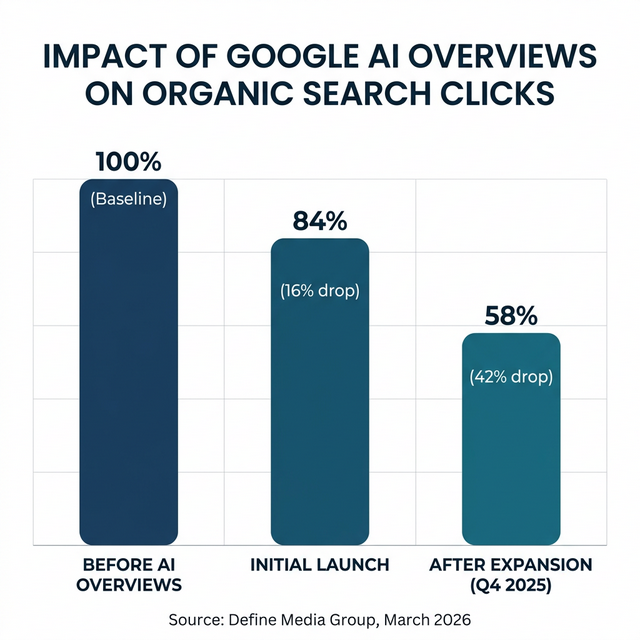
Impact of Google AI Overviews on search traffic. Source: Define Media Group, March 2026
An SE Ranking study of over 1.3 million AI Mode citations found that Google.com is the most-cited domain in its own AI Mode responses, accounting for 17% of all citations. This raises questions about whether the platform is becoming a closed loop. The Reuters Institute’s 2026 Trends and Predictions report highlighted that publishers increasingly fear AI search summaries and chatbots signal the “end of the traffic age” for many content-driven businesses.
The rise of zero-click searches
The growth of zero-click searches is perhaps the most significant trend. Across all Google searches, 43% now conclude without an external click, a figure that surges to 93% when Google’s full AI Mode is activated. For anyone involved in the death of SEO debate, these numbers provide real substance. Traditional SEO is not dead, but the rules of the game have fundamentally changed.
Beyond Google: the best AI search engines of 2026
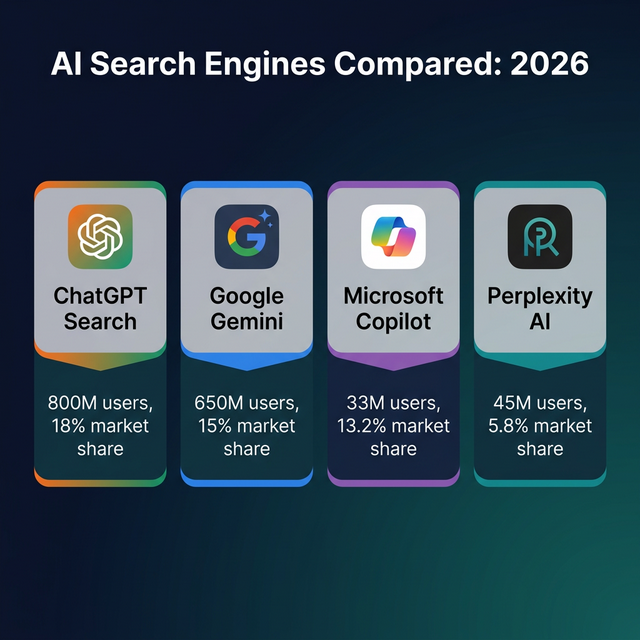
The best AI search engines of 2026: ChatGPT Search, Google Gemini, Perplexity AI, and Microsoft Copilot
While Google remains the dominant force in traditional search, the AI search market tells a different story. Choosing the best AI search engine in 2026 depends on what you need, as no single platform has taken a decisive lead. In the debate over ChatGPT vs Gemini vs Bing, several dedicated AI search engines have emerged, each offering a distinct approach.
ChatGPT Search (OpenAI)
ChatGPT Search is arguably the most significant challenger to Google’s search dominance. With approximately 800 million monthly active users and roughly 18% of the global AI search query market, it has grown from a novel chatbot to a comprehensive search platform. ChatGPT Search runs on OpenAI’s GPT-5 series and includes a Citation Engine for multi-step verification of answers. It excels at conversational reasoning, complex problem-solving, and research tasks that require synthesising information from multiple sources.
Google Gemini
Google Gemini has 650 million monthly active users and holds approximately 15% of the AI search market. Its greatest strengths are multimodal capability (processing text, images, video, audio and code), deep integration with Google’s ecosystem, and access to Google’s massive web index. Gemini Advanced offers premium features, including longer conversations and priority access to new capabilities.
Microsoft Copilot
With 33 million monthly active users and 13.2% of the AI search market, Microsoft Copilot offers a hybrid search experience that blends AI answers with traditional search results. Its major advantage is Copilot integration with Microsoft 365 and enterprise tools, making it particularly strong for business users.
Perplexity AI: the dedicated answer engine
Perplexity AI has emerged as the most notable AI-native search engine, built from the ground up as an answer engine rather than a chatbot with search bolted on. With around 45 million monthly active users, a valuation of approximately $18 billion, and processing over 1 billion queries per month, Perplexity has carved out a meaningful niche. It focuses on accuracy with real-time citations, and notably abandoned its advertising-based revenue model in February 2026, choosing to rely entirely on its $20/month premium subscription. Perplexity has also launched Comet, an AI-native browser designed for multi-step research workflows. For users who want a clean, citation-focused search experience without the complexity of a full chatbot, Perplexity is a strong choice.
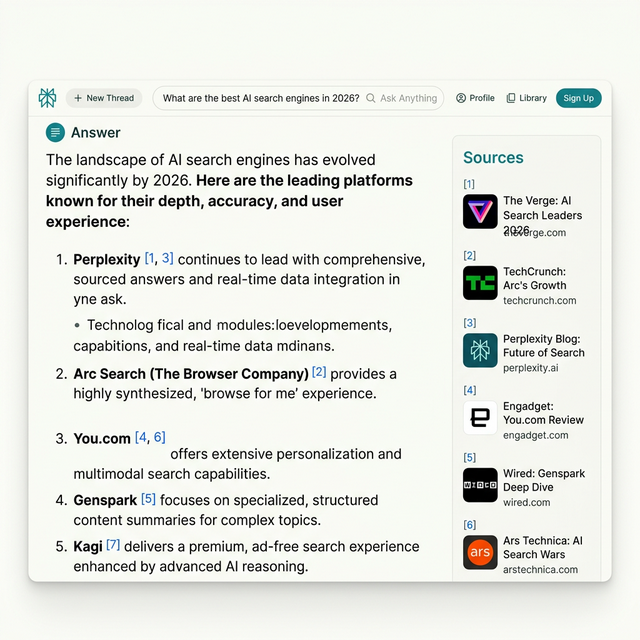
A look at the Perplexity AI answer engine interface, showing cited sources alongside AI-generated answers
The rise of Generative Engine Optimisation (GEO)
As traditional search evolves into AI-driven answer engines, the rules of visibility have fundamentally changed. We have officially entered the age of Generative Engine Optimisation (GEO). Unlike traditional SEO, which focuses on ranking ten blue links, GEO is about ensuring your brand is the source material that AI models cite when generating their answers.
A McKinsey report from late 2025 highlighted a critical shift. A brand’s own website now accounts for only 5 to 10 percent of the source material used by AI to generate search results. The vast majority of information is pulled from third-party platforms, user-generated content, and authoritative publishers. With 50% of consumers already using AI-powered search, and McKinsey projecting this to impact $750 billion in US revenue by 2028, this is not a trend businesses can afford to ignore.
To succeed in this environment, businesses need high-quality, authoritative information, which our digital content creation services provide. Creating content that AI models trust requires a focus on unique data, expert opinions, and clear formatting.
The shift to GEO does not mean traditional search is dead. Foundational technical health provided by professional SEO services remains critical for visibility. However, the strategy must now expand to influence the broader ecosystem of information that feeds models like ChatGPT Search, Gemini Advanced and Perplexity AI.
How to future-proof your content for AI search
For businesses looking to maintain and grow their visibility in the age of AI search, there are several practical steps to take:
Create content that AI models want to cite
The most important shift is from “content that ranks” to “content that gets cited”. AI search engines prioritise content that is authoritative, well-structured, clearly formatted with proper headings and bullet points, and backed by unique data or expert insight. If your content is generic, AI models will pull from a competitor instead. This applies to ChatGPT SEO, GEO, and traditional search in equal measure.
Use structured data and schema markup
Schema markup helps AI search engines understand the specific entities, facts and relationships within your content. Using schema.org JSON-LD consistently can increase your chances of being extracted and cited by AI models.
Build entity authority beyond your website
AI models learn about your brand from across the entire web, not just your website. Consistent brand mentions in authoritative publications, clear author bios, and a well-managed Google knowledge panel all contribute to how AI search engines perceive your authority. E-E-A-T (Experience, Expertise, Authoritativeness, Trustworthiness) signals are more important than ever.
Test your visibility in AI search
Regularly test how relevant queries about your products or services appear in ChatGPT, Gemini, Perplexity and other AI search tools. If your brand is not being cited, you have a visibility gap that needs addressing.
What impact could AI search have on the digital economy?
As AI search engines become more prevalent, they are having a measurable impact on the digital economy.
Websites and content creators that relied on traditional search engines have already needed to adapt their strategies. The 42% reduction in organic clicks from AI Overviews is not a theoretical prediction; it is happening now. Publishers fear that the days of reliable search traffic may be coming to an end, and many are already exploring alternative revenue models.
This is radically changing how businesses and marketers approach SEO and PPC. The death of SEO conversation has moved from speculation to measurable reality, even if the conclusion is more nuanced than the headline suggests. SEO is not dead, but it is transforming into something broader that includes GEO, entity optimisation, and multi-platform visibility.
ChatGPT vs Gemini vs Copilot: what’s the verdict?
The rapid advancements in AI have significantly transformed the technology industry, with the search engine market being no exception.
While open source, platforms like Meta’s LLaMA 3, and contenders like Claude continue to develop, the AI search engine market in 2026 is dominated by four main players:
| Platform | Monthly Active Users | AI Search Share | Key Strength |
|---|---|---|---|
| ChatGPT Search | 800 million | ~18% | Conversational reasoning, Citation Engine |
| Google Gemini | 650 million | 15% | Multimodal, Google ecosystem integration |
| Microsoft Copilot | 33 million | 13.2% | Enterprise, Microsoft 365 integration |
| Perplexity AI | 45 million | 5.8% | Citation accuracy, clean answer engine |
Based on our own experiences using all four platforms, we would still give ChatGPT our recommendation for general-purpose AI search. The reasons include:
- They were ‘first to market’ with a freely available generative AI chatbot and continue to lead in user adoption
- ChatGPT has grown to 800 million monthly active users
- The Citation Engine provides verifiable, sourced answers
- The level of programming code expertise and support remains exceptional
- Integration with Apple Intelligence and the OpenAI API ecosystem is extensive
- Custom GPTs have replaced the earlier plugin system, offering more tailored experiences
However, we would recommend Gemini for users deeply embedded in Google’s ecosystem, Copilot for enterprise Microsoft users, and Perplexity for anyone who values clean, cited answers above all else. So when it comes to ChatGPT vs Gemini vs Bing, the best AI search engine depends entirely on your use case and priorities.
Conclusion: AI search engines in 2026 and beyond
When we first published this article in January 2023, ChatGPT was a few months old, Bard hadn’t launched yet, and “AI search engine” felt like a concept of the future. Three years on, many of the predictions we made have come true: AI has been integrated into existing search engines, conversational follow-up search has become standard, and the lines between chatbot, search engine and virtual assistant have blurred almost beyond distinction.
The reality of 2026 is that AI search is here, and it is reshaping every aspect of how people find information. For businesses, this means adapting to a world where GEO sits alongside traditional SEO, where being cited by an AI model matters as much as ranking on page one, and where the concept of a single dominant search engine is giving way to a fragmented ecosystem of AI-powered platforms.
What hasn’t changed is the fundamental principle: good content wins. Whether it’s a traditional search engine, an AI Overview, or a Perplexity answer, the content that earns visibility is still the content that is genuinely useful, well-written, authoritative and original. The tools have changed. The principle has not.
If you want to discuss how AI search is affecting your business, or if you need guidance on adapting your content strategy for this shift, feel free to get in touch with our team.