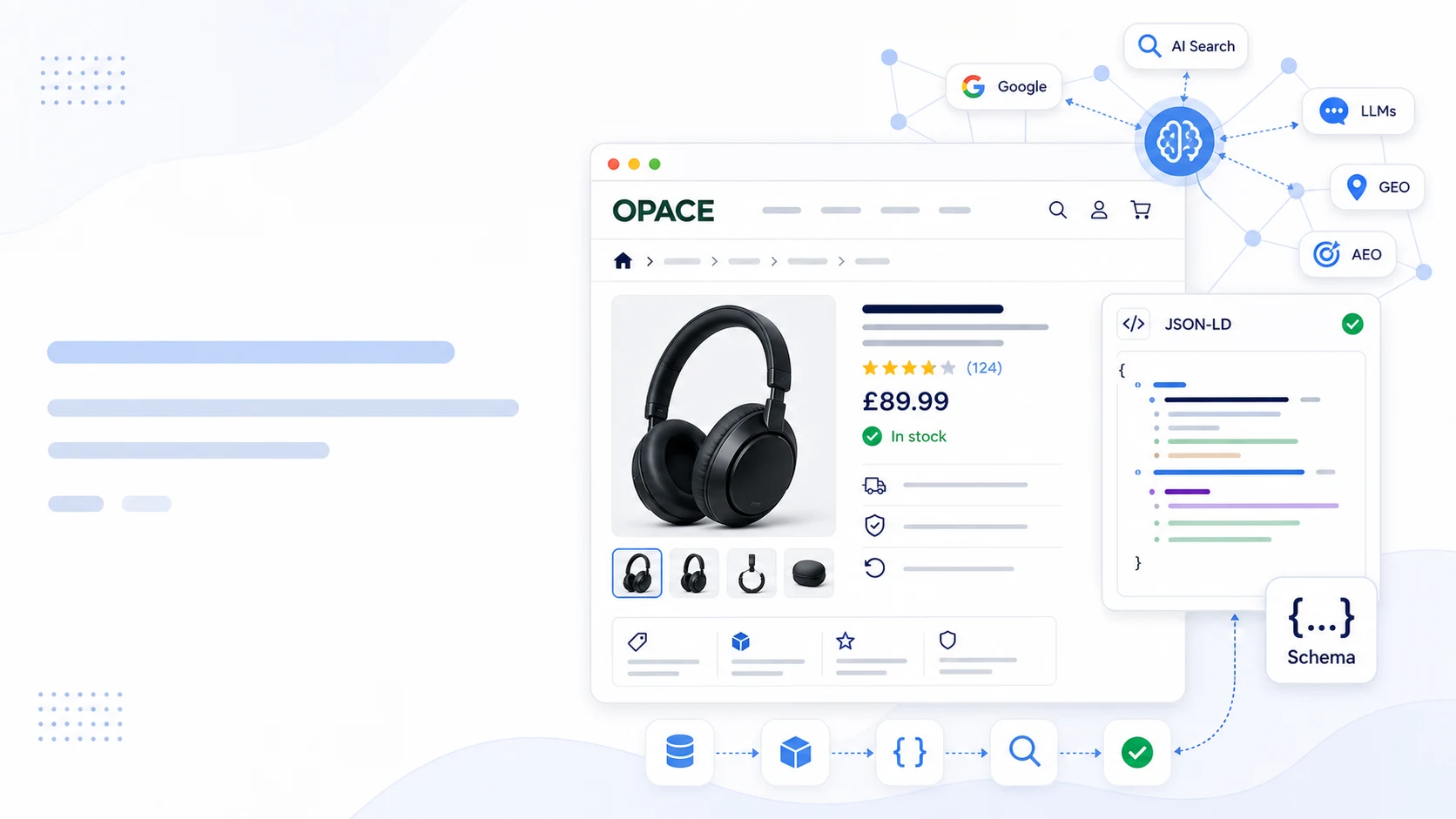
This guide walks you through the 12 most important types of schema markup for SEO — with copy-paste JSON-LD examples, implementation advice for WordPress, Shopify and custom builds, and a dedicated section on why structured data now matters for AI search, AI Overviews and LLMs as well as traditional Google rankings.
Where once we had AltaVista handling 19 million requests a day by late 1996, then Google cannibalising the market with more than 8.5 billion daily searches in 2022, we now live in a time where search engines aren’t the only dominant force. More users are finding answers across phones, AI assistants, smart speakers and cars.
Google still dominates the “traditional search” market, with around 90% global market share, and in the UK it is used by 82% of adults for roughly 3 billion searches a month. But behaviour is widening: Ofcom says AI Overviews now appear on about 30% of searches, while ChatGPT UK visits rose from 368 million to 1.8 billion in the first eight months of 2025. Voice and smart-device search is part of the same shift, with 40% of UK households owning a smart speaker and 43% of smart-speaker owners using it to search for information online. Even cars are becoming search interfaces, with Tesla now letting drivers ask Grok hands-free for answers and navigation commands.
For more on the history of search engines and battle between Google vs Bing for SEO, see below:
https://opace.agency/guide/bing-v-google-seo/
Search engines have now evolved from simple text parsers into complex semantic systems. They no longer rely only on matching words on a page. Traditional search engines like Google and Bing, LLMs like ChatGPT, and AI search engines all need to understand the facts behind the words: who a business is, what a product is, whether it is in stock, what it costs, who reviewed it, where a service is delivered and how different pages relate to one another.
This is where structured data and schema for SEO become important. Structured data translates visible page content into a machine-readable format that search engines can process more reliably. Instead of forcing crawlers to infer that “£89.99” is a price, “In stock” is an availability signal, or “4.8 from 214 reviews” is an aggregate rating, schema markup labels those details clearly.
Schema markup is not a magic ranking switch. It won’t rescue thin content, weak products or poor technical SEO. What it can do is help search engines and LLMs understand your pages, qualify eligible pages for rich results, improve product visibility, strengthen entity clarity and make your content easier for AI-driven search systems to interpret.
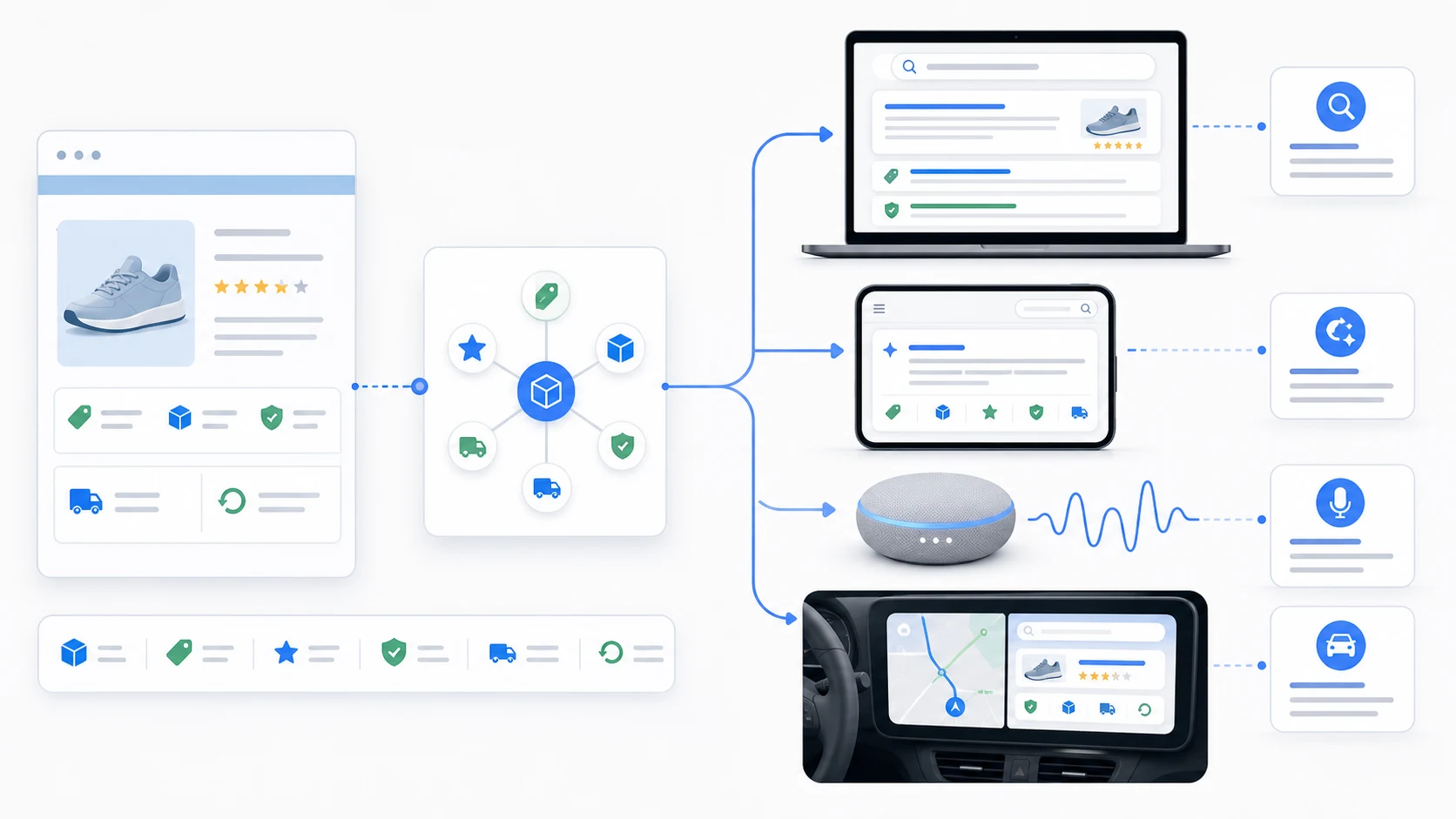 Search behaviour is widening across search engines, AI assistants, voice devices and in-car interfaces.
So, let’s dive in.
What is Structured Data and Schema Markup?
To understand schema SEO properly, it helps to separate three related ideas: structured data, schema markup and Schema.org.
Structured data is organised information that follows a predictable format. In SEO, it describes the meaning of content on a web page in a way that machines can read without relying only on visual layout or natural-language interpretation.
Schema markup is the code used to add that structured data to a page. It is normally written using the Schema.org vocabulary and added in JSON-LD format.
Schema.org is the shared vocabulary used by major search engines to describe entities such as products, organisations, people, reviews, articles, recipes, events, videos, courses, jobs and local businesses.
A normal product page might show:
- Product name
- Product image
- Product description
- Price
- Currency
- Brand
- SKU
- GTIN
- Size or colour variants
- Stock status
- Delivery details
- Return policy
- Reviews and ratings
A shopper can understand a page because they can see the design, labels, buttons, images and layout. Search engines can often infer the same information, but inference is not the same as clarity. Structured data explicitly tells search engines what each important element means.
Schema markup translates human-readable content into labelled facts that search engines and AI systems can process more consistently.
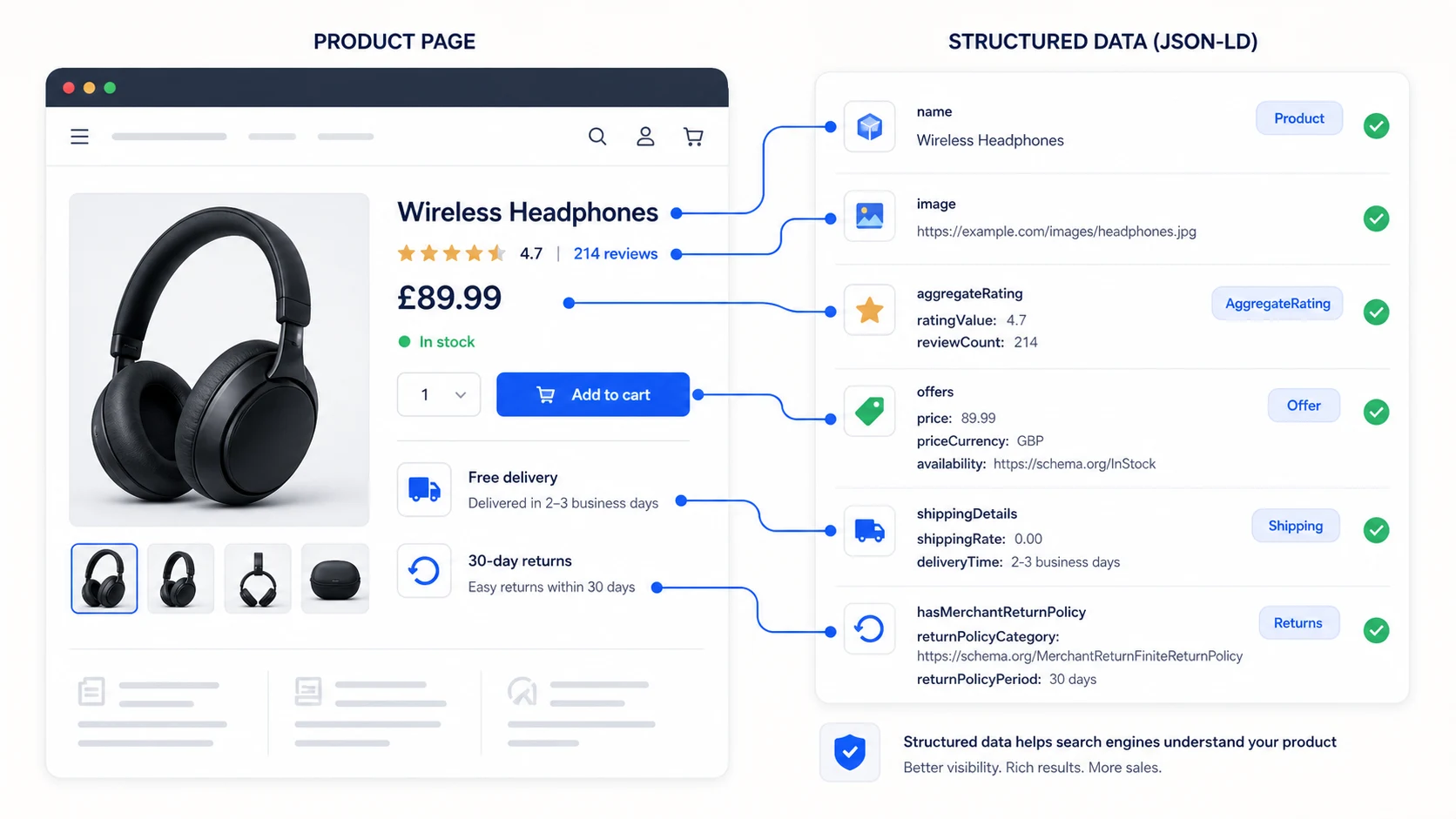 Structured data labels visible page content so search engines can process facts more reliably.
According to Google Search Central, structured data is a standardised format for providing information about a page and classifying its content. Google uses structured data to understand page content and to make pages eligible for rich search results where appropriate.
This is why investing in professional schema markup services is often a priority for technical SEO teams, eCommerce brands and businesses that rely on high-value organic visibility.
Without Structured Data, Does This Mean My Website is Unstructured?
While websites are coded using HTML, it’s fair to say that the content on most websites is unstructured.
Paragraphs, headings, images, buttons, icons, badges and tables are designed primarily for people. CSS is then used to present that HTML content so it looks good when visitors try to read the page on a desktop or mobile device. However, a search engine must interpret that layout from HTML, rendered content, links, scripts and other signals.
And what about other modes of search like voice? These days, a significant number of us demand information on the move. We don’t rely on physical computers and browsers like we used to. People speak to their phones, smart devices and cars. They expect accurate real-time information back. This is a lot harder when websites are unstructured.
Structured data reduces the guesswork.
| Visible page content | Structured meaning |
|---|---|
| “£89.99” | Product price |
| “GBP” | Price currency |
| “In stock” | Availability |
| “4.7 stars from 214 reviews” | Aggregate rating |
| “Blue, size 9” | Product variant |
| “Free delivery over £50” | Shipping offer |
| “30-day returns” | Merchant return policy |
| “Longbridge Technology Park” | Business location |
| “David Bryan” | Article author |
| “Updated 9 May 2026” | Date modified |
This matters because search engines need consistent, accurate signals at scale. On a small website, Google may be able to infer enough from page copy and layout. On a large eCommerce site with thousands of products and variants, relying on inference alone becomes risky.
Structured data acts like a translation layer between the website and search systems, turning visible content into labelled facts.
Structured Data vs Schema Markup vs JSON-LD
The terms structured data, schema markup and JSON-LD are often used interchangeably, but they are not exactly the same.
| Term | Meaning | Example |
|---|---|---|
| Structured data | The organised information itself | Product price, stock, rating |
| Schema markup | The code added to the page | Product schema, LocalBusiness schema |
| Schema.org | The shared vocabulary | Product, Offer, Review, Organization |
| JSON-LD | The implementation format | A <script type="application/ld+json"> block |
A useful way to think about it is:
- Structured data is the information.
- Schema.org is the dictionary.
- JSON-LD is the packaging format.
- Schema markup is the code you publish on the page.
Google generally recommends JSON-LD where possible because it is easier to implement and maintain at scale. Unlike Microdata or RDFa, JSON-LD does not require every visible HTML element to be wrapped with extra attributes. It can sit as a clean script block in the <head> or <body> of the page.
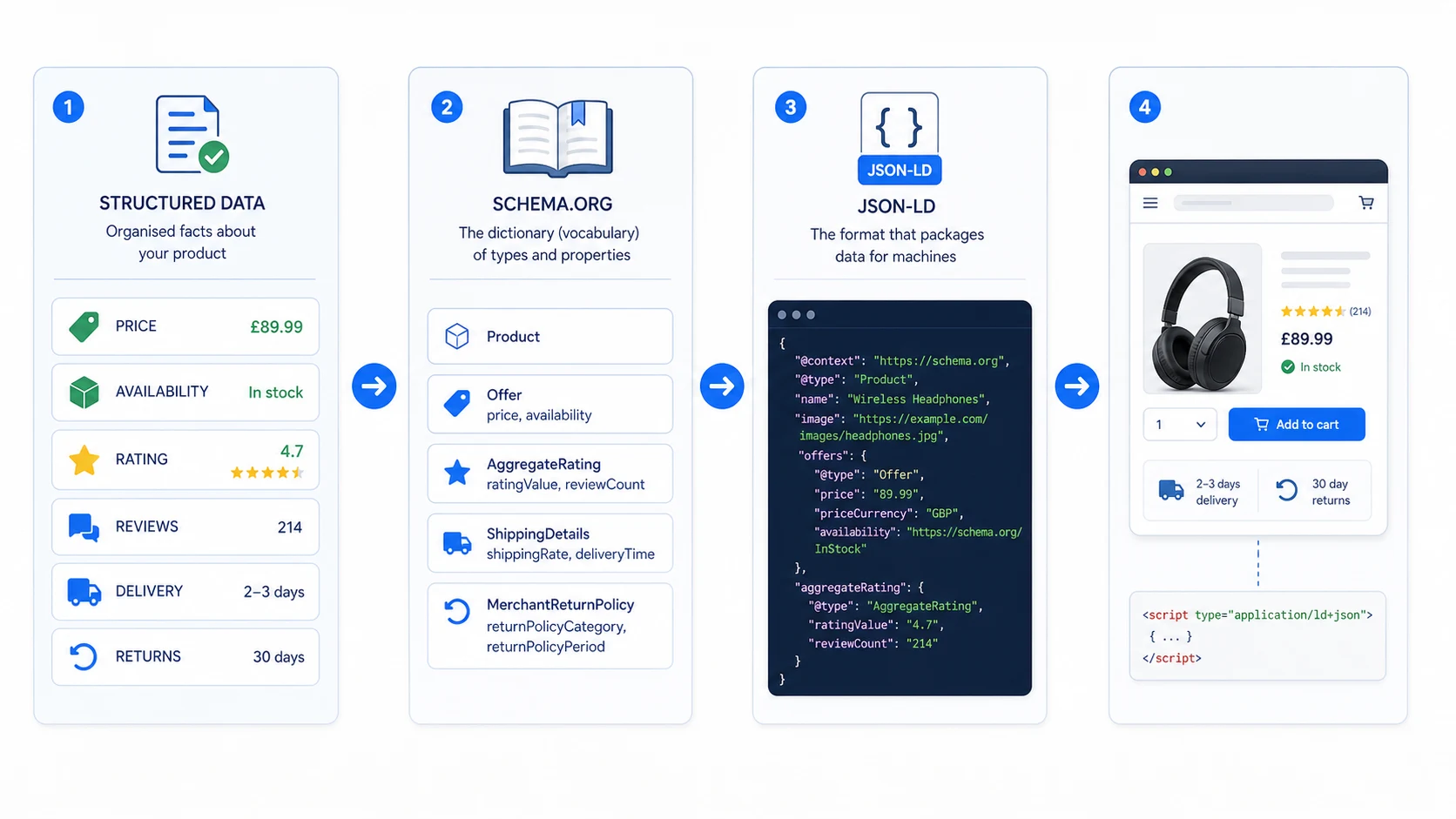 Structured data is the information, Schema.org is the vocabulary, JSON-LD is the format, and schema markup is the code added to the page.
How Important is Schema Markup for SEO?
Applying schema markup takes planning and technical effort, so it is fair to ask whether the return is worth it. If you are serious about SEO and being found, the answer is yes.
Schema markup matters because it helps search engines understand page content more accurately and can make eligible pages appear with enhanced search features. These enhanced listings are usually called rich results.
A standard organic result may show a title, URL and meta description. A rich result may show extra information such as star ratings, price, stock status, breadcrumbs, images, cooking time, event dates, job salary, course information or video thumbnails.
These enhancements can make a result more useful and more visually prominent. They can also help users make decisions before clicking. For eCommerce pages, showing price and availability directly in search results can qualify traffic earlier. For local businesses, showing address and opening details can improve confidence. For articles, clear author and date information can support trust.
Schema also supports broader search understanding. Search engines increasingly think in terms of entities and relationships rather than isolated keywords. Your business, products, authors, locations, services and content all form part of a wider knowledge graph. Structured data helps define those relationships more clearly.
For example, schema can help show that:
- A page is an article written by a specific author.
- The author works for a specific organisation.
- The organisation operates from a real location.
- The organisation offers specific services.
- A product belongs to a specific brand.
- A product has variants with shared parent relationships.
- Reviews belong to a specific product rather than the business generally.
That clarity is valuable for traditional search, eCommerce search, local SEO, rich results and AI search.
Rich Results, Rich Snippets and Featured Snippets Compared
SEO discussions often confuse structured data, rich results, rich snippets and featured snippets. They are related, but they are not the same.
| Term | Meaning | Controlled by schema? | Example |
|---|---|---|---|
| Structured data | Machine-readable page information | Yes | Product, Offer, Article |
| Schema markup | The code vocabulary and implementation | Yes | JSON-LD Product schema |
| Rich result | Enhanced Google result | Eligibility often depends on schema | Price, ratings, stock |
| Rich snippet | Older phrase for enhanced snippets | Partly | Review stars or product details |
| Featured snippet | Extracted answer box | No direct schema control | Paragraph, table or list answer |
A rich result is usually the practical SEO outcome people care about. For example, a product result with rating stars, price and stock status stands out more than a plain blue link.
A featured snippet is different. It is normally extracted from visible page content to answer a query directly. Schema markup does not force a featured snippet, although clear content structure can help Google understand and extract answers.
The important point is that schema markup can make a page eligible for certain rich results, but eligibility does not guarantee display. Google still considers search intent, content quality, policy compliance, trust, technical accessibility and whether the feature is useful for that query.
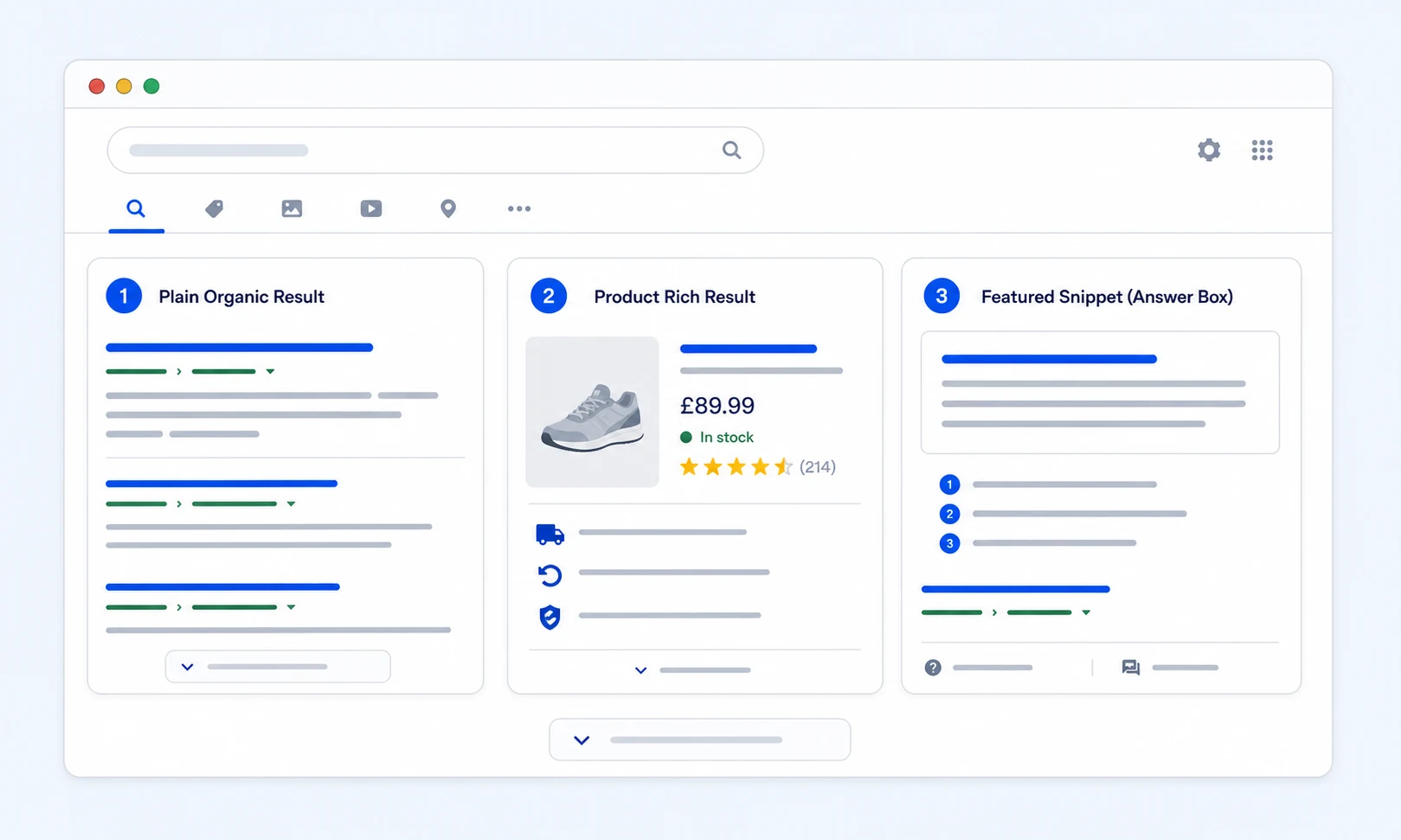 Schema can support rich result eligibility, while featured snippets are usually extracted from visible page content.
Does Schema Markup Directly Improve Rankings?
Schema markup is not a direct ranking factor in the simple sense that adding it will automatically move a page from position ten to position one. Google has repeatedly treated structured data as a way to understand content and enable search features rather than as a standalone ranking boost.
However, saying “schema does not directly improve rankings” can undersell its practical SEO value.
Structured data can improve SEO performance indirectly by:
- Making pages eligible for rich results.
- Improving search result appearance.
- Increasing click-through rate where enhanced results appear.
- Helping Google classify content accurately.
- Supporting product visibility in Google Search, Google Images, Google Lens and shopping surfaces.
- Reducing ambiguity around products, variants, reviews and business details.
- Creating Search Console reports that make technical issues easier to monitor.
- Strengthening entity understanding for AI-driven search systems.
For eCommerce websites, schema often sits close to revenue. Product structured data communicates price, availability, ratings, shipping and returns information. These are not abstract SEO details; they affect buyer confidence.
For local and service businesses, schema can help clarify organisation details, service areas, contact information, locations and opening hours. For publishers, Article and BlogPosting schema help search engines understand authorship, dates and content type.
So the right framing is this: schema markup is not a shortcut around good SEO, but it is an important technical layer that helps strong pages communicate more clearly.
Structured Data for AI Search, AI Overviews and LLMs
AI search has made structured data even more important, not less. Traditional SEO focused heavily on rankings, snippets and clicks from search engine results pages. That still matters, but users are increasingly getting answers from AI Overviews, ChatGPT, Gemini, Perplexity, Copilot, Grok, voice assistants and other answer-led interfaces.
AEO, GEO and AI Overviews
AEO, or answer engine optimisation, is about making content clear enough to be selected, summarised or spoken back as a direct answer. This applies to featured snippets, People Also Ask results, voice search, AI Overviews and assistant-style responses.
GEO, or generative engine optimisation, is about improving how well your brand, products, services and content can be understood, cited or represented by generative AI systems. Instead of only asking, “Can this page rank?”, GEO asks, “Can an AI system understand this page well enough to use it accurately?”
Structured data supports both because it turns important page content into explicit facts. Google says it uses structured data to understand page content and gather information about the web and the world, including entities such as people, books and companies. It can also use structured data to display rich results where pages are eligible.
For AI Overviews and AI Mode, Google says there are no special extra technical requirements beyond being indexed and eligible to appear in Google Search with a snippet. That means schema markup is not a guaranteed route into AI Overviews. However, structured data still helps with the wider technical foundation because it makes page meaning clearer, improves eligibility for rich results and supports Google’s understanding of entities, relationships and page content.
For example, a well-marked-up eCommerce page can help machines understand:
- The exact product being sold.
- The brand, SKU, GTIN and product category.
- The current price and currency.
- Whether the product is in stock.
- Delivery costs and shipping regions.
- Return policy details.
- Reviews and aggregate ratings.
- Product variants such as size, colour or material.
- The relationship between the product, seller, organisation and website.
This matters because AI-generated answers are only as useful as the information they can interpret. If a product page is vague, inconsistent or technically messy, an AI system may struggle to understand what is being sold, who sells it, whether the information is current, and whether it can be trusted. If the same page has clear visible content supported by accurate Product, Offer, Review, Organization, Breadcrumb and MerchantReturnPolicy schema, there is less ambiguity.
The same principle applies to service businesses and publishers. LocalBusiness schema can clarify business details, service areas, locations and opening hours. Article and BlogPosting schema can clarify authorship, publication dates and updates. FAQPage schema, where appropriate and compliant with Google’s guidance, can help define question-and-answer content. Organization and Person schema can support entity understanding around brands, authors, founders and expert contributors.
This does not mean you should add schema for information that users cannot see. In fact, schema should reflect the visible page content. If the page says one thing and the structured data says another, that creates trust and quality problems. For AI search, this kind of mismatch is especially risky because machines need consistency between the content, markup and wider brand signals.
Why LLMs Need Clear, Structured Signals
Large language models do not “read” websites like humans. They process patterns, language, context, entities and relationships. When LLMs, search engines and AI answer systems evaluate content, they need to work out what the page is about, which claims are factual, which entities are involved, and whether the information is useful enough to surface.
Structured data gives those systems cleaner signals.
It can help clarify that:
- “David Bryan” is the author of an article, not a customer or reviewer.
- “Opace” is the organisation behind the website.
- “Structured Data & Schema for SEO” is an article topic, not a product name.
- “£89.99” is a product price, not a random number in the copy.
- “In stock” is an availability status.
- “Birmingham” is a service location.
- “4.8 from 214 reviews” is an aggregate rating attached to a specific product or service.
For LLM visibility, this kind of clarity matters. AI systems are increasingly used to compare products, explain services, summarise reviews, recommend providers, answer commercial questions and help users make decisions before they ever click a traditional search result. A website that communicates its facts clearly has a better chance of being understood correctly.
That is why schema markup should now be seen as part of a wider SEO, AEO and GEO strategy. It supports rich results in traditional search, improves machine readability for search engines, and helps AI-driven systems interpret your content with less guesswork.
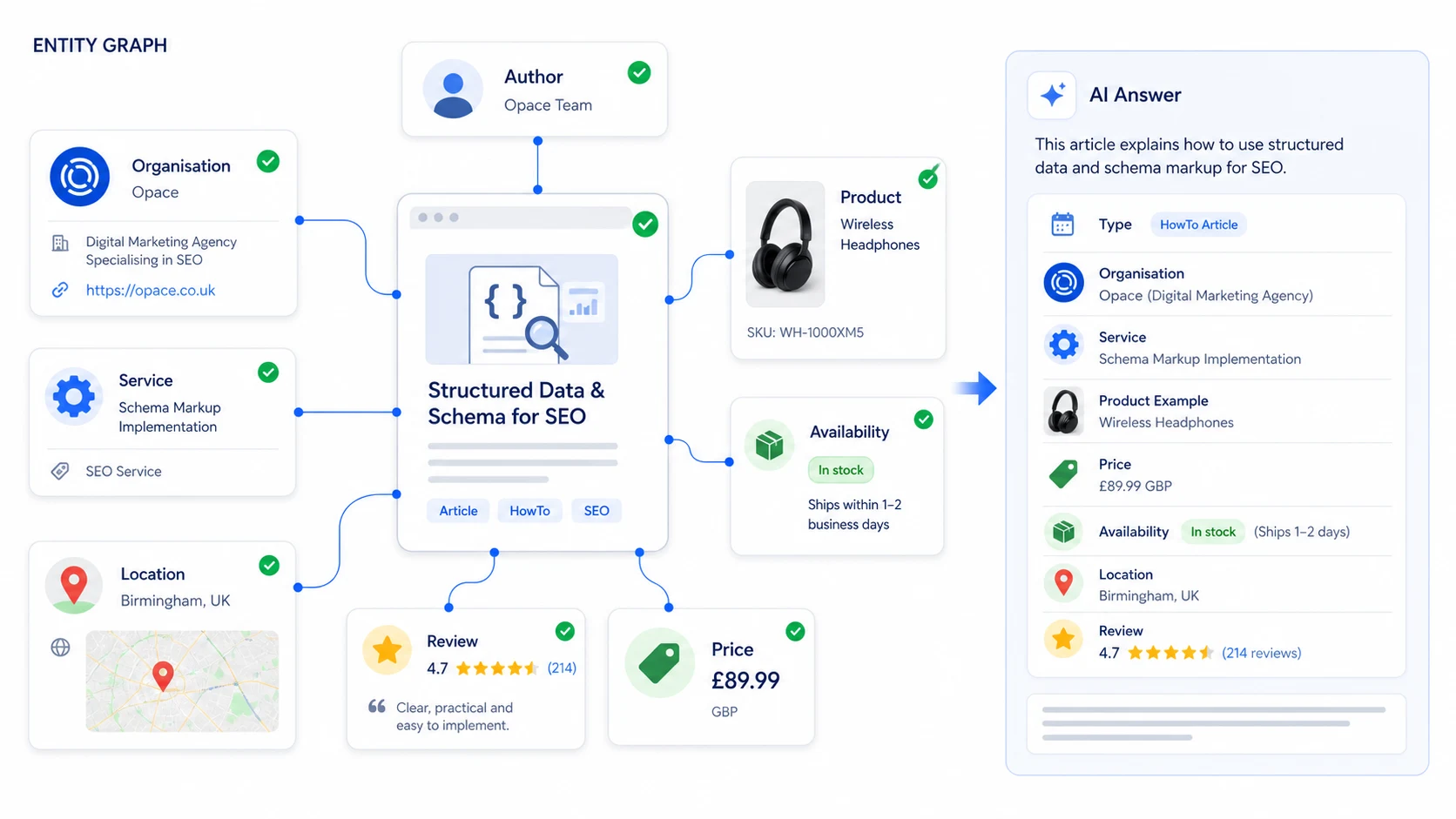 Structured data helps AI systems understand entities, facts and relationships with less guesswork.
The Most Important Types of Schema Markup
Schema.org contains hundreds of types, but most SEO strategies only need a core set. The best schema implementation uses the most specific relevant type for each page rather than adding every possible type everywhere.
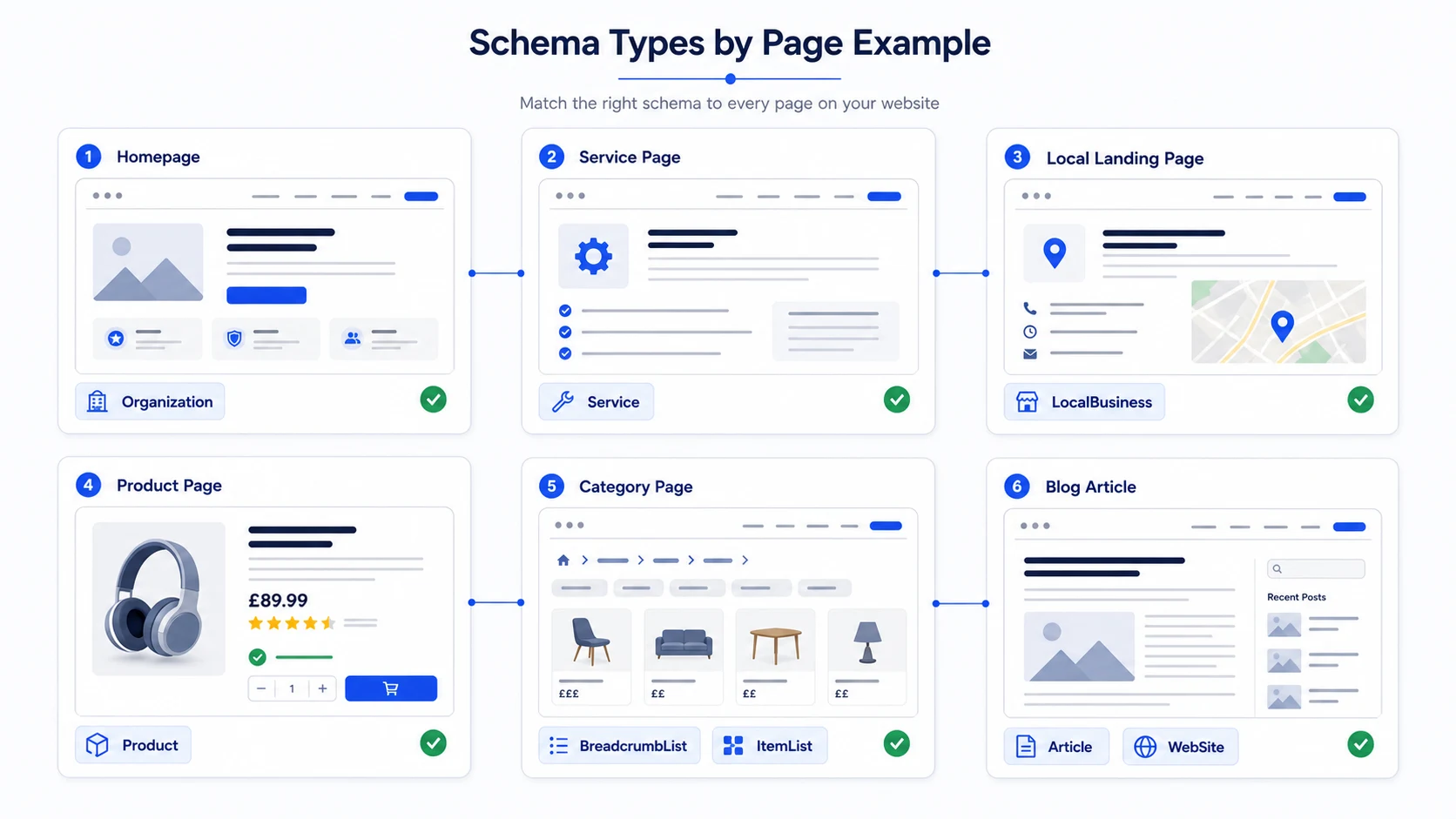 The best schema implementation uses the most specific relevant type for each page.
Organization Schema
Organization schema defines the business or brand behind a website. It is usually used sitewide, especially on the homepage and about/contact pages.
Useful Organization properties can include:
- Business name
- Logo
- Website URL
- Contact details
- SameAs social profiles
- Founding information
- Parent organisation or sub-organisation relationships
- Customer service details
- Merchant return policy
- Loyalty programme information where relevant
For eCommerce brands, Organization schema is also useful because Google recommends adding structured data for eCommerce business policies, such as merchant return policies, nested under Organization markup where appropriate.
Strong Organization schema helps search engines connect your website, brand, social profiles, knowledge panel signals, products and authors.
LocalBusiness Schema
LocalBusiness schema is essential for companies that operate in a specific geographic area or have a physical location.
It can define:
- Business name
- Address
- Phone number
- Opening hours
- Geographic coordinates
- Service area
- Department or branch details
- Price range
- Reviews where valid
- SameAs profiles
This is particularly useful for companies targeting local search visibility. A Birmingham web design agency like Opace, a local tradesperson, or any other local business can all benefit from properly implemented LocalBusiness schema.
If local visibility is a priority, structured data should be combined with a complete Google Business Profile, consistent citations, local landing pages and high-quality reviews. Schema alone will not guarantee local rankings, but it helps reinforce the business entity and location signals.
For more support, a digital marketing agency specialising in local SEO can help align structured data with broader local search strategy.
Product Schema
Product schema is one of the most important schema types for eCommerce websites. It describes individual products and can support rich product visibility in Google Search, Google Images, Google Lens, shopping features and merchant listings.
Product schema commonly includes:
- Product name
- Description
- Product images
- Brand
- SKU
- GTIN, MPN or other identifiers
- Category
- Colour, size or material
- Offers
- Price
- Currency
- Availability
- Item condition
- Reviews
- Aggregate rating
- Shipping details
- Return information
Product schema should normally be used on individual product detail pages, not generic category pages. If a page is mainly selling one product, Product schema is appropriate. If a page lists many products, category-level schema such as BreadcrumbList or ItemList may be more suitable.
Google separates product structured data into two broad use cases: product snippets and merchant listings. Product snippets may apply where product information is shown, while merchant listings are more relevant when users can directly buy from the page. eCommerce stores should pay close attention to merchant listing requirements because these can affect product visibility across shopping-related search surfaces.
Offer Schema
Offer schema is usually nested inside Product schema. It describes the commercial offer associated with the product.
Important Offer properties include:
- Price
- Price currency
- Availability
- URL
- Item condition
- Seller
- Shipping details
- Price valid until
- Return policy where applicable
For eCommerce, Offer data must stay accurate. If the page says a product costs £49.99 but schema says £39.99, the markup becomes unreliable. If the page says “out of stock” but schema says “InStock”, that is a quality problem.
Google Merchant Center guidance is especially strict here. Structured data needs to match the values shown to users, and product structured data is recommended in the initial HTML for best results.
Review and AggregateRating Schema
Review schema describes individual reviews, while AggregateRating summarises the overall rating from multiple ratings or reviews.
These properties can be powerful because star ratings are highly visible in search results when eligible. However, they are also frequently abused.
Avoid marking up:
- Fake reviews
- Hidden reviews
- Reviews copied from other websites without permission
- Business-wide reviews as product-specific reviews
- Reviews that users cannot see on the page
- Self-serving ratings where Google guidelines restrict them
A good rule is simple: if users cannot clearly see the review content or rating on the page, do not show it to search engines in schema.
BreadcrumbList Schema
BreadcrumbList schema helps search engines understand page hierarchy.
Example:
Home → SEO Services → Technical SEO → Schema Markup Services
For eCommerce, breadcrumbs might look like:
Home → Men’s Footwear → Running Shoes → Trail Running Shoes
Breadcrumb schema supports both search engines and users. In search results, it can also help Google display cleaner, more meaningful paths instead of long or messy URLs.
Article and BlogPosting Schema
Article and BlogPosting schema are used for editorial content such as guides, blog posts, news articles and resources.
Useful properties include:
- Headline
- Description
- Image
- Author
- Publisher
- Date published
- Date modified
- Main entity of page
- Article section
For blogs, Article schema helps search engines understand the content type, author and freshness. It also supports cleaner structured data graphs when connected to Organization and Person schema.
This article itself would naturally use BlogPosting or Article schema, supported by BreadcrumbList and Organization schema.
WebSite and SearchAction Schema
WebSite schema identifies the website itself. SearchAction can describe internal site search functionality where suitable.
This is usually implemented sitewide and may include:
- Website name
- Website URL
- Publisher
- Potential action for internal search
For larger sites, especially eCommerce stores, SearchAction can help search engines understand the site’s internal search pattern. However, it should only be used when the site search experience genuinely works well and is accessible.
ProductGroup and Product Variant Schema
ProductGroup schema helps describe a parent product with multiple variants. This is important for eCommerce stores selling products that vary by:
- Size
- Colour
- Material
- Pattern
- Style
- Capacity
- Pack size
Without variant schema, search engines may treat similar URLs as unrelated or duplicate products. ProductGroup helps explain that the blue, black and red versions are variants of the same parent product.
Useful properties include:
ProductGrouphasVariantisVariantOfvariesByproductGroupID
Variant schema is more advanced, but it can be very useful for fashion, furniture, electronics, beauty, tools and other eCommerce categories where product options matter.
ItemList Schema
ItemList schema can help describe a list of items on a page. It may be useful for category pages, collection pages, curated lists and some comparison guides.
However, it should be used carefully. A category page listing products is not the same as a product detail page. Do not mark up a category page as though the category itself is a single Product.
FAQPage Schema
FAQPage schema used to be a popular way to gain extra SERP space with expandable FAQ dropdowns. That tactic is no longer reliable.
Google has deprecated FAQ rich results from Google Search as of May 2026, with the FAQ search appearance, rich result report and Rich Results Test support being removed after that. FAQ content can still be useful for users, and FAQPage schema may still have limited uses in certain contexts, but it should not be treated as a dependable commercial rich-result tactic.
In practical terms, keep FAQs if they improve the page. Do not add FAQs solely to chase rich results.
eCommerce Structured Data: Why Product Pages Need Extra Care
eCommerce sites are structured data-heavy by nature. A single product page can contain more machine-readable facts than a standard blog post, including identifiers, offers, ratings, variants, stock, shipping and returns.
This makes eCommerce schema valuable, but also riskier. Product data changes often. If schema falls out of sync with the visible page, product feeds or inventory system, trust can suffer.
Product Visibility Across Search
Google’s product structured data documentation explains that product information can appear in richer ways across Google Search, including Google Images and Google Lens. Product-rich results can show information such as price, availability, review ratings and shipping information.
That means structured data can support visibility beyond the classic ten blue links.
For eCommerce brands, this can affect how products appear in:
- Organic search results
- Product snippets
- Merchant listings
- Google Images
- Google Lens
- Popular products modules
- Shopping knowledge panels
- Free listings via Merchant Center
Product schema is only one signal. Google can also use Merchant Center feeds and other product data sources. The strongest eCommerce implementations keep on-page content, structured data and product feeds aligned.
Reducing Product Ambiguity
Product pages often look simple to users but complex to search engines. A page might include a parent product, several variants, reviews, related products, upsells, delivery banners and category links. Search engines need to know what the main entity of the page is.
Schema helps clarify:
- Which product is the primary product.
- Which brand makes the product.
- Which offer belongs to the product.
- Which reviews belong to that product.
- Which variants are related.
- Whether the item is available to buy.
- Which policy applies to shipping and returns.
This clarity is especially useful when product pages are thin, heavily templated or similar to many other pages.
Keeping Product Data in Sync
eCommerce schema should not be written once and forgotten. Product structured data should be generated from the same reliable source as the visible page wherever possible.
Important fields to keep in sync include:
- Price
- Sale price
- Currency
- Availability
- Product condition
- SKU
- GTIN
- Variant details
- Review count
- Rating value
- Shipping cost
- Return window
If a promotion changes the visible price, schema should update. If a product sells out, availability should update. If a variant has a different image, size or colour, the structured data should reflect that.
How to Implement Schema Markup Using JSON-LD
There are three main formats for adding structured data to a webpage: JSON-LD, Microdata and RDFa.
| Format | Implementation method | Google recommendation | Difficulty |
|---|---|---|---|
| JSON-LD | Independent script block | Recommended where possible | Low to medium |
| Microdata | Inline HTML attributes | Supported | Higher |
| RDFa | Inline HTML attributes | Supported | Higher |
JSON-LD stands for JavaScript Object Notation for Linked Data. It allows you to place structured data in a separate script block without changing the visible HTML layout.
This makes JSON-LD easier to:
- Maintain across templates
- Generate dynamically
- Validate and debug
- Update when fields change
- Keep separate from front-end design changes
Google recommends JSON-LD where possible because it is easier for website owners to implement and maintain at scale.
The general implementation process is:
- Identify the page type.
- Choose the most specific relevant schema type.
- Add required properties.
- Add useful recommended properties.
- Make sure every marked-up fact is visible or otherwise valid for the page.
- Test with Google’s Rich Results Test.
- Validate with Schema Markup Validator.
- Inspect the live URL in Google Search Console.
- Monitor Search Console reports after deployment.
JSON-LD Example for a Local Business
Here is a basic LocalBusiness JSON-LD example for a Birmingham agency:
{
  "@context": "https://schema.org",
  "@type": "LocalBusiness",
  "name": "Opace",
  "image": "https://www.opace.agency/logo.png",
  "url": "https://www.opace.agency/",
  "telephone": "0121 468 0600",
  "address": {
    "@type": "PostalAddress",
    "streetAddress": "11 Brindley Place",
    "addressLocality": "Birmingham",
    "postalCode": "B1 2LP",
    "addressCountry": "GB"
  },
  "areaServed": {
    "@type": "AdministrativeArea",
    "name": "West Midlands"
  }
}
This example identifies the business, location, phone number and service area. In a real implementation, you would also consider opening hours, sameAs profiles, geo coordinates and department/location data where relevant.
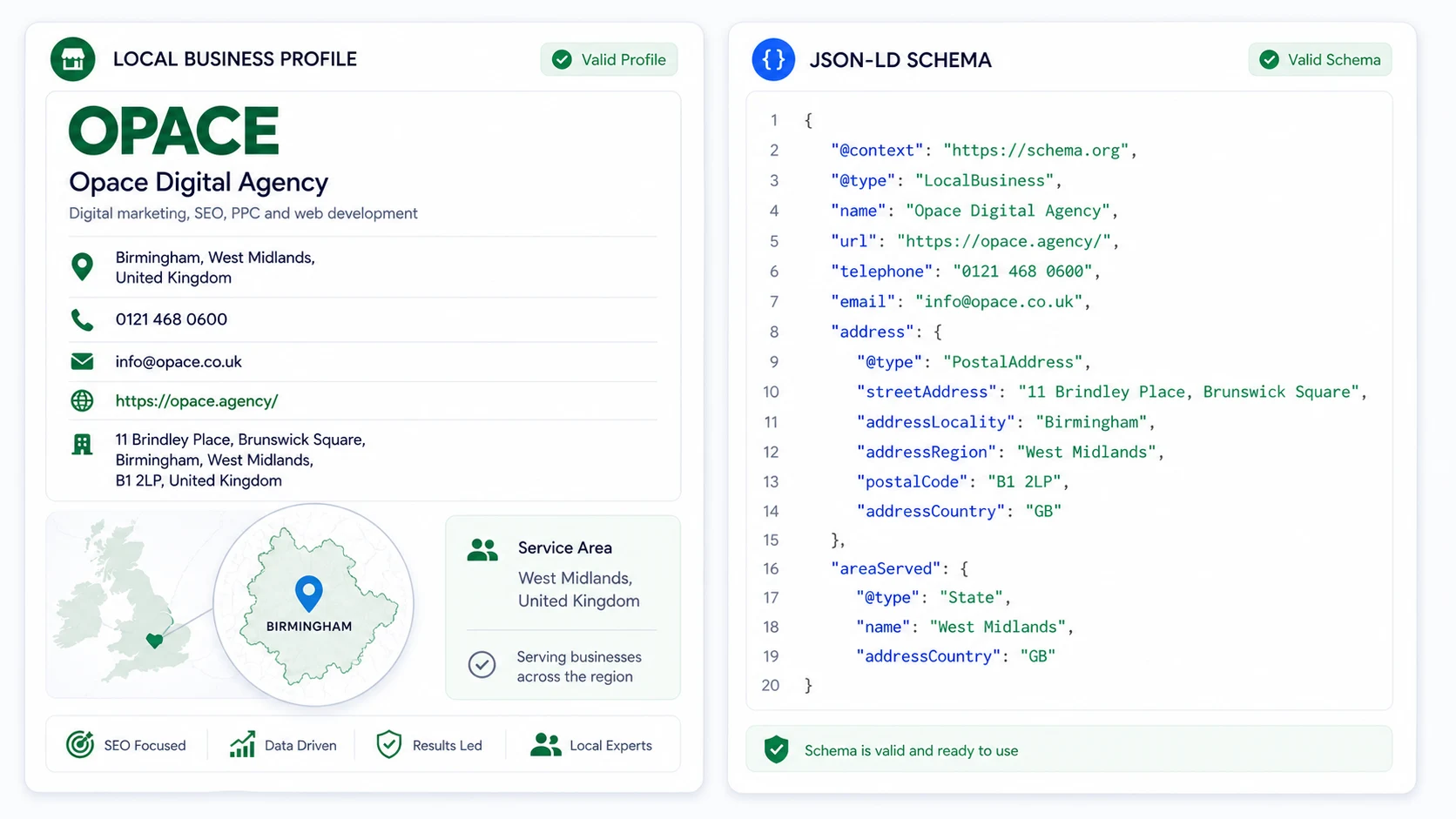 LocalBusiness schema can clarify business identity, location, contact details and service area.
JSON-LD Example for an eCommerce Product
Here is a simplified Product schema example for a fictional smart-home product. It uses a different entity from the LocalBusiness example above because service pages, local pages and product pages need different structured data.
{
  "@context": "https://schema.org/",
  "@type": "Product",
  "name": "AI-Ready Home Energy Monitor",
  "image": ["https://example.com/images/ai-home-energy-monitor.jpg"],
  "description": "A smart home energy monitor that tracks household usage, highlights appliance-level trends and supports app-based alerts.",
  "sku": "HEM-AI-100",
  "gtin13": "5012345678900",
  "brand": {
    "@type": "Brand",
    "name": "GridBright"
  },
  "offers": {
    "@type": "Offer",
    "url": "https://example.com/ai-ready-home-energy-monitor",
    "priceCurrency": "GBP",
    "price": "129.00",
    "availability": "https://schema.org/InStock",
    "itemCondition": "https://schema.org/NewCondition"
  },
  "aggregateRating": {
    "@type": "AggregateRating",
    "ratingValue": "4.8",
    "reviewCount": "89"
  }
}
Only include ratings and reviews if they are genuine, visible and relevant to the product. Do not copy placeholder examples into production without replacing identifiers, images, URLs and prices.
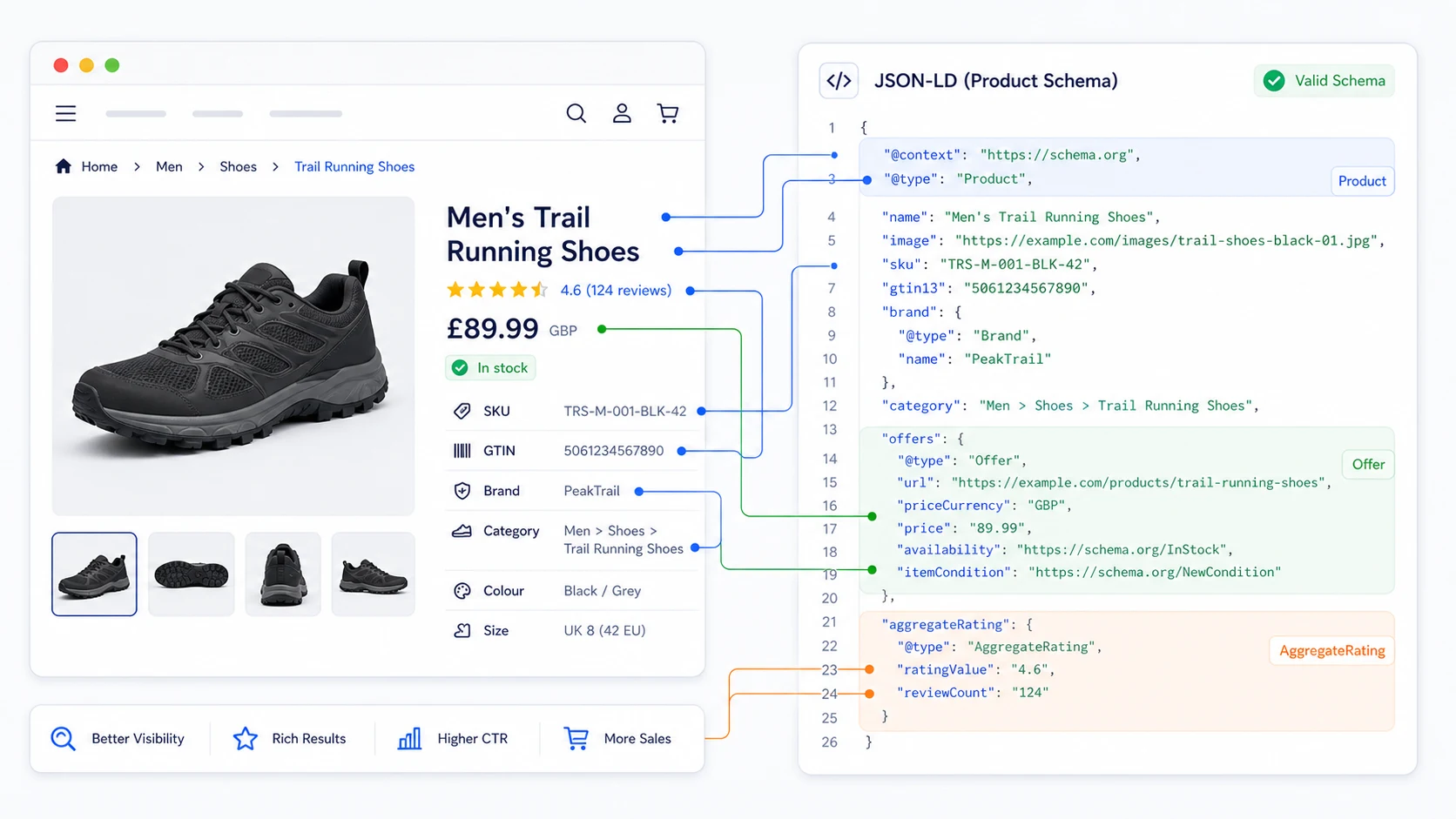 Product schema connects visible product details to machine-readable facts for search and shopping features.
Product Schema for Variants: Size, Colour and Material
Variant handling is one of the most misunderstood areas of eCommerce schema markup, and it becomes even more important as search moves towards visual search, AI-assisted shopping and more personalised product discovery.
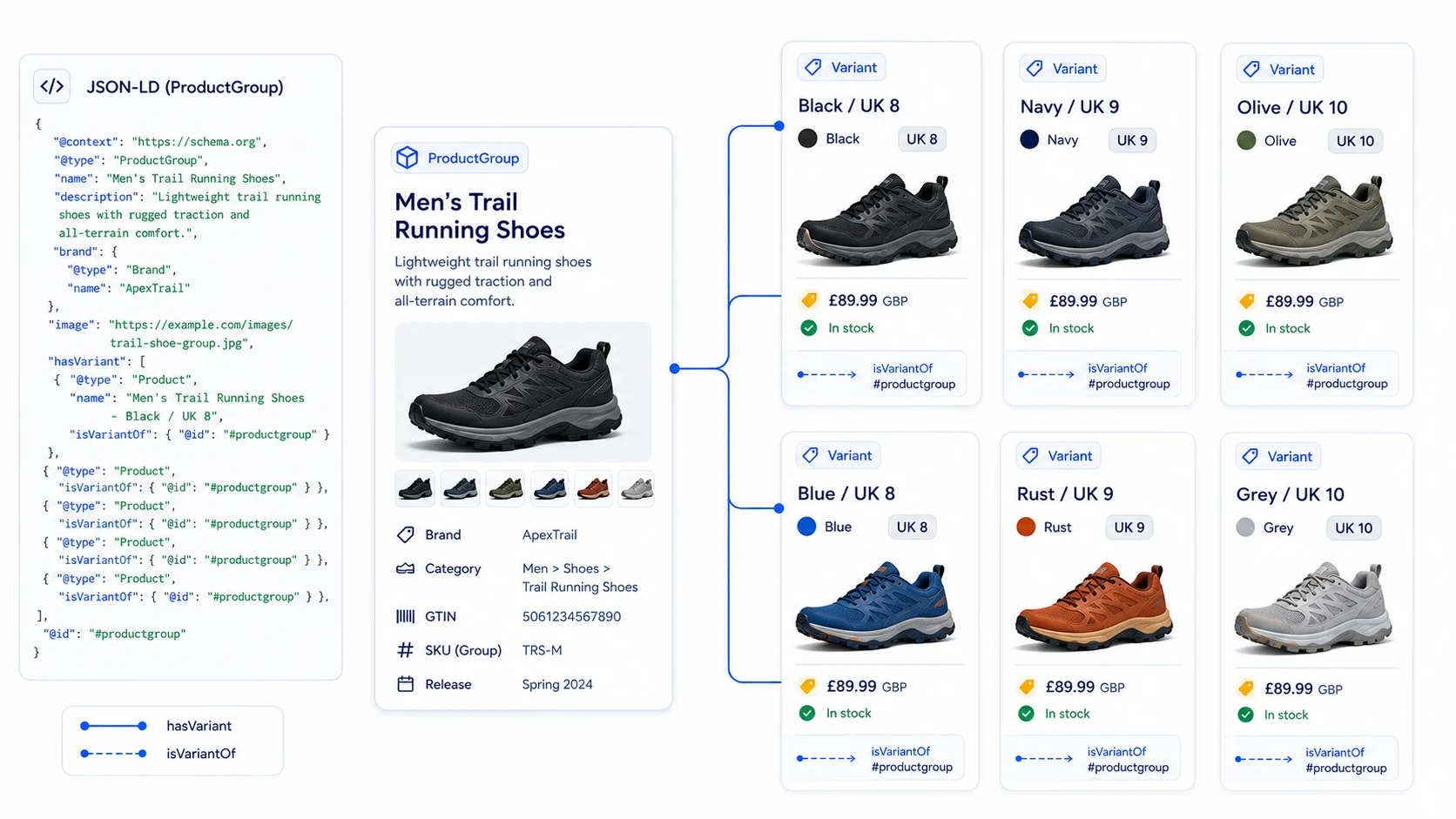 ProductGroup schema helps search engines understand how variants relate to a parent product.
A single parent product may vary by:
- Finish, colour or material
- Pack size or bundle contents
- Installation type or compatibility
- Subscription, warranty or support level
- Region, currency or market availability
- Model year or technical specification
- Variant-specific images, prices and stock levels
- Reviews or ratings tied to a particular option
If each option is marked up as a completely separate product, search engines may miss the parent-child relationship. If all options are forced into one parent page but the real differences are hidden from users or crawlers, important commercial details can also be lost.
ProductGroup schema can help define these relationships.
One URL with Selectable Variants
Some stores use one product URL where users choose the option they need, such as colour, finish, bundle size, licence tier or compatible model.
This can work well when:
- The available options are visible and easy for users to understand.
- The structured data reflects the selected, default or available option accurately.
- JavaScript does not obscure important variant details from crawlers.
- Price, stock and image changes are reflected consistently.
- Canonical tags support the preferred URL strategy.
- ProductGroup relationships are clear where relevant.
The main risk is stale markup. If the visible page changes after a user selects an option but the JSON-LD remains fixed, the structured data may describe the wrong price, image, availability or variant.
Separate URLs for Each Variant
Other sites create separate URLs for individual variants.
This can work when:
- Specific variants have their own search demand.
- Each URL provides useful, indexable information.
- Canonicals are chosen deliberately rather than left to chance.
- Similar pages are differentiated enough to justify separate indexing.
- Each option links back to the parent ProductGroup.
- Price, stock, images and identifiers are accurate for that exact variant.
This approach can suit products where users search for a precise model, finish, compatibility type or specification. A single consolidated URL may be better when variants are simple, search demand is low, or the CMS cannot keep separate pages accurate.
There is no universal best answer. The right approach depends on catalogue size, search demand, stock behaviour, CMS capability and how users shop.
Schema for Category Pages and Product Listing Pages
Category pages should not be treated like product detail pages.
A category, collection or listing page may include many products, but the page itself is usually a collection rather than one Product. Marking the whole category as a single product can create structured data conflicts and make the markup less trustworthy.
Better schema choices for category pages often include:
- BreadcrumbList for hierarchy
- ItemList where the listed items are meaningful
- CollectionPage where the page acts as a curated collection
- Organization sitewide for the business entity
- WebSite sitewide for the wider site identity
Schema supports category SEO, but it does not replace it. Strong category pages still need:
- Crawlable links to key products or subcategories
- Helpful copy that explains the range
- A clear taxonomy that matches user intent
- Useful filters that do not create crawl traps
- Sensible canonical tags
- Internal links to supporting guides or services
- Fast loading templates
- A reason to exist beyond a grid of items
For example, a “smart home security” category page should help users compare cameras, sensors, subscriptions and installation options. BreadcrumbList schema can clarify where the page sits in the site, while ItemList can describe the visible list. The visible page still needs enough useful content for users and AI systems to understand the choice being presented.
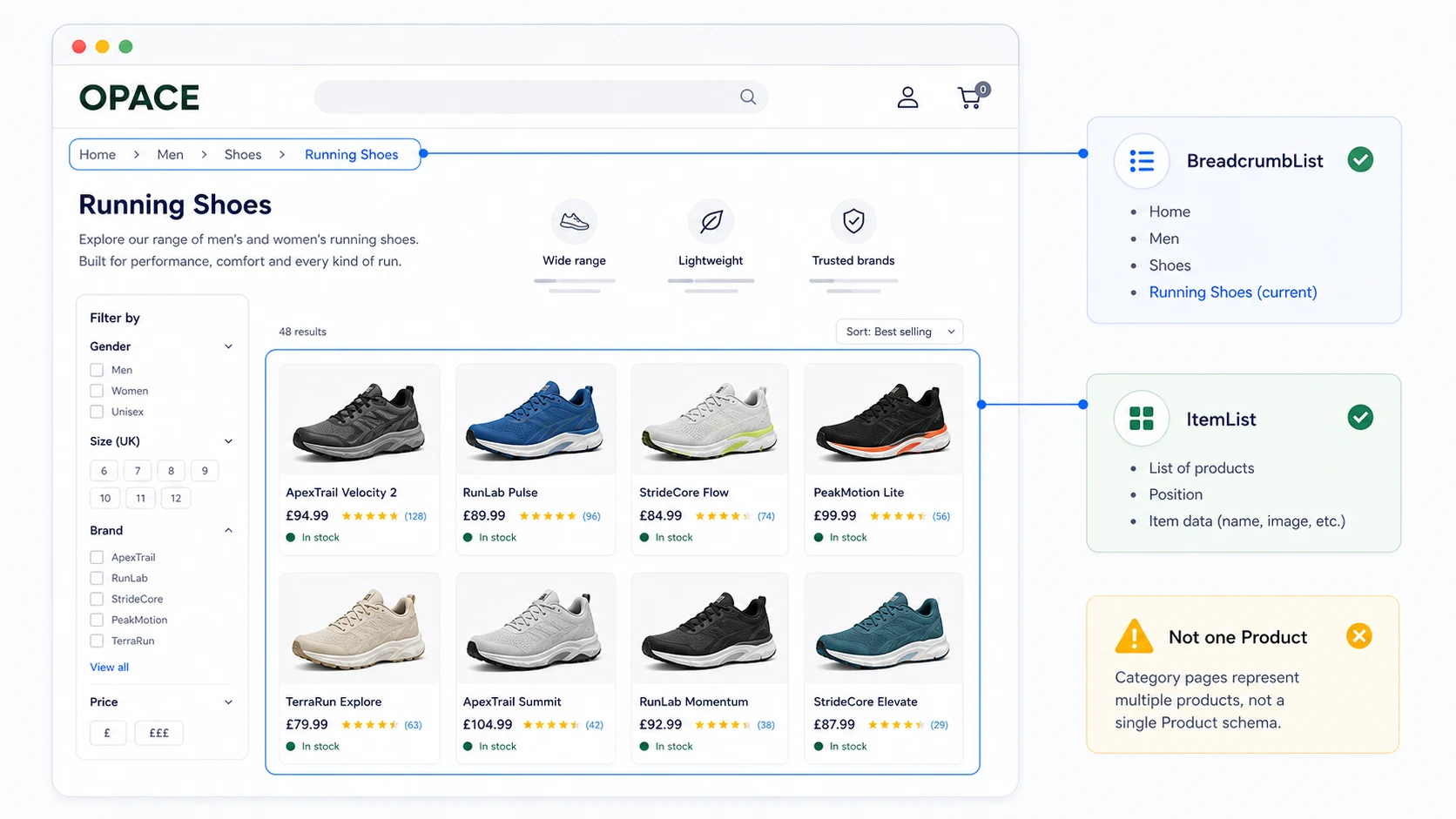 Category pages can use schema for hierarchy and list structure, but they are not usually a single Product.
Implementing Schema in WordPress, Shopify and Custom Websites
The best implementation method depends on your platform, technical setup and complexity.
WordPress and WooCommerce
WordPress sites often rely on plugins such as Yoast SEO, Rank Math, Schema Pro, WooCommerce extensions or review tools to create schema automatically.
This can work well for:
- Standard posts and pages
- Basic publisher or Organization markup
- Breadcrumb output
- Simple product templates
- Local business information
- Author and article details
However, WooCommerce stores often need extra attention for:
- Variant data and parent-child product relationships
- Missing product identifiers such as GTINs or MPNs
- Brand fields stored in custom attributes
- Review plugins adding their own markup
- Themes and plugins creating duplicate entities
- Shipping and returns data
- Custom product attributes that matter to buyers
A common WordPress problem is schema being generated from several places at once. A theme, SEO plugin, WooCommerce extension and review plugin can all describe the same page differently, which may leave search engines with conflicting Product, Article or Organization entities.
Shopify
Shopify themes often include product structured data by default, and apps may add more schema for reviews, feeds, bundles or merchant details.
Check Shopify implementations for:
- More than one Product entity describing the same item
- Missing or inconsistent brand data
- Missing GTIN, MPN or SKU values
- Variant markup that does not match the selected option
- Differences between the product feed and on-page schema
- Review app markup that does not match visible reviews
- Shipping and return policy gaps
- Theme updates that quietly change JSON-LD output
Shopify stores should be audited after theme updates, app changes and major product template changes. Structured data is not always visible on the front end, so problems can persist unnoticed.
Custom and Next.js Websites
Custom and headless websites need a more deliberate schema strategy because the markup is often built directly into templates, components or server-side data pipelines.
Good practice includes:
- Generating JSON-LD server-side where possible.
- Using the same data source for visible content and schema.
- Keeping price, availability and product identifiers aligned with inventory systems.
- Building reusable schema components for each template type.
- Testing structured data during development, staging and live deployment.
- Avoiding stale client-only schema where commercial details change quickly.
Next.js websites can implement excellent structured data, but care is needed when pages use client-side rendering, incremental static regeneration or multiple data sources. If product data changes frequently, the schema generation process must stay in sync.
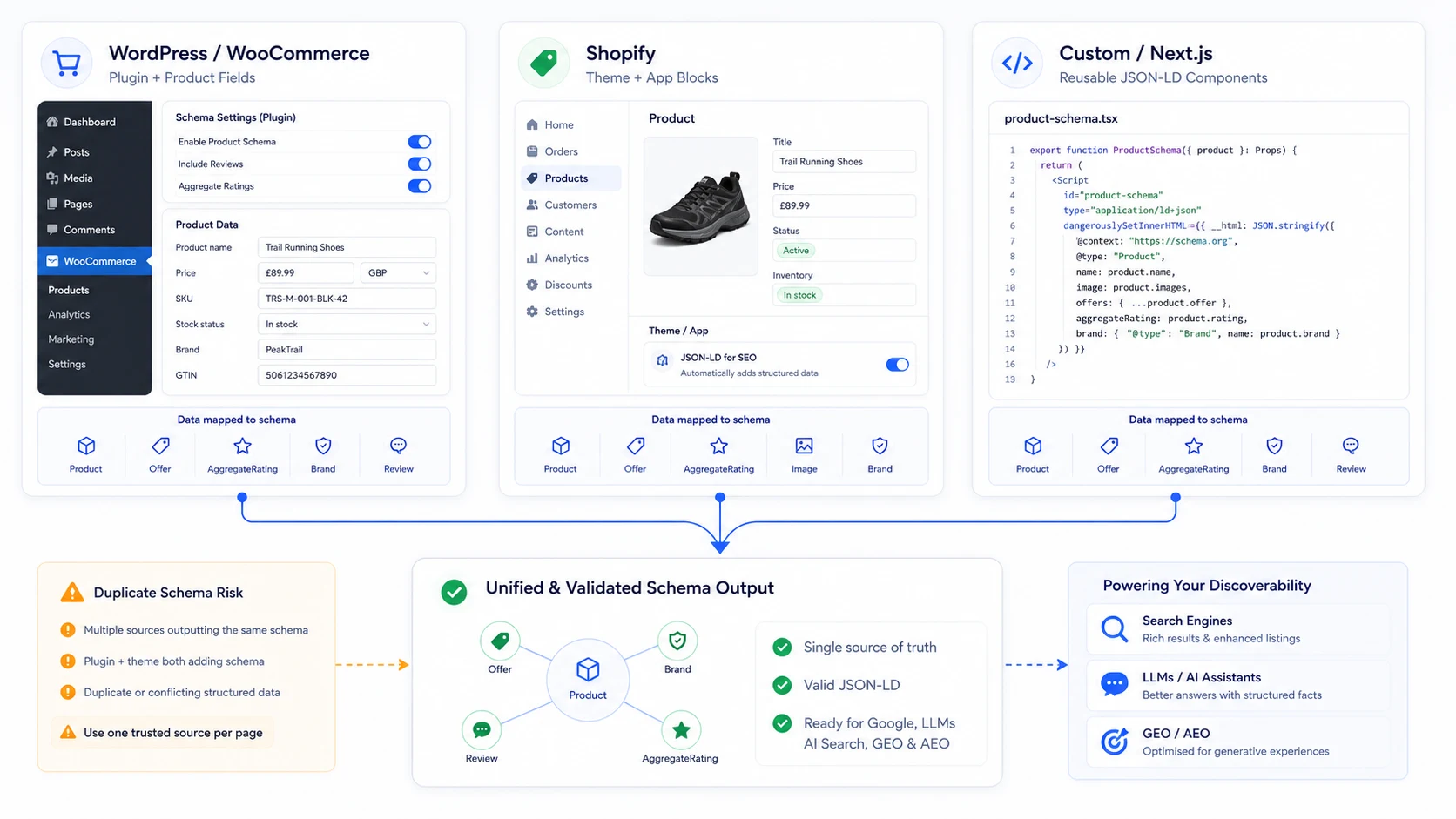 Different platforms can generate schema differently, so templates, plugins, apps and code should be audited together.
How to Test and Validate Your Structured Data
Writing schema code is only the first step. Testing is essential because a page can contain valid JSON-LD syntax while still failing rich result requirements, using the wrong entity type or describing information that does not match the visible page.
The most important tools are:
- Google Rich Results Test
- Schema Markup Validator
- Google Search Console URL Inspection
- Search Console enhancement reports
- Merchant Center diagnostics for eCommerce products
A sensible testing workflow is:
- Choose representative URLs from each important template.
- Map each page to the schema type that genuinely fits the content.
- Add the required fields for the relevant Google feature.
- Add recommended fields where the information is accurate and useful.
- Compare the structured data against the visible page.
- Test live URLs where possible, not only copied code snippets.
- Use raw-code testing for pages that are still in development.
- Fix errors before launch.
- Review warnings and decide whether the missing data can be added responsibly.
- Inspect the live URL in Search Console after deployment.
- Monitor enhancement reports after Google has recrawled the page.
Errors are critical issues that can prevent eligibility. Warnings usually mean recommended fields are missing. Warnings may not break the schema, but they often highlight opportunities to provide richer information.
Regular testing should be part of ongoing SEO analysis, especially after template changes, CMS updates, app installations or product feed changes.
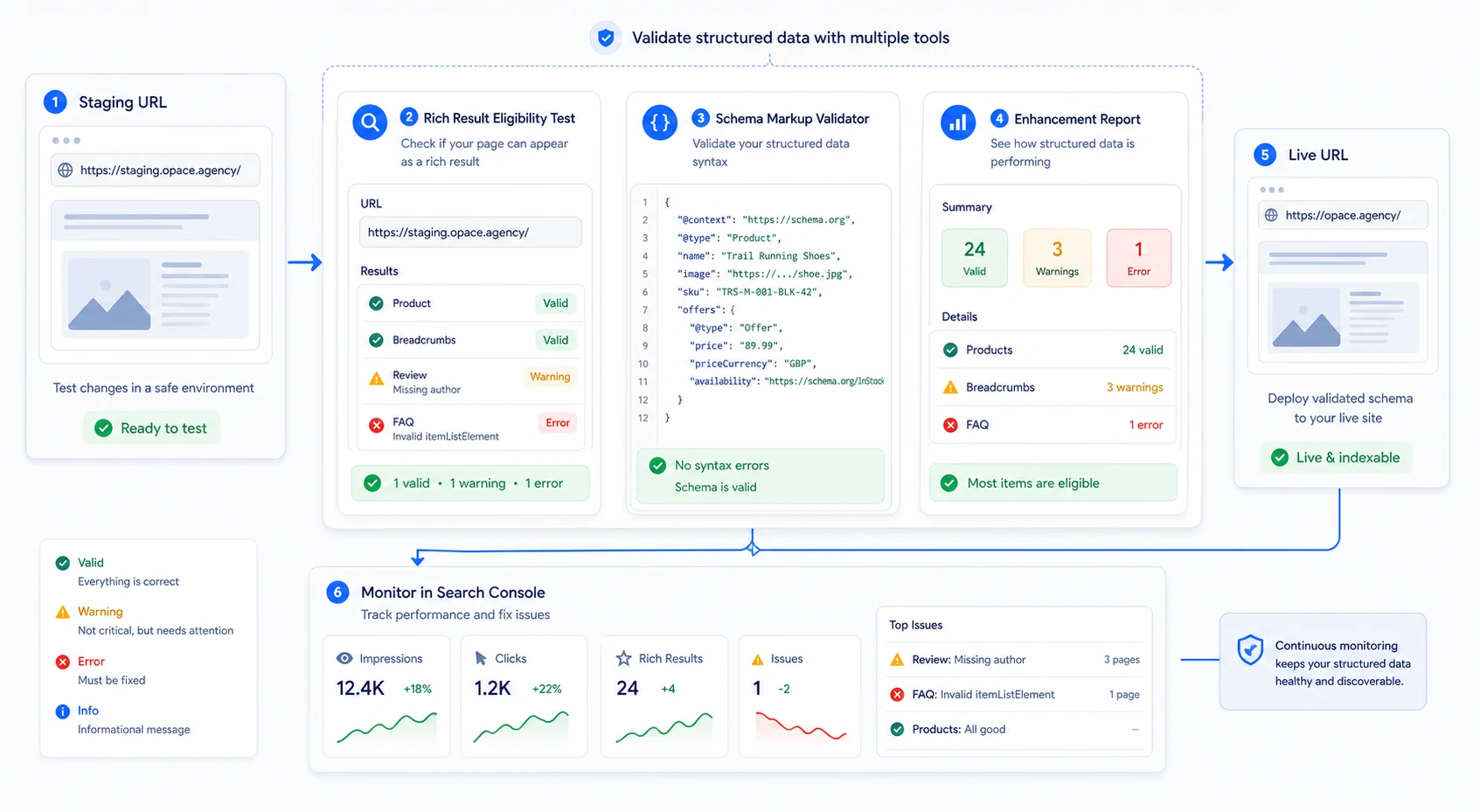 Schema testing should happen before launch and again after the live URL has been indexed and rendered.
Common Schema Markup Mistakes to Avoid
Marking Up Hidden Content
Structured data should reflect what users can see or what is genuinely part of the page experience. Hidden reviews, invisible FAQs, unavailable product details or unsupported claims should not be added simply because they are useful to search engines.
Using the Wrong Schema Type
Choose the schema type that matches the main purpose of the page. A product detail page, service page, blog post, local landing page and category page all communicate different things, so they should not all use the same markup pattern.
Adding Fake Reviews or Ratings
Review markup should reflect genuine, visible reviews. Fake star ratings, selective ratings or reviews that are not clearly tied to the item on the page can damage trust and may make the markup ineligible.
Incorrect Price or Availability
For eCommerce sites, this is one of the most serious issues. The schema, visible page and product feed should agree on price, currency, stock status and condition.
Duplicate Schema from Plugins or Apps
Themes, plugins and apps can all output schema. Multiple schema blocks are not automatically a problem, but conflicting entities, URLs, prices, ratings or organisation details can create confusion. Audit the rendered page, not just the CMS settings.
Missing Required Properties
If required properties are missing, a page may not be eligible for rich results. Product markup without the commercial details needed for merchant features, or Article markup without basic publisher and date information, may be incomplete.
Overusing Schema Types
More schema is not always better. Use accurate, specific schema rather than adding every possible type to every page or marking up minor page elements that do not represent the main content.
Relying on JavaScript for Critical Product Data
Google can process JavaScript, but critical product data that changes after page load can be risky. Prices, stock levels, variants and review counts should be available in a reliable way, especially where the data changes frequently.
Treating FAQ Schema as a Guaranteed SERP Tactic
FAQ rich results are no longer a dependable visibility tactic. Use FAQs because they help users, clarify the topic and support answer-led content, not because you expect extra SERP space.
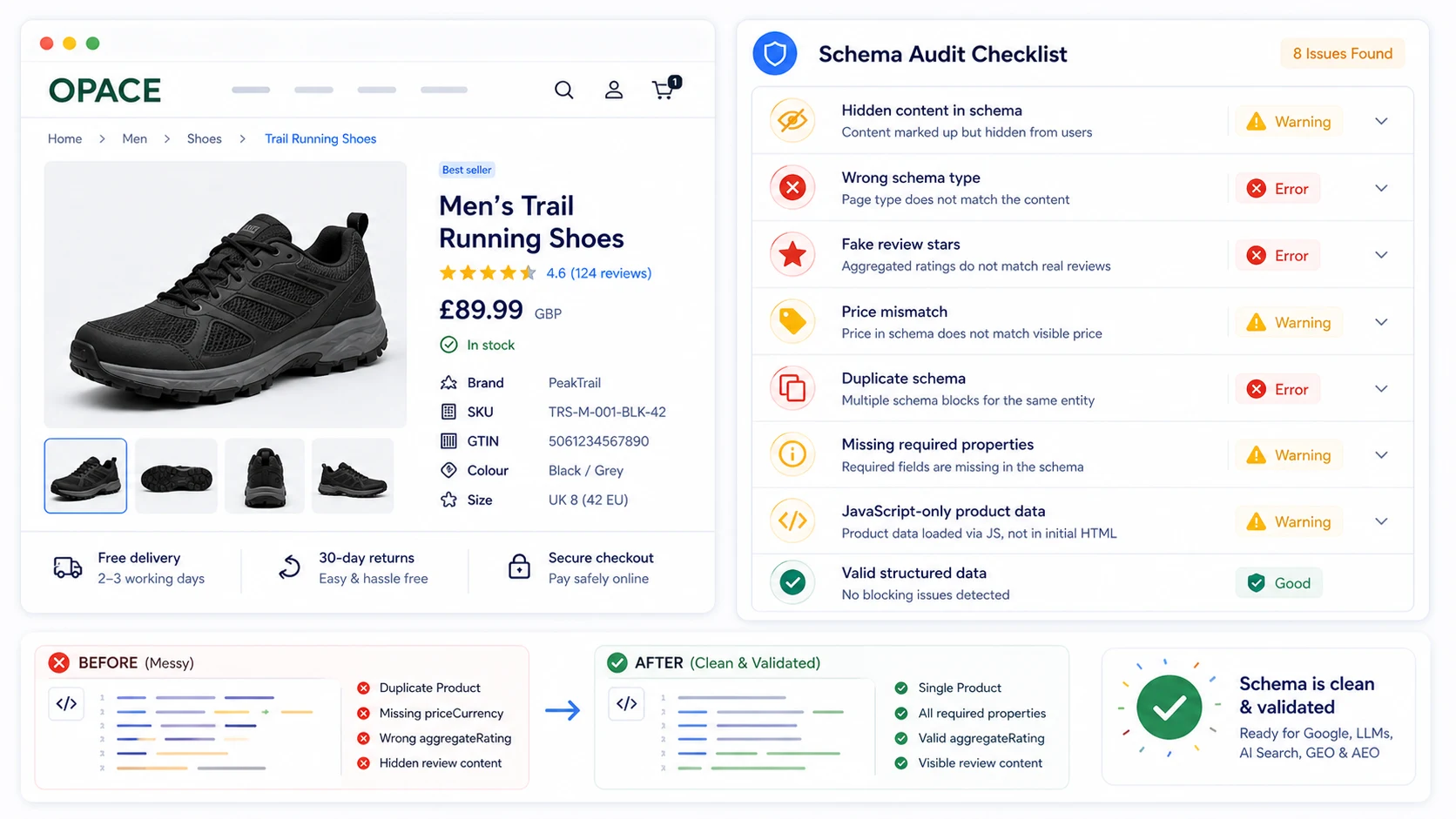 Technically valid schema can still be misleading if it does not match the visible page.
How to Measure the SEO Impact of Structured Data
Structured data should be measured against SEO and business outcomes, not just validation scores. Passing a test is useful, but the real question is whether search engines and AI-led systems can understand the page more clearly.
Useful metrics include:
- Rich result eligibility
- Valid structured data items
- Invalid structured data items
- Product snippet reports
- Merchant listing reports
- Impressions
- Clicks
- CTR
- Average position
- Organic revenue
- Assisted conversions
- Product landing page performance
- Local search interactions
- Leads or enquiries from service pages
- Branded visibility in answer-led search journeys where measurable
Google recommends comparing pages with and without structured data over time using Search Console performance data. This is more useful than assuming every schema change will immediately improve traffic.
For eCommerce, measure at the template level where possible because one product schema fix may affect hundreds or thousands of URLs. For service businesses and publishers, compare important landing pages, guides or local pages before and after the schema has been improved.
A practical measurement plan might include:
- Choose a group of stable pages or templates.
- Record baseline Search Console, analytics and conversion data.
- Add or improve schema markup.
- Validate the implementation.
- Allow time for recrawling and reporting.
- Compare performance over several weeks or months.
- Separate schema impact from seasonality, promotions, content changes and ranking volatility.
Structured data often has its clearest value when it improves eligibility, visibility and confidence across a large number of pages.
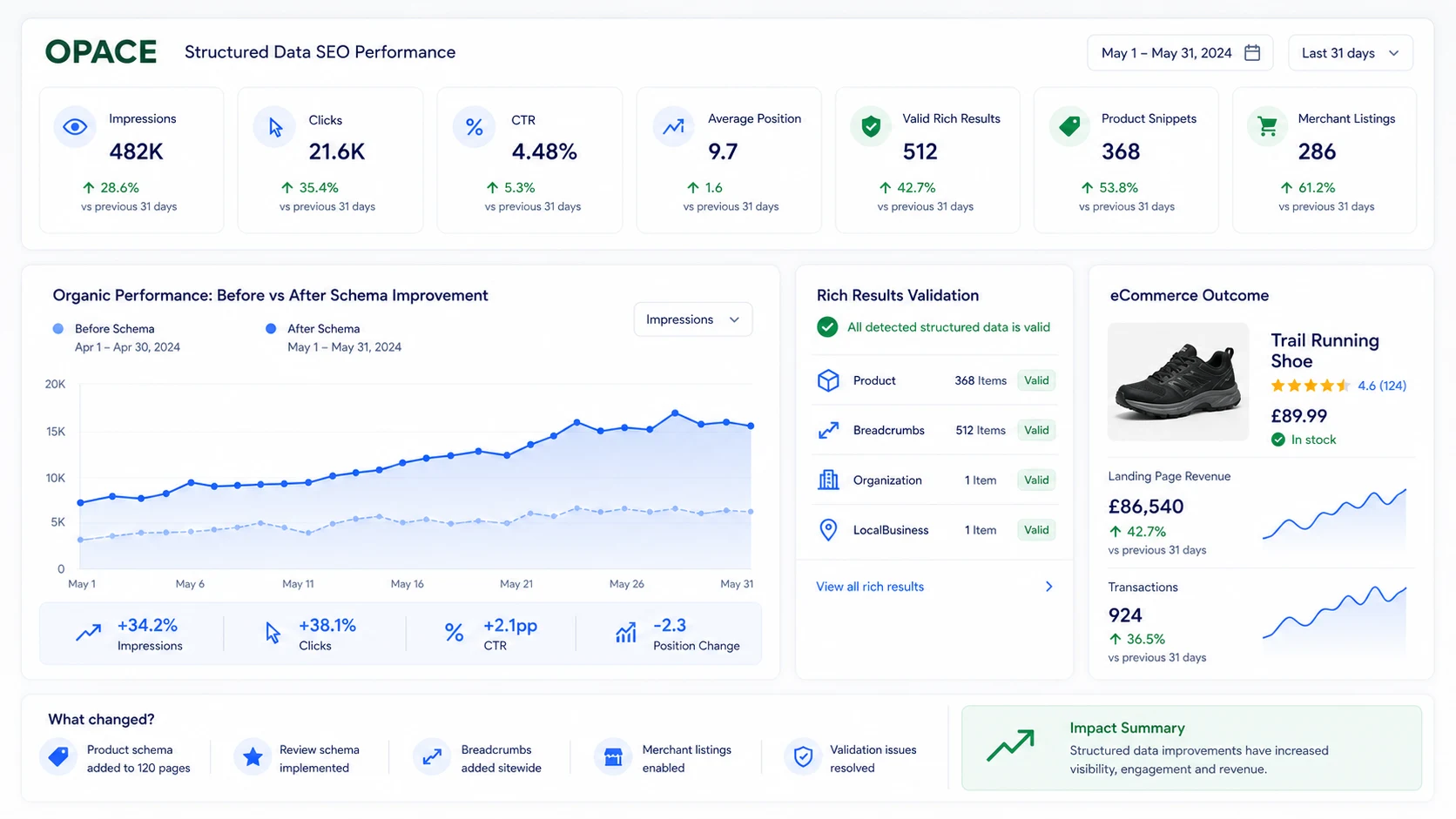 Structured data should be monitored through eligibility, Search Console performance and business outcomes.
Is Structured Data and Schema for SEO the Magic Answer?
Structured data is powerful, but it should never be treated as the whole SEO strategy. For schema to deliver meaningful results, it needs to sit alongside strong SEO services, clean technical SEO, specialist AI SEO capabilities, well-optimised content, fast page templates, crawlable navigation, logical site architecture and trustworthy brand signals. AI search makes these fundamentals even more important because LLMs, AI Overviews and answer engines need more than isolated schema fields; they need clear content, consistent entities, useful explanations, author credibility, external validation and pages that genuinely satisfy search intent.
For eCommerce websites, this means combining schema with strong eCommerce SEO, optimised product and category pages, accurate feeds, useful buying guides, reviews, internal links and conversion-focused design. For service businesses, it means pairing schema with local SEO, clear service pages, location relevance, real reviews, Google Business Profile optimisation and consistent business information across the web. For content-led SEO, it means investing in on-page SEO, original expertise, answer-led formatting and content that AI systems are more likely to understand, trust and cite. As covered in our guide to AI search engines and GEO, the future of SEO is not just about being crawlable; it is about being understandable, useful and credible wherever users search.
The best approach is to combine structured data with:
- Helpful, original content
- Clear product information
- Strong internal linking
- Consistent brand details
- Accurate business profiles
- Real reviews
- Crawlable pages
- Authoritative external mentions
- Clean technical SEO
Think of schema as a foundational clarity layer.
Recommended Schema by Page Type
| Page type | Recommended schema | Main purpose |
|---|---|---|
| Homepage | Organization, WebSite, SearchAction | Brand and site identity |
| Service page | Service, Organization, BreadcrumbList | Service clarity |
| Local landing page | LocalBusiness, Service, BreadcrumbList | Local entity signals |
| Product page | Product, Offer, AggregateRating, Review, BreadcrumbList | Product visibility |
| Variant product page | ProductGroup, Product, Offer | Variant clarity |
| Category page | BreadcrumbList, ItemList, CollectionPage | Hierarchy and list clarity |
| Blog article | BlogPosting or Article, BreadcrumbList | Editorial understanding |
| Review guide | Article, Product, Review where valid | Editorial product information |
| About page | Organization, Person where relevant | Entity trust |
| Contact page | Organization, LocalBusiness | Contact and location clarity |
| FAQ/help page | FAQPage only where useful | User support, not guaranteed rich results |
Final Structured Data Checklist
Before deploying schema across a site, check:
- Does the schema type match the page type?
- Is every marked-up fact visible or genuinely valid for the page?
- Are required fields included?
- Are useful recommended fields included?
- Is JSON-LD valid?
- Does the visible page match the structured data?
- Are product prices accurate?
- Is availability accurate?
- Are product identifiers correct?
- Are reviews genuine and visible?
- Are images crawlable?
- Are there duplicate schema blocks?
- Are plugins, themes or apps creating conflicts?
- Has the page passed the Rich Results Test?
- Has the code passed Schema Markup Validator?
- Has the live URL been inspected in Search Console?
- Are enhancement reports monitored after launch?
Structured data works best when it is treated as part of technical SEO maintenance rather than a one-off task.
Frequently Asked Questions
What is structured data in SEO?
Structured data is organised, machine-readable information added to a web page to help search engines understand the page content. In SEO, it is commonly used to describe products, reviews, articles, organisations, local businesses, events and other entities.
What is schema markup?
Schema markup is the code used to add structured data to a website. It normally uses the Schema.org vocabulary and is most commonly implemented in JSON-LD format.
What is the difference between structured data and schema markup?
Structured data is the organised information. Schema markup is the code that communicates that information to search engines. Schema.org provides the vocabulary, and JSON-LD is the common format used to publish it.
Does schema markup improve rankings?
Schema markup is not a direct ranking shortcut. It can help search engines understand pages, qualify eligible pages for rich results, improve search appearance and support click-through rate, but it will not replace strong content, authority or technical SEO.
What are rich results?
Rich results are enhanced search listings that show extra information beyond a standard title and description. Examples include ratings, prices, availability, breadcrumbs, images, event dates and other visual enhancements.
What is the best schema format for SEO?
JSON-LD is generally the best format for SEO because Google recommends it where possible and it is easier to implement, maintain and validate than Microdata or RDFa.
Which schema types are most important?
The most important schema types depend on the site. Common SEO schema types include Organization, LocalBusiness, Product, Offer, Review, AggregateRating, BreadcrumbList, Article, BlogPosting, WebSite, SearchAction, ProductGroup and ItemList.
Is FAQ schema still worth using?
FAQ content can still help users, but FAQ rich results are no longer a reliable SEO tactic in Google Search. Use FAQs where they improve the page, not simply to chase extra SERP space.
Should every page have schema markup?
Most important indexable pages should have relevant schema, but not every page needs complex markup. Use schema that accurately describes the page. Avoid adding irrelevant schema just because it exists.
How do you test schema markup?
Use Google’s Rich Results Test to check eligibility for Google-supported rich results, Schema Markup Validator to check broader Schema.org validity, and Google Search Console to monitor live URL indexing and enhancement reports.
Can schema markup help with AI search?
Yes. Schema markup can help AI systems understand entities, relationships and facts more clearly. It does not guarantee AI Overview inclusion or chatbot citations, but it supports clearer machine interpretation.
What is Product schema?
Product schema describes an individual product. It can include name, description, image, brand, SKU, GTIN, offers, price, availability, condition, reviews and ratings.
What is Offer schema?
Offer schema describes the commercial offer attached to a product or service. For eCommerce, this usually means price, currency, availability, URL and condition.
What is ProductGroup schema?
ProductGroup schema describes a parent product with multiple variants, such as different colours, sizes or materials. It helps search engines understand that the variants belong together.
Can schema markup be wrong even if it validates?
Yes. A schema block can be technically valid but still misleading, incomplete or unsuitable for rich results. Validation checks syntax and required fields; it does not guarantee that the markup accurately represents the page or will display in search results.
Key Takeaways
Using structured data for SEO is one of the clearest ways to help search engines and AI systems understand your website. It labels important information such as products, prices, reviews, organisations, authors, local business details and page hierarchy.
Schema markup will not replace content quality, authority, technical performance or user experience. However, it can improve eligibility for rich results, strengthen entity understanding, support eCommerce product visibility and make technical SEO reporting easier.
For most websites, the best starting point is simple: use JSON-LD, choose the correct schema type for each page, keep the data accurate, validate everything, and monitor Search Console after deployment.
For eCommerce sites, structured data deserves even more attention. Product, Offer, Review, AggregateRating, ProductGroup, BreadcrumbList and Organization schema can all contribute to clearer product visibility across search and shopping surfaces.
There are many layers to search engine optimisation, and we can’t cover them all here, but applying schema for SEO is one of the most important foundational activities for improving clarity, eligibility and visibility in modern search.