UX Research Agency
Build Better Digital Products WITH
UX Research - Real Users, Real Insights, Better Products.
Test With Users. Build With Confidence.
UX Research Agency Birmingham
Opinions Are Cheap — User Evidence Is Priceless
Every redesign meeting has someone who says "I think users would prefer..." and someone else who disagrees. Without user research, these debates never resolve. The loudest voice wins, the design proceeds based on assumptions, and six months later the new product underperforms because it was built for stakeholders, not users. Our UX research agency removes the guesswork. We test with real users, observe real behaviour, identify real problems and deliver evidence-based recommendations that your team can act on with confidence.
Based in Birmingham and working with clients across the UK and internationally, we provide user testing services for websites, web applications, mobile apps and digital products at every stage: pre-design discovery, prototype testing, pre-launch validation and post-launch optimisation. Forrester Research estimates that every £1 invested in UX returns £100 in value, a finding that reflects how significantly poor usability suppresses conversion rates and increases support costs. We use specialist research platforms including Maze and Optimal Workshop for unmoderated studies, Lookback for moderated remote sessions, and Hotjar for heatmaps and session recordings. Our research methods include moderated and unmoderated usability testing, user interviews, card sorting, tree testing, heuristic evaluation, competitive analysis and journey mapping. Each method answers different questions, and we select the right combination based on what you need to learn. Whether you're building something new or improving something existing, our research provides the user evidence that separates good digital products from expensive assumptions.
experience
Quick Navigation


STRATEGY WITHOUT
EXECUTION IS JUST NOISE
What our UX research services include
- Usability testingReal users completing real tasks on your website or product while we observe. We identify where they struggle, what confuses them, what they expect but don't find and what works well. Both moderated and unmoderated formats.
- User interviewsIn-depth conversations with your target users to understand their needs, motivations, pain points and decision-making processes. Interviews inform personas, user stories and design requirements.
- Card sorting and tree testingTesting your information architecture with real users. Card sorting reveals how users categorise content. Tree testing validates whether your navigation structure helps users find what they're looking for.
- Prototype testingTesting designs before development starts. Interactive prototypes are tested with users to validate concepts, identify usability issues and refine designs before committing to code.
- Competitive UX analysisEvaluating competitor products through a UX lens: what they do well, where their experience fails and where opportunities exist for differentiation.
- Heuristic evaluationExpert review of your product against established usability principles such as Nielsen's 10 heuristics. Faster and less costly than full user testing, heuristic reviews identify obvious usability issues and are an effective first-pass audit before committing to participant recruitment.
- Journey mappingDocumenting the complete user journey from first awareness through to conversion and beyond. Maps identify friction points, emotional highs and lows, and opportunities for improvement at each touchpoint.
- Quantitative analysis and analytics reviewExamining behavioural data from Google Analytics, Hotjar or equivalent tools to identify drop-off points, high-exit pages and underperforming funnels. This adds statistical weight to the qualitative findings from testing and interviews.
- Accessibility assessmentChecking your product against WCAG 2.1 guidelines to identify barriers for users with visual, motor or cognitive impairments. Accessible design consistently improves usability for all users, not just those who need additional support.
TECHNOLOGIES & PLATFORMS
Digital Experience












Usability testing that reveals what analytics can't
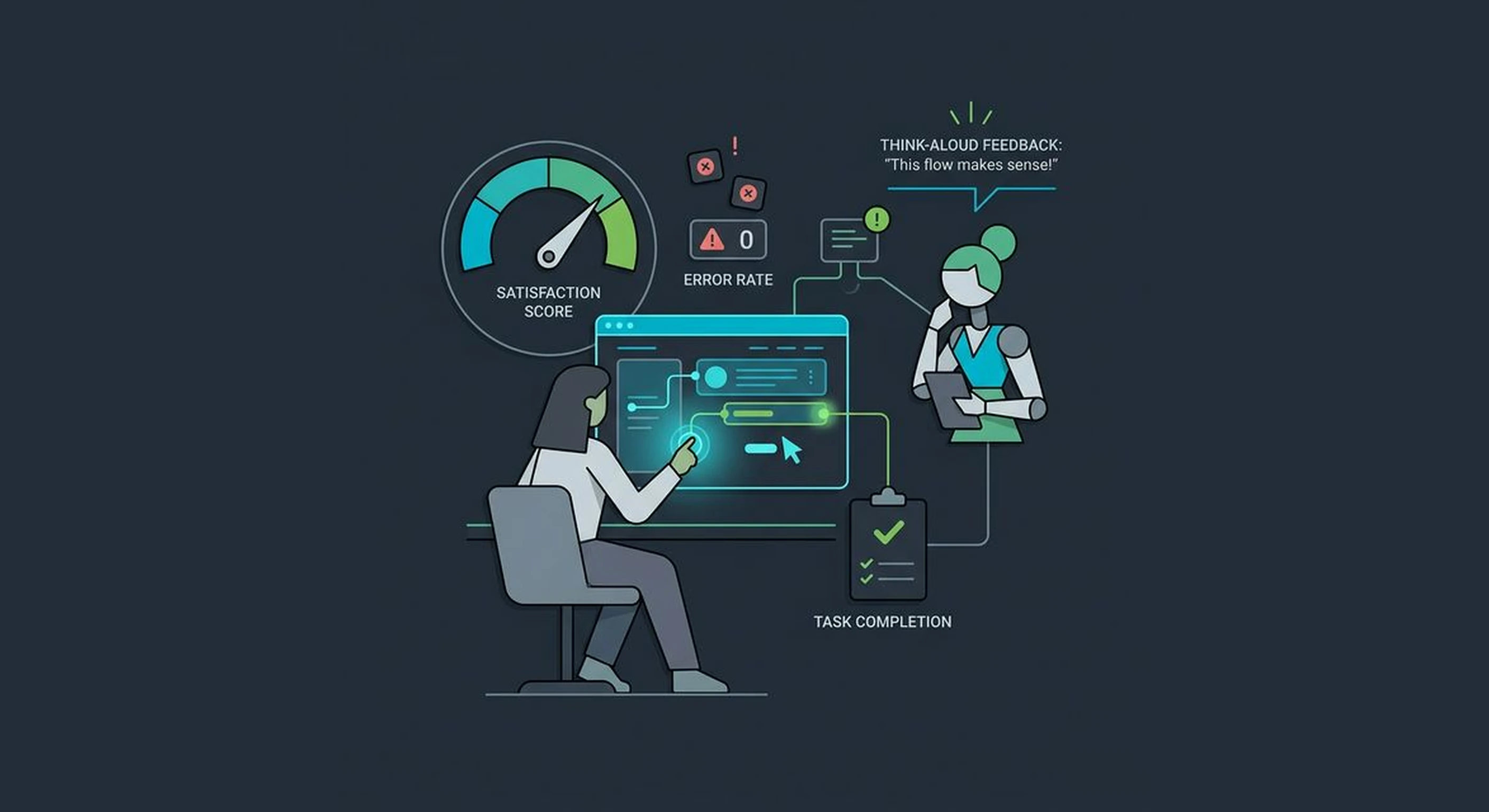
Analytics tell you what happened. Usability testing tells you why. You can see in Google Analytics that 60% of users abandon a form at step three, but you can't see why. Is the question confusing? Is the form too long? Did they get an error they couldn't resolve? Do they not trust the page enough to submit personal information? Usability testing answers these questions by putting real users in front of the real product and watching what happens.
We run usability tests with 5-8 participants per round, which research consistently shows is sufficient to identify 80-85% of usability issues. Each test session is recorded (with participant consent) and analysed for patterns. Our findings are delivered as prioritised recommendations: critical issues that must be fixed, important improvements that should be addressed and minor refinements that would be nice to have. This prioritisation helps development teams focus on changes that will have the greatest impact on user experience and conversion rates. For clients running ongoing conversion rate optimisation services, usability testing provides the qualitative insights that inform hypothesis creation for A/B testing services.

Research that feeds directly into design and development
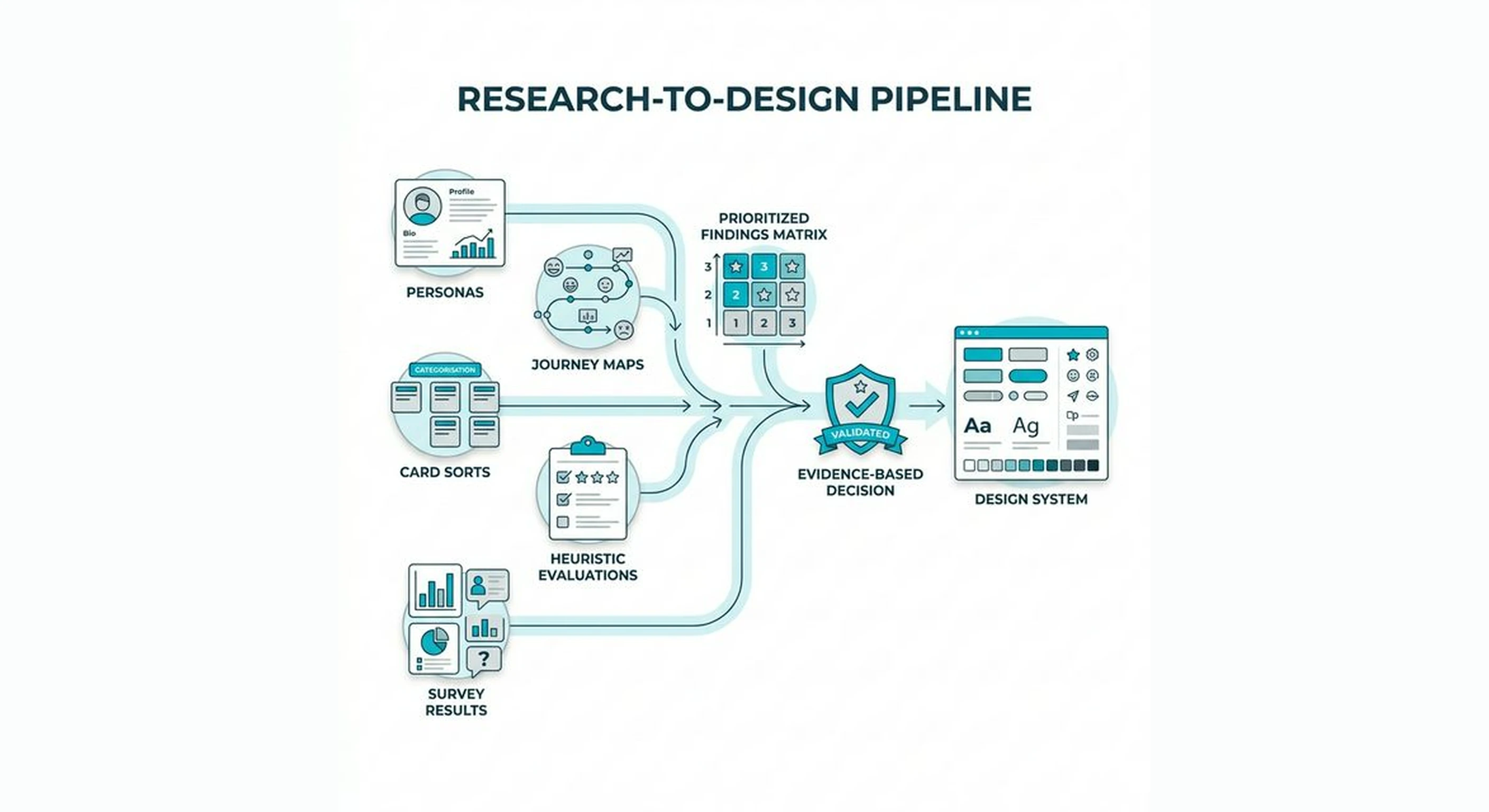
Research is only valuable when it translates into action. We've seen organisations commission expensive research studies that produce 100-page reports which sit unread on shared drives. Our deliverables are designed for action: findings are prioritised by impact, recommendations are specific and implementable, and we present results in formats that design and development teams can work from immediately.
For pre-design research, we deliver personas, journey maps, user requirements and design principles that guide the product direction. For usability studies, we deliver video clips of key issues, prioritised issue lists and specific design recommendations. For architecture research (card sorts and tree tests), we deliver validated navigation structures and content groupings. These outputs are designed to be referenced daily during design and development sprints, not filed away after a presentation. Our user behaviour analysis services complement research with ongoing quantitative data, giving teams both the "what" and the "why" they need to make informed product decisions.
Sectors
We've Engineered Growth
Across Every Sector.
From bootstrap to boardroom, we've seen it all. And we make growth inevitable.
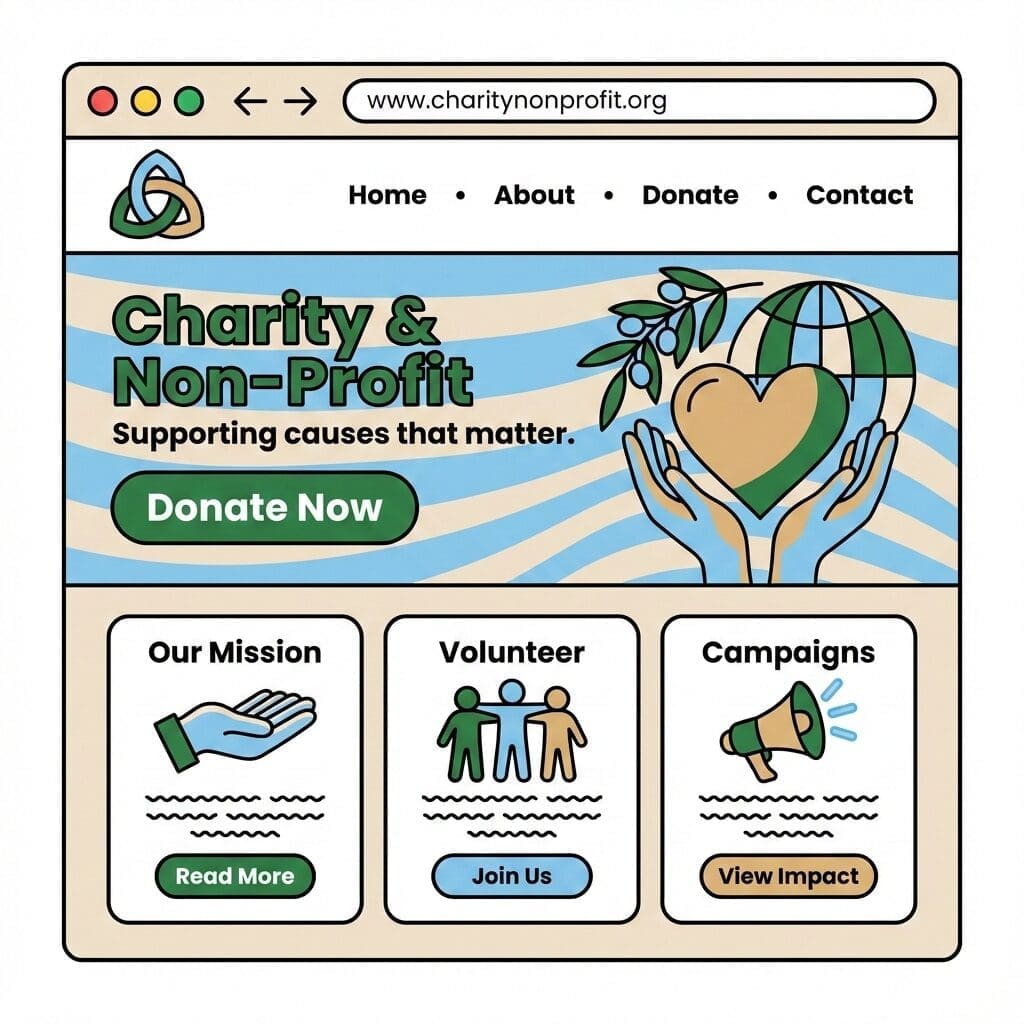
View All SectorsCharity & Non-Profit
Impactful, user-friendly websites that help charities and non-profits raise awareness and grow support.
Arts & Creative
Visually stunning portfolio sites that let artists, designers, and creatives showcase their work beautifully.
Engineering & Industrial
Specialised digital for engineering firms, manufacturing, and heavy industry.

IT & Technology
SEO, web design, and marketing for SaaS, IT services, and tech companies.

Healthcare & Medical
GDPR-compliant websites and patient-focused marketing for healthcare providers.

Financial Services
Trusted web design and marketing services for financial advisors and firms.
Manufacturing
Driving leads and visibility for UK manufacturers with targeted digital strategies.
Education & Schools
Engaging websites and visibility for schools, universities, and education providers.

Home & Garden
Beautiful eCommerce and brochure websites for home, garden, and lifestyle brands.
Food & Beverage
Appetising websites and online marketing for restaurants, food brands, and hospitality.
Logistics & Transport
High-performance websites for logistics, haulage, and transport companies across the UK.
B2B & Professional Services
Websites and marketing services for consultancies, legal firms, and service providers.

SELECTED WORK
Clients First.
Always.
We work smartly and ethically to provide intelligent and cost-effective solutions that maximise your ROI and fuel business growth.





Reviews & Testimonials
See What Our Customers Say
Opace are rated 4.93/5 for Digital Marketing based on 75 customer reviews





Local, National & Global Brands
Organisations We've Worked With













































SOME OF OUR AGENCY CERTIFICATIONS
Award Winning Digital Agency
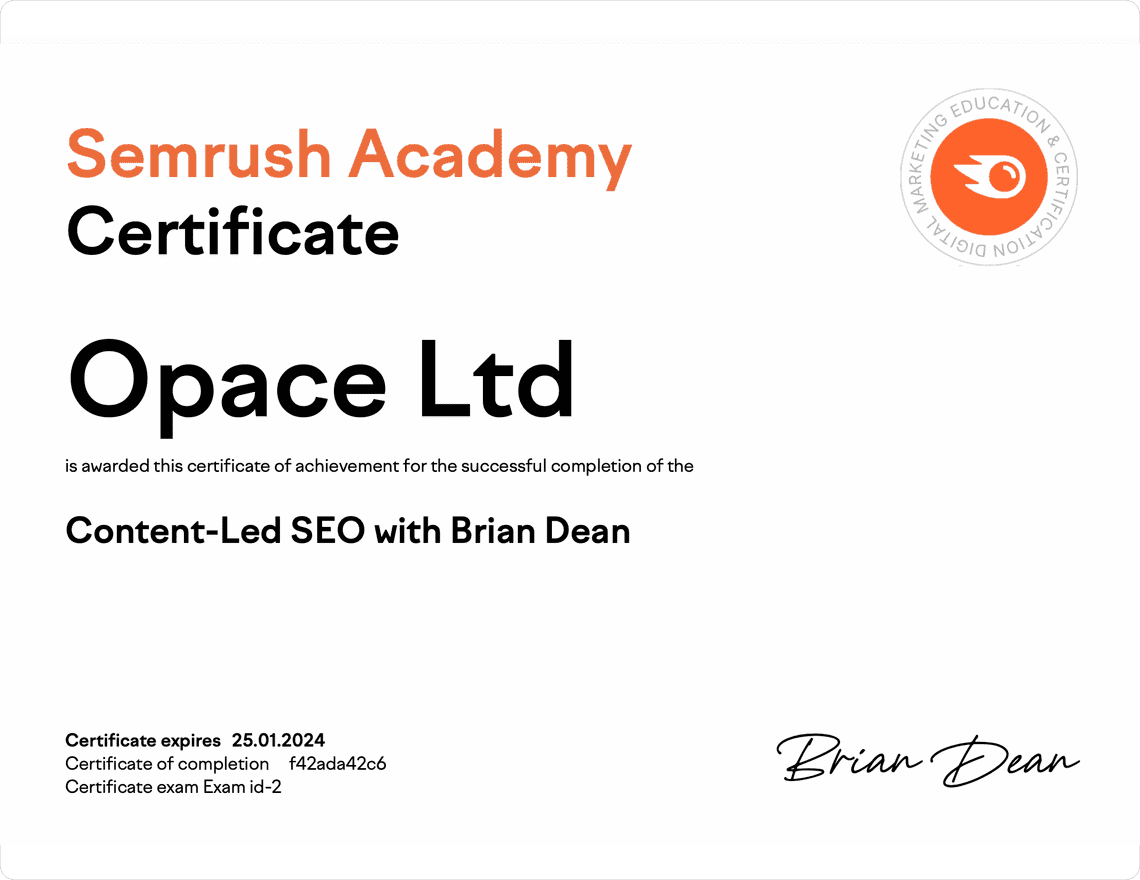
We make sure our digital marketers and specialists are always up to speed. From Google to HubSpot and Semrush, we've completed many of the major certifications available.


UX RESEARCH AGENCY UK
Why Our UX Research Produces Actionable Results
Most UX research fails at the same point: the handover. Research findings end up in a presentation deck, get discussed once, and sit forgotten. Our research is designed to be used, not filed. Prioritised, specific and formatted for design and development teams to act on immediately.
Action-oriented deliverables
Findings are prioritised by impact and delivered with specific, implementable recommendations. No 100-page reports that gather digital dust.
Method-appropriate research
We select methods based on your research questions, not habit. Usability testing, interviews, card sorting, prototype testing and competitive analysis, each answers different questions.
Real users, not assumptions
Every finding is backed by observed user behaviour. We recruit participants who match your target audience, screen for relevance and test with enough users to identify meaningful patterns.
Design and development integration
We work alongside your design and development teams, translating research into design requirements, user stories and testable hypotheses that feed directly into sprint planning.
Both qualitative and quantitative
Usability insights explain why users struggle. Combined with our behaviour analytics and heatmapping, you get the complete picture of what happens and why.
Research at any project stage
Discovery research before design, prototype testing during design and optimisation research after launch. We align research timing with your project lifecycle for maximum impact.
Why Choose Opace for UX Research?
If you're investing in user research for the first time or looking for a more effective UX research agency, these are the things that determine whether research improves your product or gathers dust.
How is your approach different from automated UX tools?
Automated tools provide quantitative data: click rates, completion times, success rates. Our research adds the qualitative layer: why users behave the way they do. Understanding motivations and mental models is what automated tools can't provide.
Can you help us build a business case for UX research?
Yes. We help stakeholders understand the ROI of research by connecting usability issues to business metrics: conversion rates, support costs, task completion rates and customer satisfaction scores.
What if our team disagrees with research findings?
Research findings are based on observed user behaviour, not our opinions. We present video evidence of users experiencing the issues we've identified. When stakeholders see real users struggling, disagreements tend to resolve quickly.
How do you handle accessibility in UX research?
We include participants with disabilities in testing programmes and evaluate products against WCAG guidelines. Accessible design benefits all users, not just those with specific needs.
Can you test products that haven't been built yet?
Yes. We test interactive prototypes created in Figma, Adobe XD or coded prototypes. Prototype testing catches usability issues before development starts, saving significant time and cost.
What turnaround can we expect?
A standard usability testing round takes 2-3 weeks from recruitment to findings delivery. Larger programmes with multiple methods take 4-8 weeks. Timelines depend on participant recruitment complexity and study scope.
How much does UX research cost?
A single usability testing round with 6 participants typically costs £2,000-£4,000. Larger research programmes including interviews, card sorting and journey mapping are scoped individually. Contact us for a quote based on your research questions.
How many users do you test with?
We typically test with 5-8 participants per round, based on established research that this number identifies 80-85% of usability issues. Larger sample sizes are used for quantitative studies or when segmentation by user type is needed.
When should UX research happen in a project?
Ideally at three points: discovery (understanding users before design), validation (testing prototypes before development) and post-launch (identifying improvement opportunities). Research at any stage adds value, but early research prevents the most expensive mistakes.
Can you test our existing website?
Yes. Usability testing on existing sites is one of our most common engagements. It identifies specific usability issues that affect conversion rates, user satisfaction and task completion. Findings feed directly into conversion rate optimisation services and redesign planning.
How do you recruit test participants?
We recruit from our research panels, your customer database or specialist recruitment partners depending on the user profile required. Participants are screened to match your target audience in terms of demographics, behaviour and technology use.
What deliverables should we expect from a study?
Moderated testing is facilitated by a researcher who guides participants and asks follow-up questions. Unmoderated testing gives participants tasks to complete independently, recorded remotely. Moderated testing provides deeper insights; unmoderated scales to more participants.
Do you provide video recordings of test sessions?
Yes. All moderated sessions are recorded with participant consent. We provide highlight reels of key findings alongside the full recordings. These videos are powerful tools for building stakeholder empathy and securing buy-in for design changes. For further guidance, see UK accessibility regulations.
Can UX research help with mobile app design?
Yes. We conduct UX research for mobile apps, responsive websites and cross-device experiences. Testing methods are adapted for mobile: finger reach zones, thumb navigation, gesture interactions and small-screen reading patterns. For further guidance, see W3C accessibility standards.
How does UX research relate to CRO?
UX research provides the qualitative 'why' that informs CRO hypotheses. Usability testing reveals the problems; A/B testing validates the solutions. The two disciplines work together in a continuous improvement cycle.
How do you recruit participants for testing sessions?
We use Maze and Optimal Workshop for unmoderated usability testing and card sorting, Lookback for moderated remote sessions, Hotjar for heatmaps and session recordings, and Miro for collaborative analysis and affinity mapping. The specific toolset varies by research method, but all tools are selected because they produce the richest, most actionable data for each study type.
What is a heuristic evaluation and do you offer it?
A heuristic evaluation is an expert review of your product against established usability principles (heuristics), such as Jakob Nielsen's 10 usability heuristics. It is faster and less expensive than full usability testing and works well as a first-pass audit to identify obvious issues before user testing begins. We offer heuristic evaluations as a standalone service or as part of larger research programmes.
Can you partner with businesses anywhere in the UK?
Yes. We're Birmingham-based but conduct research for clients across the UK and internationally. Remote usability testing makes geographic location irrelevant for participant recruitment and session facilitation.
FROM THE BLOG
Our Latest Digital Agency Insights

What Is DLSS 5? AI Generated Art, Neural Rendering & When AI Overrides the Artist
What is DLSS 5 and why are game artists furious? We break down neural rendering, the AI generated art controversy, and the AI bias problem.

ChatGPT vs Gemini vs Bing: The Best AI Search Engines and What Comes Next
Compare the best AI search engines of 2026, including ChatGPT, Gemini, Perplexity and Copilot. How AI Overviews and GEO are changing search.

What Is AGI (Artificial General Intelligence) or True AI? AI vs AGI vs ASI Explained
What is AGI and how does it differ from the AI we use today? We explain ANI vs AGI vs ASI, where GPT-5 fits, and when experts predict AGI will arrive.
Get in Touch
Interested in Working with Us?
We have 100% happy customers, so don't delay. Get in touch today and see how we can help.
SEND US A MESSAGE