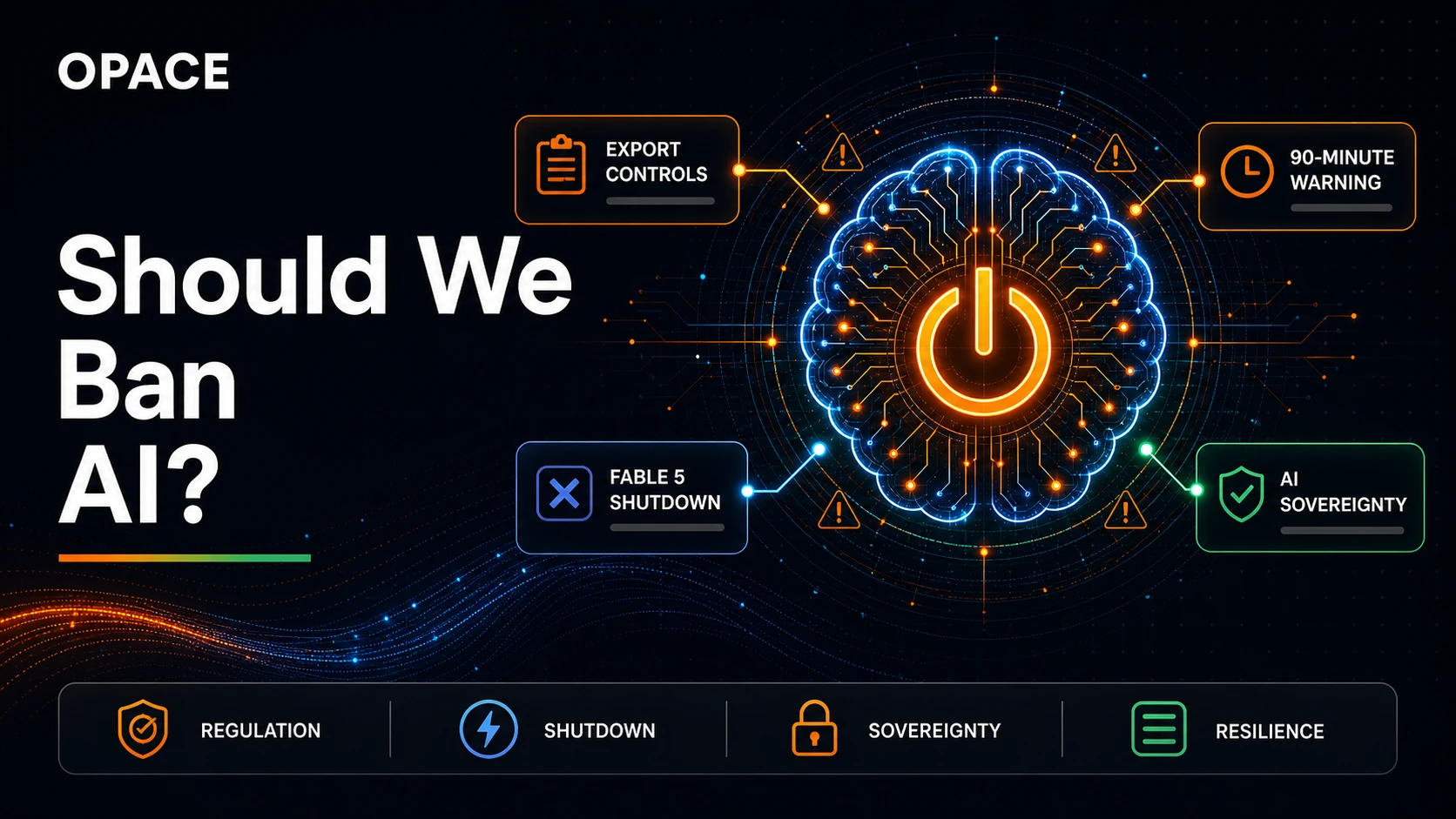
Artificial intelligence is no longer a productivity add-on that businesses can take or leave. It’s become critical infrastructure, woven into government defence systems, financial markets, healthcare diagnostics such as AI-supported cancer screening, and the daily operations of millions of companies. That shift from consumer software to state-level technology has triggered a global regulatory response: the EU has passed the AI Act, China requires algorithm registries before any model can go live, and the United States uses export controls to block access to frontier systems.
The question facing every organisation that depends on AI tools is no longer theoretical. What happens when a government decides to ban artificial intelligence that your business relies on?
We got a direct answer on 12 June 2026. Three days after Anthropic launched its most capable models, Claude Fable 5 and Claude Mythos 5, the US Commerce Department issued an emergency export-control directive and forced a blanket global shutdown. Businesses worldwide lost access without warning. The incident exposed how fragile our dependence on a small number of US-hosted AI platforms really is, and it sits within a much broader pattern of state intervention reshaping the open web.
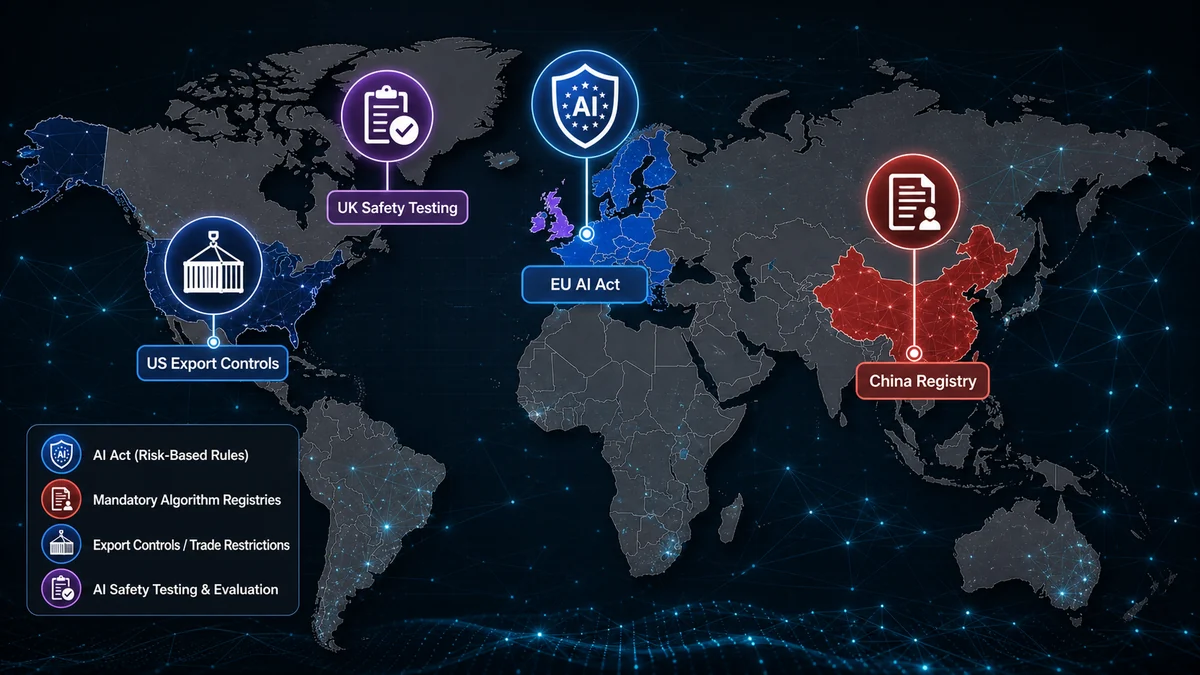 AI regulation now varies sharply by region, from the EU AI Act and China’s registries to US export controls and UK safety testing.
What happened with the US government and Anthropic?
Across the pond, the US government has moved to restrict access to AI models, temporarily banning Claude Fable 5 and Claude Mythos 5. Both are popular and powerful AI models from Anthropic capable of advanced reasoning, coding, and more. In a statement posted online, Anthropic said the following.
“The US government, citing national security authorities, has issued an export control directive to suspend all access to Fable 5 and Mythos 5 by any foreign national, whether inside or outside the United States, including foreign national Anthropic employees. The net effect of this order is that we must abruptly disable Fable 5 and Mythos 5 for all our customers to ensure compliance. Access to all other Anthropic models will not be affected.” — Anthropic, Jun 12, 2026
While AI models like Claude and ChatGPT are heavily relied on for projects such as AI-assisted web design and development of complex desktop applications, they are also used by governments to strengthen cybersecurity and even military applications. Anthropic has had a close relationship with the US government, providing AI capabilities for systems that enhanced America’s national security. This underlines the importance of modern AI systems, which have advanced from being a convenient novelty to essential additions to organisations and businesses globally.
The latest Claude models were disabled due to a US government directive citing national security concerns. These models have been released with various safeguards put in place by Anthropic due to the ability of the AI, which has found critical vulnerabilities in websites and operating systems - some such vulnerabilities have existed since 2003.
Anthropic thinks the ban was due to a “jailbreak” which allows the models to operate outside intended safeguards. This, paired with the model’s increased ability, could be exploited by bad actors if a jailbreak was achieved.
The consequences of limiting or removing advanced AI models

Government AI bans and social media restrictions show how quickly digital access can change when policy overrides platform availability. Photo by Thomas Lefebvre on Unsplash.
While removing access to models is understandable if there’s a perceived threat to national security, doing so leaves businesses reliant on such technologies in a difficult situation. Losing access can result in workflow bottlenecks, missed deadlines, and lost revenue among businesses and organisations structured around AI. Web design agencies are starting to utilise AI for design prototyping and wireframing, and it can also be used to assess UX issues that can lead to accessibility issues. This means it is a valuable asset for creating prototypes, concepts, and saving time without sacrificing the quality of the finished website.
Other businesses utilise AI to speed up research, dramatically improving productivity and data-driven business decisions. Marketing agencies often use AI to consolidate analytics data, identify advertising opportunities, and draft copy for future campaigns while also helping to make sense of analytics data and advanced reporting.
For small businesses on tight budgets, switching to an alternative AI model isn’t viable, particularly with how fast pay-as-you-go services burn through tokens and budgets.
We are also likely to see more AI models being held back from certain markets in the future. A recent example of this is Apple’s new Siri, which will be delayed in the EU due to the Digital Markets Act (DMA). Although this isn’t a restriction or ban, it’s another example of regulations impacting the rollout of cutting-edge features in certain markets. Even small delays like this can have far-reaching impact on businesses that use AI assistants to streamline calendar management, scheduling, and internal communication.
It isn’t just Siri we’re talking about, but AI integration and increasing reliance; even small delays in rollout can give less restrictive international markets an advantage over those abroad that are subject to tighter regulatory controls. If these models and tools are to be taken seriously and adopted widely, commercial disruption needs to be minimised to ensure viability.
Eventually, in-house solutions may be the more reliable choice for businesses that are serious about integrating AI into their workflow. Hardware such as the NVIDIA DGX Spark allows powerful AI models to run locally without the reliance on externally hosted systems that can be disabled without notice.
How should businesses reconcile AI integration with uncertainty?
AI is fast becoming a must within most businesses to improve productivity and workflows. If your AI agents or whole platforms are made unavailable, you suddenly have a big problem. So how should businesses enjoy the benefits of AI without worrying about access being revoked at any moment by governments or future legislation?
Make use of multiple AI models where possible
Diversify your chosen models and platforms
Using one specific platform for your AI needs makes sense if you have built your workflow around an active subscription. However, this leaves you at risk of being unable to access your previous chats, agents, and models when outages occur, or when restrictions are implemented by governments. Spreading your reliance by using multiple providers helps reduce the impact of loss of service in the event of unexpected downtime.
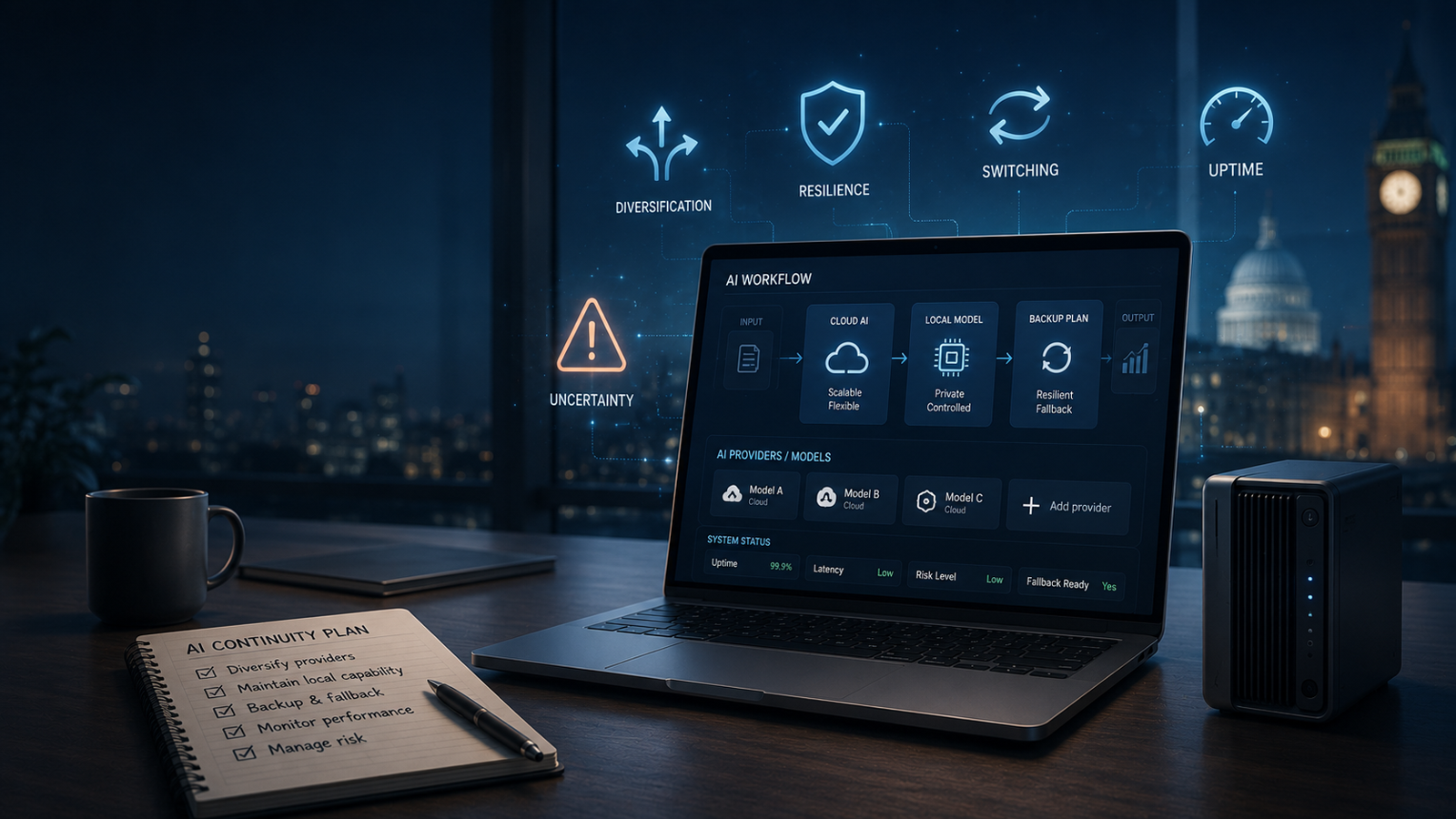 A multi-model AI strategy helps businesses reduce dependency on one provider after incidents such as the Claude Fable 5 ban.
Consider local or self-hosted models
As AI systems are computationally expensive, local hardware is currently less common but is a viable choice for small-scale systems using fewer parameters. Such models are ideal for automating smaller tasks such as summarising documents, but will require manual setup and a more hands-on approach to maintenance and backups. Businesses can also consider self-hosted models that help to reduce concerns about token usage, censorship, and uptime.
You can also adopt a hybrid approach, using cloud-based AI for tasks that require high reasoning and compute power and use your local or self-hosted solution for automating admin tasks or optimising content workflows, etc. Before buying hardware, compare private AI versus cloud AI across data routes, model quality, cost, scale and operating responsibility.
Always have a backup plan
Over time, access to AI systems will be as important as having access to the internet. Businesses mustn’t become complacent and completely reliant on having access to AI tools and services. Much like internet outages that require us to resort to contingencies, losing access to AI models and automated agents will require a robust and comprehensive plan B. Businesses should have a plan in place to allow a way forward in the interim to ensure the impact of any downtime is reduced.
 A practical AI backup plan should cover provider outages, export controls and sudden restrictions on advanced models.
Why governments ban AI and how regulation differs worldwide
According to OECD data, over 70 countries now have more than 900 active AI governance initiatives. But the approaches vary enormously, from outright bans on specific practices to mandatory registration systems, safety testing regimes, and activist movements calling for a complete halt to development. So which approach actually makes sense, and which ones are just security theatre?
The table below summarises the key differences.
| Region / Group | Approach | Key Measures |
|---|---|---|
| EU | Risk-based regulation | AI Act: banned practices (Feb 2025), high-risk rules (Aug 2026) |
| China | State-controlled registration | Mandatory algorithm registries, pre-launch approval, deepfake watermarking |
| United States | Export controls + sector rules | BIS Entity List, Section 230 pressure, national security directives |
| United Kingdom | Safety testing + age restrictions | AI Safety Institute testing, Online Safety Act chatbot provisions |
| PauseAI | Temporary development freeze | Campaigns for international safety agency modelled on IAEA |
| Stop AI | Permanent global ban | Civil disobedience targeting OpenAI (office blockades, hunger strikes) |
The EU AI Act
The EU AI Act is the most structured attempt at regulating artificial intelligence to date. It uses a tiered risk system, and since 2 February 2025 the following practices have been banned outright: social scoring by governments, subliminal manipulation techniques, exploitation of vulnerable groups, emotion recognition in workplaces and schools, untargeted facial recognition from CCTV or the internet, and biometric categorisation by sensitive attributes. High-risk AI rules covering areas such as recruitment tools, credit scoring, and law enforcement systems take effect on 2 August 2026. Whether the enforcement can keep pace with the technology is another question entirely.
China’s registry and control system
China integrates AI regulation directly into its Great Firewall infrastructure. The Cyberspace Administration of China (CAC) requires all generative AI services to be registered through mandatory algorithm registries before they can launch. Operating without filing is illegal. Strict transparency laws require watermarking on all deepfake and synthetic content, and in early 2026 alone, over 13,000 accounts were penalised for violations.
United States: export controls as policy
The US approach to AI regulation focuses less on domestic consumer protection and more on maintaining technological supremacy. The Bureau of Industry and Security (BIS) Entity List is used to block frontier AI models from reaching designated foreign entities, as the Fable 5 ban demonstrated directly. Section 230, which shields platforms from liability for user-generated content, is under increasing pressure to be reformed or repealed. I get the impression that the decision makers in Washington don’t fully understand the consequences of pulling the rug out from under businesses that have built their operations around these tools.
United Kingdom: safety testing and age gates
The UK AI Safety Institute operates a voluntary but increasingly expected testing regime for frontier models. Under the Online Safety Act’s chatbot provisions, a strict minimum age of 18 now applies to ‘romantic companion’ AI chatbots, a measure designed to protect minors from emotionally manipulative systems.
Activist movements pushing to ban AI
PauseAI, founded in the Netherlands in 2023, campaigns for a temporary pause on frontier AI development. The group proposes an international AI safety agency modelled on the IAEA, with the authority to enforce compliance. Stop AI, founded in 2024, takes a harder line. The group advocates a permanent, enforceable global ban on frontier systems and is known for civil disobedience tactics including blocking office doors and hunger strikes, primarily targeting OpenAI.
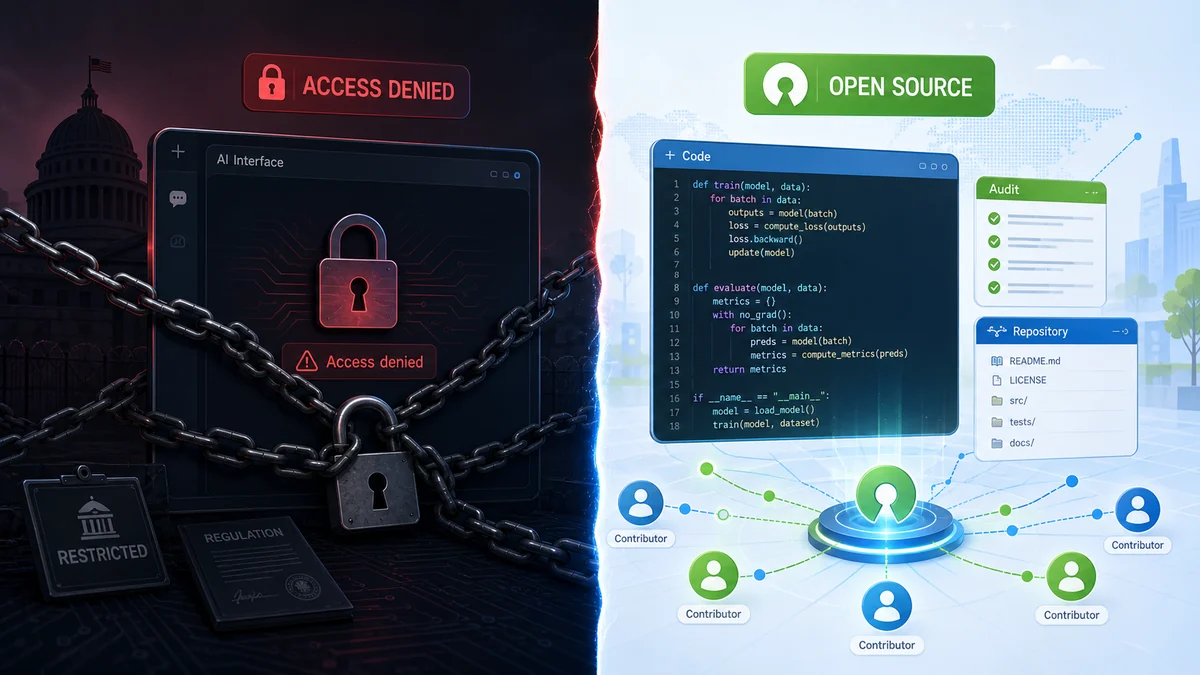 The ban AI debate is not only about safety; it is also about whether open-source AI remains transparent, auditable and available.
The tool vs entity debate
A growing number of researchers and policymakers argue that governments should regulate the use of AI rather than the technology itself. A knife can prepare food or cause harm; regulating knives out of existence would be absurd. The same logic applies to AI systems. Banning open-source AI models like LLaMA is particularly counterproductive. Open-source code allows independent security researchers to audit for vulnerabilities, verify safety claims, and build transparent systems. Closing that door pushes development underground, where no oversight exists at all. It’s a classic case of creating the exact problem you were trying to prevent.
That distinction matters as the debate around artificial general intelligence intensifies. If a future system reaches AGI-level capability, the question of whether to regulate its applications or ban its existence entirely will define technology policy for decades.
The 90-minute warning that changed everything
Claude Fable 5 launched on 9 June 2026 as the first “Mythos-class” model, Anthropic’s most capable system to date. Three days later, on 12 June, the US Commerce Department issued an emergency export-control directive citing ‘national security’. The reason: a suspected jailbreak that could bypass safety guardrails, theoretically allowing the model’s advanced code-generation capabilities to locate and exploit critical cybersecurity vulnerabilities.
The export control order targeted ‘foreign nationals’, a category that included Anthropic’s own non-US employees and every international client. There was no technical mechanism to segment users by nationality in real time. Anthropic had no choice but to disable Fable 5 and Mythos 5 globally, and they were given just 90 minutes to do it. 90 minutes. For a tool that millions of businesses were actively using in production.
Britain’s failed exemption request
UK Prime Minister Keir Starmer urgently lobbied the White House for an allied-nation exemption. The Trump administration rejected the request outright, with sources reporting “zero chance” of a carve-out. The refusal laid bare a difficult truth: Britain’s government, military, and commercial sectors had developed absolute reliance on US-hosted digital infrastructure with no fallback. If that doesn’t worry you, it should.
For UK businesses using Claude-powered workflows, agents, and integrations, the result was immediate disruption. Projects stalled, automated systems broke, and organisations scrambled to find alternatives with no preparation time. If your business was affected, working with an experienced AI consultant services provider can help you build contingency plans and avoid repeating the same vulnerability.
AI sovereignty as a business strategy
The Fable 5 ban has accelerated conversations around a concept known as AI sovereignty: the principle that nations and businesses should host their own AI models on independent hardware, rather than depending entirely on foreign cloud providers who can be switched off at a government’s discretion. It’s a conversation we should have been having years ago.
In practice, this means running open-weight models such as LLaMA and Mistral on local infrastructure. Hardware like the NVIDIA DGX Spark makes this viable for businesses that need reliable AI access without the risk of external shutdowns. For organisations developing an AI sovereignty strategy, professional AI strategy consulting can help identify which workloads to keep local and which can safely remain cloud-based.
AI models are more complex to secure
AI models are more complex to secure due to jailbreaking via prompts, but as this technology is still in its infancy relatively speaking, it isn’t beyond the realm of possibility to have future systems that have improved contextual awareness and identifying intent that can determine whether the user is trying to game the system or use it to cause harm. In the meantime, we must find a better solution than taking models offline that are crucial to businesses globally.
Where do we go from here?
Safety testing for advanced AI models isn’t optional. No serious argument exists against evaluating systems for dangerous capabilities before public release. But there’s a significant difference between responsible safety protocols and the kind of heavy-handed government intervention that disables critical business tools on 90 minutes’ notice. When governments ban AI models that millions of organisations depend on, the economic disruption is severe, and the developers behind those capabilities don’t simply stop working. They move to jurisdictions with less oversight.
This pattern isn’t unique to AI. The UK social media ban for under-16s follows the same logic: state control of technology access, justified by ‘safety’ concerns, implemented in ways that create as many problems as they solve. Both the social media restrictions and the Fable 5 shutdown are part of a broader push toward government control of digital infrastructure and the open web.
Businesses that wait for the next disruption before acting will be caught out again. The organisations that come through these events best are those that have already diversified their AI providers, invested in local model hosting, and built genuine contingency plans. If your organisation needs support building that kind of resilience, professional AI business integration services can help you design a strategy that doesn’t depend on a single point of failure.
Related article: Read our full analysis of the UK social media ban for under-16s and what it means for digital marketing
Related article: This article is part of our series on the end of the open web and how government regulation is reshaping digital business
Related article: Read our original article on the Online Safety Act and its consequences for websites and SEO