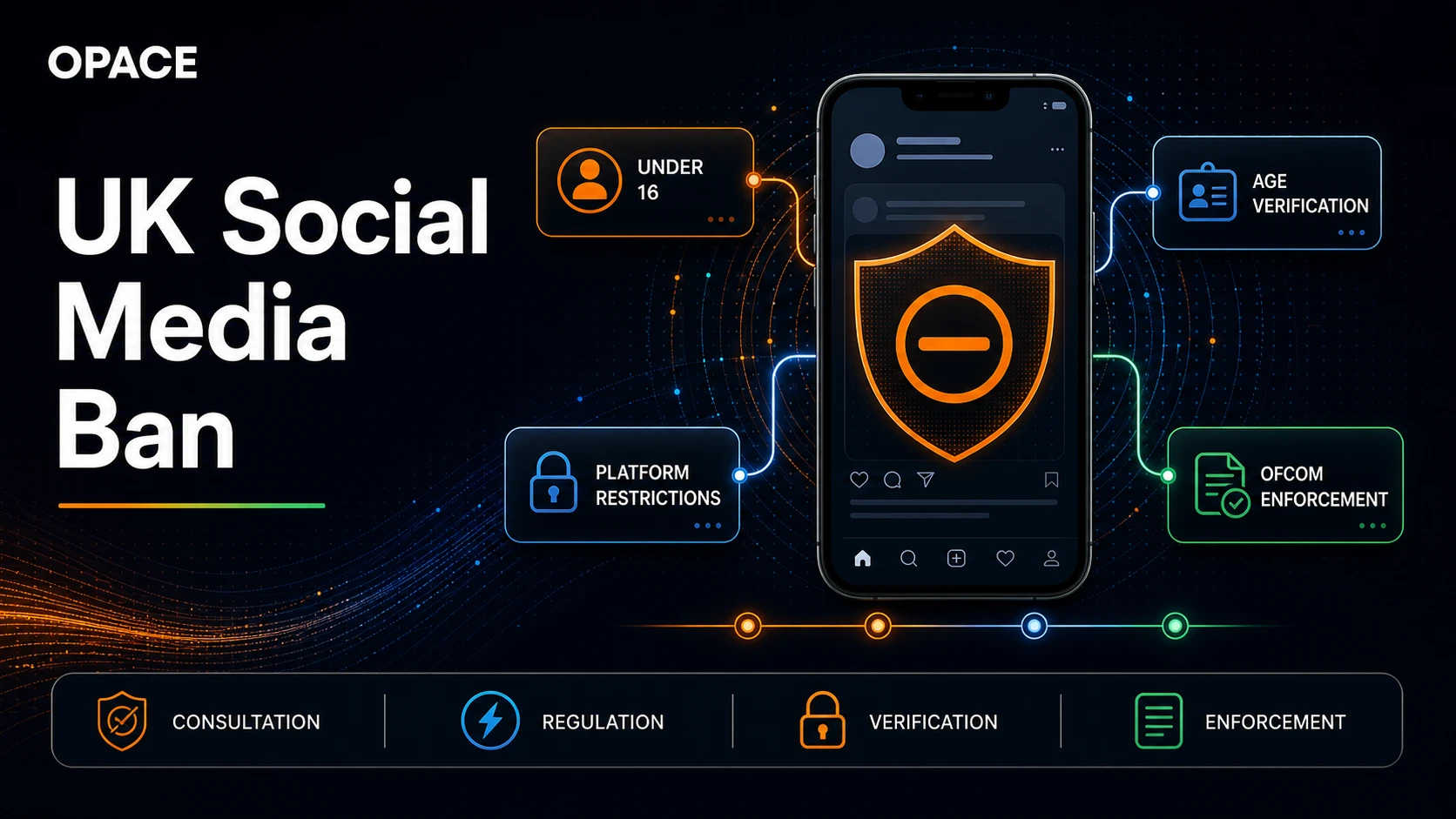
Back in September 2025, we wrote an article covering the UK’s Online Safety Act and exploring the implications for 2026. We mentioned that the OSA would likely be expanded upon in the future, setting a precedent for increased online censorship. This has now come to fruition with the UK government looking to ban under-16s from most social networks (YouTube Kids and WhatsApp are thought to be exempt from the ban, although details are not yet available). However, this has raised several questions about how the UK’s social media ban will be imposed and which other services will be affected as a result.
What exactly is the UK social media ban?
The UK social media ban for under-16s is being introduced through the Children’s Wellbeing and Schools Act 2026, a piece of legislation that builds directly on the foundations laid by the Online Safety Act. Between March and May 2026, the UK government ran its Growing up in the online world consultation, receiving over 116,000 responses. According to the government’s own summary of responses, 9 in 10 parents supported the restriction. Independent YouGov polling placed that figure closer to 77%, which still represents a clear majority but suggests the government’s framing may overstate the consensus.
The rationale is grounded in screen time data. Ofcom has verified that children aged 8 to 14 spend nearly 3 hours online daily, with over 1.5 hours of that time on social media and video platforms. The argument is that excessive, unsupervised access to algorithmically curated feeds is causing measurable harm to young people’s mental health, and that existing age gates (the “tick a box to confirm you’re 13” approach) simply aren’t working. But does the solution really lie in a blanket ban?
For a broader look at the relationship between online connectivity and its impact on wellbeing, read our article on how being connected has disconnected us.
Which platforms are affected and which are exempt?
The ban targets user-to-user social networking platforms where under-16s can post content, follow strangers, and be served algorithmically personalised feeds. The platforms explicitly in scope are:
| Banned platforms | Exempt services |
|---|---|
| TikTok | |
| Signal | |
| Snapchat | YouTube Kids |
| YouTube | Google Classroom |
| X (formerly Twitter) |
Messaging services like WhatsApp and Signal are exempt because they function as private communication tools rather than open social networks. Educational products like Google Classroom are also excluded. YouTube Kids remains available as a curated, child-specific product, though the main YouTube platform is banned for under-16s. It’s worth noting that these exemptions aren’t set in stone, and I wouldn’t be surprised to see the scope expand once the infrastructure is in place.
The restrictions extend beyond social media in a narrower form. On other online services, including gaming platforms, high-risk features such as livestreaming and contact from strangers will be restricted for under-16s. For 16 and 17 year olds, full access is permitted, but high-risk features (livestreaming, direct stranger messaging, infinite scroll) will be disabled by default to avoid a sudden cliff-edge transition at age 16.
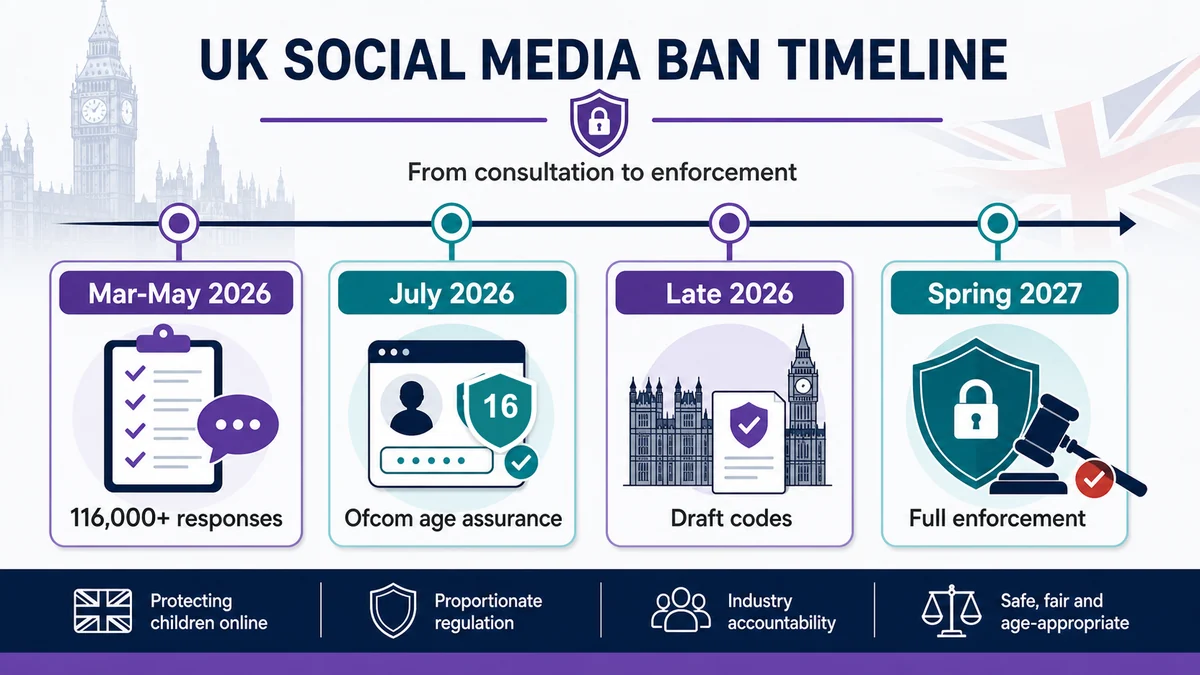 The UK social media ban moves from consultation and Ofcom age assurance in 2026 to full enforcement in Spring 2027.
Implementation timeline
The ban isn’t arriving overnight. The rollout follows a phased schedule:
- July 2026: Ofcom publishes its ‘age assurance’ report and recommendations on verification methods.
- Late 2026: Draft codes and regulations are laid before Parliament for scrutiny.
- Spring 2027: Full enforcement begins, with platforms expected to have age verification systems operational.
Platforms that fail to comply face fines of up to 10% of their global annual revenue, a penalty structure borrowed from the Online Safety Act. For a company like Meta, that could mean billions. Whether that’s enough to make them take it seriously remains to be seen.
The UK is not acting alone
Several countries have already introduced or proposed similar age-based social media restrictions:
| Country | Minimum age | Status |
|---|---|---|
| Australia | 16 | Effective December 2025 (though reports suggest ~70% of children remain active via VPNs) |
| France | 15 | Enacted |
| Spain | Under 16 proposed | Under consideration |
| Greece | 15 | Effective January 2027 |
| Denmark | 15 | Proposed |
Australia’s experience is particularly telling. Despite being the first major Western country to implement a social media ban under 16, early evidence suggests the ban has been widely circumvented through VPNs and parental account sharing. Roughly 70% of children previously using the platforms appear to still be active. If that isn’t a red flag for anyone hoping the UK ban will work differently, I don’t know what is. It raises a genuine question about whether age-based bans can be enforced at scale without intrusive verification measures.
Criticism from privacy and civil liberties groups
Not everyone supports the ban. Amnesty International, the Electronic Frontier Foundation (EFF), and privacy-focused companies like Proton.me have all criticised the legislation as privacy-infringing. Their argument centres on the fact that to verify ages at scale, platforms will need to collect age verification data (facial scans, digital IDs, or credit card details) from all users, not just children. This creates a surveillance infrastructure that affects every adult using these platforms, and the risk of data breaches only grows as more personal information is held by third-party verification providers. We’ve already seen how poorly companies handle sensitive data; the idea of handing over even more of it doesn’t exactly fill me with confidence.
The Online Safety Act and the UK’s Social Media Ban for Under-16s
The UK government’s social media ban will primarily focus on Snapchat, TikTok, YouTube, Instagram, Facebook and X. However, these measures are expected to extend further, including certain gaming services and social platforms, such as Reddit. As with most legislation marketed as keeping kids safe, it sounds great on paper, and politicians take the “protect our kids” approach to garner support for intrusive legislation that often strips away rights or freedoms. The problem always becomes visible in the small print, with the upcoming changes implying a broader digital ID requirement for all social network users to verify ages.
Privacy concerns and underground social networks
We predicted in our original article that leaving data in the hands of a third party is dangerous, and data leaks are inevitable, leaving children vulnerable to identity theft and other fraud. Banning social media for under-16s is complicated logistically, hard to implement, and creates “underground” social network sites that make it easy for children to circumvent filters and restrictions through the use of VPNs - many of which are free and do not require a credit card to use.
 Age verification for the UK social media ban raises privacy concerns because checks may affect adults as well as under-16s.
Some argue that the ban will be added via the backdoor without being subject to votes, debates, or discussion. It will come as an update to the Online Safety Act rushed through without considering the consequences. In reality, the legislation is expected to be implemented with close guidance from Ofcom. The first wave of regulations is expected in late 2026, while the majority of the changes are to be implemented in Spring 2027.
The unintended harm brought about by a social media ban
As it stands, the social media ban could result in age check errors, preventing young parents from joining parenting discussion boards or those with mental health struggles being blocked from accessing essential services. These are just two of seemingly endless examples where the social media ban lacks the careful, nuanced approach required when attempting to enforce limits on social media sites and online communities. Marginalised groups, including LGBT+ communities, often find comfort in socialising online, which serves as a reprieve from the feeling of isolation that a lot of young adults and children deal with, which could cause increased stress for those seeking an online safe space.
Nick Ferrari of LBC points out that Labour wants to impose a night-time curfew on their under-16s’ social media use, illustrating a somewhat inconsistent approach. This means the government is allowing 16-year-olds to vote yet considering a broader curfew for those under 18. Surely being at an age where you are eligible to vote should mean that the age group has access to news and opinion pieces across social media whenever they see fit.
Social media is one of the most popular places for political debate in 2026. It could be argued that limiting access to these platforms for individuals of voting age prevents them from gaining valuable political insights and engaging in discourse through the exchange of ideas.
Verification methods and third-party services for proving age
Most people understand the concept of a social media ban for children, and in many cases, this isn’t what people have an issue with. Third-party companies that handle facial scanning software, age estimation, and general age checks have poor track records in some cases, including data leaks and mishandling of user data. Then there’s the issue of accuracy and effectiveness, with many age estimation systems being tricked by users simply using marker pens to alter their appearance, or uploading images of video game characters.
Age verification required for exemption from the social media ban could become the new “digital ID” system, just wearing a new label. Requiring users to provide credit card details, photos, or forms of identification such as driving licences that many people are not comfortable sharing. In some cases, people may not have such documentation available.
Age estimation systems have already shown weaknesses in identifying the age of some ethnic groups. According to a Guardian analysis of age assurance technology trial data, these systems could not reliably determine the age of underrepresented users from Asian backgrounds, resulting in false positives and false negatives.
Keir Starmer’s response so far to concerns has been largely dismissive, according to some critics, focusing on the need to protect children online while ignoring the legitimate concerns many have about the power creep and abuse of infrastructure by future governments.
The problem isn’t whether kids should be protected online because that much is obvious and unanimous. The issue is whether government will decide that information provided by independent journalism could be filtered or hidden if deemed unacceptable by the state. It’s a dangerous precedent that could quickly become a slippery slope.
Is a ban actually enforceable in most real-world scenarios?
We’ve already touched on VPNs, but a social media ban will likely be circumvented by using parents’ accounts and devices. This ultimately leads to the same problem of children having access to potentially inappropriate material served by algorithms tuned for adults, and it is the responsibility of parents to ensure appropriate supervision. Platforms need to do their part too, but it should be a collaborative balance instead of a heavy-handed government-led whack-a-mole that would constantly need to add sites to the ban list as and when they emerge. There are similarities here to pulling AI models due to fears of abuse by bad actors. Those with nefarious intent will still be able to seek open-source AI models to aid them, whereas legitimate users suffer most.
As the ban intends to target popular platforms, smaller sites with weaker moderation will emerge. This will still result in children being exposed to potentially harmful content.
The ban may reduce harmful content, but not solve the fundamental issue. For all the negatives that come as a result of restrictions and censorship, you have to wonder if the ends justify the means with the current ban.
It’s hard not to see the government as naive when introducing legislation that is well-meaning in concept but is way more complicated in practice.
How the UK social media ban will affect digital marketing and business strategy
The commercial ripple effects of the UK social media ban will hit much harder than most businesses expect. This isn’t a niche compliance issue that only affects children’s brands. It’s going to reshape ad costs, influencer economics, audience targeting, and digital marketing strategy across nearly every sector.
According to eMarketer, UK digital ad spend for 2027 is projected to drop by £1.3 billion, revised down from £18.3 billion to approximately £17 billion. That contraction is driven by the removal of under-16s from major platforms and the subsequent loss of a large, highly engaged demographic segment.
Rising ad costs across all platforms
A smaller addressable audience means the same number of advertisers are competing for fewer eyeballs. The result is predictable: higher CPMs and CPCs across the board. Even brands that have never marketed to children will feel this through increased bidding competition in adult demographics.
Platforms will also begin purging unverified and underage accounts to avoid Ofcom fines (up to 10% of global annual revenue). For brands that have built large social followings, this will cause a sudden, visible drop in follower counts and engagement metrics. Vanity metrics will take a hit, and businesses that have relied on inflated audience numbers to justify social budgets will need to recalibrate. If your social media ‘success’ has been built on follower counts that include a significant chunk of under-16s, you’re about to get a reality check.
Micro-influencers with Gen-Z and Gen-Alpha followings will experience particularly severe reach drops, making campaigns built around youth-oriented creators less cost-effective.
Shifting budgets away from social feeds
Businesses that directly target under-16s (gaming, youth fashion, tutoring, education technology) will need to redirect their advertising spend entirely. The two most viable alternatives are:
- Streaming ad tiers: Netflix, Disney+, and Amazon Prime Video all offer ad-supported plans with strong family demographics.
- Family television programming: Traditional broadcast still reaches young audiences, particularly during school holidays and weekends.
For brands that have leaned heavily on social media marketing to reach younger demographics, this isn’t a gradual shift. It’s a forced reallocation that needs planning well before Spring 2027.
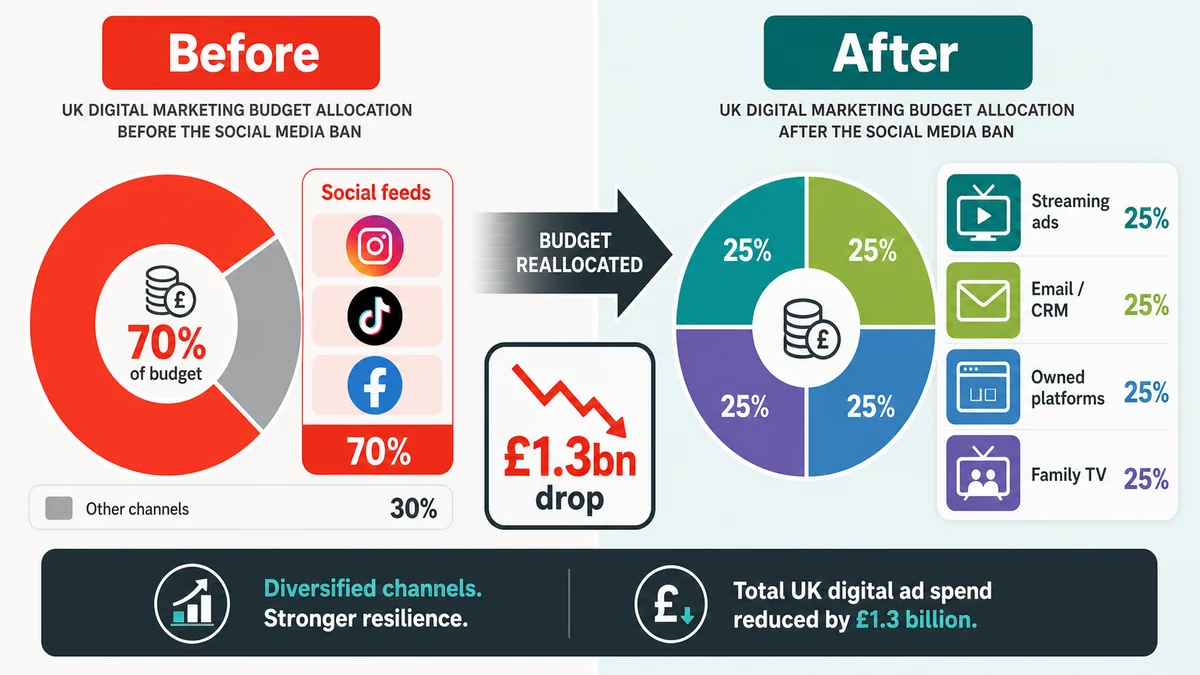 The UK social media ban is expected to push digital marketing budgets away from social feeds and towards owned channels, CRM and family media.
Building first-party data and owned channels
The bigger strategic lesson from the ban is that rented audiences on third-party platforms are fragile. A single policy change, whether from a government or from the platform itself, can wipe out years of audience building overnight. We’ve seen it happen before, and this won’t be the last time.
The priority for 2027 and beyond should be investing in first-party data infrastructure:
- Email newsletters that give you a direct line to your audience, independent of any algorithm.
- SMS marketing lists for time-sensitive promotions and updates.
- CRM systems that allow you to segment, personalise, and retain customer relationships on your own terms.
Rather than chasing viral reach through algorithm-dependent content, brands should be building interest-based communities on owned platforms, whether that means web forums, private Discord servers, or branded membership areas. This approach is slower to build but far more resilient. It’s the difference between renting someone else’s audience and actually owning the relationship.
For a broader perspective on how social media fits into business marketing, read our guide on social media for B2B and B2C business marketing.
What about B2B companies?
B2B companies are less directly affected, since their target audiences (decision-makers, procurement teams, senior leaders) will remain on LinkedIn and other professional platforms. However, B2B advertisers should still expect rising ad costs as overall platform CPCs increase. The knock-on effect of reduced supply in ad inventory will push prices up across all advertiser categories, not just those targeting consumers. In short, even if you’ve never marketed to a teenager, you’re still going to feel this.
A better set of safeguards
There are several ways that social media and AI companies can safeguard their users without working to the detriment of the wider service. Let’s look at some achievable changes these companies can implement that have few negatives associated with bans or pulling access to AI models.
Better reporting, moderation and parental controls could protect under-16s without relying solely on a blanket social media ban. Photo by Glenn Carstens-Peters on Unsplash.
Improved and more effective report features
The report function on social media platforms and most websites is often neglected internally. Ensuring that reports are taken seriously can help reduce exposure to harmful content or unintended features on social platforms or using AI services.
Proactive moderation teams
Investing more in moderation teams can help to prevent the spread of harmful or illegal content before it has a chance to spread through the network. Having teams that are proactive in stopping fake news stories circulating that are gaining popularity is much less harmful than being reactive after the damage is already done.
Better parental controls for social media
Giving parents more control over the types of content their children can access and adding educational content for parents to understand the dangers of unsupervised social media access for children can go a long way in making platforms a safer place for under-16s.
New accounts have more robust safety filters enabled by default
Newly created social media accounts already feature safety filters by default, but going a step further would ensure children are not instantly exposed to feeds and algorithms that are primarily designed for adults. This keeps access to communities intact while still preventing access to adult content.
Ultimately, a careful balancing act is required to allow children to have access to online social groups within a safe environment without completely locking them out. AI models should be able to disable certain tasks and higher-tier complex reasoning when concerns are raised by governments and regulatory bodies. This allows businesses to resume using the service, with the high-risk areas being closed off and unavailable in a modular fashion.
Much like busy roads, online platforms can be dangerous. However, the solution isn’t to impose bans on children coming within 5 metres of a road. Instead, we rely on common-sense parenting, education, and speed limits that ensure safety. With that being said, social media companies need to put safeguards in place to prevent harmful or addictive content from reaching under-16s. This can be done in several ways using content detection algorithms and better parental controls.
 The UK social media ban is part of a wider move from a borderless open web towards state-controlled digital spaces.
What this means for the future of the open web
The UK social media ban isn’t an isolated policy decision. It fits into a much broader pattern of governments asserting control over digital spaces that were, until recently, largely self-governing. The same instinct that drives this ban, the belief that the state must intervene to ‘protect’ citizens from online harms, is also driving moves to ban or restrict artificial intelligence. Different technologies, same playbook.
What connects these threads is a fundamental shift in how the internet operates. The borderless, open web that defined the first two decades of the commercial internet is being replaced by something more partitioned and state-managed. Age gates, content filters, mandatory identity verification, geofenced AI access: these are all symptoms of the same direction of travel. I can’t help but think we’ll look back on this period as the point where the ‘open’ in open web stopped meaning very much. We explored this trend in depth in our article on the end of the open web.
For businesses, the practical takeaway is straightforward. Don’t wait for Spring 2027 to start adapting your digital marketing approach. Audit your audience demographics now, assess how much of your social reach depends on under-16 users, and begin shifting spend toward owned channels and platforms with longer-term stability. Build first-party data assets that no government policy or platform algorithm change can take away from you.
If you need support rethinking your social strategy ahead of these changes, our social media consultancy team can help you build a plan that accounts for the regulatory environment taking shape across the UK and beyond.
Related article: Read our analysis of how governments are also banning artificial intelligence, and what the Fable 5 kill switch means for UK businesses
Related article: This article is part of our series on the end of the open web and how government regulation is reshaping digital business
Related article: Read our original article on the Online Safety Act and its consequences for websites and SEO