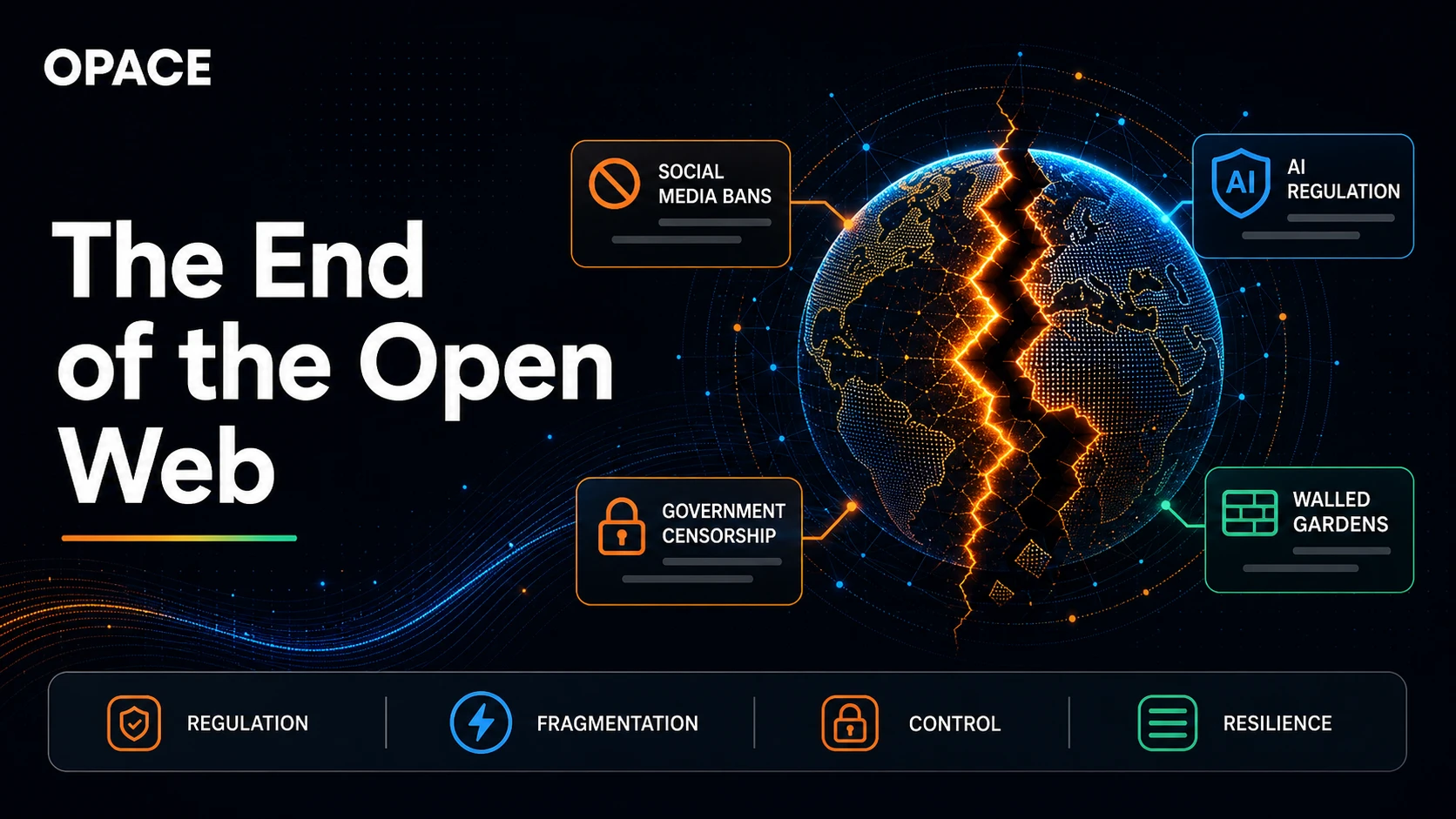
The open web, the version of the internet built on decentralised public standards like HTTP, HTML, and RSS, is breaking apart. For two decades, anyone could publish a website, have it indexed by search engines, and reach a global audience through organic discovery. That model is eroding faster than most people realise. And I’d argue that most businesses still aren’t taking it seriously enough.
Google’s AI Overviews now answer queries directly inside the search results page, causing significant zero-click search traffic drops for publishers who once relied on those visits. Major content owners are responding by blocking search crawlers entirely unless paid, creating a fragmented pay-to-crawl web where information sits behind commercial gates. Meanwhile, AI-powered search engines are replacing the familiar ten blue links with machine-generated summaries, and the incentive to publish openly is shrinking as a result. We explored how AI is shaping the future of SEO in a previous article; the situation has only got worse since.
Audiences are responding by retreating into closed spaces. Discord servers, WhatsApp groups, Substack newsletters: these platforms offer smaller, curated communities free from algorithmic noise, but they’re walled gardens by design. Content shared inside them is invisible to search engines and inaccessible to anyone outside the group.
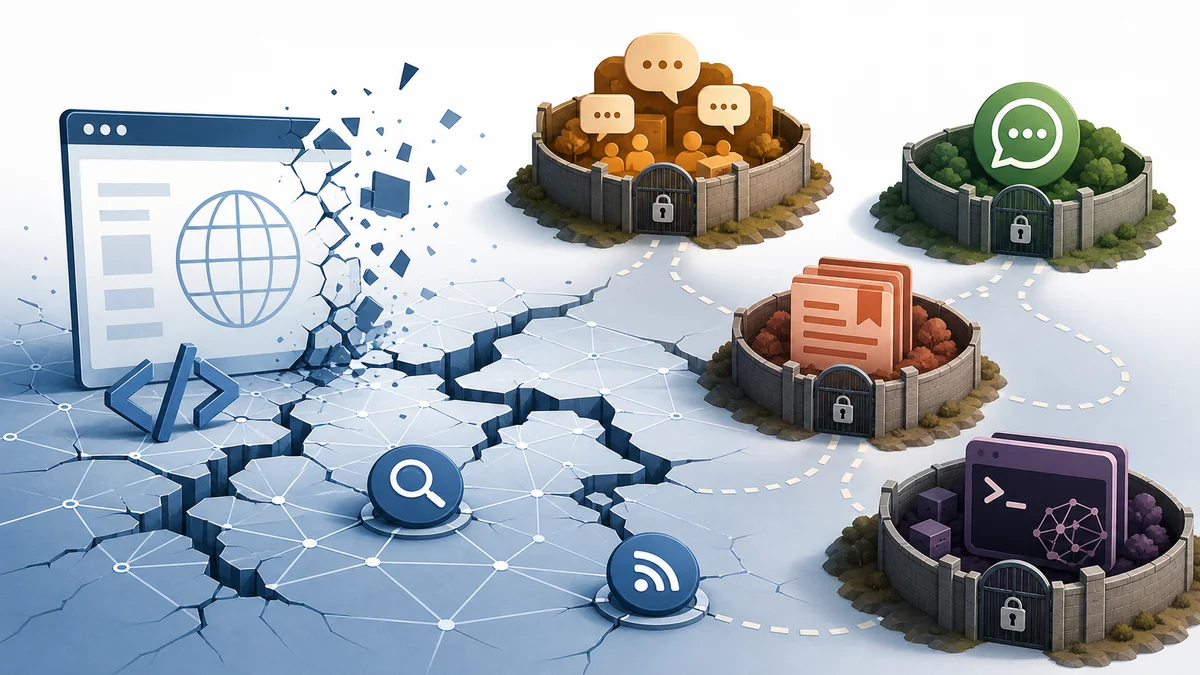 The open web is fragmenting into walled gardens, making public discovery harder for users, publishers and UK businesses.
On top of this commercial fragmentation, governments are now actively intervening on two separate fronts. The first is domestic access control: the UK’s social media ban for under-16s represents the most significant restriction on platform access since the internet became mainstream. Forrester’s April 2026 data shows that 67% of UK consumers support the ban, yet 69% believe it’s structurally unenforceable. You have to wonder what that says about the policy. The second front is international infrastructure control: US export restrictions triggered the global shutdown of Anthropic’s Claude Fable 5 models, cutting off businesses and developers worldwide with just 90 minutes of warning.
These aren’t isolated incidents. They’re symptoms of a broader pattern: the end of the open web as we’ve known it. Whether you view this as a necessary correction or a dangerous overreach, the practical consequences for businesses, publishers, and everyday users are already being felt. The question isn’t whether the open web is changing. It’s how quickly, and what replaces it.
The UK and US decide which technologies the population has access to.
Both bans - although one being temporary in the case of Claude - will have far-reaching implications, and in this blog we aim to explore them in detail. Are such bans and censorship a necessary evil in the fight for ensuring online safety for children? Or are our governments gaining unnecessary control of online platforms and technologies under the guise of protection? How much of a role should the government play in parenting our children online, and should they be able to control access to emerging technologies including AI models? The social media ban and Claude’s ban may seem like two unrelated topics, but they have one commonality: control.
This blog isn’t suggesting that we should ignore the problems inherent in social media and AI platforms. It is to draw attention to the fact that any infrastructure that allows governments to control the flow of information and access to technologies is something to be cautious of, and how we can best prepare ourselves to handle unexpected loss of service once reliant on the tools available to us as people and businesses.
The connection between AI bans and social media bans
 Social media bans, AI regulation and government tech regulation are now part of the same debate about digital censorship.
Although the Anthropic ban is a separate issue from the UK’s social media ban, there are some important commonalities to consider. Both examples show a willingness and proactive approach that governments are now taking to control access to digital services. Businesses losing access to their chosen AI models and children losing access to their online support groups are both major consequences of government intervention. Should governments have this much control over online services when many illustrate a lack of understanding of the lasting consequences caused by heavy-handed censorship or restrictions?
Related article: Read our full analysis of the UK social media ban for under-16s and what it means for digital marketing
Related article: Read our deep dive into the Anthropic Fable 5 ban and what it means for UK businesses relying on AI
Disinformation, AI models, and social media
Disinformation has been a problem on social platforms for some time, but now, with advanced AI models that create convincing fakes, it has become a bigger issue. Scams, fraud, and propaganda can be used to sway public opinion and power bots across networks like Reddit. The difficulty is knowing how to deal with the influx of fake news and misinformation in 2026 without hindering functionality or availability. Regulation should be measured and proportionate, striking a balance between safety and functionality. Independent journalism and reporting should not be collateral damage when rooting out such content with a wide brush.
Education and fact-checking are also important when trying to separate the wheat from the chaff online. It’s a difficult balance. Should we trust the government to decide what is considered fake, offensive, hateful, or dangerous, when looking at how governments have handled such power throughout history? Can we trust them not to expand on newly formed infrastructure when we have already seen the Online Safety Act expand further than its originally intended scope?
Regulation is needed, but implementation needs rethinking
There is no denying that harmful content exists online and is often available to children. Similarly, AI models can be used to create harmful content and exploits in applications and websites. However, the same AI models can be used to help patch security holes and identify vulnerabilities. Both AI services and social media platforms are tools that can be used for good and bad. The answer to this can’t be to stop access for all users or restrict platform access for age groups using inconsistent and unreliable third-party tools.
Banning access entirely is not proportionate. Social media platforms need stronger safeguards, better parental controls, and smarter content detection algorithms rather than blanket restrictions that push young people onto unmoderated alternatives. We cover exactly how this could work in practice in our deep dive into the UK social media ban.
AI models present a different challenge. Jailbreaking through prompts makes them harder to lock down than traditional platforms, but the technology is still in its infancy. Future systems with improved contextual awareness could detect malicious intent without cutting off legitimate business users entirely. We explore the consequences of pulling AI models offline and what businesses should do about it in our companion article.
The end of the open web is a global pattern, not a UK problem
The restrictions we’re seeing in the UK aren’t happening in isolation. Every major economy is now actively partitioning and policing web infrastructure. Over 70 countries have introduced some form of AI regulation, and the OECD has tracked more than 900 AI governance initiatives worldwide. The question of whether governments should control what we access online is no longer theoretical. It’s happening right now, and the pace is only picking up.
European Union
The EU has been the most aggressive regulator of technology platforms globally. The Digital Services Act (DSA) forces platforms to be transparent about content moderation and algorithmic recommendation systems. The Digital Markets Act (DMA) targets large gatekeepers directly; compliance requirements under the DMA delayed Apple’s Siri AI consumer rollout across the entire EU market. The EU AI Act goes further still, banning social scoring, subliminal manipulation techniques, untargeted facial recognition scraping, and biometric categorisation. A major deadline for high-risk AI systems lands on 2 August 2026, after which non-compliant systems face significant penalties. Businesses operating in EU markets need to understand how these regulations intersect with GDPR compliance obligations they may already have.
China
China operates the most controlled internet on earth through its Great Firewall, but its approach to AI governance has moved well beyond simple blocking. The Cyberspace Administration of China (CAC) runs mandatory algorithm registries requiring pre-launch approval before any AI service goes live. Strict transparency and watermarking rules apply to all deepfake and AI-generated content. In early 2026 alone, Chinese authorities penalised over 13,000 accounts for violations of these rules.
United States
The US has taken a different approach, using export controls rather than domestic content regulation as its primary tool. The Bureau of Industry and Security (BIS) Entity List restrictions triggered the global shutdown of Anthropic’s Claude Fable 5 models, affecting businesses in allied nations including the UK. Section 230 of the Communications Decency Act, the legal shield that protects platforms from liability for user-generated content, is under intense pressure. A Senate Commerce Committee hearing in March 2026 examined proposals to significantly narrow its protections.
Australia
Australia was the first Western democracy to pass a social media ban for children under 16. The Online Safety Amendment Act 2024, effective from 10 December 2025, applies to platforms including Instagram, TikTok, Snapchat, and X. Fines for non-compliant platforms reach up to A$49.5 million. But here’s the problem: early enforcement data suggests roughly 70% of children remained active on banned platforms through VPNs and workarounds. If that doesn’t raise serious questions about whether age-based bans can actually work in practice, I’m not sure what would.
United Kingdom
The UK’s approach combines two pieces of legislation. The Online Safety Act enforces age-verification requirements and introduced a minimum age of 18 for romantic companion AI chatbots. The Children’s Wellbeing and Schools Act 2026 mandates the under-16 social media ban that’s dominated headlines. We’ve covered the full implications of the UK social media ban in detail.
Other countries following the same path
France has set its minimum age for social media access at 15. Spain is proposing a ban for under-16s. Greece has legislated an under-15 ban effective from January 2027. Denmark has set its limit at age 15. The Netherlands is exploring similar measures but hasn’t yet passed legislation. The direction of travel is clear, even if the details differ from country to country.
The following table compares how different countries and regions are approaching government tech regulation and digital censorship:
| Country/Region | Social media age restriction | AI regulation approach | Key legislation | Enforcement mechanism |
|---|---|---|---|---|
| United Kingdom | Under-16 ban (2026) | Online Safety Act; AI chatbot age limits | Children’s Wellbeing and Schools Act 2026 | Platform responsibility; Ofcom enforcement |
| Australia | Under-16 ban (Dec 2025) | Pending review | Online Safety Amendment Act 2024 | Platform fines up to A$49.5m |
| European Union | Varies by member state | EU AI Act; DSA; DMA | AI Act high-risk deadline Aug 2026 | EU-wide regulatory bodies |
| United States | No federal ban | Export controls (BIS Entity List) | Section 230 under review | Trade restrictions; platform self-regulation |
| China | Platform-specific rules | Mandatory algorithm registries; deepfake laws | CAC pre-launch gate | State enforcement; 13,000+ accounts penalised (early 2026) |
| France | Age 15 minimum | EU AI Act applies | National legislation | Platform-enforced age checks |
| Spain | Proposing under-16 | EU AI Act applies | Pending legislation | TBC |
| Greece | Under-15 (Jan 2027) | EU AI Act applies | National legislation | TBC |
| Denmark | Age 15 minimum | EU AI Act applies | National legislation | Platform-enforced age checks |
Browser consolidation and the shrinking open web
Beyond regulation, the technical foundations of the open web face their own threat. Chromium, Google’s open-source browser engine, now powers Chrome, Edge, Brave, Opera, and dozens of smaller browsers. This consolidation means that a single company’s engineering decisions shape how the majority of internet users experience the web. If Google deprioritises an open standard, it effectively dies. I can’t help but think that this concentration of power sits uncomfortably alongside the principle of a decentralised, interoperable internet.
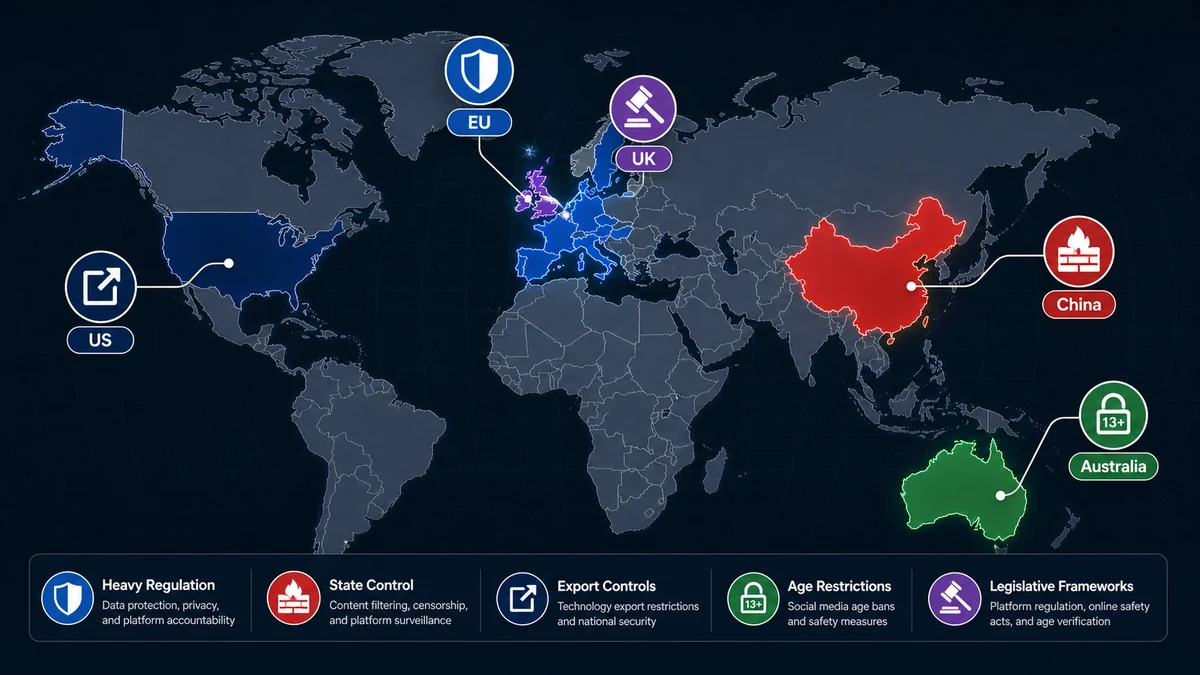 Internet regulation is no longer a local issue; the EU, China, the US, Australia and the UK are each reshaping access to the open web.
What this means for UK businesses
The commercial impact of these shifts is already measurable. eMarketer projects a £1.3 billion drop in UK digital ad spend by 2027 as social media audiences fragment and ad targeting becomes less reliable. Businesses that have built their entire marketing strategy around Instagram, TikTok, and Facebook are facing a shrinking, less predictable return on that investment. The under-16 ban will only accelerate this by removing a significant demographic segment and triggering platform-wide verification changes that affect all users, not just children.
The answer isn’t to abandon social media entirely, but to stop treating it as the foundation of your digital presence. We’ve written about whether social media is dead as a marketing channel; the reality is more nuanced, but dependency is dangerous. If your social media marketing strategy can’t survive the loss of a single platform, it needs restructuring.
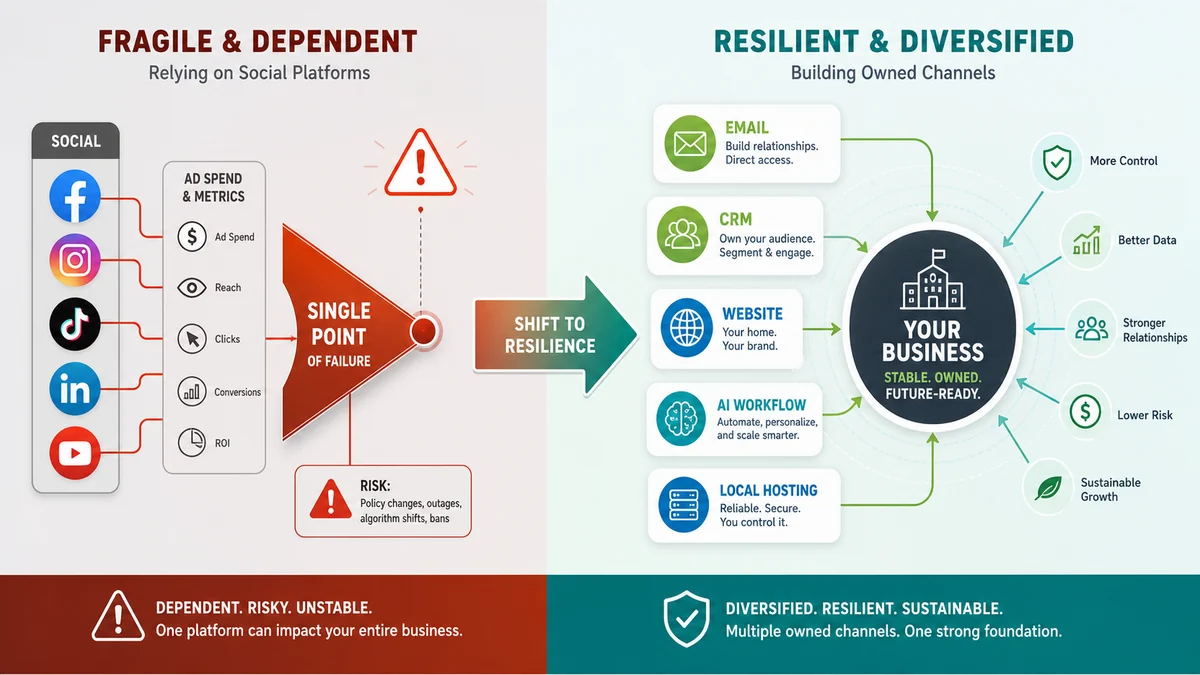 UK businesses need digital resilience built around owned channels, first-party data and portable AI workflows.
Build first-party data assets
First-party data is the single most valuable asset a business can own in this environment. Email lists, CRM databases, customer accounts on your own website: these are channels that no government ban or platform policy change can take away from you. Every customer interaction that happens on a rented platform is data you don’t control. Every interaction on your own platform is data you own permanently. We explored whether websites will outlast social media in a previous article; the evidence continues to stack in favour of owned platforms.
Make your AI tech stack resilient
The Claude Fable 5 shutdown exposed a critical vulnerability in how UK businesses use AI. The 90-minute warning Anthropic gave before pulling access showed exactly how fragile a dependency on a single US-hosted API can be. Businesses that had built workflows, customer service systems, or content pipelines around Claude had no fallback.
A hybrid approach is the only sensible strategy. Run open-source models like Llama or Mistral locally for critical operations that can’t afford downtime. Use commercial API services like GPT or Claude for tasks where the risk of temporary interruption is acceptable. Keep your prompts, fine-tuning data, and pipelines portable so you can switch providers without rebuilding from scratch. Organisations considering local inference can assess local AI servers, including their limits and operating requirements. If you’re unsure where to start, our AI strategy consulting team can help you audit your current setup and build in the right redundancies.
Own the platforms, content, and pipelines
The pattern across all of these changes is consistent: businesses that own their infrastructure, their content, and their customer relationships are the ones best positioned to weather whatever comes next. Rented platforms can change their terms, restrict access, or disappear entirely. Your website, your email list, and your locally hosted tools can’t be taken from you by a policy decision made in Washington or Canberra.
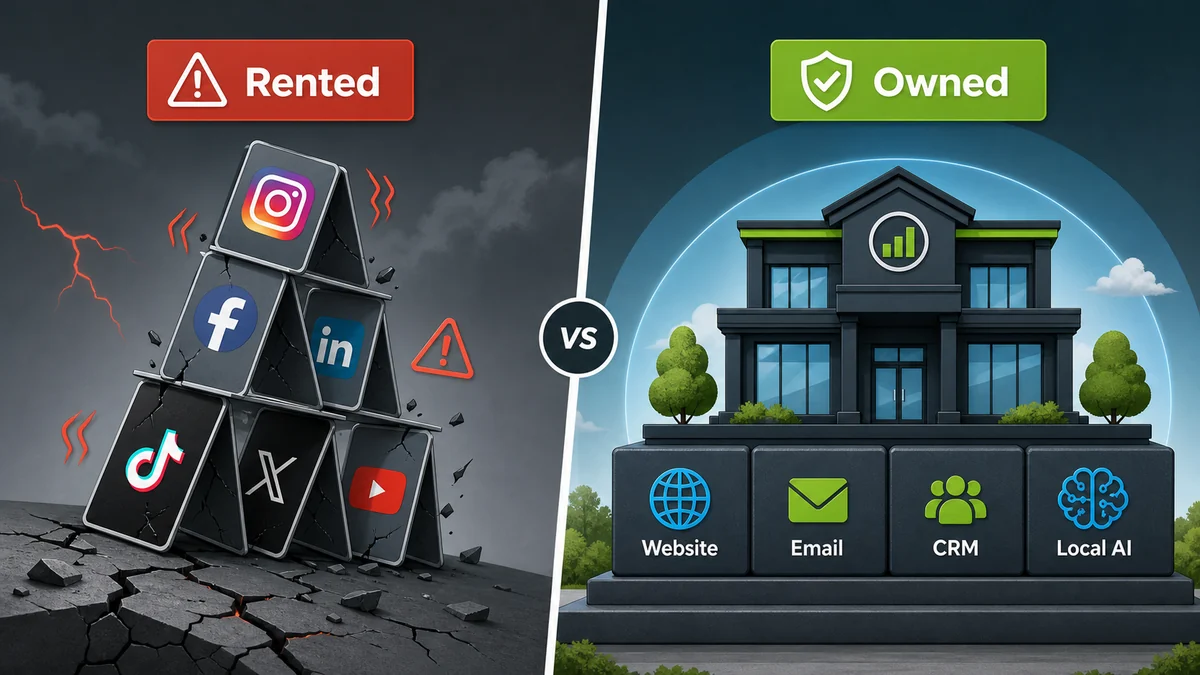 Owned platforms, email, CRM and local AI tools give businesses more control than rented social media audiences.
This isn’t about predicting exactly what will happen next. It’s about building the kind of digital resilience that means your business can adapt regardless of what governments, platforms, or AI providers decide to do. The end of the open web doesn’t have to mean the end of your online presence, but it does require a fundamentally different approach to how you build and maintain it.
What do you think about the US government’s decision to remove the latest Anthropic models? What are your thoughts about the UK and Australia’s social media ban for under-16s? Please let us know in the comments. We would love to hear your thoughts.
Related article: Read our original article on the Online Safety Act and its consequences for websites and SEO