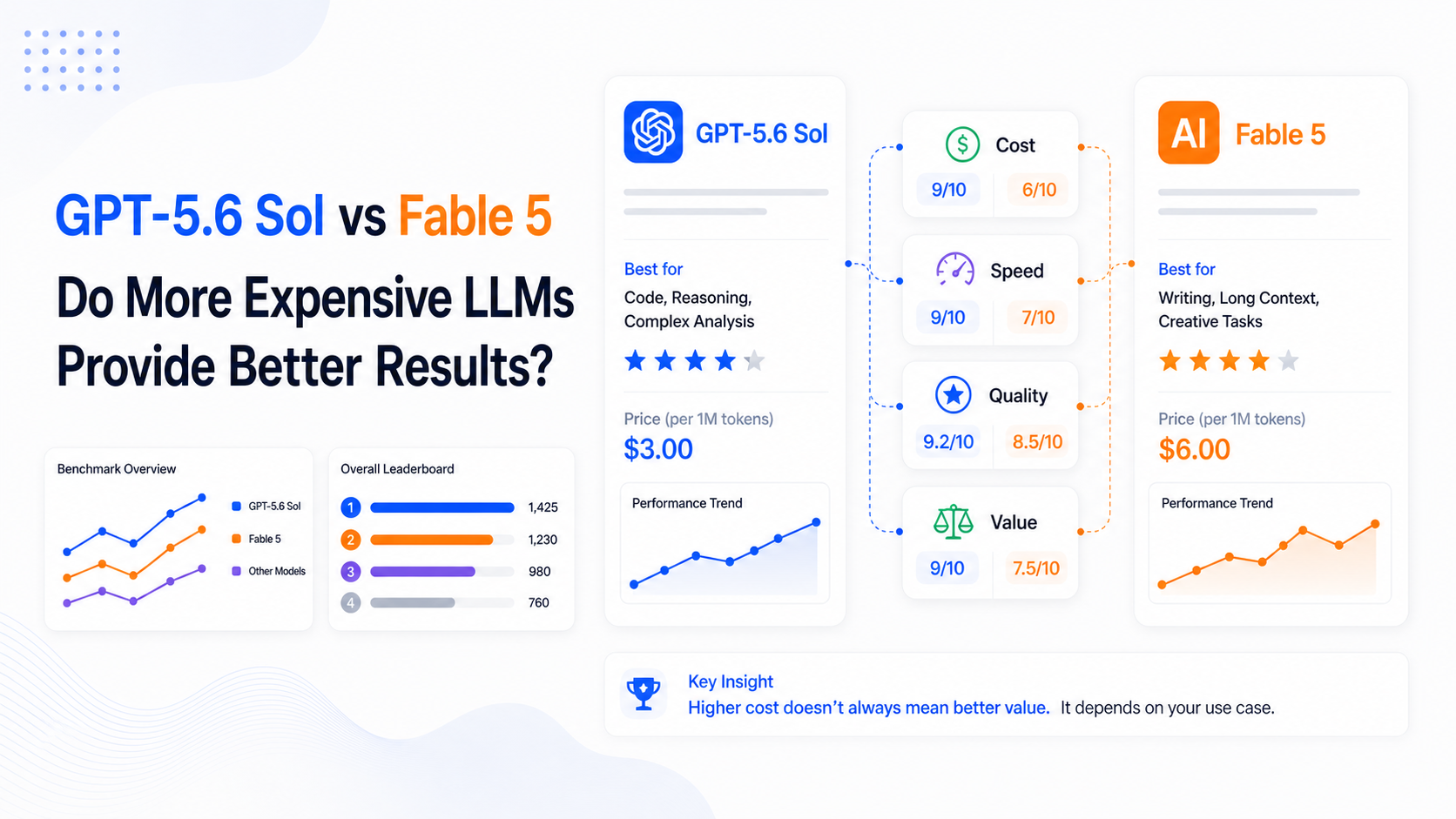
GPT-5.6 Sol and Claude Fable 5 are two of the most capable large language models available to businesses, developers and technical teams. They are also expensive enough to make casual experimentation feel rather less casual once the token meter starts moving.
At their standard API rates, GPT-5.6 Sol costs $5 per million input tokens and $30 per million output tokens. Claude Fable 5 costs twice as much for input at $10 per million tokens and $50 per million output tokens. Both can process around one million tokens of context and generate up to 128,000 output tokens, so the price difference is not simply explained by one model accepting vastly larger files.
The obvious question is whether Fable 5 produces results good enough to justify the premium. A second question follows close behind: if Sol is cheaper, does it offer better value, or does its lower price sometimes conceal additional review, retries and correction? Any honest GPT-5.6 vs Fable 5 comparison needs to account for both.
Having tested these models across coding, web development, research, writing, analysis and finished business material, I do not think price and quality form a neat upward line.
More expensive LLMs can provide better results, but only when the task benefits from the capability being purchased. Paying for deeper reasoning does not help much when the work is routine. Persistence adds little when the answer is already clear. A beautiful presentation does not rescue an incorrect conclusion. Equally, a cheaper model is no bargain if someone spends three hours repairing what it produced.
The useful question is not:
Which model is more intelligent?
It is:
What additional value does the more expensive model produce, and is that value worth more than the difference in cost?
That may sound less exciting than declaring a winner. It is also far more useful when deciding which model to integrate into a real business process.
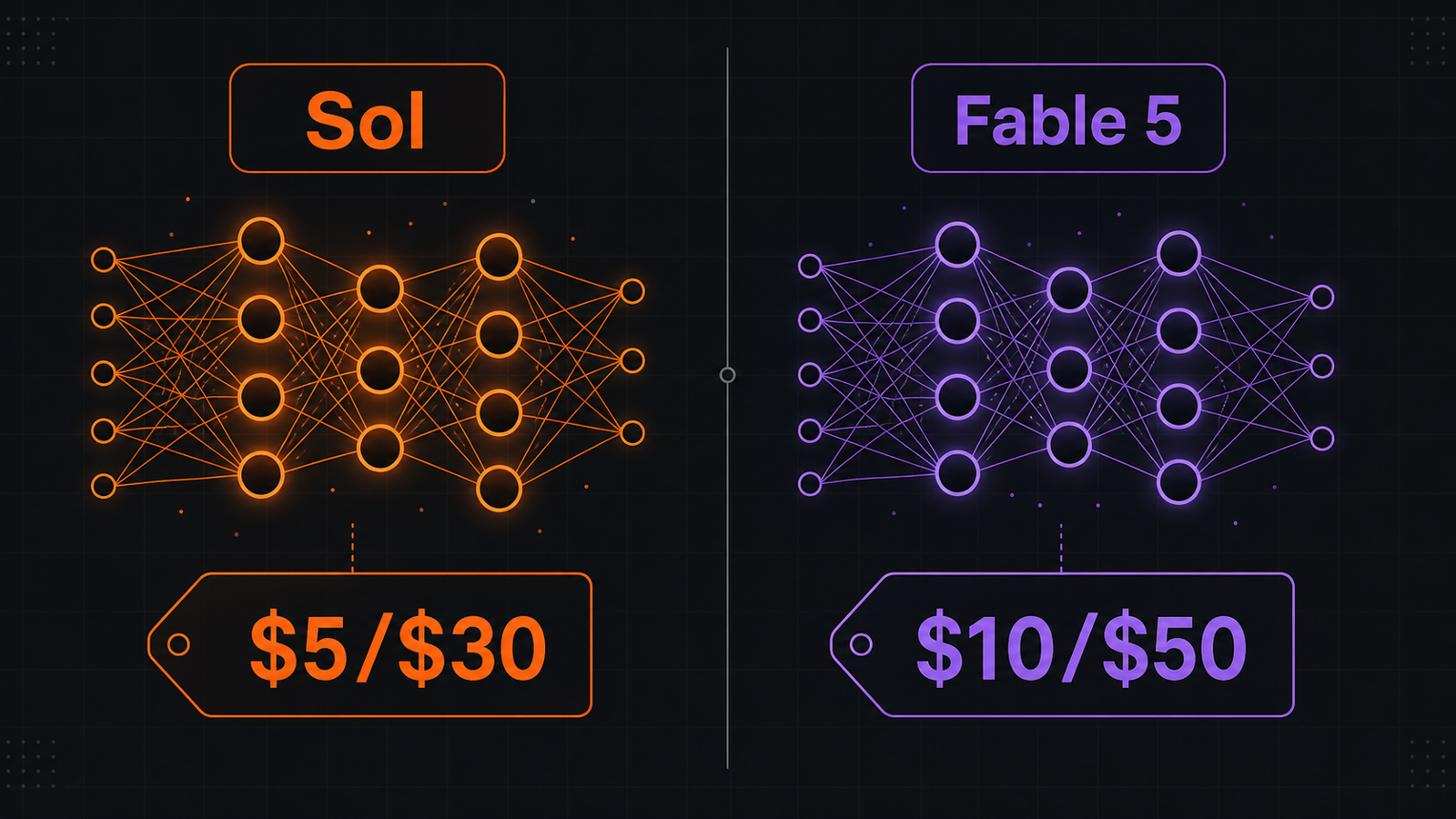
Standard API rates for GPT-5.6 Sol and Claude Fable 5 at the time of testing, before caching, tool calls or reasoning adjustments
Do expensive LLMs provide better results?
Sometimes.
A premium LLM is more likely to earn its price when the task is difficult, interconnected, expensive to get wrong and hard to verify. This can include repository-wide software changes, multi-stage research, complex technical analysis and work requiring reliable use of several tools.
For straightforward extraction, classification, summarisation, formatting and tightly defined production tasks, cheaper models can often achieve the same accepted result. In some cases, they complete the work faster and with less unnecessary reasoning.
The central distinction is between capability, result quality and value.
| Question | What it measures |
|---|---|
| Is the model more capable? | Its potential across many tasks and tests |
| Did it produce the better result? | The quality of its output on this particular task |
| Did it provide better value? | The improvement after accounting for cost, time, review and risk |
A model can win the first question while losing the next two.
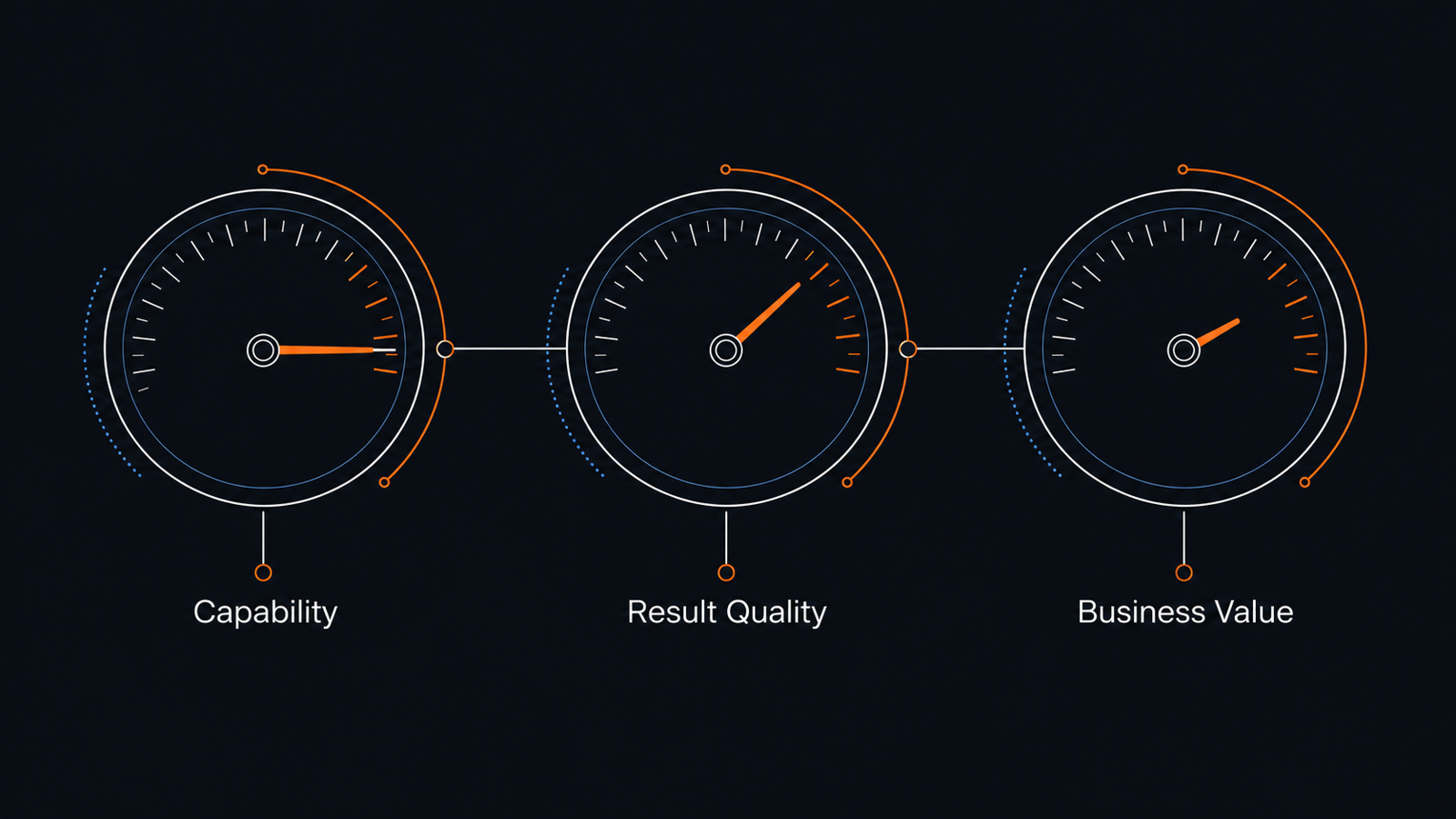
Higher capability does not automatically translate into proportionally better results or greater business value
That is not a criticism of premium LLMs. It is a reminder that businesses buy outcomes, not benchmark prestige.
Why model price and result quality are not directly linked
It is tempting to treat LLM pricing like a product range.
The low-cost model handles basic work. The middle model is the sensible everyday choice. The flagship sits at the top because it is the best.
Model providers encourage some of that interpretation through tier names and product positioning, but API prices reflect more than the quality of a single answer. They can incorporate:
- the compute used during inference
- how long the model reasons
- the number of tools or agents involved
- context and output capacity
- demand and available infrastructure
- safety systems and monitoring
- the intended customer
- market positioning
- the supplier’s commercial strategy
GPT-5.6 makes the relationship especially visible. Sol supports higher reasoning settings, including max, while ultra coordinates multiple agents in parallel. OpenAI’s evolution from GPT-3 through to today’s multi-model families reflects a broader shift from single-model releases to tiered systems built for different cost-to-performance vectors. Fable 5 uses always-on adaptive thinking, with an effort setting controlling how much work the model applies.
In both cases, the model name does not describe one fixed amount of intelligence at one predictable cost. Settings, tools, caching, prompts, source material and the surrounding product all change the result.
Price is evidence that additional resources are available. It is not proof that those resources are needed.
There is also a wider economic trend working against the idea that the dearest model must be best. Research published in late 2025 estimated that the cost of achieving a given level of benchmark performance had fallen by roughly five to ten times per year across knowledge, reasoning, mathematics and software engineering. Yesterday’s flagship performance has a habit of becoming tomorrow’s mid-tier option.
The expensive model may still be stronger. The gap may simply be smaller than the price difference suggests.
What does a better LLM result mean?
Before judging whether an expensive model produces better results, we need to decide what “better” means.
This is where many comparisons go wrong. A response is shown beside another response, and the reviewer chooses the one that looks more complete, sounds more intelligent or has the cleanest design. Those qualities matter, but they are not enough.
Accuracy
Are the facts, calculations, technical decisions and conclusions correct?
A confident answer containing one material error is not improved by an attractive layout. It is simply an error wearing a nice jacket.
Brief fidelity
Did the model follow the actual request?
This is separate from general quality. A model can produce excellent work for a problem that was not quite the problem it was asked to solve.
We have seen this distinction repeatedly in practical testing. Strong models often infer what they think the user wants. When the inference is right, the result feels unusually intelligent. When it is wrong, the same confidence carries the task away from the brief.
Completeness
Did the model finish every required part?
A response may be accurate but omit the final files, validation, references, tests or implementation notes needed to use it.
Completion matters more as AI moves from chat responses into agents carrying out multi-stage work. This is especially relevant for AI web development projects where incomplete implementations create compounding technical debt.
Structural quality
Is the result organised in a way that helps somebody use it?
Good structure is not merely visual. It includes priorities, dependencies, sequencing, evidence and the separation of important decisions from supporting detail.
Presentation
Is the result clear, readable and appropriate for its audience?
Presentation has real commercial value in reports, proposals, interfaces, presentations and client material. It matters far less in a background process categorising thousands of records.
Reliability
Can the model produce a comparable standard again?
One exceptional result does not establish a production capability. Businesses need a performance range, including what happens with awkward prompts, incomplete files and ordinary users.
Revision behaviour
What happens after the first correction?
A model may respond well initially but lose accepted work during revision, change unrelated sections or introduce a fresh problem while repairing the first one.
Most meaningful business work involves correction. First-pass output is only the opening round.
Verification burden
How much expertise and time are required to establish that the result is correct?
A technically sophisticated response can be difficult to review. This creates an awkward possibility: the more convincing the model becomes, the easier it may be to accept a subtle mistake.
Cost of acceptance
What did it take to move the result from “generated” to “approved”?
This includes:
- model and tool charges
- failed runs
- review time
- revisions
- technical repair
- delays
- specialist involvement
- the remaining risk after approval
A better LLM result is not the longest, most polished or most expensive output. It is the result that meets the required standard with the least avoidable work and risk.
GPT-5.6 Sol vs Fable 5 pricing
The headline API comparison is simple:
| Model | Input per 1M tokens | Output per 1M tokens | Position |
|---|---|---|---|
| GPT-5.6 Sol | $5 | $30 | OpenAI flagship |
| Claude Fable 5 | $10 | $50 | Anthropic premium long-horizon model |
OpenAI describes Sol as its flagship model for coding, professional work, design and tool use. Anthropic describes Fable 5 as its most capable widely released model for demanding reasoning and long-horizon agentic work.
At standard rates, Fable costs 100% more for input and approximately 67% more for output. That difference becomes material when a workflow repeatedly sends large repositories, research packs, operating manuals or customer histories.
Yet the standard rates are not necessarily the effective rates.
Both providers offer prompt caching. OpenAI charges 10% of the normal input price for GPT-5.6 cache reads, following an initial cache write. Anthropic also prices Fable 5 cache hits at $1 per million tokens rather than its standard $10 input rate. A workflow repeatedly reusing the same large source may therefore cost far less than a basic token calculation suggests.
Anthropic’s newer tokeniser adds another complication: its documentation says Fable 5 and several recent Claude models can produce around 30% more tokens for the same text than models using the previous tokeniser, although the exact difference depends on the workload. Token prices between providers are not always a like-for-like measure of how much text or work you receive.
Tool calls, searches, computer use, managed-agent runtime and multi-agent execution can add more cost. Independent trackers such as Artificial Analysis maintain live pricing comparisons across providers, making it easier to check effective rates before committing.
The published rate is important. It is not the invoice.
What are businesses buying when they choose a premium model?
Businesses rarely pay more because they need a cleverer paragraph.
They pay for one or more of four things.
More difficult reasoning
The task may require the model to compare evidence, hold several constraints together and identify consequences that are not stated directly.
Premium reasoning helps when a superficially plausible answer is not enough.
Greater persistence
A difficult task often stops being difficult because of one insight and starts being difficult because everything must remain consistent over several stages.
This is where Fable 5 makes its strongest case. Anthropic positions it around long-horizon work, adaptive thinking, task budgets, code execution and programmatic tool use.
Stronger execution
The model may need to decide which tool to use, run it, interpret the result and choose the next action without being guided through every step.
OpenAI presents Sol as both capable and token-efficient in tool-heavy work, with programmatic tool calling designed to reduce repeated model round trips and discard irrelevant intermediate material.
Better finishing
Some models are better at turning research and analysis into material that is ready to present, edit or publish.
This matters in our own work. A technically correct output can still require substantial effort before it becomes a usable strategy, report, interface or client deliverable.
The important point is that these are different types of value.
A business needing persistence should not assume it also needs the most expensive model for every subtask. A team needing good visual hierarchy should not assume the same model is the best choice for a deep backend migration. We see this distinction regularly in client engagements, where the model selection decision sits within a broader set of technology and process choices.
Premium capability has to match the expensive part of the problem.

Premium models sell different types of value, and each type applies to different categories of business work
Where expensive LLMs are more likely to provide better results
There are situations where paying more is sensible.
Multi-stage work with dependent decisions
Consider a task involving research, diagnosis, planning, implementation and testing.
An error in the research changes the diagnosis. A weak diagnosis distorts the plan. The wrong plan can be implemented perfectly and still fail.
The value of a stronger model is not that each stage looks impressive. It is that the relationship between those stages remains coherent.
This is one reason premium models are attractive for complex AI business integration. The model is only one part of the system, but its ability to carry decisions across a workflow can affect everything beneath it.
Large codebases with connected dependencies
A small code change can be handled by many models. A repository-wide change is different.
The model needs to understand:
- where behaviour is defined
- which dependencies will be affected
- what existing tests prove
- which tests are missing
- how data moves through the system
- what must remain backwards compatible
- where an apparently local change creates a wider failure
Our testing supports the view that premium models become more defensible as the number of connected assumptions rises.
Independent research also warns against treating coding output as a simple speed contest. A 2025 randomised trial by METR involving 16 experienced open-source developers and 246 tasks found that early-2025 AI tools increased completion time by 19%, even though participants believed they had become faster. The models and tools have advanced considerably since then, but the study remains useful because it measured completed work rather than perceived activity.
Long source material spread across formats
Some tasks require the model to work across reports, spreadsheets, screenshots, code, diagrams and earlier decisions.
A large context window is useful, but capacity alone does not guarantee that the model will identify the right evidence. The harder part is maintaining relationships between sources and knowing which details affect the answer.
Premium models can earn their cost when missing one connection would invalidate the result.
Work where partial completion has little value
A half-finished summary may still be useful. A half-finished migration is usually not.
The value of persistence rises when the work only becomes valuable after all major stages have been completed, tested and packaged correctly.
This is an important difference between content generation and agentic execution. The cost of a longer run may be justified because stopping early leaves nothing useful to deploy.
Difficult problems with objective verification
Premium models are particularly valuable when they can attempt hard work and an external system can verify it.
Examples include:
- code checked by tests
- calculations checked by formulas
- structured data checked against visible information and platform rules
- accessibility checked against defined criteria
- migrations checked through data counts and functional tests
- outputs compared with a known specification
The model contributes capability. The verification system prevents capability from being confused with correctness.
High-value work where specialist time is expensive
If a premium model saves several hours of senior review, its token cost may be trivial.
This does not mean the model replaces the specialist. It means the specialist spends less time on mechanical preparation and more time on decisions that require experience.
That is the same principle we apply in our AI web design and development work: AI can accelerate research, prototyping, coding and testing, while experienced people retain responsibility for architecture, quality and commercial direction.
Where cheaper LLMs can perform just as well
The easiest way to waste money on AI is to send every task to the most capable model available.
Clearly bounded tasks
When the instructions, inputs and expected output are precise, a cheaper model has less ambiguity to resolve.
Examples include:
- extracting specified fields
- reformatting approved content
- categorising records against fixed labels
- summarising a call into a defined template
- checking whether required fields are present
- converting one structured format into another
There is little value in paying for prolonged reasoning when the task has one clear route.
Repetitive processing
High-volume automation rewards consistency, speed and low unit cost.
A tiny difference per request becomes significant across thousands or millions of runs. In these workflows, a premium model may improve a small proportion of edge cases while multiplying the cost of all ordinary cases. Routine automation tasks like those handled by AI chatbots and business automation systems are a clear example.
The better design is often to let a cheaper model handle routine work and escalate uncertain cases.
Work with strong automatic checks
If a result can be validated cheaply, the system does not need to purchase maximum intelligence for every attempt.
For example, a lower-cost model can generate output that is then checked against:
- a schema
- a database constraint
- a test suite
- a word or character limit
- a calculation
- an approved vocabulary
- a list of mandatory fields
Failures can be retried or escalated.
Tasks where speed matters more than depth
Customers waiting for search suggestions, support triage or an interactive response may value lower latency more than a marginal improvement in reasoning.
The premium model can still be used behind the scenes for unusual or high-consequence cases.
Creative work where more reasoning creates stiffness
More capable models do not automatically reproduce a brand voice more naturally.
In our tests, additional reasoning often improved structure and coverage but sometimes made writing too orderly. The model recognised the content pattern yet smoothed away some of the irregularity that made the original voice recognisable.
This is not universal, but it is a useful warning for AI-assisted content, SEO copywriting and SEO services more broadly. Better reasoning can create a better argument while producing less convincing final copy.
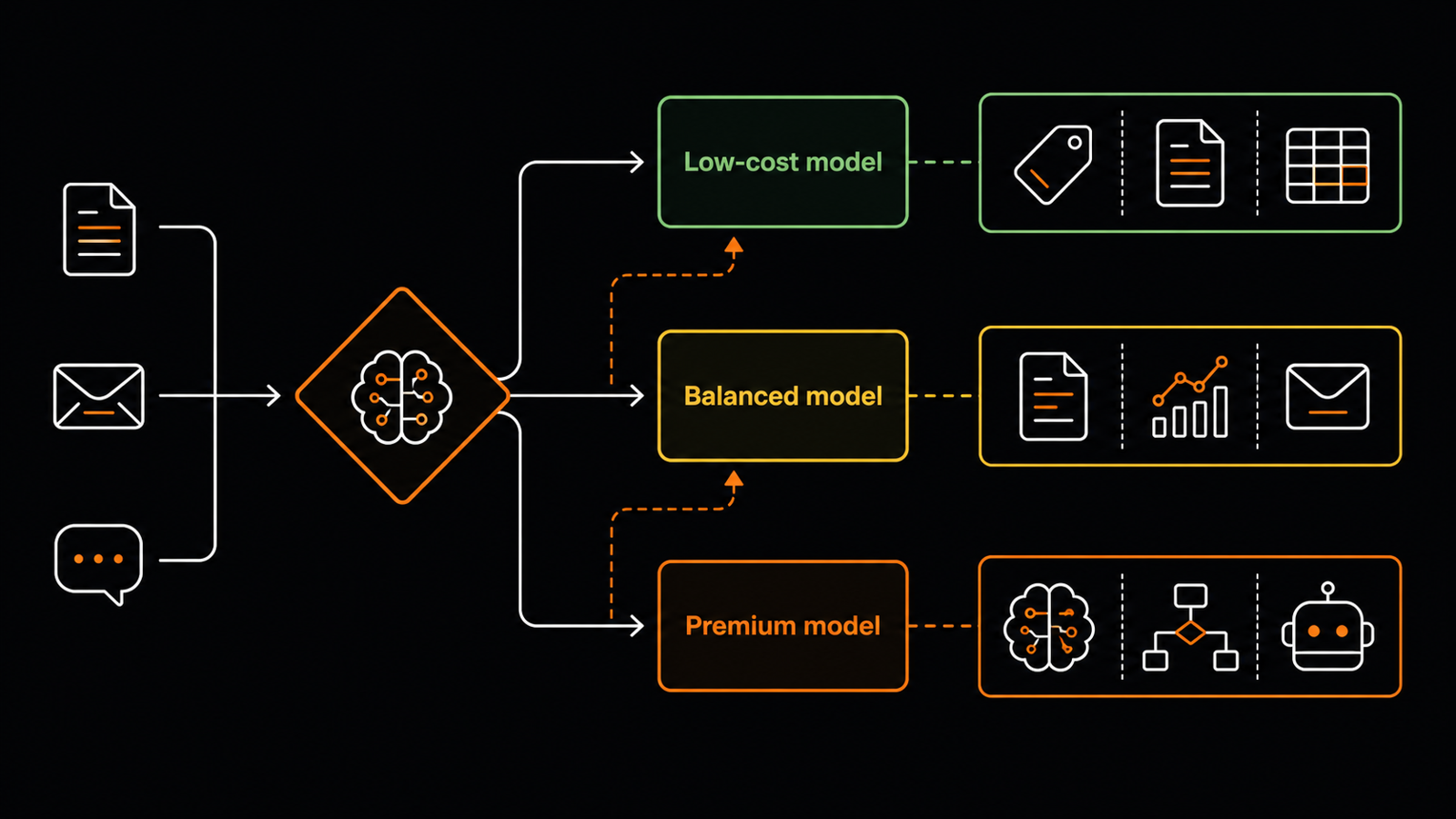
Routing work to the right model tier prevents overspending on routine tasks and underspending on difficult ones
The sensible workflow may be:
- use the stronger model for research, distinctions and technical reasoning
- apply detailed editorial rules
- edit the final copy against approved examples
- keep human judgement over tone
The law of diminishing LLM returns
Model performance normally improves in steps rather than in proportion to price.
Imagine three models completing the same task:
- a low-cost model produces 82% of what is needed
- a balanced model produces 94%
- a flagship produces 97%
The first upgrade removes most of the gap. The second costs much more to improve the final few percentage points.
Those final points may be essential. They may also be commercially irrelevant.
If the task is a customer-facing legal analysis, a small reduction in material errors could justify a large premium. If the task is tagging internal support messages, 94% performance with an escalation path may be entirely sufficient. In a GPT-5.6 vs Fable 5 comparison, this principle holds: both models sit at the top of the curve, and the practical gap between them is often narrower than the price gap.
This is the law of diminishing LLM returns:
As model capability rises, each additional unit of quality tends to cost more, while affecting a smaller share of tasks.
The point where the curve flattens changes by use case.
It arrives early for simple, verifiable work. It arrives much later for difficult research, engineering and agentic workflows.
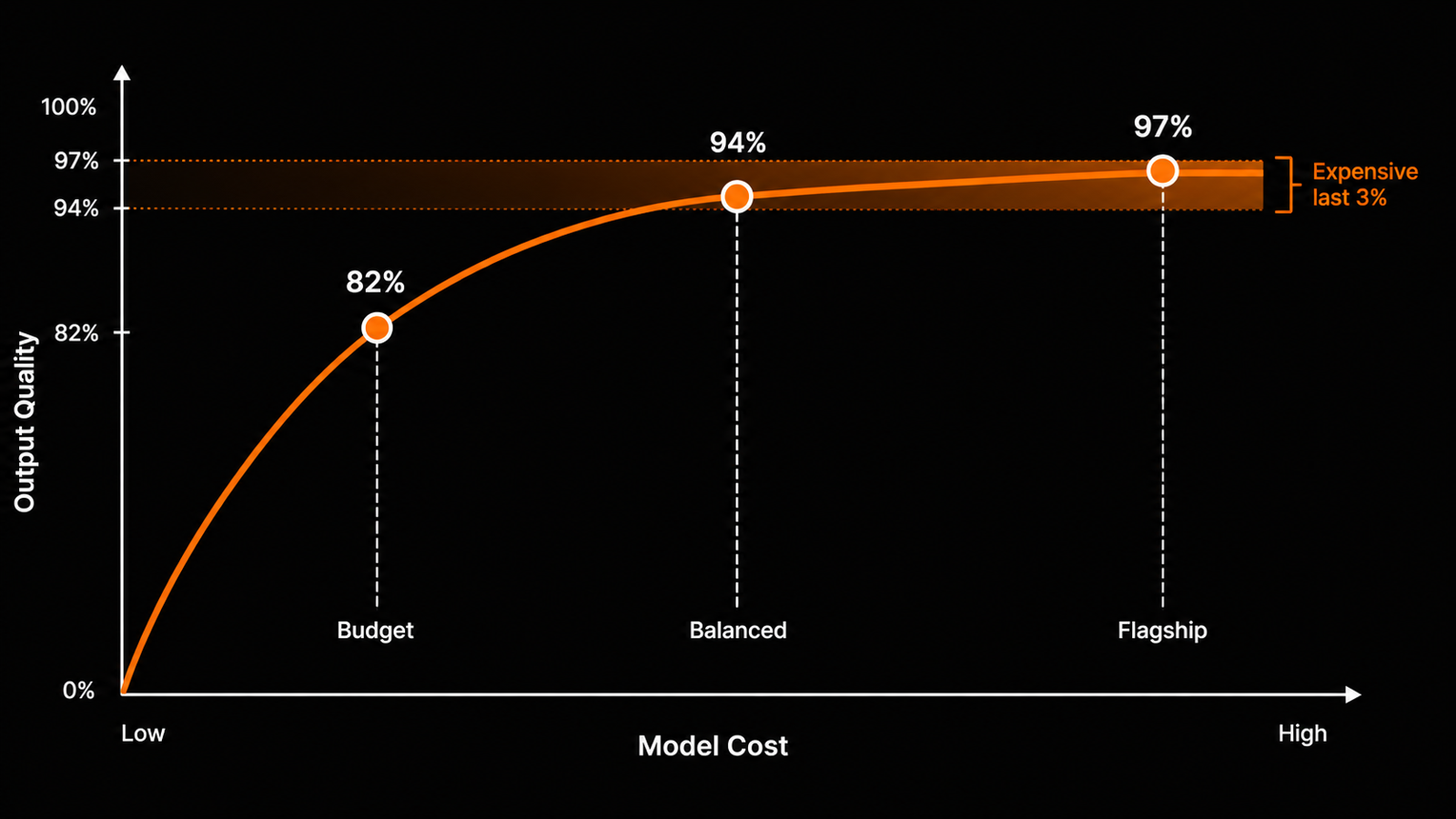
The final percentage points of quality improvement often cost disproportionately more than the earlier gains
This is why benchmark averages can mislead you about how intelligent an AI model really is. Even crowd-sourced comparisons like the Chatbot Arena leaderboard reflect preferences across thousands of general prompts rather than the narrow set of tasks a specific business performs every day. A model may be substantially better on the hardest tasks while producing no meaningful benefit on the work a particular company actually does.
Research into generative-AI evaluation has reached a similar conclusion from a different direction. A 2026 paper examining 28 deployment cases argued that static benchmarks often fail to measure whether AI improves a stakeholder’s ability to achieve a goal in context. Earlier work on evaluation science also called for metrics tied to production performance and refined through repeated use rather than one-off tests. This mirrors the broader shift from traditional SEO metrics to AI-driven search evaluation across platforms like AI Overviews, ChatGPT Search and Perplexity.
The benchmark tells us what the model did in the benchmark.
The business still needs to discover what it does inside the business.
When expensive models create expensive waste
A premium model can be worth every penny. It can also consume the pennies with great enthusiasm.
Unnecessary reasoning
Some tasks do not need an extended plan, several alternatives and a detailed review of each decision. The answer may already be clear.
Allowing the model to continue reasoning can increase token use and delay without changing the accepted output.
Over-engineering
A premium agent may create infrastructure around a problem that needed one direct change.
Extra files, abstractions, agents and tests can appear rigorous while increasing the amount of work somebody must understand and maintain.
More activity is not the same as more value.
Persistence in the wrong direction
Persistence is useful after the model has understood the objective.
Before that point, persistence can magnify an error.
A weak assumption at the start of a long-running task may affect every stage beneath it. The model can produce a complete, tested and beautifully documented solution to the wrong problem.
Impressive, yes. Helpful, less so.
Excessive output
Longer responses create their own review burden.
A concise answer can be checked quickly. A 40-page report requires someone to confirm that the additional detail is accurate, relevant and consistent.
Premium models may reduce the effort needed to create material while increasing the effort needed to approve it.
Agents polishing work past the acceptance threshold
A model that can continue refining may keep working after the result is good enough.
Without clear acceptance criteria, stopping conditions and budgets, additional reasoning can become a paid search for tiny improvements.
Anthropic’s own model-selection guidance recommends defining capability, speed, cost and effort requirements, testing with actual prompts and data, and changing model only where the use case shows a capability gap. It even suggests starting with a fast, inexpensive model for many applications and upgrading only when required.
That is sensible advice, even if it does make model selection sound suspiciously like ordinary engineering.
When a cheaper LLM becomes the costly option
The reverse problem is easier to miss because the API invoice still looks reassuring.
Repeated attempts
A model costing half as much is not cheaper if the task must be run three times.
Retries also consume staff attention. Someone has to identify the failure, rewrite the instruction and review the new result.
Incomplete work
Lower-cost models may stop after the obvious part of a task, leaving difficult integration, testing or edge cases for a person.
This can be a perfectly good trade when the handover is expected. It is a poor trade when the workflow assumes completion.
Hidden repair
Generated code, analysis or content can appear usable until a specialist checks it.
Repair time is often the largest unrecorded AI cost because it is absorbed into normal staff time rather than attached to the model bill.
Escalation after failure
A task may begin with the cheaper model, fail twice and then be restarted with the premium model.
The business has paid for all three attempts and delayed the result.
A tiered system still makes sense, but escalation should happen when confidence is low, not only after obvious failure.
Plausible errors
The most expensive mistake is not always a broken output. It may be a plausible one.
A broken result is rejected. A convincing mistake, the confident kind of error people call an AI hallucination, can pass review, influence a decision or reach a live system.
The stronger the writing and presentation, the more important direct verification becomes.
What Sol and Fable reveal about different types of premium AI
Sol and Fable 5 are useful because they challenge the idea that premium LLMs all sell the same thing.
They do not.
Sol: paying for efficient reasoning, action and finish
OpenAI’s argument for Sol is based heavily on performance per dollar.
The company reports strong results in coding, browsing, computer use, professional analysis and design while using fewer tokens than several earlier or competing models. It also positions Sol as a model that can produce finished documents, spreadsheets, presentations and interfaces rather than stopping at analysis. These are vendor claims and should be treated as such, although they align with much of what we observed in practical use.
The premium appears to purchase a combination of:
- strong reasoning
- decisive tool use
- design judgement
- good information hierarchy
- the ability to turn analysis into finished material
This makes Sol appealing for work crossing technical and commercial boundaries.
An agency report, for example, may require research, calculation, prioritisation, writing, tables and presentation. The ability to carry those elements into one coherent output can reduce handovers between tools and people.
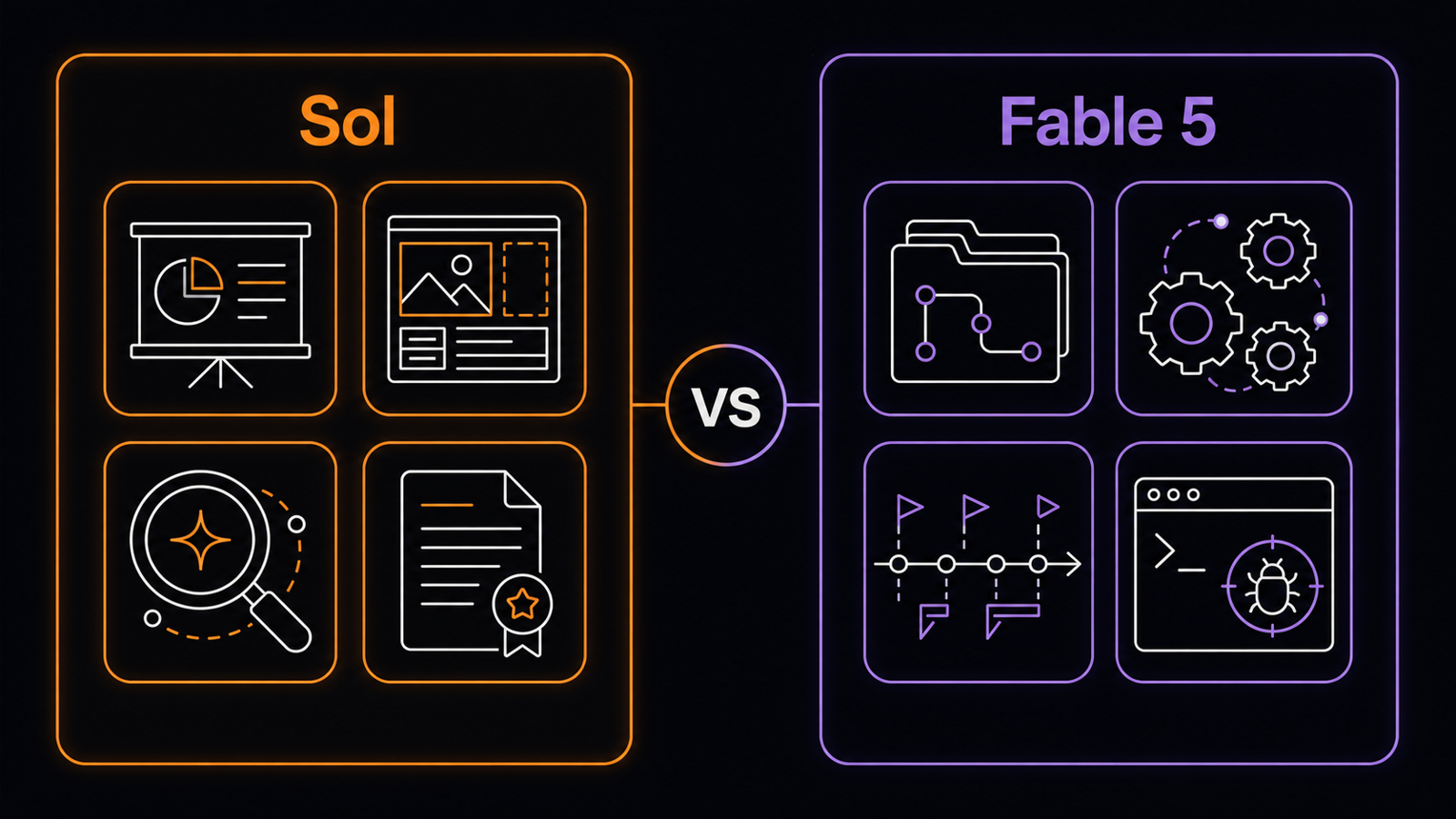
Sol and Fable 5 sell different types of premium performance, making them complementary rather than interchangeable
The weakness is that a polished result can create premature confidence. Sol can produce something that looks finished before every underlying assumption has been checked.
Fable 5: paying for endurance and long-horizon work
Anthropic’s case for Fable 5 is different.
Fable is positioned as the company’s most capable widely released model for demanding reasoning and long-horizon agentic tasks. Adaptive thinking is always active, and the platform includes controls for effort and task budgets alongside code execution, memory and programmatic tool calling.
The premium appears to purchase:
- sustained attention
- extended planning
- persistence across stages
- deeper inspection of large projects
- continued work after an initial approach fails
This is attractive for migrations, difficult debugging, complex research and tasks where stopping halfway leaves little value.
The risk is equally clear. A model designed to continue can continue unnecessarily. It can also carry a mistaken interpretation much further before a person intervenes.
GPT-5.6 vs Fable 5: more expensive, but better at what?
This produces a more useful comparison than asking which model is best.
Sol and Fable 5 can both be premium models while selling different forms of premium performance.
| Premium quality | Sol | Fable 5 |
|---|---|---|
| Decisive tool use | Strong emphasis | Strong, with longer-horizon focus |
| Presentation and visual hierarchy | Clear strength | Useful, but not its main commercial case |
| Bounded professional work | Strong fit | Can be excessive |
| Long-running engineering | Capable | Strongest justification |
| Persistence after failure | Good | Central strength |
| Cost efficiency | Lower standard rate | Higher rate, improved by caching |
| Risk of overwork | Reasoning and polish beyond need | Extended planning and execution beyond need |
This is not a universal scorecard. It is the pattern emerging from our GPT-5.6 Sol vs Fable 5 testing, vendor documentation and independent work.
Why polished output can be dangerously persuasive
Presentation quality is valuable. It is also capable of distracting us.
Across our own tests, some of the most attractive outputs were not the most accurate. The model had understood the general purpose and produced something convincing, but details of the structure, direction or source requirement were wrong.
This is a recurring issue in AI web design. A layout can look modern while failing accessibility, content, usability or technical requirements. An interface can feel complete while an important action does not work.
We encountered the same gap during our vibe coding and agentic coding case study. Early AI-generated work looked finished in preview but contained broken forms, fabricated information, mobile issues and missing SEO requirements. The lesson was not that AI coding was useless. It was that professional quality only appeared after the work was tested against real requirements and failures were converted into permanent rules.
Visual confidence arrives before technical certainty.
That creates three review traps:
The halo effect. Strong typography, structure or writing influences how reviewers judge accuracy.
Reduced scrutiny. A polished result feels as though somebody has already checked it.
Misplaced correction effort. Reviewers focus on minor style choices while missing a structural error beneath them.
The remedy is to separate presentation review from correctness review.
Check:
- whether the result follows the brief
- whether the facts and mechanics are correct
- whether all deliverables are present
- whether it works in the intended environment
- only then, whether it looks good
Premium presentation is valuable after correctness. Before correctness, it is very convincing wrapping paper.
More reasoning is not the same as better judgement
The catch is that LLMs can only reason from the information, tools and objective they receive.
They do not automatically possess the commercial context surrounding a task.
More reasoning cannot repair:
- an inaccurate brief
- missing business knowledge
- the wrong success measure
- an incorrect assumption supplied by the user
- a conflict that nobody has identified
- source material that is already misleading
A model can spend more compute analysing the wrong evidence.
This is where experienced human input remains most valuable. The specialist decides:
- what matters
- what must be preserved
- which trade-offs are acceptable
- what constitutes failure
- when uncertainty requires more evidence
- when the model should stop
The model’s role may be substantial. It can research, write, calculate, implement, test and revise. Responsibility still sits with the people selecting the objective and accepting the result.
This is why our ChatGPT consulting and engineering work focuses on the surrounding system as much as the model: instructions, retrieval, tools, permissions, validation, logging, fallbacks and human approval.
Buying a more capable LLM without improving that system is similar to fitting a larger engine to a car with questionable steering. It will reach the hedge more efficiently.
The Opace LLM Price-to-Value Test
To decide whether a premium LLM is justified, we use six questions.
1. How difficult is the task?
Do not judge difficulty by the length of the prompt.
A short request can require deep reasoning. A long prompt may describe a simple transformation.
Assess:
- the number of dependent decisions
- ambiguity
- source complexity
- technical depth
- number of stages
- novelty
- whether several tools are needed
2. What is the cost of failure?
A minor wording error and a faulty production migration should not receive the same model, review process or level of autonomy.
Consider:
- direct repair cost
- lost time
- customer impact
- reputational harm
- security
- compliance
- data integrity
- reversibility
3. How difficult is the output to verify?
A task with a known answer can be checked cheaply. A strategy recommendation may depend on experienced judgement.
Verification may be:
- automatic
- procedural
- possible for a general user
- possible only for a specialist
- uncertain even after expert review
The harder an output is to verify, the less comfortable we should be with unsupervised model choice based on benchmark scores.
4. Does persistence improve the result?
Some tasks benefit from a model continuing for hours.
Others become more expensive without becoming better.
Ask:
- Is there a genuine difficult middle?
- Will tests provide useful feedback?
- Can the model recover from failure?
- Is each additional stage necessary?
- Is there a defined stopping condition?
5. Does presentation quality affect the value?
Presentation is central to some work and almost irrelevant to other work.
It matters in:
- client reports
- interfaces
- proposals
- training material
- research summaries
- presentations
- customer communications
It matters far less in:
- log processing
- tagging
- extraction
- backend classification
- hidden intermediate steps
6. Can a cheaper model complete most of the work?
Do not ask one flagship model to perform every step simply because it can.
Separate:
- routine from exceptional
- generation from approval
- extraction from judgement
- drafting from verification
- orchestration from execution
The expensive model should handle the part of the process where its capability changes the result.
The LLM price-to-value matrix
The following matrix provides a starting point.
| Task complexity | Failure cost | Verification | Appropriate approach |
|---|---|---|---|
| Low | Low | Easy | Use the cheapest reliable model |
| Low | High | Easy | Use a lower-cost model with strict validation |
| Low | High | Difficult | Improve the process before increasing autonomy |
| Medium | Low | Easy | Use a balanced production model |
| Medium | Medium | Moderate | Compare balanced and premium models |
| Medium | High | Difficult | Use a stronger model with specialist review |
| High | Low | Easy | Test whether a balanced model reaches the threshold |
| High | High | Easy | Premium model with automated checks |
| High | High | Difficult | Premium model, staged approval and human ownership |
This matrix creates a useful correction to the usual model hierarchy.
The most expensive model is not automatically selected for every high-cost task. If a task is easy but costly to get wrong, validation may matter more than intelligence. If a task is difficult but easy to verify, a lower-cost model may make several attempts and still provide good value.
If a task is both difficult and hard to verify, premium capability alone is not enough. Governance becomes part of the solution.
Why businesses should route work between models
The choice between Sol and Fable 5 should rarely be permanent or exclusive. Any GPT-5.6 Sol vs Fable 5 decision works better as a routing question than a procurement one.
A mature AI system routes work.
For example:
- a low-cost model classifies and prepares incoming data
- a balanced model handles standard production
- Sol turns complex research into polished material or completes tool-heavy work
- Fable 5 handles difficult sustained engineering
- a person approves high-consequence decisions
Routing can happen at several levels.
Before the task. Use known task type, source size and risk to select a model.
During the task. Escalate when the model reports uncertainty, validation fails or the task exceeds a defined budget.
After generation. Send failed or low-confidence output to a stronger model for review rather than repeating the entire workflow.
At a component level. Use different models for planning, execution, checking and presentation.
The model performing the most intelligent part of the workflow does not need to perform every administrative step around it.
This is one of the most practical opportunities within AI strategy consulting. Model selection is not a one-off procurement decision. It is an architectural choice about where different levels of capability create measurable value.
Routing also protects against model churn. Sol, Fable and every model beneath them will change. A workflow based on task requirements can swap models without rebuilding its business logic around one provider. Understanding the future of SEO helps illustrate why this flexibility matters: the tools and models behind search are evolving rapidly, and rigid single-provider commitments create unnecessary risk.
How to test whether a more expensive LLM is worth it
Anthropic recommends creating evaluation sets specific to the use case and testing models with actual prompts and data. Its documentation describes a good evaluation set as “the most important step in the process”.
We agree.
A useful business test should not consist of asking two models the same clever question and choosing the response you prefer.
Step 1: Select representative tasks
Choose work the organisation actually performs.
Include:
- routine tasks
- difficult tasks
- edge cases
- incomplete instructions
- large source material
- at least one task where failure is easy to miss
Step 2: Define acceptance before testing
For each task, record:
- the required outcome
- mandatory elements
- acceptable variation
- automatic failure conditions
- verification method
- maximum review time
- maximum revision rounds
If success is defined after seeing the output, the reviewer is likely to reward whichever model made the best first impression.
Step 3: Keep the comparison fair
Use the same:
- source material
- task objective
- tool access
- environment
- output requirement
- acceptance rules
Prompts do not always need to be word-for-word identical. Different models sometimes require different prompting conventions. The objective and information supplied must remain comparable.
Step 4: Record the entire path
Measure more than the final token bill.
| Measure | Why it matters |
|---|---|
| Model cost | Direct usage expense |
| Completion time | How long the workflow took |
| First-pass acceptance | Whether revision was needed |
| Requirements missed | Brief fidelity |
| Failed attempts | Hidden model expense |
| Human review time | Staff cost |
| Correction time | Repair burden |
| New errors after revision | Reliability |
| Deliverable problems | Product and workflow quality |
| Final accepted quality | The result that matters |
Step 5: Test revision
Give each model one realistic correction.
Check whether it:
- repairs the issue
- preserves accepted work
- changes unrelated material
- introduces new errors
- explains its changes
- knows when the instruction conflicts with the original brief
Step 6: Blind the review where practical
Remove the model name before asking reviewers to score the output.
Premium branding creates expectations. Those expectations can influence how people interpret confidence, length and visual quality.
Step 7: Calculate total accepted-result cost
A practical formula is:
Accepted-result cost = model usage + tools + failed attempts + human review + correction + delay + remaining risk
Not every component can be converted neatly into pounds or dollars. Recording it still improves the decision.
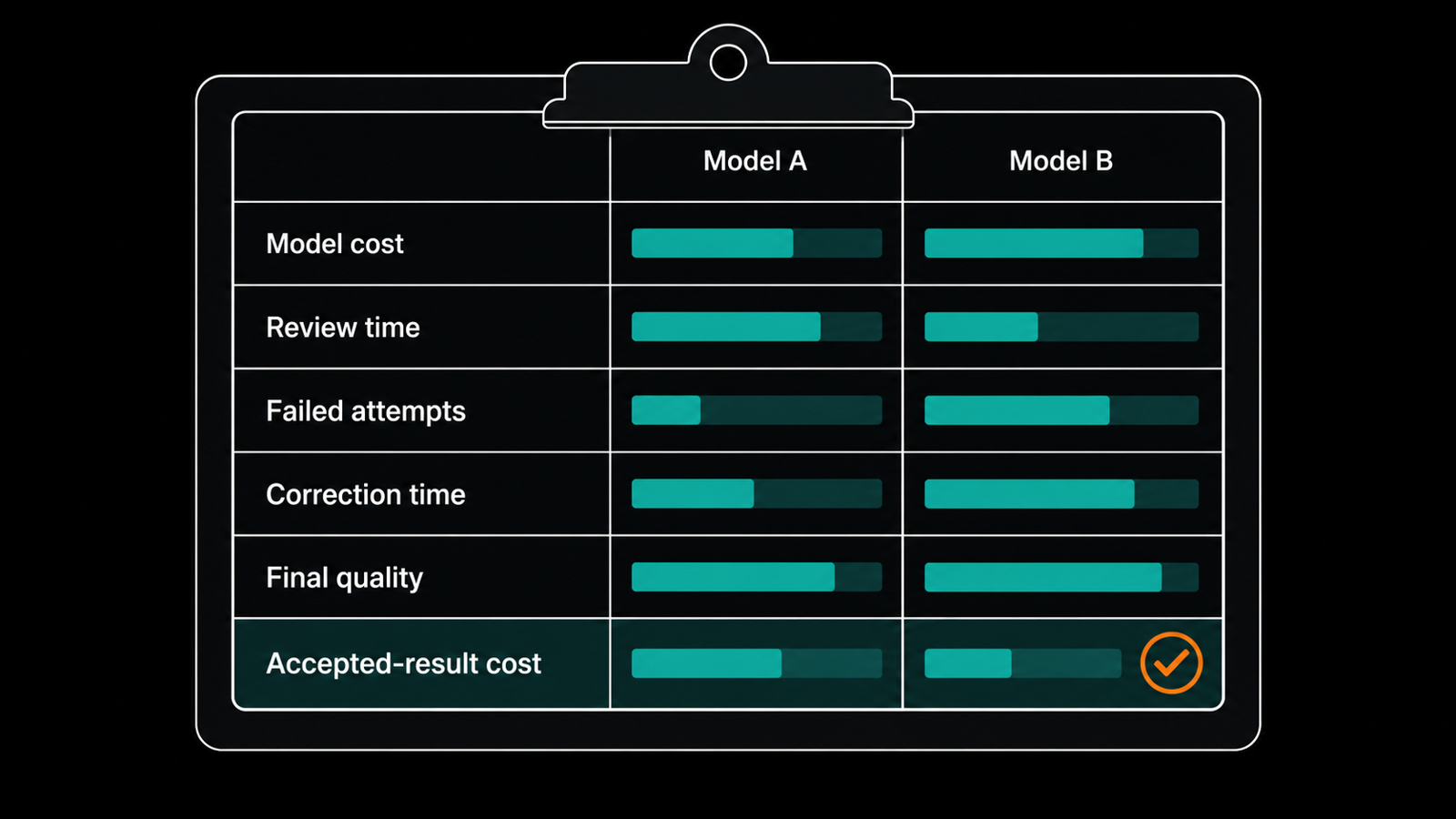
Measuring accepted-result cost rather than token price gives a more accurate picture of which model delivers better value
Step 8: Retest after workflow changes
A model that performs poorly with a generic prompt may become excellent after:
- better source preparation
- retrieval
- stronger rules
- automatic validation
- a narrower task
- clearer acceptance criteria
The goal is not to discover the best model in isolation. It is to discover the best working system.
One recent repository-level coding benchmark illustrates why this matters. Researchers found that the deployed Claude Code product silently substituted another model for Fable 5 on 20% of tasks. Their conclusion was that the product configuration, rather than the named model alone, was the true unit being measured.
That is a minor nightmare for a neat comparison table, but an important insight for production evaluation.
When should you pay for GPT-5.6 Sol?
Sol is likely to justify its price when a task needs several of the following:
- strong reasoning without the highest available token rate
- fast and decisive tool use
- research converted into a finished deliverable
- good visual hierarchy
- interface or frontend judgement
- business and technical information combined
- a high-quality first draft that reduces specialist preparation
- complex but relatively bounded execution
We would consider Sol for:
- technical and strategic reports
- complex research summaries
- tool-heavy analysis
- client presentations
- interface concepts
- frontend implementation
- multi-file work with clear acceptance criteria
- tasks where the output needs to be understood and used by people
Its pricing also makes it easier to justify as a general premium option than Fable 5. For teams already exploring AI marketing tools and AI in SEO workflows, Sol offers a strong balance between capability and cost for content-adjacent tasks.
Sol is less likely to provide good value when:
- the task is repetitive
- the answer is tightly constrained
- visual quality has no value
- a cheaper model already reaches the acceptance threshold
- the work requires days of sustained repository-wide persistence
- the apparent finish makes errors difficult to notice
Its lower price does not remove the need for verification.
When should you pay for Claude Fable 5?
Fable 5 is likely to justify its price when:
- the project cannot be solved cleanly in one pass
- several stages must remain coherent
- the task involves a large and unfamiliar codebase
- tests and failures provide useful feedback
- the model needs to continue without constant instruction
- incomplete work has little value
- the project is worth substantially more than the run
- there are clear task budgets and stopping conditions
We would consider Fable 5 for:
- difficult migrations
- repository-wide refactoring
- extended debugging
- complicated implementations
- long-running research across many files
- tasks where sustained progress matters more than immediate response
- work with robust external validation
Fable is less likely to provide good value when:
- the task can be completed in one or two direct steps
- the output is disposable
- a person must supervise every action
- the work is high volume and low risk
- the workflow lacks a clear definition of “finished”
- persistence is likely to turn into additional activity rather than better output
Fable’s higher price is not automatically a weakness. It simply raises the standard of work needed to justify it.
Final verdict
Do more expensive LLMs provide better results?
They provide access to capabilities that can produce better results.
That is not the same thing.
A premium model is worth paying for when:
- the task is genuinely difficult
- its additional reasoning or persistence addresses that difficulty
- the improvement affects whether the result is accepted
- the saving in review, repair or risk exceeds the additional model cost
It is poor value when:
- the task is routine
- a cheaper model reaches the same standard
- the additional reasoning creates little practical improvement
- the output becomes longer or more polished without becoming more correct
- the workflow has no way to verify what the extra intelligence produced
Between these two models, Sol provides the easier premium to justify for general professional work. Its lower API rate, tool use, knowledge work and presentation capabilities make it suitable for a broad range of difficult but bounded tasks.
Fable 5 has a narrower and potentially more valuable role. Its price makes sense when sustained reasoning, persistence and multi-stage execution are central to completing the work.
I would not make either the default for everything.
The strongest approach is to use cheaper models wherever they meet the required standard, route difficult work to Sol or Fable according to the type of difficulty, and measure the full cost of reaching an accepted result. This is the same principle behind effective content marketing services: match the investment to the task, measure what matters and improve the process rather than simply upgrading the tools.
Pay for the difficulty in the task, not the prestige in the model name.
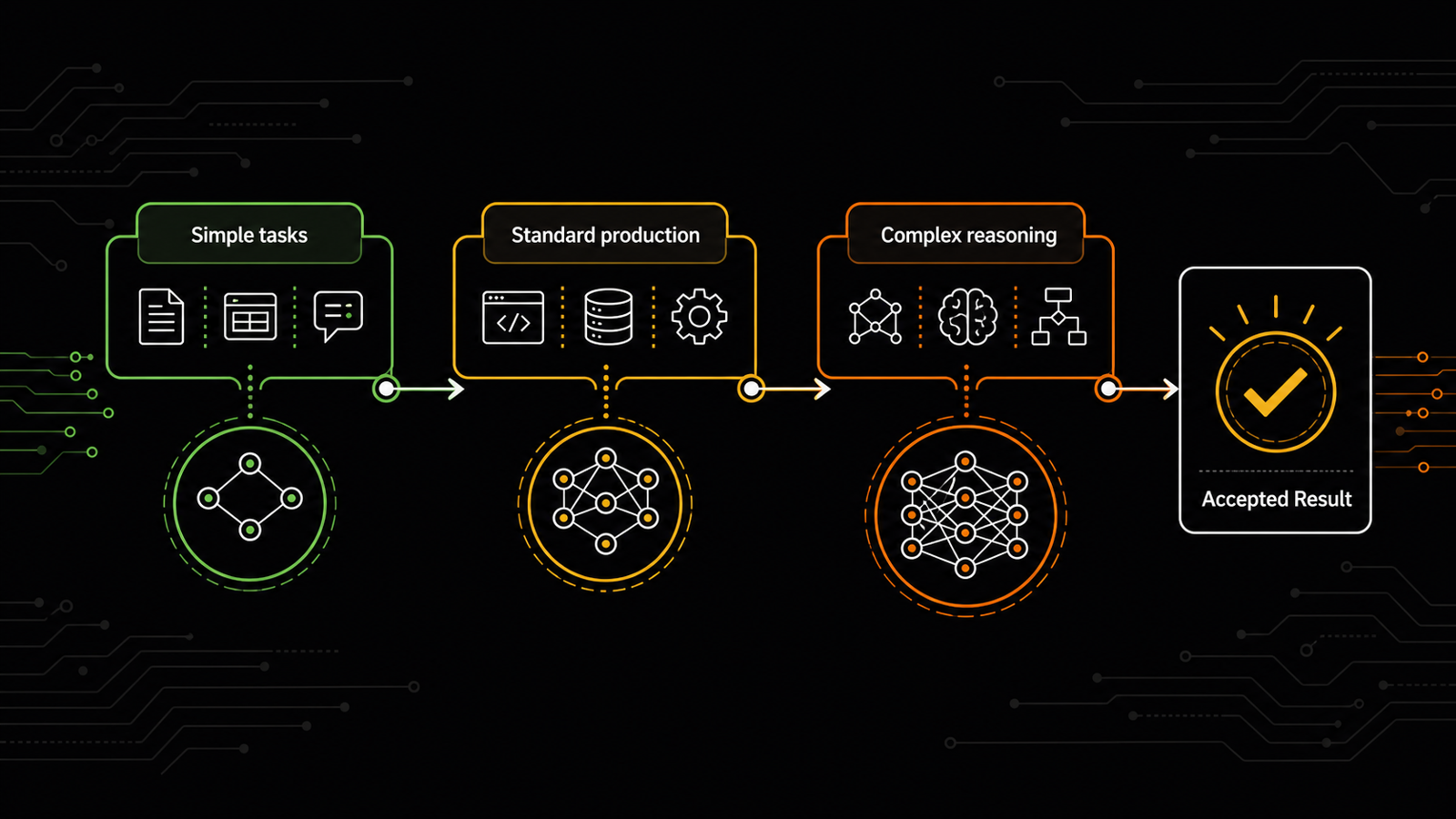
The strongest AI strategy matches each task to the model tier where additional capability actually changes the result
That is less glamorous than placing one flagship at the top of every workflow.
It is also how AI starts paying for itself.
Frequently asked questions
Are expensive LLMs more accurate?
Premium LLMs often perform better on difficult reasoning, coding and agentic benchmarks, but this does not mean they will be more accurate on every business task. Accuracy depends on the prompt, source material, tools, model settings and verification method. A cheaper model can equal or exceed a premium model on tightly defined or routine work.
Is GPT-5.6 Sol cheaper than Claude Fable 5?
Yes. At the prices checked on 10 July 2026, GPT-5.6 Sol costs $5 per million input tokens and $30 per million output tokens. Claude Fable 5 costs $10 per million input tokens and $50 per million output tokens. Caching, tools, reasoning settings and repeated context can change the effective cost.
Which model provides better value?
Sol is likely to provide better overall value for general professional work, particularly research, reports, tool use, presentations, interfaces and bounded coding tasks. Fable 5 may provide better value for difficult long-running engineering where persistence and completion are worth more than the additional usage cost.
Do reasoning tokens improve output quality?
They can. Additional reasoning gives a model more opportunity to inspect assumptions, compare alternatives and revise its work. The benefit depends on the task. For simple or badly defined work, extra reasoning may increase cost without correcting the underlying problem.
Can cheaper models produce the same quality?
Yes. Cheaper models can match premium output when tasks are clear, bounded, repetitive or easy to validate. They are often the better choice for extraction, classification, formatting, simple summaries and high-volume processing.
What is cost per accepted result?
Cost per accepted result is the total expense required to produce work that meets the required standard. It includes model charges, tools, retries, human review, corrections, delay and residual risk. It is more useful than token price when comparing models for production use.
Should a company use one LLM provider?
Usually not. Different providers and model tiers perform better on different types of work. A routed system can use low-cost models for routine processing, balanced models for daily production and premium models for tasks where additional capability changes the outcome.
How can businesses compare LLMs fairly?
Use representative work, define acceptance criteria before testing, provide comparable source material and tool access, measure revisions and review time, and judge the final accepted result rather than the first response. Testing should happen in the same environment intended for production.
How often should businesses retest their models?
Retest when a provider releases a meaningful model update, pricing changes, the workflow changes or quality begins to drift. A scheduled quarterly review is sensible for important production systems, but rapidly changing or high-volume applications may need more frequent checks.
Can premium LLMs replace expert review?
No. A premium model can reduce preparation, execute complex work and perform valuable self-checking. It cannot take responsibility for the organisation’s objectives, trade-offs or acceptance decision. The harder an output is to verify and the greater the consequence of failure, the more important qualified human review becomes.
References and further reading
- OpenAI: GPT-5.6, Frontier intelligence that scales with your ambition
- Anthropic: Introducing Claude Fable 5 and Claude Mythos 5
- Anthropic: Choosing the right model
- Anthropic: Claude API pricing
- Artificial Analysis: LLM model comparison
- Chatbot Arena: Live crowd-sourced LLM leaderboard
Research and AI assistance disclosure: This article draws on Opace’s practical testing across software development, research, content, design and business workflows, supported by current vendor documentation, published evaluations and independent research. AI tools assisted with organising the research and checking the article structure. The author reviewed, corrected and edited all conclusions, pricing and technical claims.
Pricing note: Model features and prices were checked on 10 July 2026 and may change. Confirm current rates with OpenAI and Anthropic before making purchasing or integration decisions.