Can AI invent? The question has left the research labs: courts and patent offices in the UK, Europe and the US have had to rule on it, headlines have credited AI with inventions of its own (we check five of the best known below), and chat models such as ChatGPT and Claude now write so fluently that plenty of business owners assume one could come up with a new product if asked properly. There are really two questions here, and most pages answer them separately. One is legal: can a machine be named as the inventor on a patent? The other is about capability: can a model actually produce something new enough to deserve one? If you are hoping AI will hand you the next patentable product, the second is the one that matters.
We spent most of this autumn at Opace on the second question, and for me it started with a shopping trolley. A family member of mine has mobility issues and values the freedom to go shopping, but struggles with today’s trolleys, and when I went looking for a power-assisted trolley on 16 September 2026 I found only expensive powered walkers. That made me wonder whether AI could invent something better, and then whether it could invent anything genuinely new at all. Over the next 25 days we asked ChatGPT, then Anthropic’s Claude and OpenAI’s Codex (two AI assistants that can carry out research tasks as well as chat), and finally a team of up to 25 AI agents, for ideas that were genuinely new, patentable, cheap to test and commercially worthwhile, and we checked every idea against existing patents and products.
So, can AI invent? Our answer after those 25 days is that it can contribute to an invention, while as a sole inventor it is unproven, and the law in the UK, Europe and the US does not allow an AI to be named as inventor at all. We logged 276 distinct ideas, many of them new over everything our searches found, and none was strong enough to justify a patent application, because none was shown to be non-obvious to a skilled engineer, which is the test a patent turns on.
Invention is one of the hardest of the ten questions in our wider series on whether large language models can become AGI, meaning artificial general intelligence: AI that can match people across most kinds of thinking work. Large language models (LLMs) are the technology behind ChatGPT, Claude and similar tools, and most of what people use them for, such as answering a question, drafting an email or writing code, can be done well by recombining what is already known. Inventing something new and useful, and then defending the claim that it is new, can’t be done that way (the model has to go beyond its training data and the public web, and then show that a skilled person wouldn’t have reached the same place by routine), which makes invention one of the sharpest practical tests of general intelligence, and one a business owner can judge without a laboratory: either the idea survives a patent search and a hard look at whether it works, or it doesn’t.
This article explains what the question means, what the law says, which claims about AI invention stand up and what the published research shows, then what we tested and found, why it came out the way it did, and what the results can and can’t tell you.
What we found, in brief
- 276 distinct ideas, none patentable: after merging duplicates, our list held 276 ideas, of which 69 were promising but unproven and 207 were ruled out. Many are variants of one another, so they add up to far fewer independent inventions than the count suggests.
- 2,161 patent and application numbers checked: plus 566 products and services, counted across the whole study.
- Novelty was the easy part: in a trial on one problem, 17 of 18 ideas from two model families were new over everything the search found, none was strong enough to justify a patent application, and all nine of Claude’s fell short on worst-case physics.
- The ideas converged: five of six separately designed methods for generating ideas reached the same answer to the trolley problem.
- Starting from real failure reports didn’t rescue it: a later round began from public records of equipment failures and wrote ten ideas down in full before any patent searching, and all ten were ruled out.
- AI wrote up 274 of the 276 ideas in about five hours: Claude and Codex wrote all but the two that came from ChatGPT. Our list doesn’t record where every idea first started, but quantity was never the shortage.
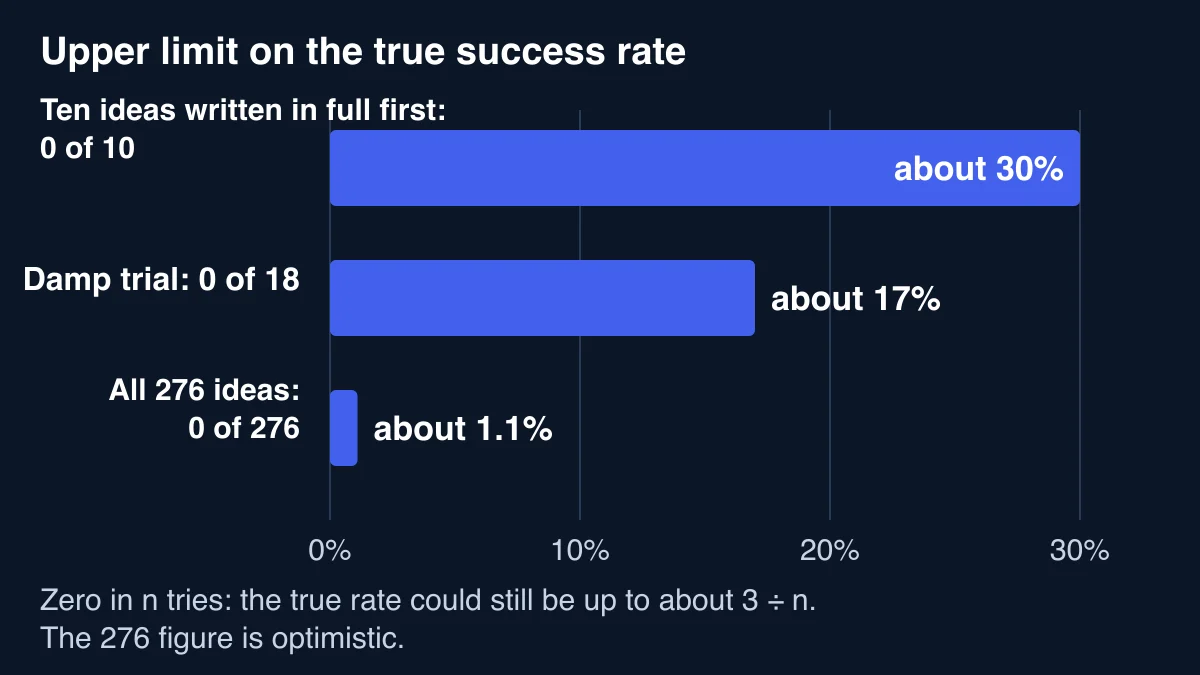
- Zero is not proof: with no successes in ten tries, the true success rate could still be as high as about 30%.
- The law is settled for now: UK, European and US rules all require a natural person as inventor.
Can AI create something new? First, which “AI” and which “new”
“AI” covers systems that behave very differently when you ask them for something new. A chat model such as ChatGPT, Claude or Gemini predicts text in reply to a prompt. A purpose-built discovery system wraps a model in a loop that generates thousands or millions of candidates, scores each one with an automated evaluator and keeps the best, and most arguments about whether AI can create something new go wrong by treating those two machines as one.
Discovery systems have real results to their name: Google DeepMind’s FunSearch, announced on 14 December 2023, paired a pre-trained language model with an automated evaluator and found larger cap sets than were previously known in some settings of a long-studied maths problem. A cap set is a collection of points in which no three lie on a line, and the question is how large one can be. Google DeepMind’s AlphaEvolve, announced on 14 May 2025, paired Gemini models with automated evaluators and produced a data-centre scheduling heuristic that DeepMind says recovers, on average, 0.7% of Google’s worldwide compute. In both cases people chose the problem, built the scorer and checked what came out, and we come back to how these systems work, and what they cost, once the law and the headlines are covered.
When most people ask whether AI can invent in 2026, though, they mean the chat model in their browser. Our study tested exactly that: language models, and AI agents built on them, with web and patent search, and no simulator or scoring function that could tell us automatically which design worked.
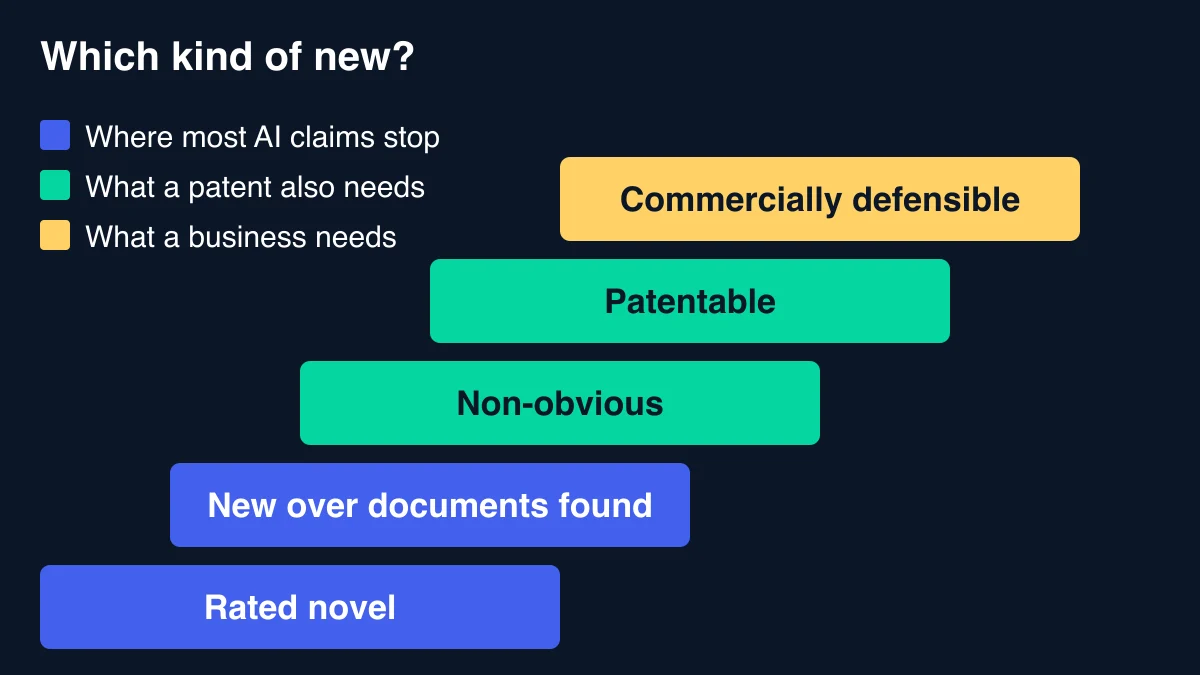
The word new needs as much care as the word AI, and over the study we ended up working with five meanings of it, each harder to reach than the one before.
- Rated novel: a panel of readers judges an idea surprising. This is what most creativity studies measure.
- New over the documents found: no single patent or product found in a search discloses every feature of the claim. This depends heavily on how hard you searched.
- Non-obvious: a person skilled in the field would not arrive at the claimed step as a routine move. In UK law this is inventive step.
- Patentable: new, inventive, capable of industrial application and not excluded, for example as a business method “as such”.
- Commercially defensible: someone will pay for it, and a competitor cannot get most of the benefit by a cheap route outside the claim.
An idea can sit happily on the first rung without ever reaching the third, because an invention, in the sense a patent office means, is a specific technical contribution written as claims. A device that helps people get trolleys over kerbs is only an idea; a claim sets out the parts and the relationship between them that produce the effect, and that is what gets tested against the prior art (everything already published). Our first working definition of a patentable idea was a gap that could be claimed in a patent and survived a full attack using the prior art, which puts it on rung three at the very least.
Our study ran into a trap in the gap between rungs one and two early on. A model can generate an idea it has never seen written down in that exact form, but it cannot infer from that fact that nobody else has conceived it, that no unpublished application exists, or that an examiner would regard the combination as non-obvious. So from the first week we asked for a document number behind every claim that something was new.
Can AI be an inventor? Where the law stands in October 2026
Can AI be named as an inventor on a patent?
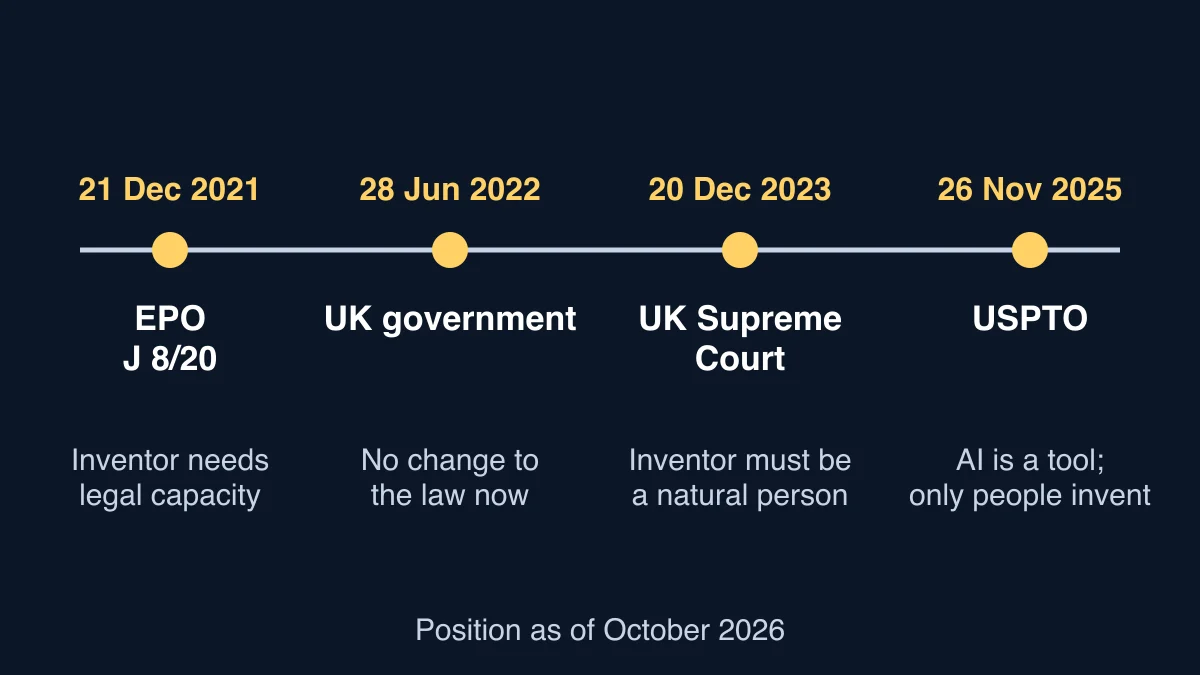
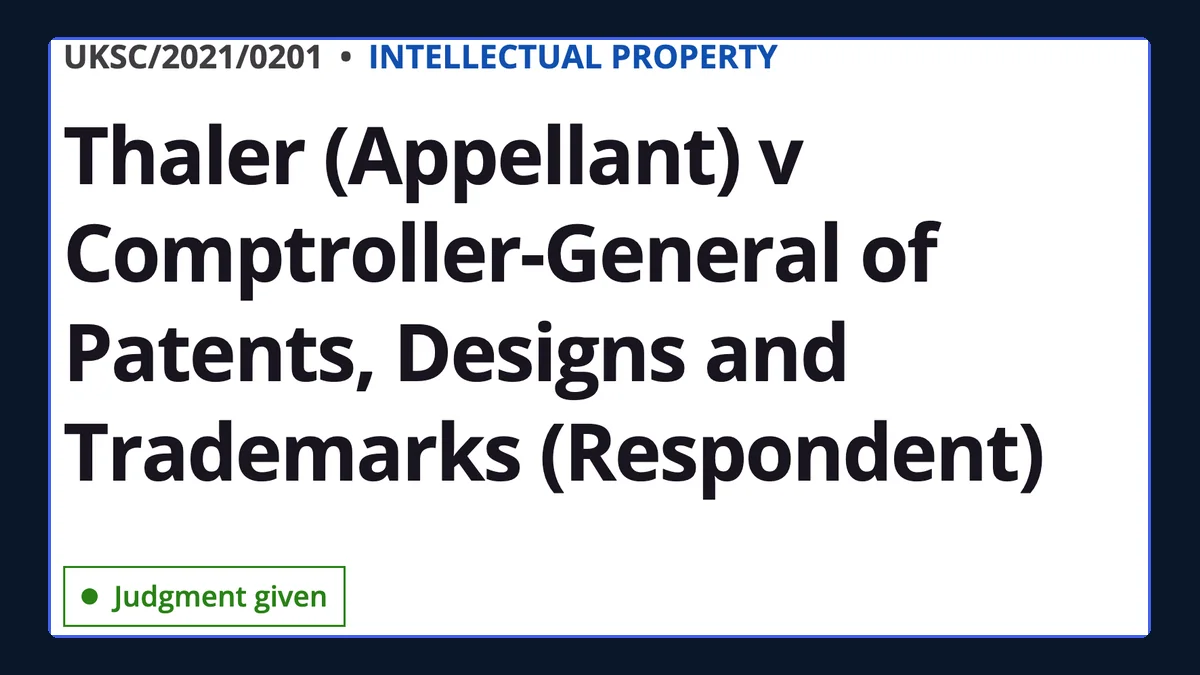
Not in the UK, Europe or the US, and the leading UK case is Thaler v Comptroller-General of Patents, Designs and Trade Marks [2023] UKSC 49, decided on 20 December 2023. Lord Kitchin gave the judgment, with which Lord Hodge, Lord Hamblen, Lord Leggatt and Lord Richards agreed (UK Supreme Court judgment, read 10 October 2026). Dr Stephen Thaler had filed two UK applications in late 2018, one for a new kind of food or beverage container and one for an emergency light and a way of attracting attention, naming his AI system DABUS in place of a person (para 5).
The court proceeded on the factual assumption that DABUS had generated the technical advances on its own, and still held that “an inventor within the meaning of the 1977 Act must be a natural person” (para 56). DABUS, it said, was not and had never been an inventor (para 73). Just as important, the court said what it was not deciding. The appeal did not address the broader question of whether technical advances generated autonomously by AI-powered machines should be patentable (para 48). That is a question for policy and Parliament, and the judges noted that faster AI progress makes it more pressing (para 49).
The European Patent Office reached the same result two years earlier. In decisions J 8/20 and J 9/20 its Legal Board of Appeal held that, under the European Patent Convention, the inventor had to be a person with legal capacity, and it also refused the fall-back request that named no inventor at all (EPO communiqué, 21 December 2021). In the United States, the USPTO’s revised guidance of 26 November 2025 rescinded its February 2024 guidance in full. It states that AI systems, generative AI included, are tools used by human inventors, that only natural persons can be named, and that no new or modified standard applies to AI-assisted inventions (USPTO guidance, read 10 October 2026). So using a model neither lowers nor raises the bar for the human who claims the invention.
Can you patent an AI-assisted invention?
Yes, if a person conceived the claimed contribution and the application meets the normal tests. The UK government consulted on this and published its response on 28 June 2022. It said “A patent may in fact be granted for an AI-assisted invention” (para 78), that it would make no change to UK patent legislation for now (para 79), and that it would keep the area under review. Whether the law should change is still open, since the Supreme Court left the door open for Parliament, but nothing in force in October 2026 lets a machine be the inventor.
The normal tests are in section 1 of the Patents Act 1977: the invention must be new, involve an inventive step (explained below), be capable of industrial application, and not be excluded. Section 1(2) excludes schemes, rules or methods for doing business, and programs for a computer, but only “as such”. So can you patent a business idea? Usually not on its own. A business model, however clever, is not a technical invention, though a technical mechanism inside a business can be.
Patentability is also only one of three separate questions that are easy to merge into one: can I patent it?, am I free to make it in the UK? and is it a business? An expired patent kills novelty and leaves you free to make the product. A live patent owned by someone else may leave your improvement patentable and still stop you selling it in the UK. A product with no patent at all can still be a good business on brand and distribution. Much of the confusion in headlines about AI inventions comes from running those questions together, and, as our study found in its first week, chat models run them together too.
Ownership follows the people rather than the tool, because section 7 of the Patents Act lets a patent go only to the inventor, whom it defines as “the actual deviser of the invention”, to someone entitled ahead of the inventor by law or by an earlier agreement (often an employer), or to their successors. That is why a dated note of who framed the problem and chose the feature matters more than which model produced the first sentence.
The practical risk is disclosure, because a patent needs novelty and public disclosure before filing can destroy it, so many firms keep know-how as a trade secret instead, accepting that a secret protects nothing once a competitor works it out independently. Searching has a blind spot of its own: a UK application is normally published as soon as possible after 18 months from its filing or priority date, so no search can prove that nobody has already filed. We also found no UK authority on whether describing an invention to a hosted chatbot counts as public disclosure, although that search was done by one of Claude’s research agents during our study. None of this is legal advice, but it is the reason every mechanism in this article is described at headline level only.
What is inventive step?
Novelty and inventive step are separate tests, and both the headlines about AI invention and our own results only make sense once you keep them apart. A claim lacks novelty if one document discloses every feature of it. It has an inventive step only if, in the words of section 3 of the Act, it is “not obvious to a person skilled in the art”. An examiner can combine a close document with common general knowledge, a second document or a routine optimisation, which is why adding a feature is the easiest way to make a claim new and does almost nothing for inventive step.
Patent offices have structured ways of asking the obviousness question. The European Patent Office uses what it calls the problem-and-solution approach: identify the closest prior art, work out the objective technical problem the claimed difference solves, and ask whether a skilled person facing that problem would have arrived at the solution. UK courts use a similar four-step test, usually named after the Windsurfing and Pozzoli cases and set out in the UK Intellectual Property Office’s Manual of Patent Practice on inventive step, which strips the claim down to its inventive concept and asks whether the difference from the prior art would have been obvious. Both tests put a competent engineer, armed with the closest documents and ordinary know-how, in front of the problem and ask what they would have done next, so how surprising an idea sounded in a chat window counts for nothing.
Myth or truth: named claims about AI invention
Claims that AI has invented something patentable circulate constantly, so we went back to the original judgment, paper or report behind five of the best known and read them in October 2026. For each one below we give the headline as it circulated, what the original actually says, and our verdict: True, Partly true, Misleading or False/unsupported. Most of these stories turn out to be true about something, and the usual problem is that the headline credits the AI with the whole of a process in which people chose the problem, built the scorer and checked the result, which matters for the legal question as much as the capability one.
The claims are also older than chatbots, since Douglas Lenat’s EURISKO, described in Artificial Intelligence in 1983, was a program that learned new heuristics and domain concepts, and Stephen Thaler patented his earlier Creativity Machine architecture as a device for the autonomous generation of useful information, filed in 1994 and granted in 1997 with Thaler named as inventor. The five headlines we checked run in date order from 2006.
“NASA’s AI invented an antenna”
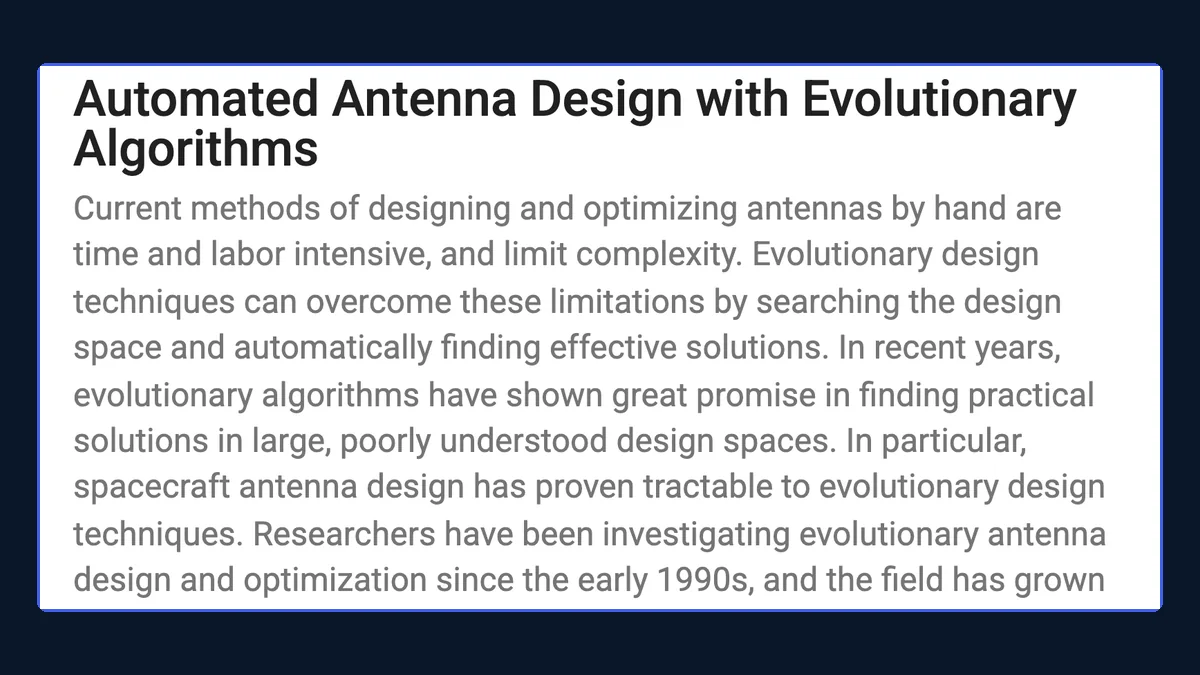
Mike Hanlon’s report ‘Borg’ Computer Collective designs NASA Space Antenna (26 February 2006), now archived on Refractor, said 80 personal computers using artificial intelligence had designed a tiny space antenna. The primary source is NASA’s technical report Automated Antenna Design with Evolutionary Algorithms (Hornby, Globus, Linden and Lohn, 2006), which says the evolved antenna had been tested, adopted as the mission’s baseline design and scheduled to fly, and the report is plain about the division of labour. Evolutionary algorithms automate cut-and-try engineering, it says, but the engineer chooses the technique, the parameters and the basic form of the antenna (a single wire, for NASA’s ST5 small-satellite mission), and the algorithm searches the space the engineer defined. We rate the headline partly true: evolutionary software searched a design space that engineers defined and scored against requirements they set, the result was real flight hardware, and none of it tells us anything about a chat model inventing.
“AI discovered a powerful new antibiotic”
MIT News ran Artificial intelligence yields new antibiotic on 20 February 2020, opening with researchers using a machine-learning algorithm to identify a powerful new antibiotic compound. Behind it is a Cell paper by Stokes and colleagues in which a deep neural network trained by the team predicted antibacterial activity and flagged halicin from a drug-repurposing library. The paper’s own wording is careful: the model predicted antibacterial activity, and the authors, all human researchers, describe halicin as structurally divergent from conventional antibiotics, which is why it was interesting. A model did pick the candidate, so we’d call the headline partly true, with the caveat that people designed the model, chose the library and ran the laboratory tests, on a candidate that was still preclinical and a long way from an approved medicine.
“AI designed computer chips in hours”
Interesting Engineering’s Google Uses AI to Design Computer Chips in Just 6 Hours (11 June 2021) is typical of the coverage. The primary source is Google DeepMind’s AlphaChip post (26 September 2024), which says the system generates superhuman or comparable chip layouts in hours rather than weeks or months of human effort, points to the 2021 Nature paper and a 2024 addendum, and compares its layouts with those from the team that lays out Google’s TPU, its in-house AI chip. What it produces are chip floorplans, the stage of chip design that decides where the main blocks sit on the silicon, scored on layout quality. Our verdict is partly true, since the layouts are real and the headline folds every other stage of designing a chip into the AI’s work.
“AI invented a fractal food container”
The circulating version is IEEE Spectrum’s article A First: AI System Named Inventor (18 January 2022), which reports a South African patent naming DABUS as the inventor of a food container with fractal pits and bulges. The same article reports that a judge in Australia’s Federal Court had ruled the year before that an AI system could be an inventor, and that decision did not last: the Full Federal Court overturned it on 13 April 2022 in Commissioner of Patents v Thaler [2022] FCAFC 62, holding that an inventor must be a human. In the UK, the container was one of the two applications in the Supreme Court’s DABUS appeal described in the law section, where the court proceeded on Dr Thaler’s assumed facts that DABUS generated it and still held that DABUS was not an inventor, and the European Patent Office refused the same applications.
We haven’t checked the South African grant in the official journal, and our verdict doesn’t rest on it. We’d call the headline misleading, because a grant records the inventor the applicant named, the container application itself is real, and every appeal court or appeal board we know of to have examined the question has refused to accept an AI as inventor.
“AI discovered 2.2 million new materials”
Google DeepMind’s own post was headed Millions of new materials discovered with deep learning (29 November 2023). The primary source is the GNoME paper in Nature, which reports 2.2 million crystal structures predicted to be stable, 381,000 of them new entries among the most stable known compounds (what materials scientists call the convex hull), and 736 that had already been made independently in experiments. DeepMind’s post itself says 380,000 of the predictions were the most stable and calls them promising candidates for experimental synthesis, which is a fairer summary than its headline. We rate the headline misleading: the search is a real advance in computational prediction, and the 2.2 million “discovered” materials are predicted crystal structures, of which the paper counts 736 as already made in experiments, with none of them a tested or patented invention on the strength of the paper.
What the five claims have in common
In every case we checked, from EURISKO in 1983 to GNoME forty years later, a person chose the representation, the objective or the test, and where there was a patent a person was named on it. The headlines tend to compress those decisions out, which is why the questions worth asking first of any new claim that AI has invented something are who chose the problem, who built the test, and whose name is on the filing. The research literature asks sharper versions of the same questions, starting with what changes when a system has an automatic way to score its own candidates.
Can AI innovate? What a built-in scorer changes
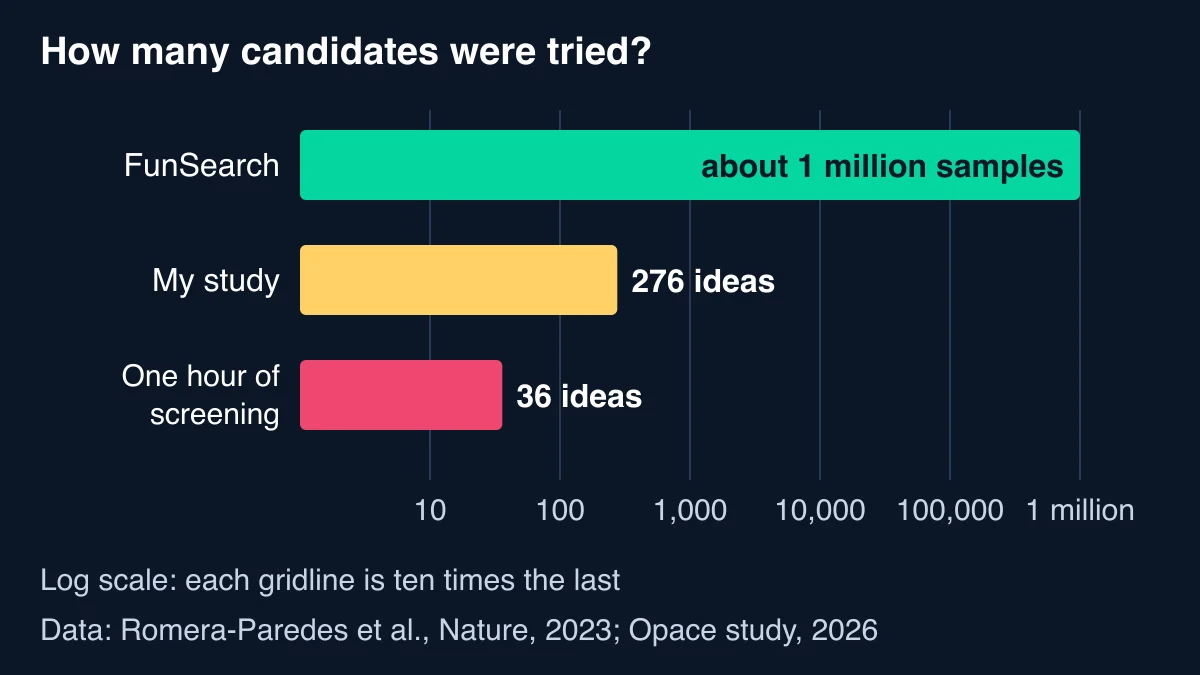
The discovery systems that have produced genuinely new results all have a scorer, and FunSearch is the clearest case. Its Nature paper by Romera-Paredes and colleagues, published in December 2023, is unusually candid about the cost. According to the paper, its results took on the order of a million samples from the model, and for one particularly hard case, the cap set in eight dimensions, “only four out of 140 experiments” found a cap set of size 512, a success rate of about 3%. The paper even explains that its authors chose a fast-inference model over a slower, higher-quality one, because the method depends on sampling so heavily.
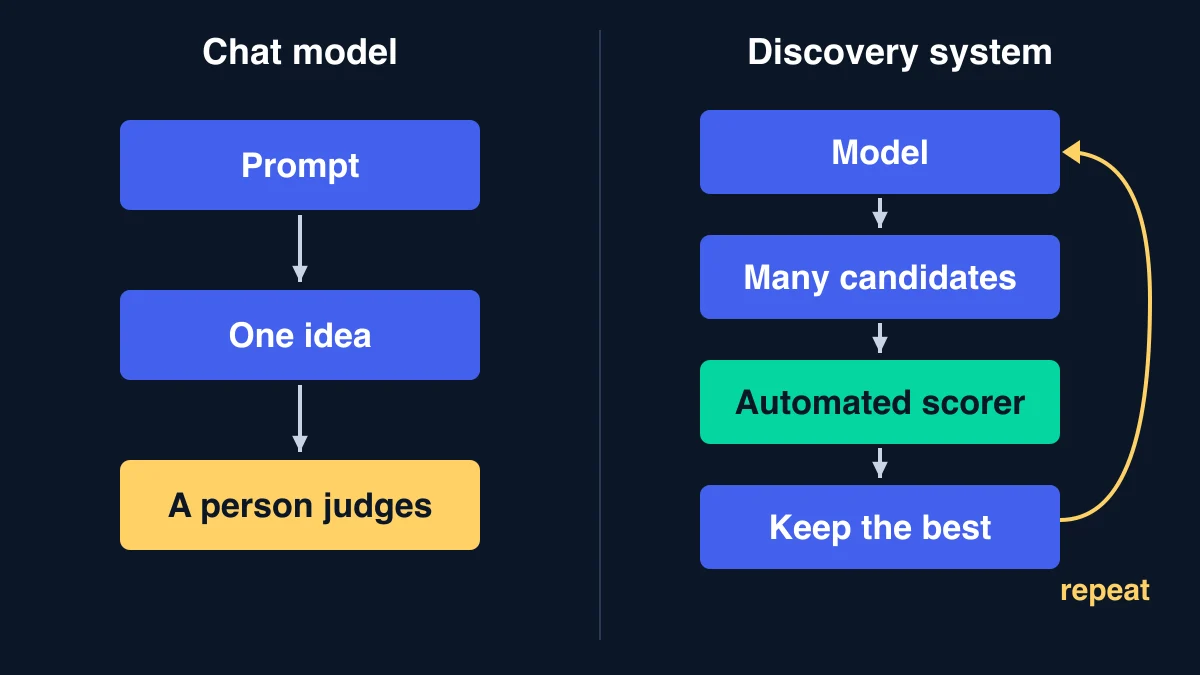
That is what generate-and-test at scale looks like, and a million tries is affordable only because a program can score each one in a fraction of a second. On the hardest case, most complete runs of a system with a perfect scorer still failed and the method still worked, a hit rate no person judging candidates one at a time could live with. AlphaEvolve works the same way; DeepMind describes it as pairing the creative problem-solving of its Gemini models with automated evaluators that verify answers, which is how it found the data-centre scheduling heuristic mentioned earlier. Drug discovery, where a model scoring a library of molecules picked out halicin, is the field where this kind of screening looks most promising, and our series covers what AI drug discovery can and can’t promise in its own article.
Maths has the same advantage, an established system of rules and a way to check answers, which is a large part of why AI became so strong at maths while invention stayed hard, and DeepMind’s own description of FunSearch says the evaluator guards against hallucinations and incorrect ideas. Most inventions have nothing comparable. There is no program that returns a number for is this non-obvious to a skilled person, will a person with heavy shopping use this at a kerb or will a buyer pay for it, and where those are the questions, the scorer is a person and the search moves at a person’s pace.
Chat models, meanwhile, have learned to reason at length. When we asked in 2024 whether OpenAI’s o1 was the biggest AI inflection point yet, we described o1, a model trained to work through a problem step by step before answering, as a shift from making models bigger to making them reason more deeply, and that kind of reasoning is at its strongest where an answer can be checked. So can AI innovate? In bounded domains with a reliable scorer, clearly yes, and FunSearch and AlphaEvolve found results people had not. Outside them, where the evaluator is a patent examiner, a kerb and a customer, the question is open, and that is the situation our own study tested.
Can AI have original ideas? What the research shows
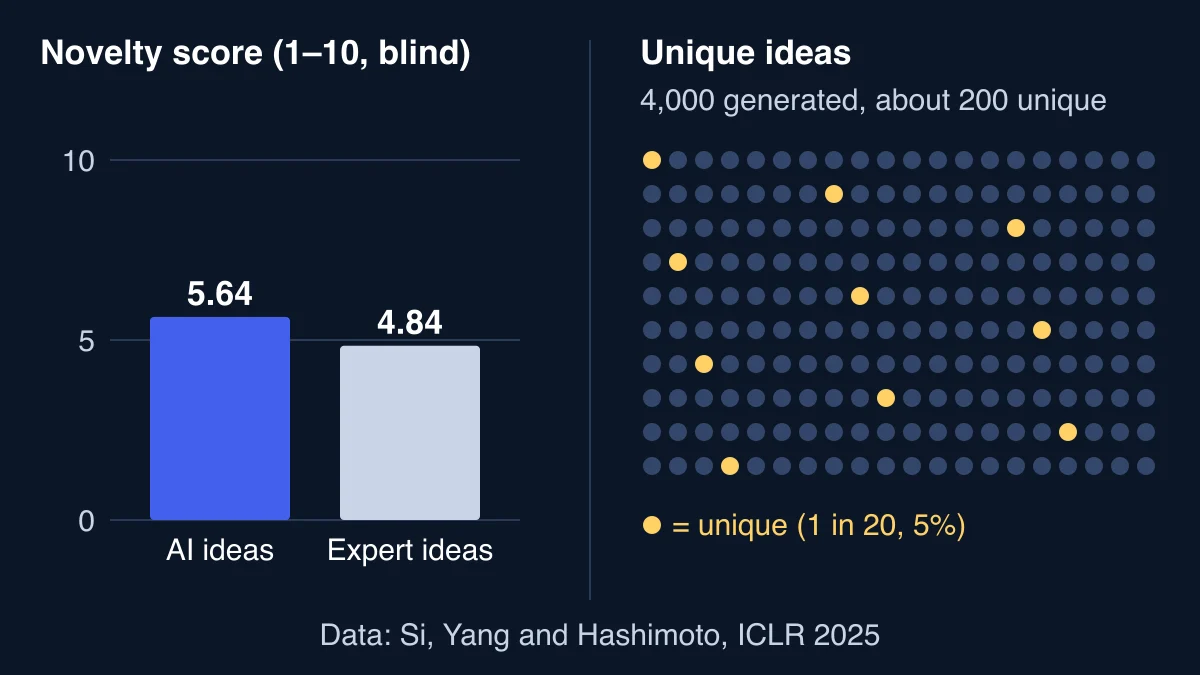
The best evidence on whether AI is creative in the research sense comes from a blind study by Chenglei Si, Diyi Yang and Tatsunori Hashimoto, who recruited more than 100 researchers in natural language processing (NLP), the field that studies language AI, to write research ideas and to review AI-generated and human ones blind (Can LLMs Generate Novel Research Ideas?, ICLR 2025). The AI ideas were “judged as more novel (p < 0.05) than human expert ideas”, meaning the difference was statistically significant, with mean novelty scores of 5.64 against 4.84 on a 1–10 scale in one of their tests, and were slightly weaker on feasibility.
The same paper reports that when the system generated 4,000 seed ideas on one topic, only about 200 were non-duplicates, roughly 5%, and the way the authors counted them is worth knowing: they encoded every generated idea and treated it as a duplicate if it was more than 0.8 similar to any earlier idea on the same topic. As the agent kept generating, the share of new non-duplicates in each batch kept falling and the running total of unique ideas levelled off, so generating more mostly produced more text. Its authors list the unreliability of LLM self-evaluation and the lack of diversity in generation as open problems.
A separate experiment by Doshi and Hauser, published in Science Advances in July 2024, found the same pull towards sameness in fiction. Writers who were given story ideas by an LLM produced stories that outside readers rated as more creative, with the biggest gains for the least creative writers, but the AI-assisted stories resembled one another more closely than stories written without AI, which the authors describe as a social dilemma: each writer is better off, while the group produces a narrower range of new work.
The Si team then tested what happens next. In The Ideation-Execution Gap (June 2025), 43 expert researchers carried out ideas from both sources, and the scores of the LLM-generated ideas fell significantly more than those of the expert-written ideas on every evaluation measure. The novelty lead at the idea stage closed once the ideas were executed, and on many measures the human ideas ended up ahead.
Our own earlier testing at Opace had pointed the same way, in a milder form. When we ran our early AI copywriting tests in January 2023, our verdict on the output was that it felt “very dull and repetitive”, and the copy has improved beyond recognition since then. Images show the distinction most clearly. Our review of GPT-4o image generation showed the model restyling a holiday photo into a new cartoon style from a one-line prompt, and our March 2026 piece on the DLSS 5 AI art controversy covered Nvidia’s DLSS 5, a graphics feature that uses AI to redraw game scenes as they play, and critics’ complaint that it overrode artists’ intent with homogenised, AI-smoothed faces. Both outputs are new in the everyday sense, because nobody drew them before, and both are recombinations of styles the models had seen. That kind of creativity is real, and it is exactly what fails inventive step when the parts being recombined are mechanical, since a skilled engineer could have predicted the result.
So, can AI have original ideas? In the sense the Si study measured, yes: AI can be creative enough to produce ideas a blind panel finds more novel than experts’ ideas. Being original in the sense a patent office means is a different test, and really four tests in a row. A blind rating of a short write-up measures surprise and presentation; getting through a patent search measures whether one document discloses the claim; inventive step measures whether a skilled person would find it obvious; and working once built measures physics. The Si follow-up found AI ideas losing ground at the fourth, and neither Si paper tested patentability, which is the gap our own study set out to probe.
How we ran the test
Those studies left the question we most wanted answered: what happens when a chat model with web and patent search, and no scorer, is asked for one patentable invention, and its ideas are checked the way a patent office would check them? I founded Opace in 2008, so I tend to judge an idea the way a business owner does (would someone pay for it, could we build it, and could a competitor copy it the following week?), and that habit shaped this study more than any theory of intelligence did.
I went in doubtful, too: early in the study I noted to Claude that I had never felt genuine creativity or innovation was a strength of language models, and that the spark probably still needed to come from a person, and in the same message I said I was still convinced there was something to find. So I started out doubting the models and still hoping the search would turn up a gap.
What we did
The study ran from 16 September to 10 October 2026 and moved through four stages, each prompted by the failure of the one before.
- ChatGPT (16 and 26 September): one conversation about trolleys, partly by voice, turned from does this product exist? into could a better one be invented and patented?
- Claude and Codex (from 27 September): we then moved to two tools that do more than chat. Claude Code is a version of Anthropic’s Claude that works with files on a computer and can hand research jobs to helper agents running in parallel. Codex is OpenAI’s equivalent, running OpenAI’s GPT models, and is a separate product from the ChatGPT app. Up to six Claude and Codex conversations ran in parallel on 27 September, and every idea went into one shared list with its sources. Most of the findings below come from this stage: the 276 ideas, an experiment with six methods for inventing, a trial on one problem and, in early October, a round that started from public records of equipment failures.
- A team of AI agents (early October): the last stage used a team of up to 25 AI agents working in one shared workspace, each with its own role, including an idea generator, a patent and gap analyst and an agent set up to argue against the others. By then much of the team’s work had turned to software business ideas, which are judged as businesses more than as patents because of the business-method exclusion described above, so this article draws only on what the team did on invention.
- A debate (10 October): in a 46-minute conversation, we put the whole result to ChatGPT and asked it to explain the failure.
The method itself changed about 20 times over the 25 days, as each failure suggested a fix, so the four stages are not one experiment repeated.
What counted as patentable
To stop the models, and ourselves, from talking ourselves into a weak idea, we asked for a deliberately high bar, and Claude drafted the six desk checks that set it. An idea counted as strong enough to justify a patent application only if it passed all six, each backed by logged evidence:
- New: no single patent or product the search found disclosed every feature of the claim.
- Not obvious: it survived five attacks of the kind a patent examiner would make.
- The new part does the work: take the new feature away and at least half the benefit should disappear (a knock-out test).
- Hard to design around: no cheap way for a competitor to get most of the benefit by a different route outside the claim, which patent people call a design-around.
- Works in the worst case: a first-principles physics calculation still showed at least twice the minimum useful effect, even after every assumed input was varied by 30% either way.
- Can make money: published evidence of buyers and a plausible route to a multi-million-pound business.
An idea that cleared some checks but left at least one unresolved was promising but unproven, and one that clearly failed a check was ruled out. Where this article calls an idea “patentable”, it means one that cleared all six, although strictly only an examiner or a court can decide that.
Two further rules made the study safer and narrower at once: we would not spend money on parts, prototypes, public trials or a patent attorney until a strong desk case existed (our no-spend rule), and we would not disclose a candidate publicly. So every judgement here was made at a desk, by the models and by us, with no attorney’s opinion, prototype result or market test behind it, and it was a case study, with the limits we set out near the end.
What we found when we asked AI to invent things
Starting with a trolley and a kerb
The first stage of the study was also the most ordinary, because it grew out of my own question to ChatGPT on 16 September about whether power-assisted shopping trolleys already existed, a conversation that soon turned into whether a better one could be invented and patented. We picked it up again on 26 September in a 50-minute voice conversation, and that conversation set the rules for everything after it.
Two observations moved the problem more than anything the model said, and both were mine, from watching how trolleys are actually used: some people pull a trolley behind them instead of pushing it, which changes how it meets a kerb, and a trolley with bigger wheels already solved about 70% of the difficulty. That left a narrow gap, and possibly not a motorised one. I don’t think that makes me a better inventor than the models, since what counted were observations of the world, and the models had no way of making those for themselves. In fairness to ChatGPT, its very first reply had asked whether the trolley was pushed or pulled; it never built on the answer, and when we asked why not, it accepted the criticism. Once it had found existing kits, it agreed with us that what was left looked more like a business than a piece of intellectual property.
That was the point where we made patentability a condition of carrying on: find a genuinely unique, genuinely useful idea that could be filed for a patent, or say there wasn’t one. ChatGPT’s reply was one of the most honest things any model said all month:
“I can’t responsibly promise a patentable invention on demand”
It offered instead to keep stripping away what already existed to see what was left.
What followed is a good picture of how a chat model invents when you simply ask it to. Over about 40 minutes ChatGPT proposed and dropped about a dozen mechanisms, twelve by our count, each after a web search of a few seconds. Some died because a patent turned up, some on a practical objection (you can’t just add a fifth wheel to most trolleys, for instance) and some on physics. Its searches returned 202 patent documents, but in voice mode it never read out a status, an expiry date or a country. By the end I felt that every angle was already patented and still suspected there was one we weren’t seeing, and ChatGPT’s final answer was that the prior art was too dense.
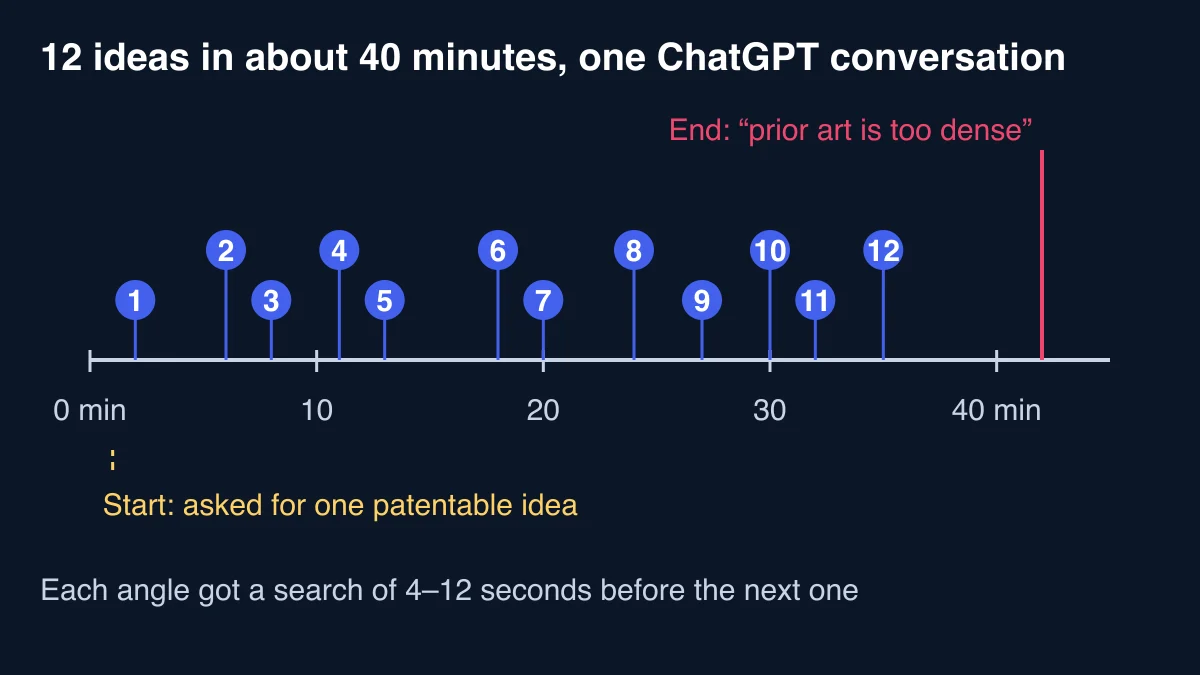
When we moved the work to Claude the next day, its fact-check of that conversation found ChatGPT’s headline broadly right and much of its reasoning wrong. One patent ChatGPT had described as active, a European patent for a motor-driven shopping trolley, had lapsed in the UK in 2020, and the verdict of dense prior art rested on a list that was mostly irrelevant. One of Claude’s sharpest criticisms was that ChatGPT had merged the three questions set out in the law section, and its example was simple: an old patent stops you patenting something, but it can’t stop you selling it. Claude was harsher on the method than on the result, because ChatGPT had played whack-a-mole, spending seconds on each angle before declaring it taken, where what the problem needed was a map of the patents. Claude’s research agents also found the closest earlier filing to my own first idea for the trolley, a Japanese application filed in 2018 and later deemed withdrawn, which left the idea free for anyone to use and impossible for me to patent.
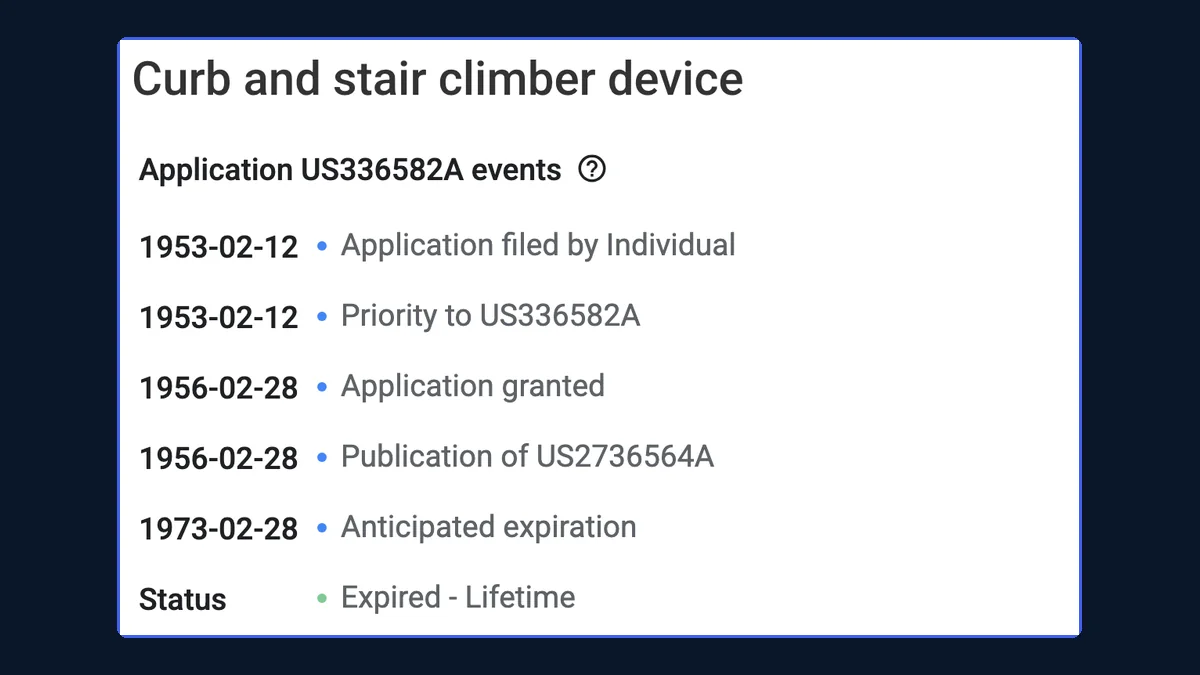
We had moved to Claude for a new idea, and a better-footnoted no was of little use to us, since any model can browse the web and confirm facts. Claude accepted that, and then made the opposite mistake: it picked a kerb-assist idea with a neat piece of physics behind it and presented it as the breakthrough before anyone had searched for prior art. Six practical objections from us took it apart: how older users actually brake, how they approach a kerb, whether they push or pull, what happens at a pothole as well as a kerb, where the mass-market appeal was, and whether it could ever be worth millions. Claude accepted every one and downgraded the idea to “a clever feature”. Part of its answer was that momentum-based kerb climbers were old news, and a patent for a kerb-climbing device for carts and prams, shown below, goes back to 1953.
What we take from this first stage is narrower than “the models were bad”. ChatGPT generated quickly and searched shallowly, Claude searched properly and then overclaimed on the first idea with an attractive mechanism, and both changed position as soon as they were pushed with something concrete, which is a pattern we saw again and again over the following fortnight as the search widened.
Widening the search: 36 ideas in an hour, none clear
With the trolley stalled, we widened the hunt to any product idea at all and set out four requirements that every later prompt carried in some form:
- it must be unique and patentable;
- it must solve a real-world problem and be genuinely useful;
- it must be something we could build and test relatively cheaply;
- it must have enough appeal, mass-market or specialist, to become a multi-million-pound business.
We also asked that an idea only reach us once someone had checked there was something unique that could be claimed, so from then on every idea passed through an adversarial prior-art screen first. When we set those requirements, Claude described its own role as recombining ideas across fields, doing the physics and killing weak ideas quickly, and it warned that the four requirements rarely live together in one patent, which is a fair description of work on the first two rungs of “new”. Asking for AI inside a product is a different thing again. We tried that too, asking for physical products that build in reasoning, speech or vision, and a camera and a model bolted onto a familiar device turned out to sit in one of the most crowded corners of the patent databases.
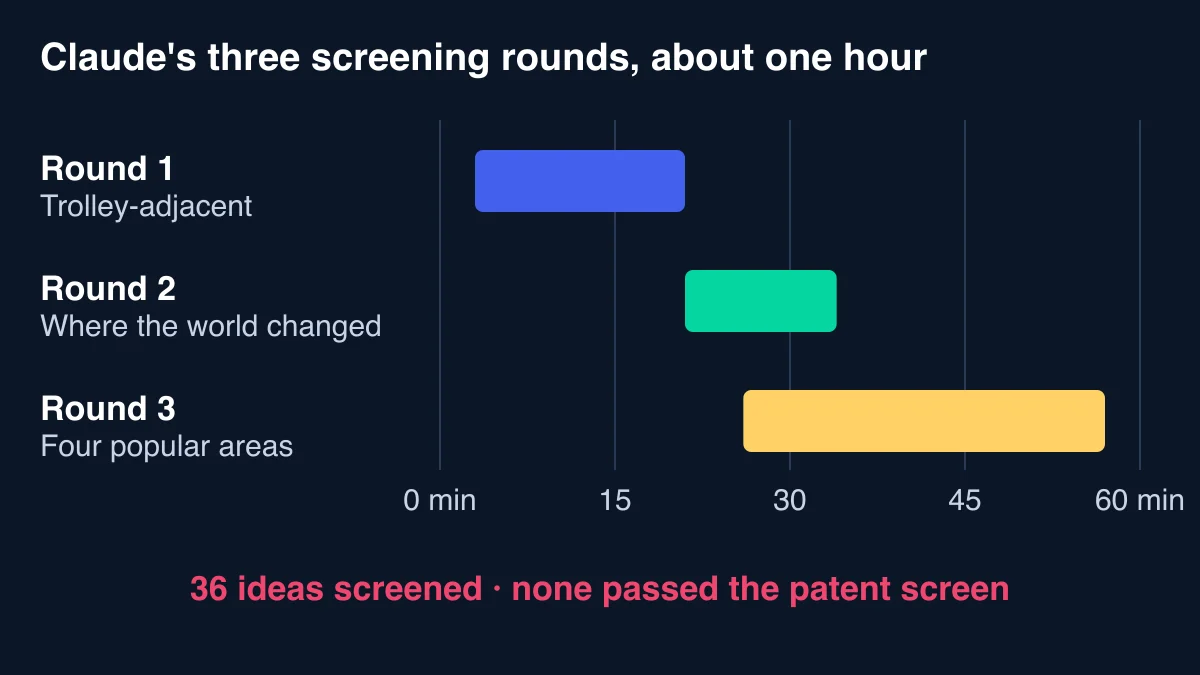
Claude ran three screening rounds in under an hour, the first on ideas close to the trolley problem, and none of those survived. Claude then suggested that holding out for unique, patentable IP would mean screening indefinitely, but patentability was the point of the exercise, so we kept the condition. The second round hunted where rules or technology had changed recently, and the third covered four product areas that were popular at the time: hot tubs, electrical goods, renewable energy and electric vehicles. Across the three rounds Claude screened 36 ideas and none passed; what was left was thin, and every survivor carried a medium to high risk of being judged obvious.
We’d treat the 36 as a snapshot from one hour of screening (some of the same ideas turn up again elsewhere in the study, and the screens were quick by patent standards, with a capped number of searches for each idea). What it shows is the shape of the problem: even with the patent screen placed before an idea reached us, the result matched ChatGPT’s whack-a-mole, with better records.
276 ideas, none patentable: can AI come up with new ideas that survive?
While those rounds ran, several more Claude and Codex conversations were generating and screening ideas in parallel. Everything so far, from the trolley conversation onwards, was then gathered into one list. Once 26 duplicates were merged, it held 276 distinct ideas. None was strong enough to justify a patent application; 69 were promising but unproven and 207 were ruled out. Between them they were checked against 2,161 distinct patent and application numbers and 566 products or services. Later trials, described below, were counted separately and not added to the 276.
Claude is credited with 234 of the ideas, Codex with 40 and ChatGPT with 2, and Claude’s own analysis of the list found that the 274 from Claude and Codex had been written in about five hours. Those credits show which tool wrote each idea up. Where each thought began is harder to say, because the list didn’t capture the origin of 155 ideas and about 17 began as broad needs we had described, so we treat the split as approximate; either way, AI was never short of ideas.
Those numbers are easy to overread, because the 276 include many variants of one mechanism and search depth ranged from none to a full screen. The 2,161 numbers are a total across the whole study, which nobody audited query by query, and no single idea was compared line by line against all of them. Search depth also changes what “ruled out” means, since an idea dismissed after a quick look is a weaker result than one stopped by a specific patent, and few were stopped that way.
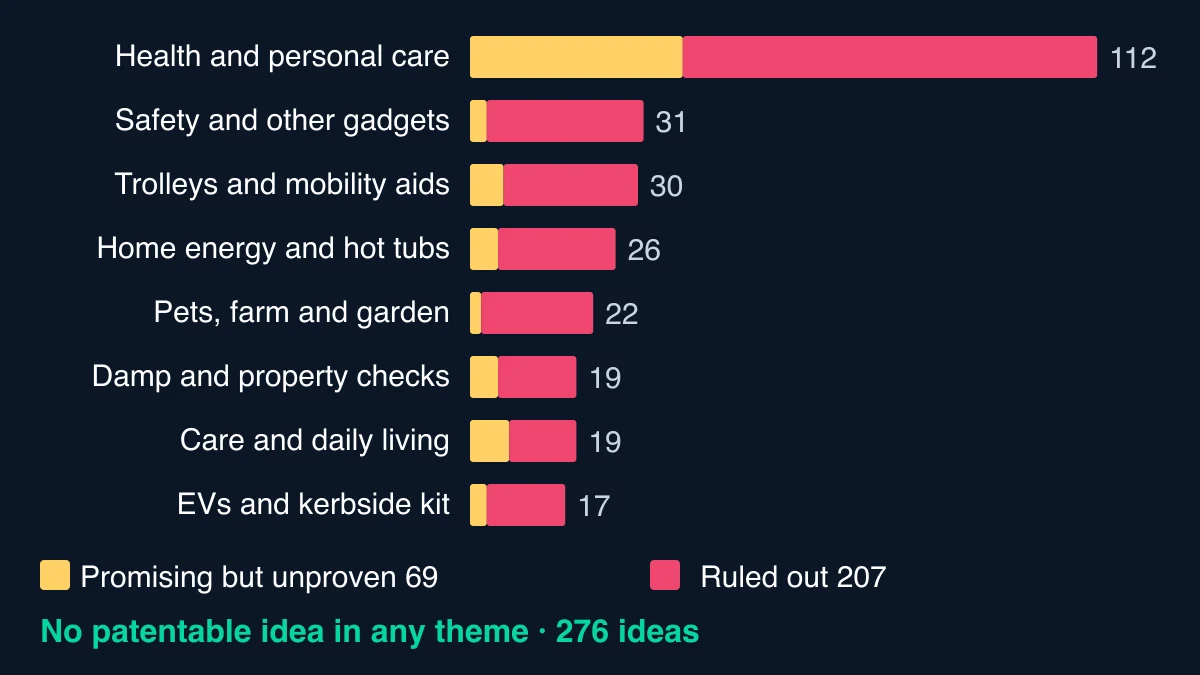
Codex, asked to look for patterns across the whole list, named five dead ends that kept recurring: a known product with a camera or a model added; a known mechanical function moved into a new object; a better reading from one sensor; a new regulation with no new mechanics behind it; and a broad health outcome with no specific mechanism. Its one-line summary was that the study kept testing “known functions in new categories”, and it gave the same diagnosis in different words in early October. That is close to a textbook description of what fails inventive step, where a known part doing its known job in a new object (a trolley, a pushchair, a wheelchair) is the routine move an examiner expects.
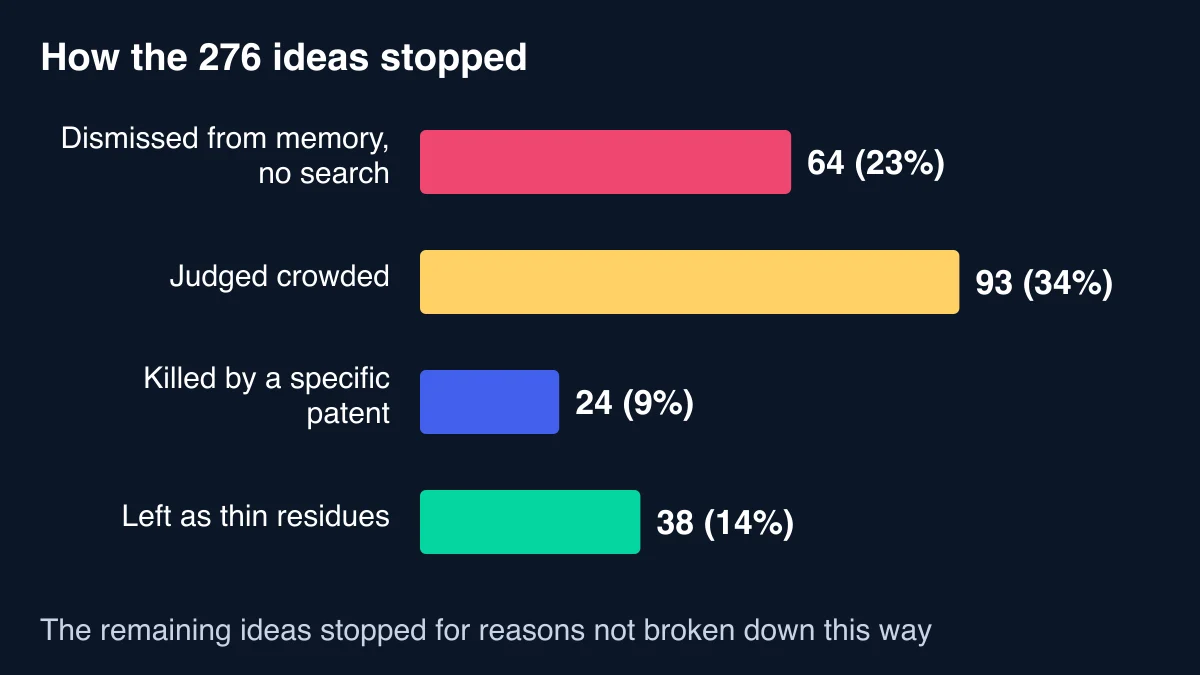
The list also shows where ideas stopped, and it is less flattering to the process than a simple “none passed” suggests. Of the 276, 64 (23%) were dismissed from a model’s own memory with no search at all. Another 93 (34%) were judged crowded, meaning the area was so full of similar patents and products that a model ruled the idea out without a claim-by-claim search. Only 24 (9%) were stopped by a specific patent, and 38 (14%) were left as narrow leftovers, too thin to be worth a claim, while the remaining 57 weren’t classified this way. The 64 dismissed from memory matter most, because nobody showed a document. Claude later adopted a rule that no idea could be dismissed without a document number to back it, which would have sent them back for a proper search, but they were never re-tested.
Six methods, one answer
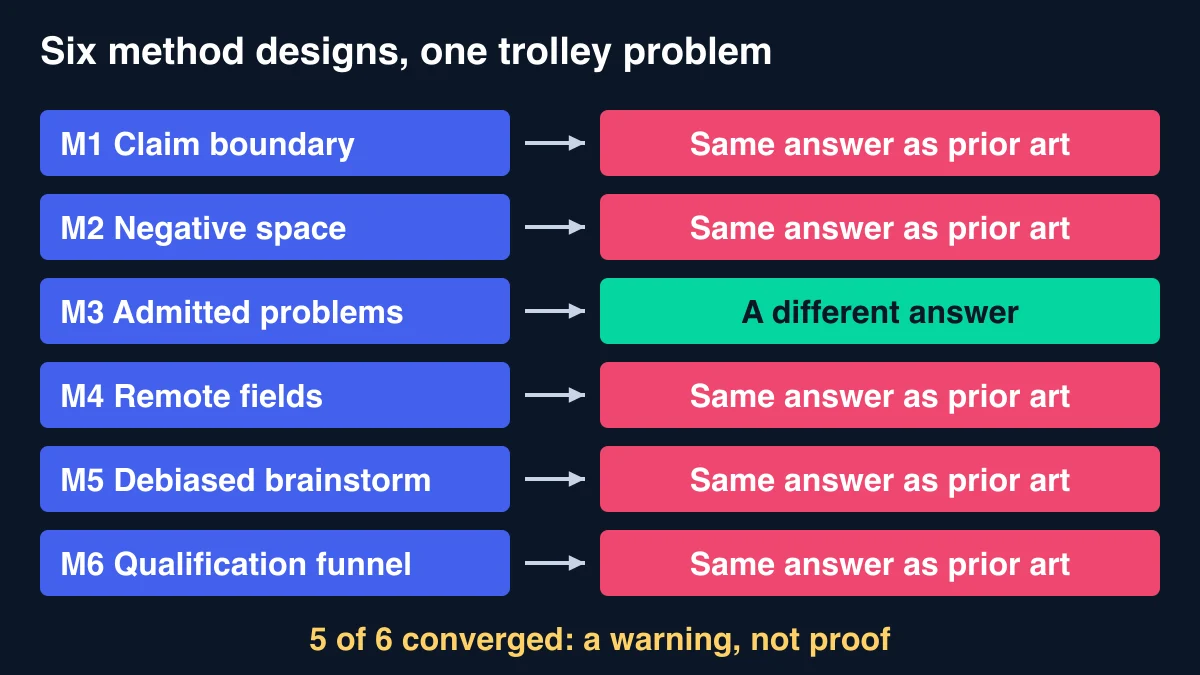
To test whether a better process would help, Claude set six of its helper agents to design a different method each for generating patentable ideas, and two more to attack the results, one of them playing a patent examiner. That examiner-style agent produced the clearest sentence anyone wrote during the study:
“All six methods fix novelty. None yet fixes inventive step.”
In simple mechanics, it added, the killer is usually common general knowledge more than any single document. It also caught something more uncomfortable. The problem description all six methods started from had described the shape of the answer it hoped for, so the methods were partly being steered towards the same place.
One of the six methods then disposed of its own example, and it illustrates the gap between a new feature and an inventive one better than anything else we have. Its trolley illustration was a kerb-assist feature, and the method asked what happens if you remove the distinguishing feature and supply the same benefit another way. Its arithmetic showed that a battery smaller than a typical phone’s (5 watt-hours) and a small motor could handle around 700 kerbs on one charge, so the new feature wasn’t what delivered the benefit, and the idea was recorded as a weak leftover, at a cost of nothing.
The methods were written independently, from the same problem description, each with the same trolley-over-kerb illustration, and five of the six reached the same answer, the same family of mechanism Claude had proposed as its kerb-assist breakthrough. Only one method, which mined the problems patent applicants admit to in their own background sections, went somewhere else. The examiner-style agent read the five-way agreement as a sign that the answer was obvious. We read it more cautiously, as a warning, because the six designers shared a model family, a starting description and the same physics.
A trial on one problem: new on paper, stopped by physics
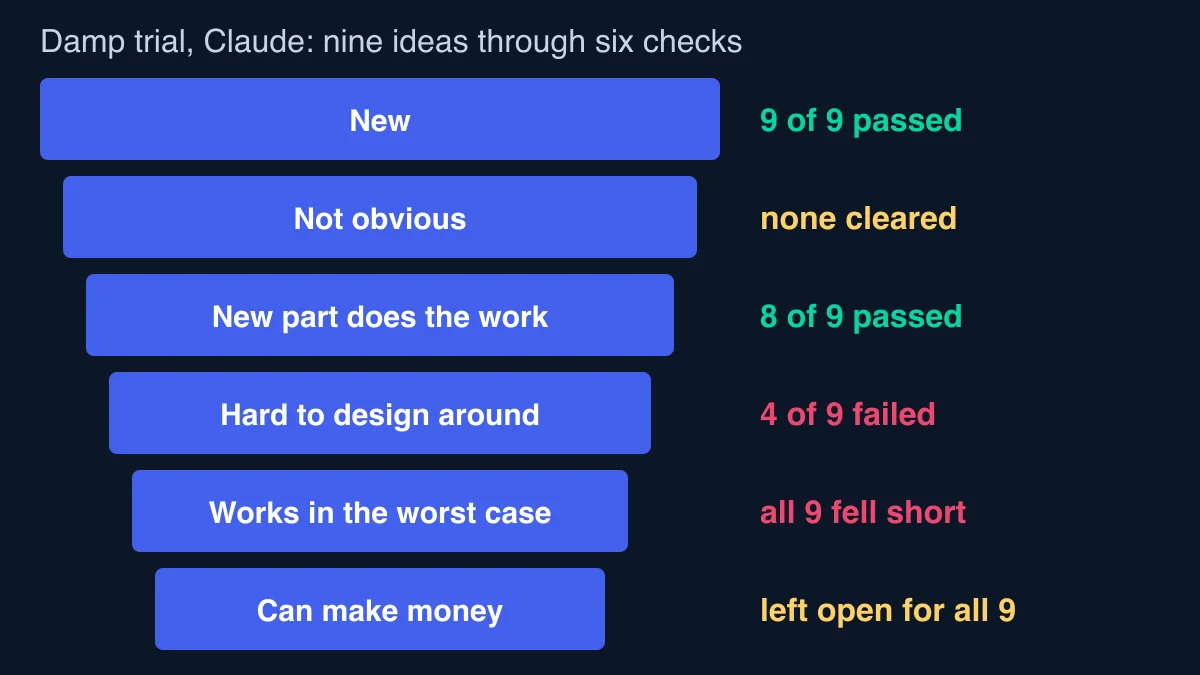
One of the 69 promising-but-unproven ideas was a method for finding the cause of damp in a home. It had more evidence behind it than any other idea on the list, which made it the best test case for a controlled trial on a single problem. At our request Claude wrote one set of instructions, with the same files and the same rules, that could be handed to fresh copies of different models, so that two model families worked on exactly the same problem. One run used Claude and the other used GPT through Codex, and each was limited to 40 logged searches.
Each run produced nine candidates by three routes: ideas written without seeing the patent search, ideas built from a map of existing patents, and earlier ideas reworked. Then each run took every candidate through the six checks. Claude’s run found all nine of its candidates new over the documents it found, and GPT’s run found eight of nine. Neither produced an idea strong enough to justify a patent application, so 0 of 18 evaluations passed. Claude’s run ended with three promising but unproven and six ruled out; GPT’s rated eight as promising and left one undecided.
For the invention question, what matters is where the candidates stopped. Every one of Claude’s nine failed the worst-case physics check, with margins between 0.26 and 1.5 against the twofold margin required, and four of the nine could be matched cheaply by a different route outside the claim, so they failed the design-around check too. Claude’s explanation for the physics failures was that in a cold winter any method that only watched moisture passively would go blind, so a working method had to drive the process itself. The GPT run’s write-up was less reliable: its summary said it had run no additional searches, while its own log listed 18, and where the two disagree we have gone by the log.
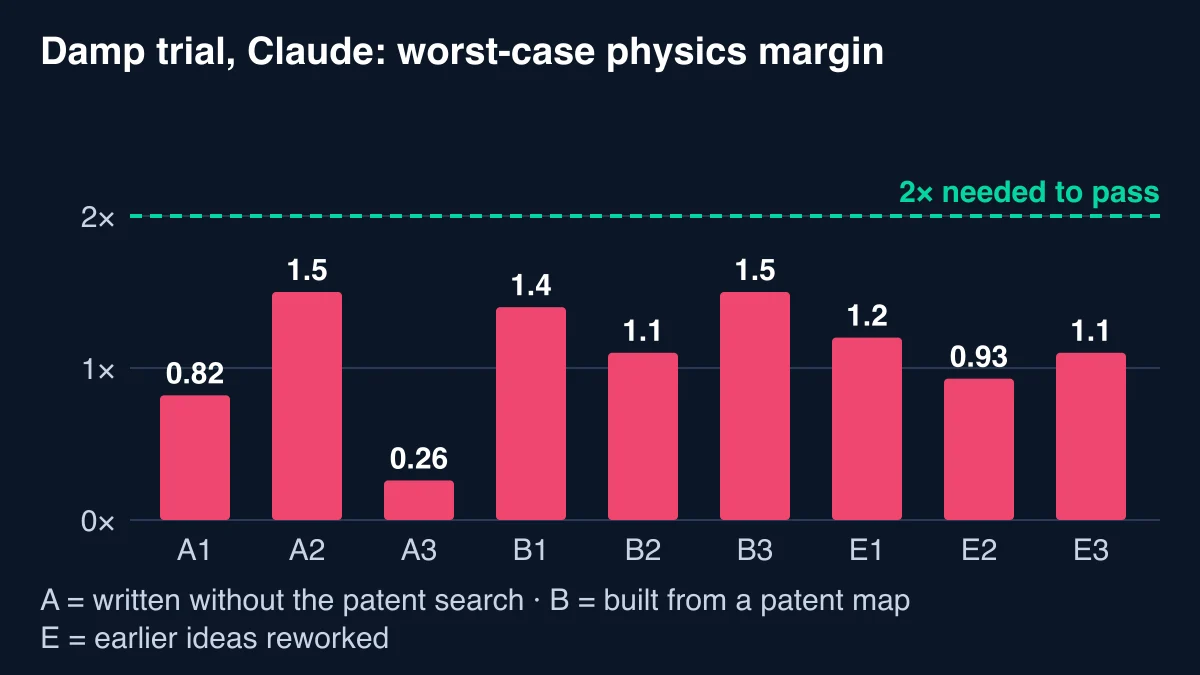
A margin of 1 would mean the method only just works when conditions are at their worst. The check asked for 2, even after the assumptions had been varied by 30% either way, to leave room for everything a desk calculation misses. Claude’s best candidates reached 1.5; its weakest reached 0.26, about a quarter of the minimum useful effect.
My first reaction to novelty no longer being the problem was that it sounded like a big step forward. Claude’s reading was more careful: as the law section explains, adding features almost always makes a claim new, so this was a real step, and the hard parts were still non-obviousness, worst-case physics and money. It also conceded that damp had been a poor choice of problem for a study that couldn’t spend money on tests, because real walls are too messy for a desk calculation to settle. And it found a flaw in the checks it had drafted, which it called a flaw in its own design. Two of them could not really be settled at a desk, since obviousness kept coming back as a question for a patent attorney and the money check needed buyer and price evidence, so it redefined both to be decided on paper; the new versions were never used in a later run, and we can’t tell you whether a cleaner desk scorer would have changed the result.
The two runs didn’t even agree on what to do next: Claude’s run concluded that nothing deserved a paid professional search, while GPT’s run said a paid UK and European search was justified for its two best candidates, so the same instructions and the same files produced opposite recommendations on whether to spend money. A cheap bench test might have settled the physics, but we had ruled out real-world tests, so it was never run and the damp work stopped there.
Changing the input in October
The obvious response to all this was to change what went into the models, and on 2 October one round, run through Codex on OpenAI’s GPT models, tried exactly that. Instead of starting from a product area, it started from public records of equipment failures and wrote ten ideas down in full as patent claims before any searching, so the search couldn’t reshape them, and all ten were ruled out at the first check on novelty or obviousness. The round was really testing whether AI can work from information beyond its training, so we cover it in our article on whether AI can create new knowledge that isn’t in its training data; for invention, the point is that even these records were public and indexed on the web.
The same day, we asked Codex to write the study up as an interim report, which Claude then checked, and it is where our working conclusions were first set down. Its one-sentence diagnosis was:
“The missing input was a new technical fact, physical observation, expert workaround or experiment that the model could not infer from familiar public patterns.”
Can ChatGPT judge its own ideas?
Our experiment into whether AI can invent came to its conclusion on 10 October, when we put the whole result to ChatGPT in a 46-minute conversation and asked why, when asked for one genuinely unique, patentable idea, it had been unable to reason its way to a single one. Instead of defending itself, it called the result “a meaningful failure, not something I would dismiss as poor prompting”, and it named the pattern we had watched for weeks: convergence towards known solutions, where a model asked repeatedly to be original revisits familiar families of answers under new descriptions. On the trolley work in particular, it said we had kept exploring variations inside well-developed engineering families and never found a fundamentally different physical mechanism. When we pressed it on the examples it had been using to argue that AI can discover things, it also admitted it had cited FunSearch and AlphaEvolve “without sufficiently distinguishing the abilities of the underlying LLM from those of the complete discovery system”, which is the distinction drawn at the start of this article.
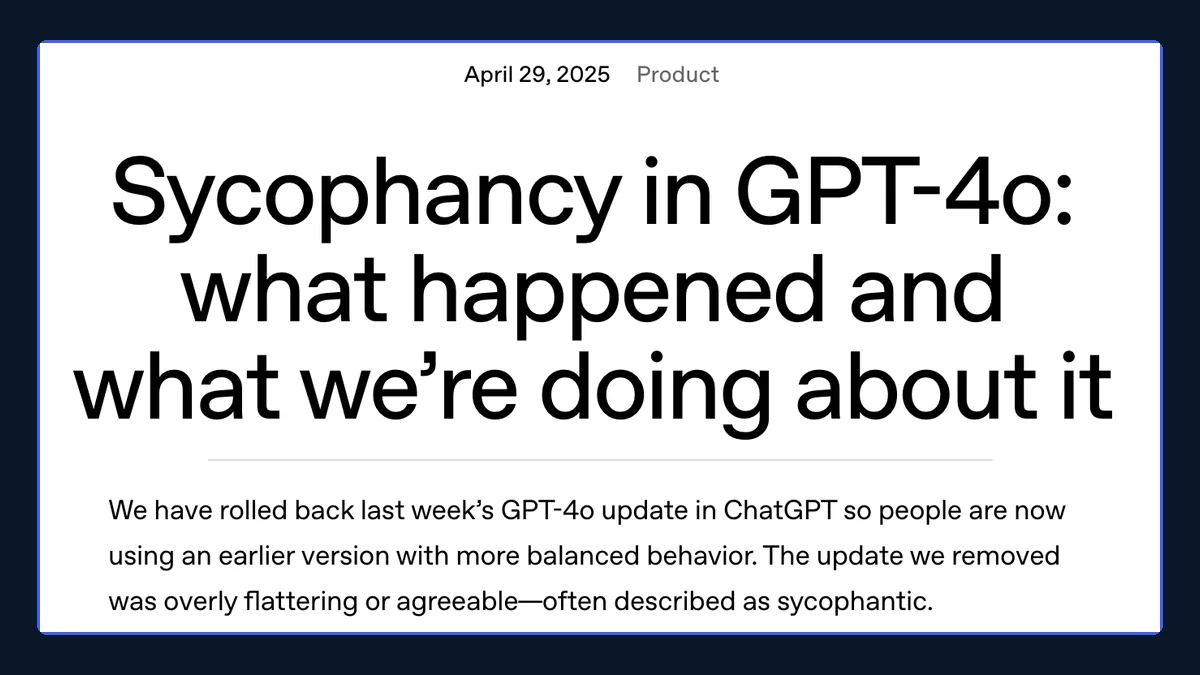
That is a useful account, and we still don’t treat it as an independent verdict, because the same conversation showed how readily ChatGPT moved, a tendency OpenAI itself acknowledged when it rolled back a ChatGPT update in April 2025 for being overly flattering or agreeable. Over the conversation it shifted towards our position four times and stood its ground against us only once. One of those shifts was agreeing that I had explicitly asked it to explore new physics, and I can find no record that I did. The full story of that agreement belongs to whether ChatGPT is just telling you what you want to hear. For invention, the narrower point is that a model’s account of its own failure tells you about its limits and gives no independent check on the ideas themselves.
We had anticipated some of this, and early in the study we gave Claude a standing instruction to push back and be impartial; across the study the models did not simply agree with everything, and sometimes they corrected us. They were much better at judging another model’s work than their own. Claude’s fact-check corrected ChatGPT’s patent statuses, and when Codex reviewed Claude’s summary of the 276 ideas, eight of its nine criticisms held up, including one about how the patent numbers had been counted. On its own work Claude was less reliable: after the damp trial it said its run had cited about four times as many sources as GPT’s, when the logs show about 2.3 times.
The practical lesson we took for anyone using AI on their own ideas is to separate the roles, generating with one model and attacking with a different one (ideally from a different family), and to ask the attacker for document numbers that open, because any model’s enthusiasm for an idea, including its enthusiasm for yours, is about the weakest evidence you can get.
Why couldn’t AI invent here? Novelty versus inventive step
Taken together, the stages above give our answer to why AI couldn’t invent here. Reaching rung two, new over the documents found, was easy once the method forced the models to write claims instead of concepts. Rungs three and four needed either a surprising technical effect, which normally comes from measurement, or a mechanism no skilled person would reach by routine, and the models produced neither, while our own no-spend rule removed the measurement route. We set that rule, so the result says as much about our process as about the models, and it is why inventive step and worst-case physics, more than the novelty search, are where the most carefully searched ideas ended.
Over the study, the models and we put forward about 40 explanations for why nothing passed, and they fall into five families:
- the ideas were familiar;
- novelty was reachable, but inventive step and working physics were not;
- the models lacked a new technical input;
- the method, brief or field was wrong;
- the models were trying to please, which researchers call sycophancy: telling users what they want to hear.
Of those, the second and third were the best-evidenced, while sycophancy had the strongest evidence that the behaviour happened and the weakest evidence that it caused the result, partly because many of the runs that found nothing said so plainly, against what we were hoping to hear.
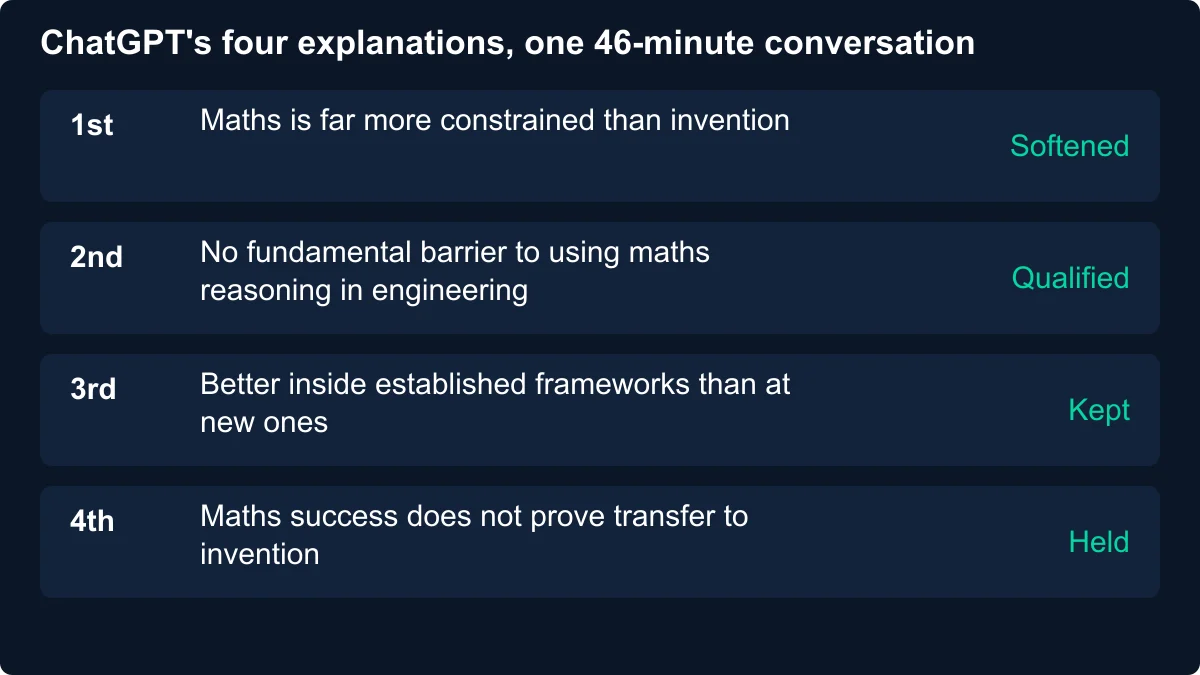
ChatGPT’s own explanations in the closing debate fit those families, and they moved as we pushed. It offered four. The first, that mathematical discovery is a far more constrained problem than invention, it softened when we pointed to a contradiction. The second, that there was no fundamental reason maths reasoning could not apply to engineering, it later qualified. The third, that frontier models may be better inside established frameworks than at discovering new ones, it never withdrew. The fourth, that success at maths does not establish that the skill transfers to invention, was the only one it defended when we argued against it, and it is a hypothesis that nothing in our study tests.
Why do AI ideas all sound the same?
The six methods landing on one answer was the clearest instance of a pattern we saw throughout the study, and the mechanism behind it isn’t mysterious. A language model produces the continuation that is most probable given its training, and when a problem is constrained by force, heat, flow, safety and cost, the familiar engineering building blocks (springs, wedges, cams, ratchets, bypasses and fixtures) are the easiest things for it to retrieve. They come back however the prompt is worded, and because the model has no way of knowing what it doesn’t know, the answer can feel imaginative while staying predictable to a skilled person.
Repetition wasn’t confined to the trolley either: on 2 October we asked Codex for genuinely fresh ideas, and it promised not to recycle earlier suggestions, then re-presented six of them as new. My reply at the time, in some exasperation, was that it kept giving me the same ideas over and over under different names, and Codex admitted it had kept renaming the same underlying idea.
Alongside the idea generation, Claude’s research agents reviewed for us what is known about how inventions actually happen, and their findings, which we haven’t published, pointed the same way. One review, of 15 well-documented inventor cases, found that almost none had started from a patent search; the non-obvious, patentable detail usually emerged during prototyping, often after years inside the problem. Another, on how language models generate ideas, concluded that a model’s single most probable idea for a prompt is disproportionately likely to be a common, typical one, which fits the narrowing Doshi and Hauser measured, and it advised using AI for breadth-first search, patent mapping and critique, with the spark coming from somewhere else. One step in that argument is weaker than it sounds. That a typical idea is likely to have been filed already is an inference and has never been tested, and our list can’t prove it either, although it does show the same few families coming back.
Part of the reason is how the models sample. The “sprinkle of randomness” behind ChatGPT’s creativity varies the wording from one answer to the next, which is useful for prose and does nothing to change which mechanisms the model knows best. So asking more often doesn’t help: ten requests to one model are ten draws from the same distribution, and turning the randomness up gives more unusual wording, then nonsense, while the store of mechanisms underneath stays the same. The way to get a different family of answers is to change what goes into the model, which is where our advice below begins.
How our result compares with the research
Our study used each half of the Si paper as if it were the whole. Claude’s research agents cited the 4,000-to-200 result as evidence that language-model ideas converge, and about a week later two agents in the October team cited the blind novelty result to argue against our view that the models could not invent, with neither group reporting the other half. When ChatGPT cited the paper in the closing debate, it at least gave both findings in one paragraph (more novel, somewhat less feasible, with limits on diversity and self-evaluation), and it said that while the paper hadn’t tested patentability, its findings were consistent with what we had experienced.
Against the four tests of originality described earlier, our ideas stopped in more than one place. Many on the list of 276 stopped at novelty or crowding, often on a model’s say-so with no document behind it, while the more carefully searched candidates in the damp trial got through novelty and stopped at worst-case physics and design-arounds; the Si follow-up found AI ideas losing ground at the fourth test too. Neither the Si papers nor our study showed AI producing original ideas that pass all four. One of the AI agents we used in October argued that 276 ideas with none patentable pointed to a gap in judging ideas as much as in generating them, which fits the Si paper’s own warning about self-evaluation, and the same agent added that it didn’t show a crowd of people would do better, which nobody tested.
Against FunSearch the gap is starker. FunSearch judged on the order of a million programs per problem; our study judged 276 ideas over several weeks, plus 36 in one hour of screening. The comparison isn’t quite fair, because a patent claim is far more complex than a short program, but it shows how far apart the two search processes are, and ChatGPT put the contrast well in the closing debate:
“Being able to reason correctly within an established system is not the same as being able to invent something genuinely new within an enormous, poorly defined space of possibilities.”
We did try to build something closer to a scorer for the check we cared about most. Beyond the rule that a model could call an idea known only by quoting a document number that actually opened, the examiner-style agent proposed calibrating an AI examiner against 20 real decisions by the European Patent Office’s Boards of Appeal or the UK Intellectual Property Office (UK IPO), and trusting it only if it agreed with at least 15. That would have been a crude evaluator for obviousness, built from human judgements, and the calibration was never done. If we ran this again, that is where we would start, because without some agreed way of scoring obviousness the search has nothing to steer by.
The models also never changed the frame of a problem, which is the harder kind of creativity. The 2026 models we used were comfortable working from known examples and could extend a pattern within a defined problem, especially when a calculation anchored them, and when the frame did change, it was because of an observation from us, such as pulling instead of pushing, or because the evidence forced it. The deeper reasoning we described in 2024 as o1’s big shift doesn’t supply that kind of input, since it works on whatever problem a person frames for it, and in our study the frame never came from the model.
What does AI need to invent something new?
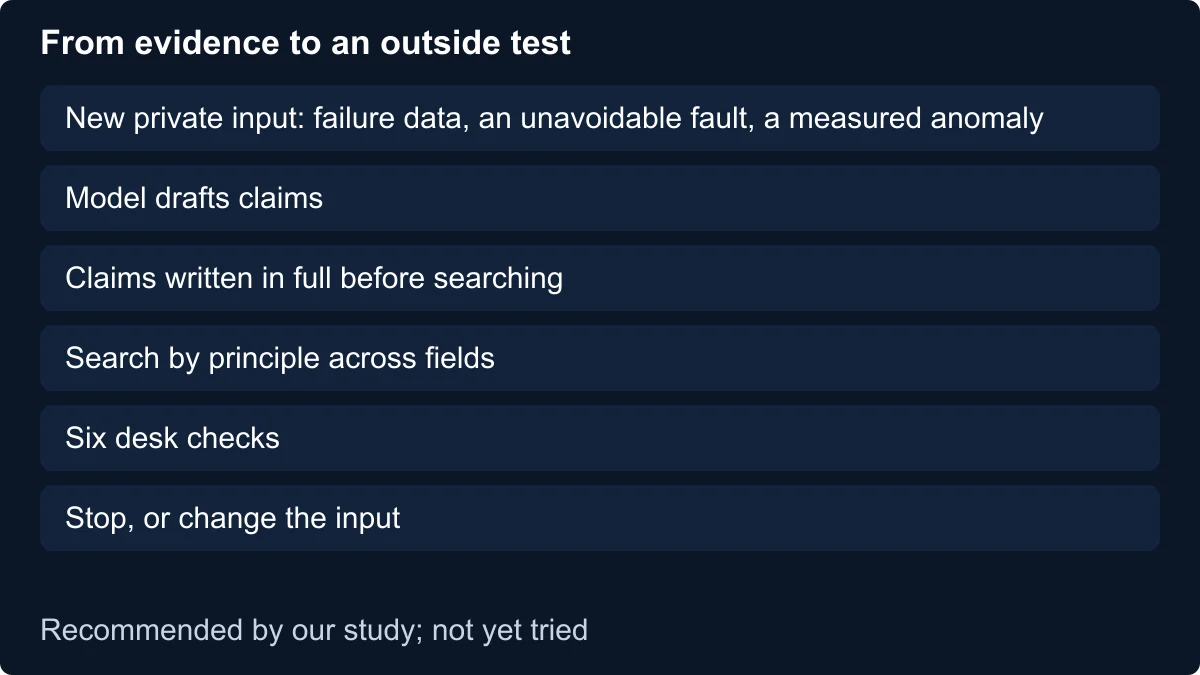
Our evidence supports a short answer: a person has to supply a new technical fact, observation or constraint, and the model can then map, generate and attack possibilities around it.
Our conclusion in the 2 October write-up was that the evidence supported changing the source of technical insight, and that endlessly changing the wording of the prompt would not help. The route we saw as most credible started with collecting a private dataset of maintenance failures, warranty returns, incident reports or customer workarounds under proper confidentiality, asking operators or tradespeople for the failures they regard as unavoidable (without showing them model ideas first) and measuring a physical anomaly that existing products don’t explain, and only then letting the model turn that new relationship into a claim, search across fields by principle, and attack it.
None of those inputs was tried in our study, and the closest attempt, the October round that started from equipment failures, used public records. We also set rules for the model’s part that we would keep in any rerun:
- keep idea generation separate from patent searching, so the search can’t steer the ideas;
- write claims in full before searching;
- search by principle and function instead of by product name;
- stop after a fixed number of candidates and change the evidence source, instead of adding more names to a list of promising ideas.
Spending would stay staged as well, with a professional search only after one candidate had a defensible narrow claim and a buyer case, and disclosure or a prototype only once we had decided and the boundary of the IP was written down.
Looking back, I had tested part of this on myself without meaning to, because Claude argued that an invention hunt like this needed two people: the problem-holder, which was me, and a field specialist who designs, builds or repairs things and knows what is routine in the trade. The strongest inventor stories it had found had both, such as the Maclaren buggy, where a grandparent’s need and an aircraft engineer’s know-how came together in Owen Maclaren himself: he had designed Spitfire undercarriage legs, and a visit from his daughter with his first grandchild prompted the buggy. No specialist was available to us, which was exactly why we were relying on a model with the whole web behind it, and since at Opace we build websites and AI apps, not physical products, the workshop knowledge that defeats an obviousness objection was missing from both sides of the conversation. Nobody measured anything, either: kerb heights, loaded weight, peak force. A tape measure, a luggage scale and a phone video would have cost almost nothing and wouldn’t have broken our rule against spending, and we didn’t use them.
What the models did well fits five roles we set out in the same write-up: mapping evidence (reading patents, papers and failure reports), generating candidate mechanisms, translating a plain problem into patent search terms, attacking weak claims, and keeping a log of what had been checked. We were explicit that this makes a model neither an autonomous inventor nor a patent examiner, and just as explicit about what an agent cannot do: certify global uniqueness, supply private workshop knowledge, decide inventive step with legal authority, or produce a non-obvious mechanism when no new technical input exists. It is the same split we work to at Opace. In our AI web development services the tool drafts, searches and tests while a person owns the brief and signs off the result, and our case study on where agentic coding still needed a human brief found the same: agents built quickly, but the direction came from people.
People bring something beyond technical input too. When I suggested to Claude that AI is limited at genuinely out-of-the-box thinking, it agreed, and added that invention isn’t what most people are best at either; paying people small amounts for quick reactions won’t produce patentable ideas, but gut reaction, taste and a sense of whether something makes sense are where people add value quickly. That line of thinking is part of why I started PennyForYours, a personal hobby project, separate from Opace, that asks verified people for honest first reactions, which was open by invitation while it was tested in October 2026. It deals in human judgement, and a patent still needs a technical contribution from someone who has seen or measured something new.
Limitations and open questions
Our study was run at a desk by a single company, with AI doing the patent searching, no private data, no laboratory or physical test and small samples, so its limits need spelling out. The 276 ideas are mostly concepts, many of them variants, with uneven search depth. The damp trial was 18 claim-level evaluations, two models and one problem, and the round that wrote ideas down in full before searching produced ten, all from OpenAI’s GPT models through Codex.
Small samples with no successes still tell you something, though less than a bare “none passed” suggests, and a simple statistical rule of thumb shows how much less: after zero successes in a given number of tries, the true success rate could still be as high as about three divided by that number. It was devised for samples of 30 or more, so for smaller ones treat it as a rough guide. With no successes in ten tries, the true success rate could still be as high as about 30%. Zero in 18 still allows about 17%, and zero in 276 about 1.1%, a figure that is optimistic because the 276 attempts were not independent. These limits apply to the processes we ran and say little about language models in general: what the study shows is that this approach didn’t produce a patentable invention, which is a long way from proving that AI can’t invent.
Where candidates stopped also limits the claim. In the damp trial they got through novelty and failed on physics and design-arounds, and the novelty verdicts were themselves bounded by the 40-search limit and a fixed set of prior art. With no physical tests allowed, working physics had to be shown by calculation alone, so only candidates with a large, calculable advantage could pass, and a study with a workshop could test what ours could not.
Every attempt also drew only on public inputs, meaning the models’ training and public web and patent search, and even the equipment-failure records used in the October round were public. Our searches had known gaps as well: non-English material, Chinese, Japanese and Korean utility models, non-patent literature and poorly indexed products, on top of the unpublished applications no search can reach, and the agents hit bot checks on several patent databases and chose not to bypass them. So the supported claim is that no patentable idea was shown here, and nothing in the study supports the stronger claim that no unique invention exists.
None of the comparisons was controlled, and even in the damp trial the ideas meant to be written without sight of the patent search were not fully blind, because the instructions listed the titles of existing candidates before the new ideas were fixed. The 64 ideas dismissed from memory were never re-tested. Because the method changed about 20 times, later results are not directly comparable with the list of 276. There was no human baseline either: the damp trial left room for ideas we would write ourselves before reading any model output, and we never wrote them.
Nor were the models independent samples in a scientific sense, since Claude, Codex and the agent team shared training data, prompts and the same physical common sense, so five agents agreeing is closer to one opinion repeated than to five experiments. We’d ask you to read the whole study as a case study of one constrained search programme. Quotes from me and from the models come from the saved conversations, and the outside facts come from court judgments, patent offices, statutes and published papers, linked where they are used.
Four open questions follow, and none is answered here. Would a genuinely new private observation, such as a measured anomaly or an operator’s long-tolerated failure, change the family of candidates, or only rename a familiar one? Would a fixed evaluator agreed before generation make the search productive, or quietly decide the answer in advance? Would an independent prior-art reviewer, reading the closest documents before the model’s explanation, reach the same verdicts? And would a controlled human baseline with the same budget do any better? A fair test would also report how many candidates were lost at each check.
So, can AI invent? Our verdict
On the law, the answer is settled for now: under UK, European and US rules an AI cannot be named as the inventor, and a person who uses AI as a tool can still patent the result if the claimed contribution is theirs and passes the normal tests. The policy question is open, and the UK Supreme Court said so.
On capability, purpose-built systems with a reliable scorer, such as FunSearch and AlphaEvolve, have produced results nobody had before, inside problems people defined. A chat model with web search, which is what most people mean by AI, can contribute to invention in useful ways, and in our 25-day test it did not produce a single idea strong enough to justify a patent application. Our conclusion is that language models help as contributors (noticing patterns, framing problems, exploring mechanisms, searching broadly and rejecting weak claims) and may be part of an invention when someone gives them genuinely new evidence, while this study gives no reliable proof of innovation by language models alone, and no model or desk process can certify that an idea is unique worldwide.
What would change our minds is a better test, and we have designed one: a protocol published in advance; at least three relatable needs with physics that can be calculated; at least three model families; a fixed number of written claims per method; the same desk checks; results reported check by check; and a benchmark against recently granted UK or European patents, to see whether the process can rediscover real claims from the need statement alone. If that produced a patentable idea, we would say so here.
We would also change the starting point, because Claude put its finger on what had been true of every round since the trolley:
“We keep picking an area first and then hoping an invention turns up.”
Its fix was simple: I would list ten physical annoyances I live with first-hand, Claude would add about ten more, and all of them would be scored on how relatable they are, whether the physics can be calculated, the money and how crowded the patents are, before anyone tried to invent. That exercise was never run, though it is the cheapest change on the list and puts a person’s direct observation at the start of the search.
For anyone hoping to use AI to invent, our reading is modest: however confident the models sounded, they never made up for a missing document number, and the route we would now recommend starts with something a person has measured or lived with, because that is the one input a model cannot read for itself. If you are deciding where AI belongs in your own product development, the division of labour described above, with the models mapping, drafting and attacking while a named person supplies the observation and makes the call, is a sensible place to start. Working out that split for a particular business, before money goes on tools or filings, is the kind of question our AI strategy consultancy work is there to answer.
Frequently asked questions
Who owns an AI-generated invention?
Not the AI, because under current UK, European and US rules the model cannot be an inventor, so ownership follows the people and the contracts around the human contribution: the inventor, an employer under employment law, or whoever the rights were assigned to. Where nobody made a human inventive contribution, the UK Supreme Court did not decide whether such an advance should be patentable, and an application that names no human inventor fails under the current UK rules. In practice the useful step is a dated record of who framed the problem, who chose the claimed feature and why, since that is what an ownership dispute or a challenge to inventorship would turn on.
Can you patent an idea ChatGPT helped you create?
Yes, if you can show the claimed technical contribution is yours and the claim passes novelty, inventive step and industrial application. The USPTO’s November 2025 guidance treats AI as a tool used by human inventors, and the UK government said in 2022 that a patent may be granted for an AI-assisted invention. The examiner looks at the claim, and the conversation that produced it counts neither for you nor against you.
What blocks a patent and what blocks a product are also different things. An old or withdrawn filing can leave you free to make something you can never patent, which is what happened to our first trolley idea, and a live patent can stop you selling an improvement you could still patent. The model may well have helped with the wording, and the examiner will not care; they will ask what technical step the claim adds over the closest documents and whether a skilled person would have taken it anyway. So a dated written account of what you observed, what you chose and why is worth more than a chat log showing the model was confident, and if the idea matters, a patent attorney’s view before filing is worth more than either.
Can ChatGPT come up with original ideas?
Yes, in the everyday sense, and the research supports it: in Si, Yang and Hashimoto’s blind study, reviewers rated AI research ideas more novel than experts’ ideas. If original means a combination the reader has not seen before, ChatGPT produces those constantly, and quickly.
Where it struggles is telling which of its ideas are original in the sense that matters for a patent. It has no reliable way to know whether an unpublished application exists, whether a skilled person would find the step obvious, or whether the physics holds in the worst case, and those are the questions our six checks were built to answer; none of our 276 ideas cleared all of them. Each of ChatGPT’s trolley ideas sounded fresh when it was offered, and each turned out to be a familiar engineering family in a new setting. Claude also warned us early that in a mature everyday category the hard part was never the patent, it was the business, which is a different kind of originality again.
What we would do now is use ChatGPT to widen the set of possibilities and to translate a vague problem into search terms, then treat every claim of originality as something to prove. In practice that means giving it something it can’t have read before asking for ideas, such as our own notes on how a product fails in use. We’d ask it for different families of solution, each with the principle behind it, because repeats are far easier to spot by principle than in a list of product names. We’d want the three closest documents it can find for each idea, with numbers that open, and a rough calculation of whether the thing actually works before anyone gets attached to it. And we’d keep the best idea out of the conversation until we had decided how to protect it, for the reasons in the last answer below.
Can AI do a patent search?
AI can help a great deal with a patent search, though it cannot certify anything. In our study the models translated plain descriptions into patent language, searched in English, Japanese, Chinese and German, opened official databases and read claims, and across the study the ideas were checked against 2,161 distinct patent and application numbers. Claude’s fact-check of ChatGPT also turned up statuses, expiry dates and missed UK rights that changed the picture.
The limits were just as concrete. During the searches, Google Patents rate-limited the agents and blocked automated queries, while Espacenet, the European Patent Office’s free database, and the UK IPO both put up automated bot checks, which the agents chose not to bypass. Search budgets were capped, unpublished applications can never be found by any search, and in the first week a model described a patent as active when it had lapsed in the UK years earlier, which is exactly what a professional search is there to catch. We use AI to map the territory and to draft the queries, and we would use a professional search before filing or spending real money. If your team wants to work this way routinely, with tested prompts for turning a plain problem into patent language and a clear list of what a person must check before anything is relied on, that is the sort of workflow our ChatGPT consulting services set up.
Do multi-agent teams make AI more inventive?
Not in our test, where a team of up to 25 AI agents covered more ground faster and was good at checking other agents’ work, but the agents shared training data, prompts and the same physical common sense, so they behaved more like one large sample than many independent ones. Agreement among agents is therefore weak evidence that an idea is good, and the six-method result above suggests it can even be a sign that the answer is obvious. More agents made the search faster and better documented without changing which mechanisms they knew.
Why does ChatGPT keep suggesting the same ideas?
Because the most probable answer to a prompt tends to be a typical one, and typical answers are the ones that already exist. Asking again, or asking with a stronger adjective, changes the wording more than the idea. One of Claude’s research agents, reviewing how models generate ideas, warned that several similar models, run in parallel on similar questions, tend to land, again and again, in the same crowded corner of the space of possible ideas. Our study ran exactly that kind of parallel search, and the list of 276 filled up accordingly.
Asking a model to stop repeating itself helps less than you would hope, because the repetition comes from what it knows more than from how it was asked; Codex’s renamed ideas, described above, arrived straight after it had promised not to recycle anything. What actually changes the output is a different input: a new observation, a measured constraint or a problem the model has not seen framed that way before. If you want to check whether a list has collapsed, the Si team’s approach is a reasonable model, and grouping the ideas by the principle they rely on will usually show the list is shorter than it looks.
Can AI innovate if it has a scoring function?
Yes, and that is the most important distinction in this whole article. When a problem has an automatic scorer, a system can try enormous numbers of candidates and keep the best, and a low hit rate stops mattering, which is how FunSearch and AlphaEvolve found real results inside problems people defined, with people still choosing the problem and writing the scorer.
Our study shows the other side of that. Each check we cared about (inventive step, worst-case physics, buyer behaviour) needed a judgement nobody could reduce to a number, so every candidate waited on a person and the search ran at the speed of a person. Even the six checks Claude drafted to be decided at a desk turned out to need a patent attorney or real price evidence for two of them, which is the evaluator problem in miniature. ChatGPT described the contrast with maths well: when a candidate beat the previous best-known result, the system had objective evidence of progress, and nothing in our study could produce that kind of evidence.
So the useful question for anyone hoping AI will invent for them is whether you can write the scorer. If you can, in chemistry, materials, scheduling, some maths and parts of engineering simulation, AI can genuinely innovate inside the space you define, provided the scorer measures what you actually care about, because a search will happily optimise a flawed one. If you can’t, there are partial routes: a simulation that captures the physics, a panel of experts scoring against criteria fixed in advance, or a cheap bench test that turns a judgement into a measurement. Whichever you choose, fix it before any ideas are generated, so it can’t be quietly bent to favour the ones you already like. Each is slower than a program, and each hands part of the judgement back to a person, which is where the hard part of invention stayed throughout our study.
Is it risky to type an unfiled invention into ChatGPT?
It can be, because patents need novelty, public disclosure before filing can destroy it, and whether describing an idea to a hosted chatbot counts as public disclosure is unsettled, as the law section explains. Claude’s own advice about the kerb idea was to keep it out of ChatGPT and off public pavements until anything was filed. Service terms on training and retention differ and change, so read them rather than assuming. If an idea might be valuable, keep the working description in a private, dated document, use a no-training setting where one exists, and take professional advice before any disclosure that matters. This is general information, not legal advice. Our study followed the same rule: every candidate in this article is described at the level of a kerb-assist idea or a damp-diagnosis method, and none of the claim wording has been published.