Will AI cure cancer? It is one of the biggest promises made for artificial intelligence, and in September 2026 it became a headline when the head of the chip designer Arm told the BBC:
“I believe in our lifetime, AI will help cure cancer.”
Most people asking the question have two kinds of AI in mind at once: the chatbots they now use every day, and the specialised systems that read scans and design drugs in research labs. Those are very different tools, and the answer depends on which one you mean. The question also feeds a bigger argument about whether large language models are the path to AGI or only one useful part of a much longer process. For anyone waiting on a treatment, what matters is whether any of it reaches a clinic, and when.
Opace is a digital agency rather than a medical research group, and I founded it after years of consulting on government IT projects; none of us, me included, is a doctor or a scientist, so what we bring to this question is a 25-day study we ran between 16 September and 10 October 2026 into whether AI can invent something new, using ChatGPT, Claude, OpenAI’s Codex and finally a team of up to 25 AI agents. Part of that study turned to health at home, including whether AI could help people recognise serious illness such as cancer. The AI mapped everything already known about the field remarkably fast, found home monitoring for cancer already crowded with existing products and patents, and then stopped where it always stopped, at facts nobody had yet measured, which are the same kind of facts a cure for cancer depends on.
This article looks at AI and research, and it does not give medical advice. If you are worried about a symptom, the NHS cancer pages explain when to see a GP, and a GP is the right first step.
What we found, in brief
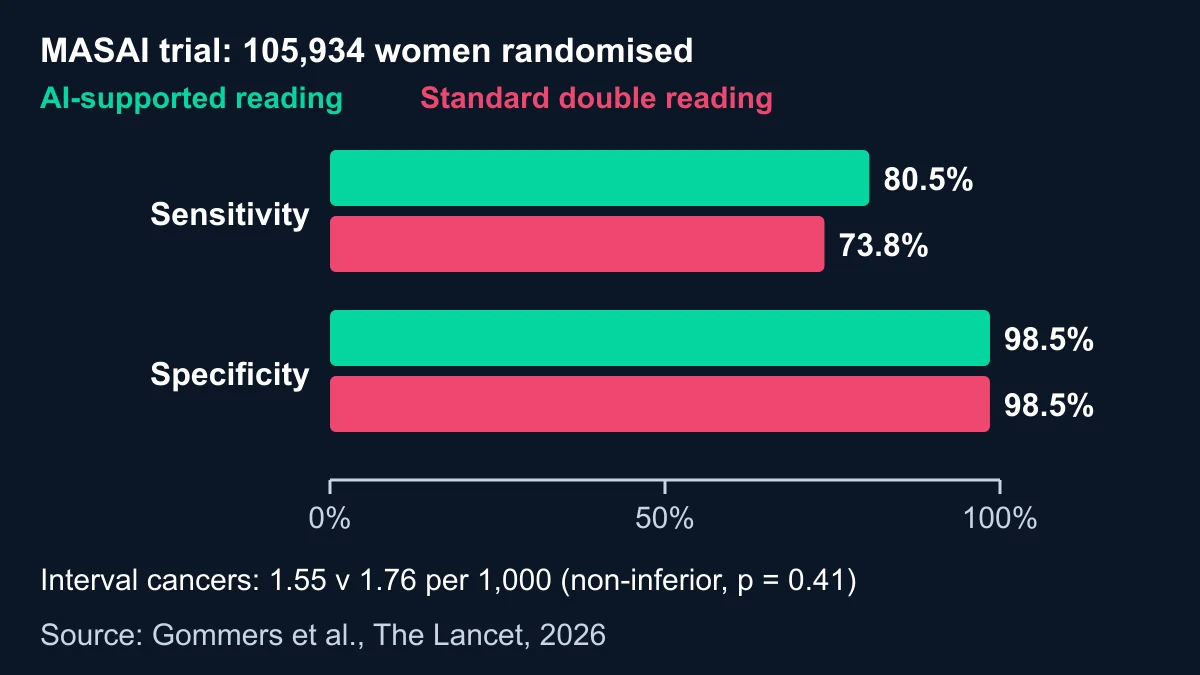
- In a randomised trial of 105,934 Swedish women, AI-supported mammography reading found cancers with 80.5% sensitivity against 73.8% for two radiologists, with the same 98.5% specificity.
- The furthest AI-discovered drug, rentosertib, began a Phase 3 trial on 9 September 2026 in idiopathic pulmonary fibrosis, a scarring disease of the lungs; no AI-discovered cancer drug has yet reached that stage.
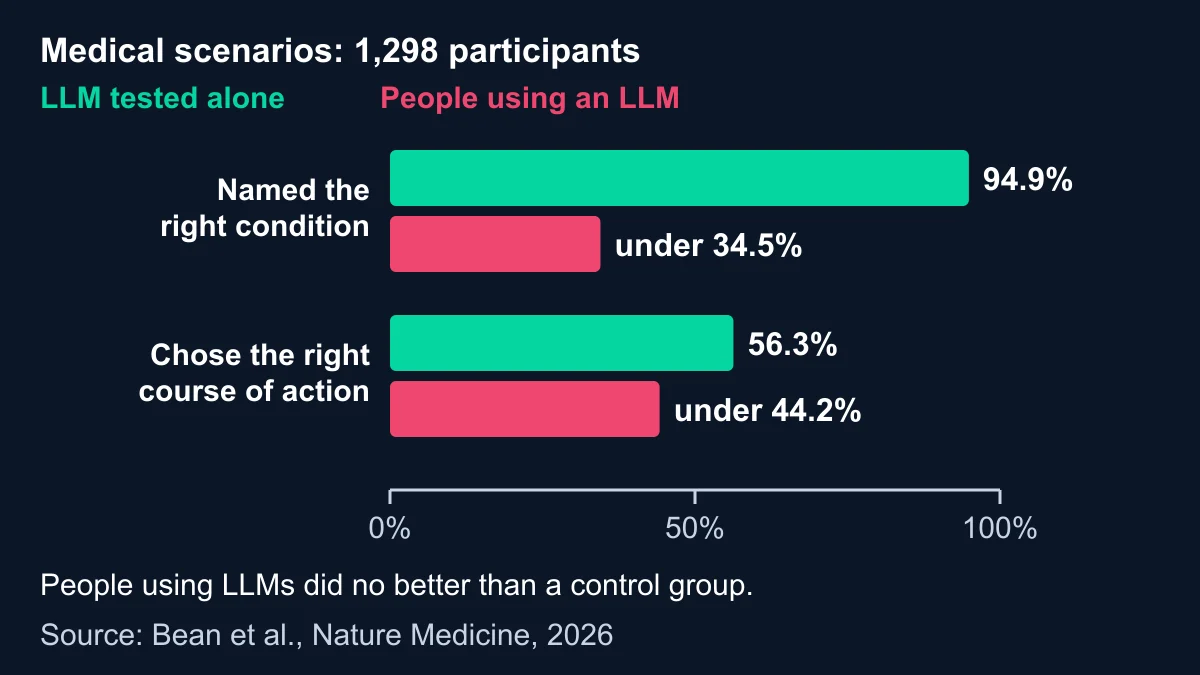
- Tested on their own, chat models named the relevant conditions in 94.9% of medical scenarios, while members of the public using the same models managed fewer than 34.5%, no better than people using their usual sources.
- Our own 25-day study produced 276 distinct ideas, almost all of them in a few hours of AI time, and none was strong enough to justify a patent application. What was missing each time was a new fact from outside the model.
- Every home-health idea in the study asked AI to notice something, which is a long way short of treating it, and each met existing patents, device regulation or nobody willing to pay.
- Of the nine viral claims we traced, one was true, two were partly true, three were misleading and three were unsupported by the evidence.
Will AI cure cancer? The short answer
AI will not cure cancer on its own, although it is already helping: it reads mammograms in randomised trials, predicts protein structures and suggests drug candidates. A cure needs new biological facts, lab experiments and clinical trials, and those take years whatever the model, so ChatGPT can propose a hypothesis while someone with a laboratory still has to run the experiment that would prove it.
Much of the confusion in the headlines comes from the word cure, which in cancer usually means something specific. A person treated for a particular cancer stays free of it for long enough, often five or ten years, that doctors expect it not to return. That is measured in people, one cancer type at a time, and only after the treatment has passed through trials that compare it with the best existing care.
So when we read that AI will cure cancer, we split the claim into two kinds of evidence. Pipeline evidence says a step got faster or better: a scan read more accurately, a protein shape predicted, a molecule designed in months rather than years. Patient-outcome evidence says people lived longer or stayed free of disease because of the change. Most of what AI has delivered so far is the first kind, and a small but real part, mainly in screening, is starting to reach the second.
The distinction matters because a faster pipeline does not guarantee a better outcome. Screening that finds more early cancers helps only if those cancers would have caused harm and the treatment that follows works, and a drug designed in record time still has to show, in a randomised trial, that it beats what patients already get. AI can shorten some of those steps, but each of them is where new facts about the disease and the person are measured, so none of them can simply be skipped.
Prof Chris Jones, head of cancer biology at the Institute of Cancer Research, put it plainly in the ICR’s explainer How are we using artificial intelligence to defeat cancer?, published on 27 May 2026, where he is quoted saying that AI “can’t directly cure cancer”. We take that seriously, and we take the people forecasting a cure just as seriously, so the rest of this article puts both views against the evidence, starting with what the optimists actually said.
Who says AI will cure cancer, and what do they mean?
The headline we quoted at the start came from an interview that Rene Haas, chief executive of Arm, gave to the BBC’s Faisal Islam, published on 8 September 2026 under the title “AI will cure cancer in our lifetime, claims boss of UK chip giant”. His fuller argument was that modelling how cancer affects markers in a person’s DNA is too complex a problem for people and today’s computers, but that “as we feed more and more of the models into these computers… they’re going to solve it.” In the same interview he predicted widespread humanoid robots within five years. It is a forecast from someone whose company designs the chips that AI runs on, and the BBC also noted that until April he had sat on the board of the drug company AstraZeneca, a connection readers can weigh for themselves. The same report quoted Prof Chris Bakal of the ICR saying the real question is what data the models are fed.
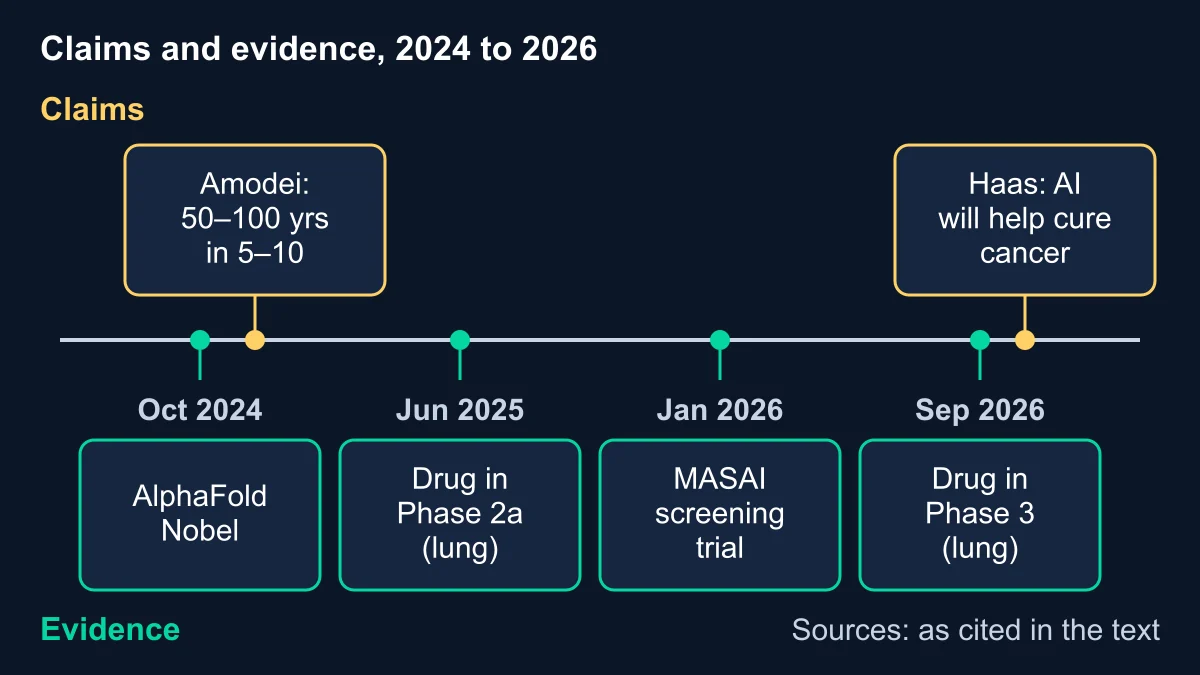
The most detailed optimistic case is older and more careful, and it came in October 2024, when Dario Amodei, chief executive of Anthropic, published Machines of Loving Grace. He predicted that AI-enabled biology could “compress the progress that human biologists would have achieved over the next 50-100 years into 5-10 years”, and he gave cancer its own section, suggesting that cuts of 95% or more in both cancer deaths and new cases might be possible. The same essay sets its own limits, though: it calls cancer probably the hardest of these diseases to destroy completely, says that more intelligence does not help where the data is missing, and argues that a project such as developing a cancer cure “may have an irreducible minimum” of time, because cells and animals run at a fixed speed. He is also more optimistic about deployment than we would be, writing that drugs, once developed, are generally deployed and used successfully. It is fair to add that Anthropic sells AI models, as Arm sells the chips they run on, and that neither interest makes either man wrong, although it is a good reason to treat their forecasts as arguments that the evidence has to test.
When people ask whether artificial intelligence will cure cancer, they are usually hearing a compressed version of claims like these, with the conditions removed. We have shared some of that hope at Opace, and our own forecasts are dated too. In March 2023 our article on AI reaching an inflection point listed personalised medical analysis among the things AI might improve. In 2024 we wrote about OpenAI’s early promise of better medical research as one of the discoveries that might come next, and in August 2025, writing about what GPT-5 could mean for medical research, we said “we have seen great progress with using LLMs to help with medical research and disease analysis”. We still think the hope is reasonable, though reading those lines back in October 2026, the progress since has come mostly from the narrow systems described below, and far less from the chat models we were writing about.
What we have learned is to read each claim for its verbs: help, speed up and compress are different promises from cure, and the people building the technology tend to choose the softer verbs in their own essays. We read AI products the same way when clients bring them to us for AI strategy consulting, asking what a tool has been shown to do, as distinct from what its seller forecasts it will do.
Which “AI” are we talking about?
Almost all the AI doing measurable cancer work consists of image classifiers reading mammograms and chest X-rays, risk models trained on millions of health records, protein-structure predictors such as AlphaFold, and drug-design platforms that generate and score molecules. Yet someone asking whether AI will cure cancer after a headline like Haas’s usually pictures ChatGPT, Claude or Gemini. Those large language models play a smaller and different role: they read and summarise papers, propose hypotheses, write analysis code and explain results. A chat model produces its answer by predicting likely text from patterns in its training data (our story-form guide to how ChatGPT works walks through the mechanics), which is very good for drafting a hypothesis and of no use at all for measuring a tumour.
Why AlphaFold is not ChatGPT
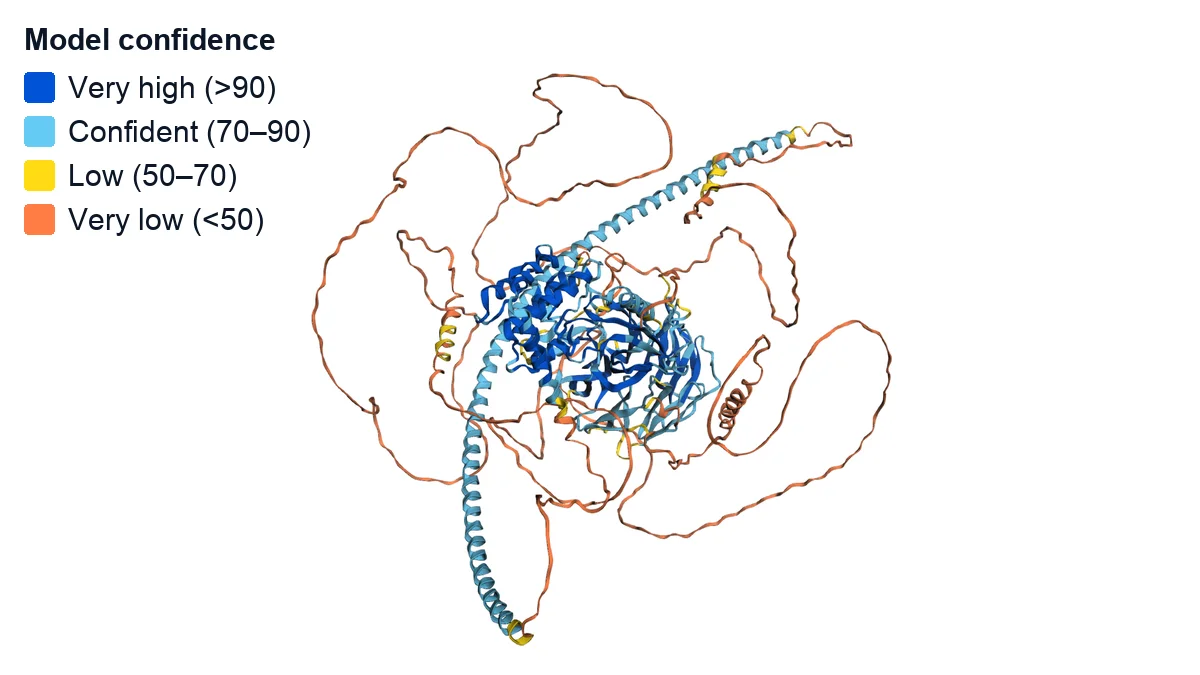
AlphaFold predicts the three-dimensional shape of a protein from its sequence. The 2021 Nature paper describes a problem that had been open for more than 50 years, and its predictions were “competitive with experimental structures in a majority of cases” in the CASP14 assessment. In October 2024 Demis Hassabis and John Jumper shared half of the Nobel Prize in Chemistry “for protein structure prediction”, and the Nobel committee’s announcement noted that AlphaFold2 had been used by more than two million people in 190 countries and that its predictions now cover virtually all of the 200 million proteins researchers have identified. That is a large gift to drug designers, though it remains a prediction of shape, and whether blocking a particular protein will help a patient is a separate question that only experiments answer.
AlphaFold was trained on one kind of data, for one task, and checked against measured structures, which puts it a long way from a general-purpose chat model. When a headline credits “AI” with a biology result, the system behind it is nearly always a narrow model like this, wired to data that experiments produced.
Is it the model or the system that makes the discovery?
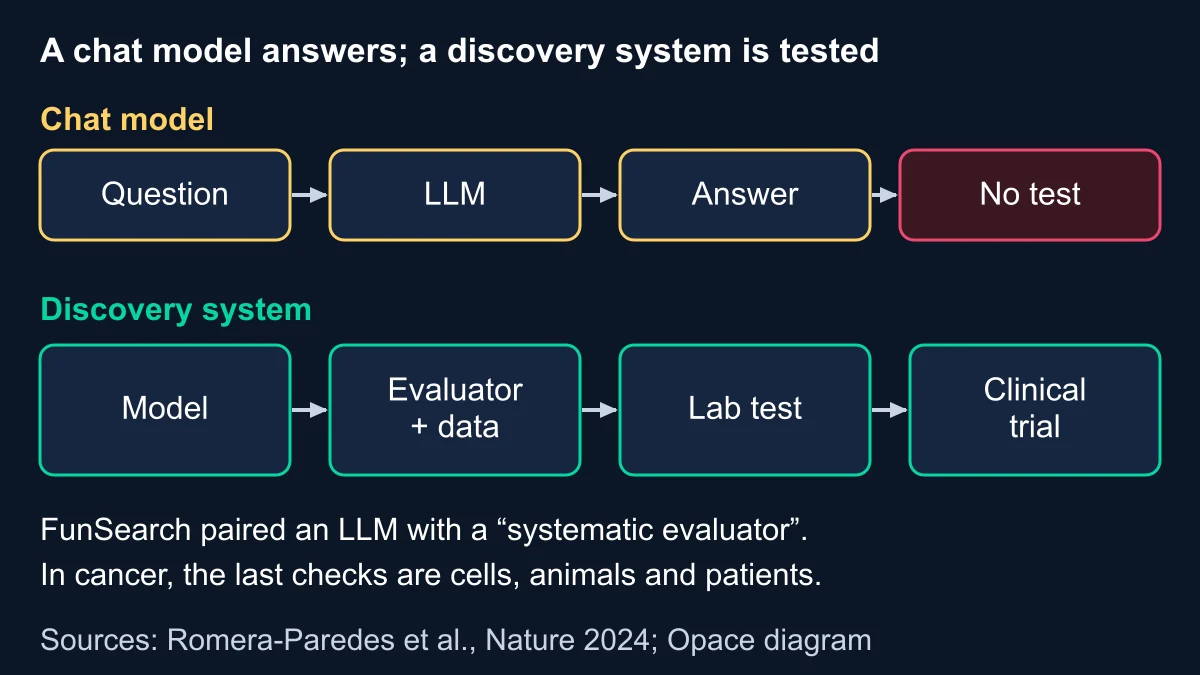
Google DeepMind’s FunSearch shows most clearly how much of a discovery belongs to the system built around a language model. Its Nature paper on FunSearch admits that “LLMs sometimes suffer from confabulations (or hallucinations)”, and its answer was “pairing a pretrained LLM with a systematic evaluator” that scored every candidate automatically, so the language model proposed and the evaluator decided what survived. In its best-known result, an improvement on the cap set problem in mathematics, only four of 140 independent runs found the improved answer, even with a perfect automatic scorer checking every candidate, which says a good deal about how much of the work the evaluator was doing. In cancer the complete system is bigger still, because after the model and the evaluator come cell experiments, animal studies, trials, regulators and the clinicians who use the result, and each of those can overturn what the model suggested.
Why “cure cancer” is a harder target than it sounds
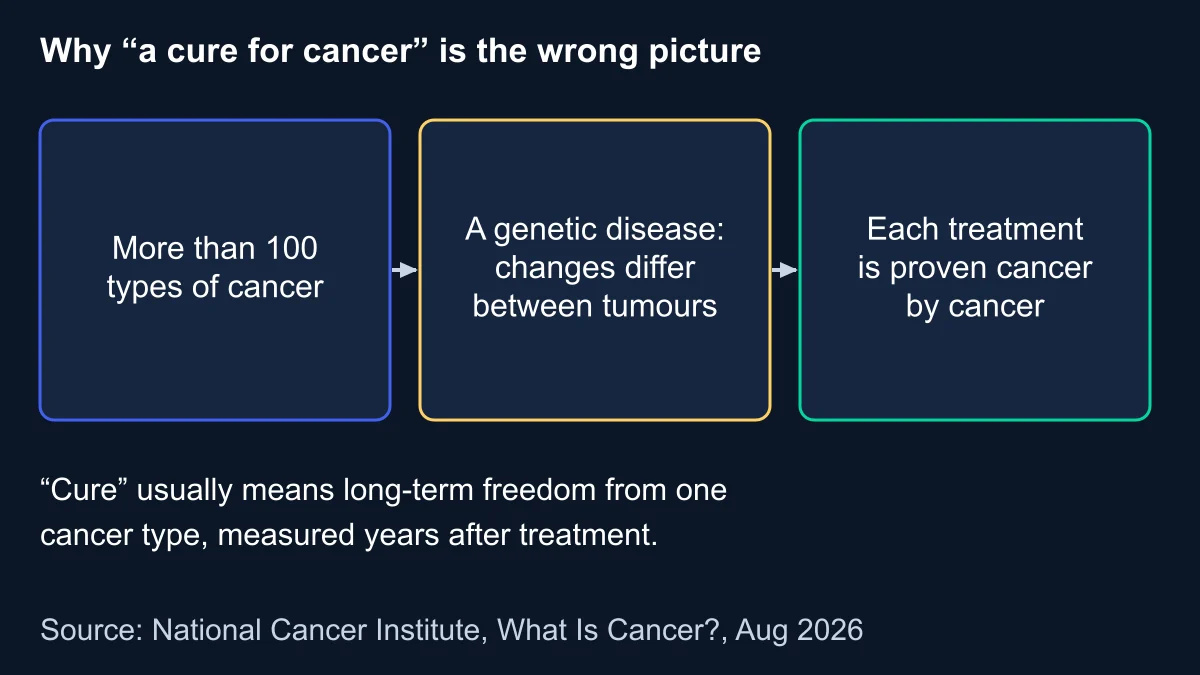
The US National Cancer Institute’s “What Is Cancer?” page, updated on 28 August 2026, says “there are more than 100 types of cancer” and that “cancer is a genetic disease”. Cancer can start almost anywhere in the body. Its cells ignore the signals that normally tell cells to stop dividing or to die, and they can hide from the immune system. The same page adds that each person’s cancer has its own combination of genetic changes, and those changes differ between cancer types, between patients with the same type, and sometimes between parts of the same tumour, so a treatment that works for one group can do nothing for another, and a tumour can evolve around a drug that worked at first.
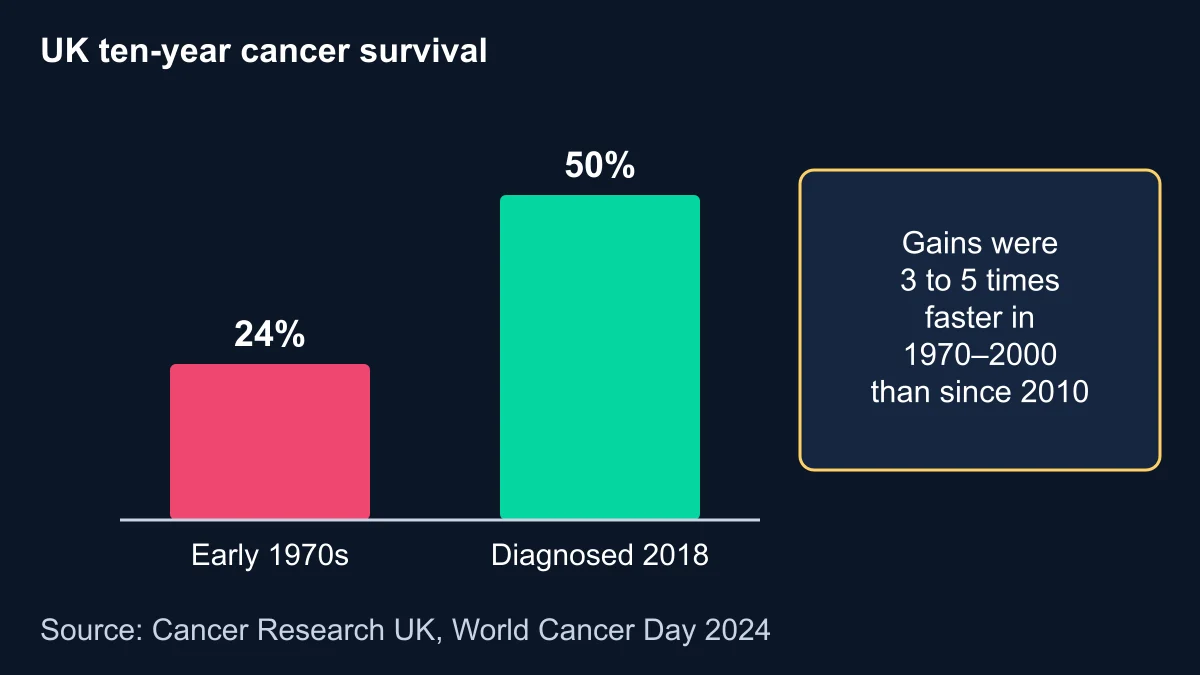
That is why real progress has come cancer by cancer. Cancer Research UK reported in February 2024 that half of people diagnosed in 2018 were expected to survive ten years or more, against around a quarter in the early 1970s. The same analysis found that “survival increased three to five times faster between 1970 and 2000, compared to the improvement since 2010.” So the curve AI is being asked to bend is real and has been rising for fifty years, but it has also been flattening. Any claim that AI changes it will have to show up in figures like these, and they arrive slowly: ten-year survival for people diagnosed in 2026 cannot be measured before 2036, so even an AI tool that helped everyone diagnosed this year would not show up in Cancer Research UK’s figures until the mid-2030s.
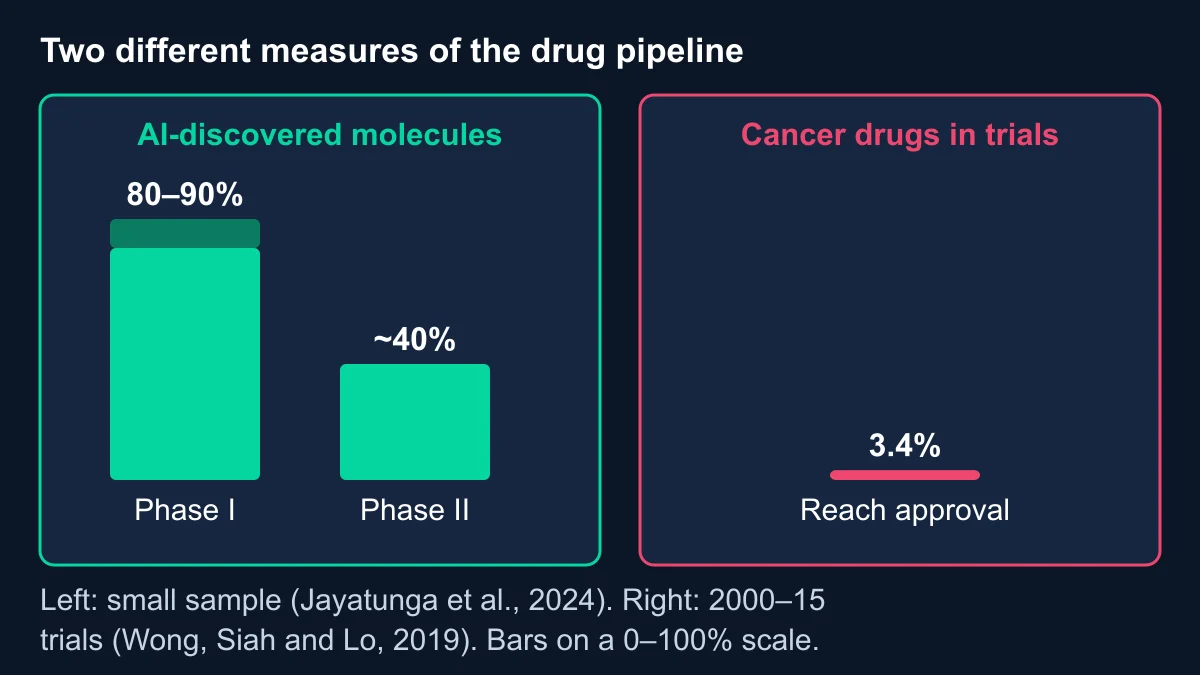
The drug pipeline shows the scale of the problem, as Wong, Siah and Lo found when they analysed 406,038 clinical-trial records from 2000 to 2015 for a 2019 paper in Biostatistics: they estimated that only 3.4% of cancer drug programmes that entered trials went on to approval. By the authors’ own comparison, that is lower than the 5.1% that earlier studies had reported for cancer drugs, and it moved a lot from year to year, falling to 1.7% in 2012 before recovering to 8.3% in 2015. Most candidates fail because the biology in people turns out to differ from the biology in the dish or the mouse. Those figures cover drugs that entered trials between 2000 and 2015, before most of today’s AI drug-discovery platforms existed, so they are the baseline AI has to beat rather than a verdict on it. Better candidate selection could raise that figure, and that is a large part of what AI drug discovery promises, although each candidate would still have to be tested in patients before anyone knew.
The Institute of Cancer Research offers a useful example of what AI-assisted progress looks like in practice: in a 2022 paper in Cancer Discovery, Carvalho and colleagues, with Prof Jones as senior author, described how “an artificial intelligence-based platform” suggested combining two existing drugs, vandetanib and everolimus, for a rare and aggressive brain tumour with a particular mutation. The team then tested the pair in tumour cells, in a mouse model grown from a patient’s tumour, and in four treated patients, to inform dosing and safety for future trials. The AI step took the search to a candidate, and everything that turned the candidate into evidence, from the cells to the four patients, was laboratory and clinical work that is still some way from a cure.
There is also a measurement trap that matters for every claim about AI screening. Finding a cancer earlier makes survival look longer, because the clock starts sooner, even if the person dies on the same day they would have anyway. Screening can also find small cancers that would never have caused harm, which inflates detection figures. That is why the best screening trials look at interval cancers and, eventually, at deaths, as well as at how many cancers were found. When an AI screening trial reports more cancers detected, the question that matters most for a cure is whether fewer people later die of the disease, and that answer takes many more years.
AI can still help at many points along that chain, and the next section looks at where it already does; the word cure, though, sits at the very end of it, after a long run of measurements that no model can make on its own.
How AI is helping cancer research and care today
So where does AI already change what happens to patients, and how strong is the evidence for each change? The answer differs sharply by stage, since screening has randomised trial data and risk prediction has large retrospective studies, while drug discovery has candidates in trials but, so far, no approved AI-discovered cancer medicine.
Can AI detect cancer earlier?
Screening is where the evidence is strongest and the news is genuinely good, thanks largely to Sweden’s MASAI trial, which randomised 105,934 women in routine breast screening either to standard double reading by two radiologists or to AI-supported reading, in which the software triaged each mammogram to one or two readers and marked suspicious areas. The final results, published by Gommers and colleagues in The Lancet in 2026, found sensitivity of 80.5% with AI support against 73.8% without it, and identical specificity of 98.5%. In other words, AI-supported screening caught more of the cancers that were there without recalling more healthy women.
The interval-cancer result, the cancers that appear between screening rounds and are often the ones that matter most, needs reading carefully. The rate was 1.55 per 1,000 women with AI support against 1.76 without it. That met the trial’s test for being no worse, but the difference itself was not statistically significant (p = 0.41), so the accurate word is non-inferior, and the trial cannot claim fewer. An earlier safety analysis by Lång and colleagues in The Lancet Oncology in 2023 found that the AI arm cut the radiologists’ screen-reading workload by 44.3%. The trial is registered as NCT04838756 and is marked completed.
England is moving in the same direction more slowly, and in February 2025 the government announced the EDITH trial: nearly 700,000 women, 30 screening sites and £11 million through the National Institute for Health and Care Research. We could find no published results by October 2026. For lung cancer, a GOV.UK announcement on 10 June 2026 says AI chest X-ray tools are already available in half of England’s NHS trusts and will reach all of them by 2029 with £20 million. It also says the tools have helped “more than 4 million receive a faster diagnosis or all-clear for lung cancer”, and that radiologists now report the most complex scans in an average of 4 days instead of 8. Those are the government’s own figures, with no published method behind them, so we read them as claims about how quickly scans are reported, which on their own say nothing yet about survival.
That 2029 deadline for every trust in England, set alongside an £8.1 million pilot for six other technologies, shows how slowly even a working tool spreads. The pace is familiar to me from consulting on large government IT projects, including NHS work, before I founded Opace, where a national health service changed procurement, training and clinical pathways one trust at a time, even when the software was ready.
Can AI predict who is at risk?
The second strand is risk prediction: finding the people most likely to develop a cancer before symptoms, so they can be checked sooner. Pancreatic cancer is a hard test because it is usually found late. In a 2023 study, Placido and colleagues, writing in Nature Medicine, trained a deep-learning model on the disease histories of about 6 million Danish patients, including 24,000 pancreatic cancer cases. For cancer within 36 months the best model reached an AUROC of 0.88, a measure where 0.5 is chance and 1.0 is perfect.
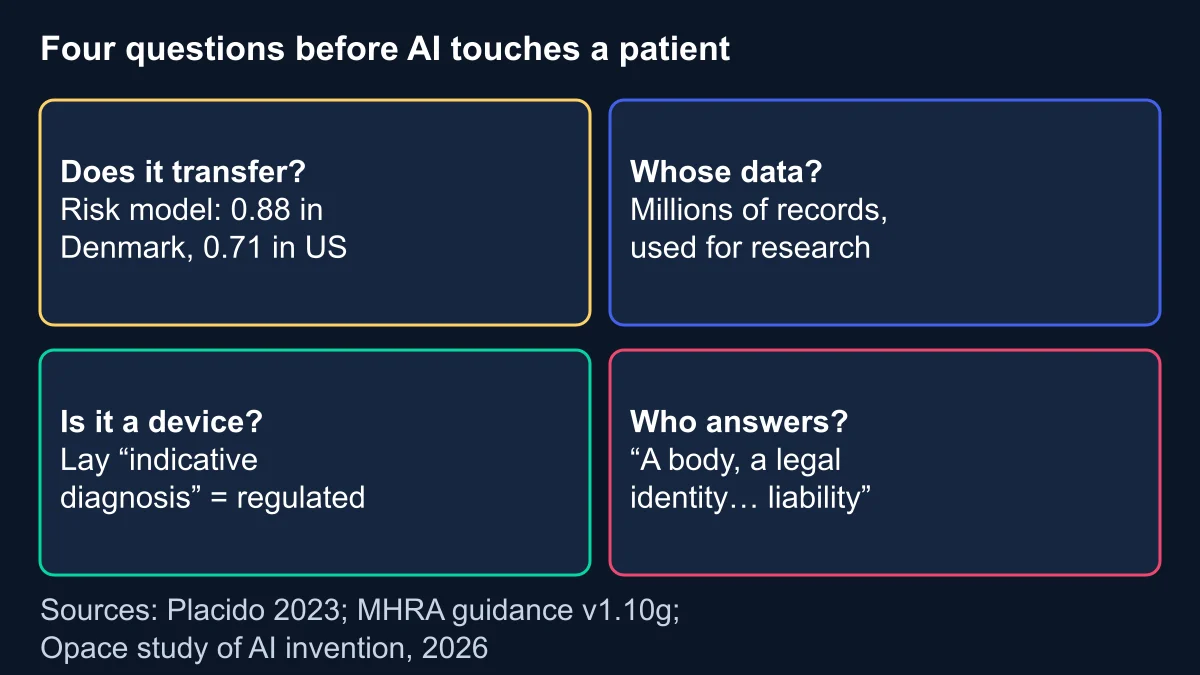
The result that interests us most is what happened when the Danish model was applied to about 3 million US veterans. Performance fell to 0.71, and retraining on the US data brought it back to 0.78. The same algorithm, moved to a different health system with different coding habits and a different population, lost much of its skill until it was fed local data, which is exactly the point Prof Bakal made in the BBC’s report about what the models are fed, and it means a risk tool proven in one country cannot simply be switched on in another.
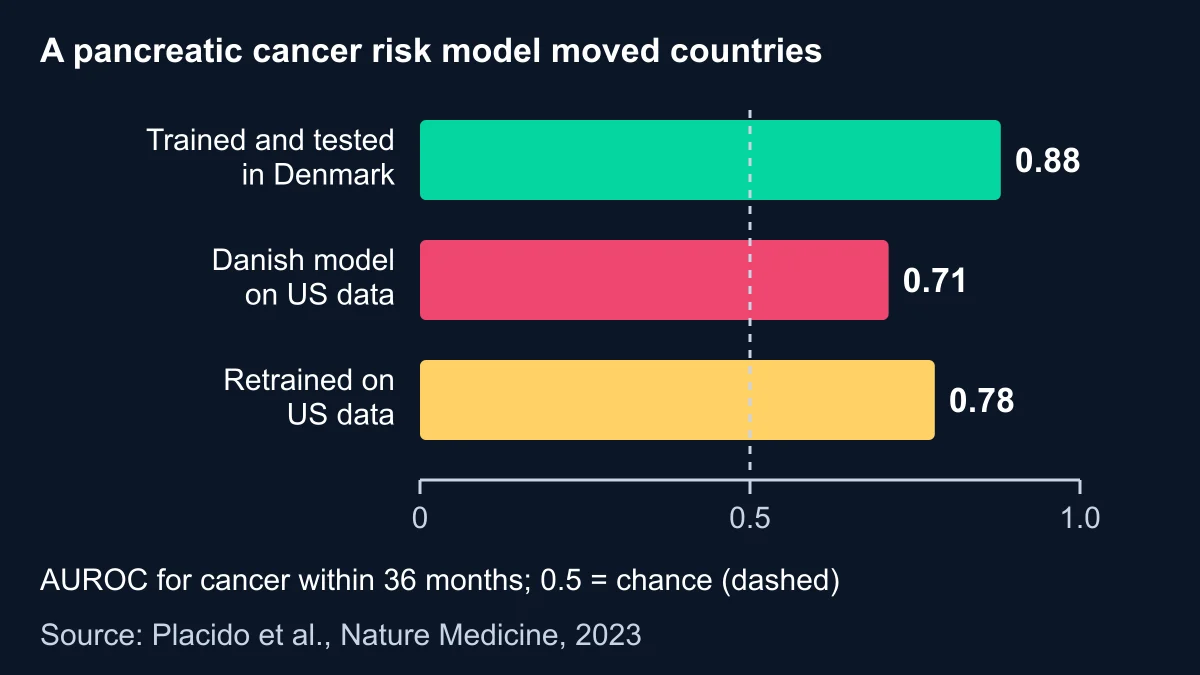
The paper contains a second warning that is easy to miss. When the researchers removed the disease events from the three months before diagnosis, the Danish model’s score fell from 0.88 to 0.83, because part of what a model like this predicts is the run of symptoms and appointments that happen once a cancer is already causing trouble. A risk score is useful for deciding who to check sooner, and that is where its usefulness stops: the diagnosis, and everything that happens once a cancer is found, still depend on tests and treatment.
Protein structures and AI-designed drugs
AI can now propose drug targets and molecules, and the furthest example has reached a late-stage trial, mostly through two kinds of tool working together. AlphaFold-style structure prediction helps chemists design molecules that fit a protein they could not previously see, and generative chemistry platforms then propose and score candidates far faster than a human team could.
The clearest published case is rentosertib, an inhibitor of a protein called TNIK, discovered by Insilico Medicine. In June 2025 Xu and colleagues reported in Nature Medicine a randomised Phase 2a trial of this generative-AI-discovered drug in idiopathic pulmonary fibrosis, a scarring disease of the lungs. Seventy-one patients took one of three doses or a placebo for 12 weeks. The trial’s main purpose was safety, and side-effect rates were similar across the arms. On lung function, the highest dose showed a mean change of +98.4 ml against −20.3 ml on placebo, a promising signal from a small, short study. Prof Zuojun Xu, the paper’s first author, told News-Medical in September 2026 that TNIK, the target the AI selected, “had never previously been linked to fibrosis”, so the AI’s contribution here included the choice of target as well as the design of the molecule.
Looking at AI-discovered molecules more broadly, Jayatunga and colleagues in Drug Discovery Today in 2024 found that they had “an 80-90% success rate” in Phase I, which is mainly about safety and is well above historic industry averages. In Phase II, where a drug first has to show it works, the success rate was about 40%, “albeit on a limited sample size”, which is in line with historic industry averages. That is the pattern we would expect if AI is good at producing well-behaved molecules but has no special insight yet into whether a target matters in a sick person.
One caution applies to rentosertib and to Jayatunga’s figures alike, which is that AI-discovered is a label companies apply to their own drugs, and definitions vary, so any success rate for AI-discovered molecules depends on which drugs were counted under the label. The careful papers, Xu’s among them, say which steps the AI did, such as choosing the target or generating the molecule, and which steps people did, and that is worth checking before believing a headline.
Can AI cure diseases? What has reached patients
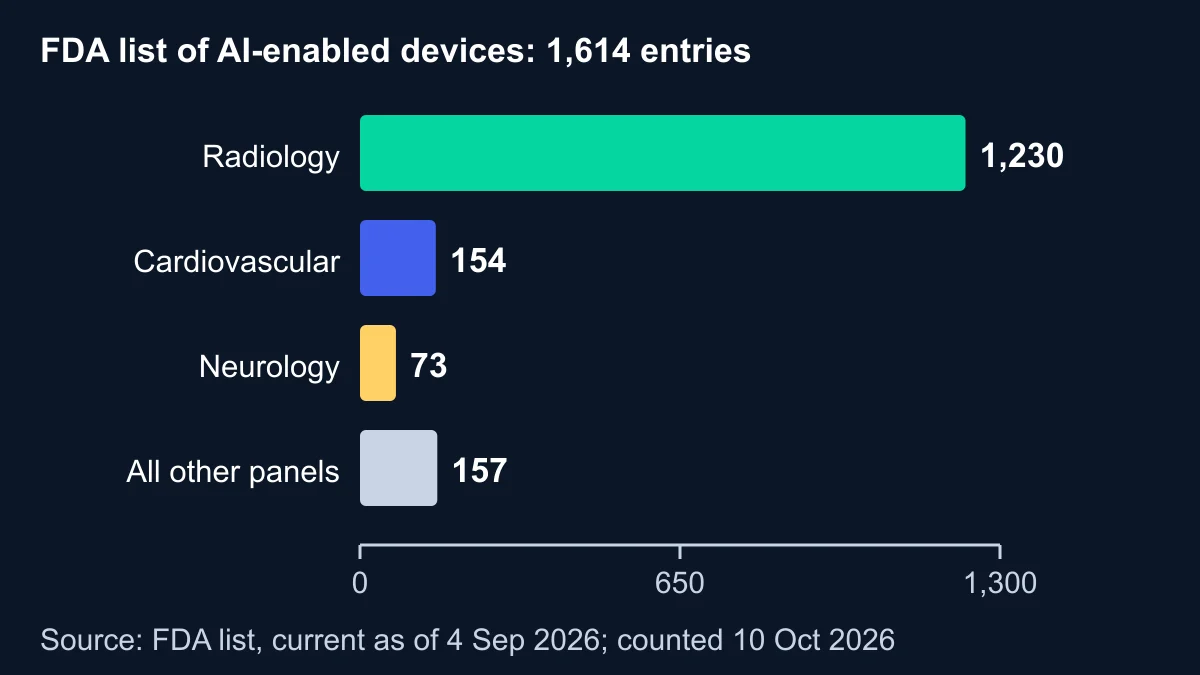
What has reached patients so far, for cancer and for other diseases, is mainly software that looks at images and signals. The US Food and Drug Administration keeps a list of AI-enabled medical devices authorised for marketing, and when we counted it on 10 October 2026, against the list’s own date of 4 September 2026, it held 1,614 entries. Of those, 1,230, about 76%, sat under the radiology panel, with 154 under cardiovascular and 73 under neurology. Most of them read, measure or flag something on a scan or a signal, whether the disease is a cancer, a heart rhythm problem or a stroke, so the list is, in effect, an inventory of tools for finding and measuring disease.
In the UK and the EU, medical devices fall into four risk classes, I, IIa, IIb and III, from lowest to highest, and the UK’s best-known autonomous cancer example sits at the top of that scale. On 6 February 2025 Skin Analytics announced a Class III CE mark for its DERM skin-cancer system, and the company says DERM was the first such system approved in Europe to make clinical decisions without a clinician reviewing them. Even that success is used inside NHS referral pathways rather than sold to consumers, and it is still a detection tool. As far as published records show on 10 October 2026, no AI-discovered drug has been approved to treat any cancer, and none has reported Phase 3 results in cancer.
Drug discovery for other diseases is at a similar stage, as halicin shows: a deep-learning model helped MIT researchers find this antibiotic candidate, which, according to Stokes and colleagues in Cell in 2020, treated two hard-to-treat bacterial infections in mice. That was a real discovery made with AI, and like the cancer candidates above it was a result in animals, which would still need human trials before anyone could call it a treatment. So AI is already helping to diagnose many diseases, while curing any of them is still waiting on the same trials a cancer cure needs.
Can AI make scientific discoveries?
AI systems can make scientific discoveries under the right conditions, and the conditions matter more than the model. They have produced verified new results where every answer can be checked automatically, which is why AI is racing ahead at maths. Google DeepMind’s AlphaEvolve is a good example: it checks, runs and scores every program it proposes using automated measures, and one scheduling rule it found recovers about 0.7% of Google’s worldwide computing resources. Applied to more than 50 open problems in mathematics, it matched the best known solutions in roughly 75% of cases and improved on them in 20%, including a way to multiply 4×4 complex-valued matrices with 48 scalar multiplications, improving on Strassen’s 1969 algorithm. In biology the check is an experiment, and experiments are slow, expensive and sometimes surprising.
So when we ask whether AI can generate genuinely new knowledge in medicine, the question keeps turning into who runs the experiment. A model wired into a loop that tests its suggestions can contribute to real discoveries, while one that is not produces candidates that still need someone else to find out whether they are true.
Can AI do scientific research without a lab?
Some of the lab work can be automated, and the idea is older than most people think. In 2009 Ross King and colleagues described in Science a robot scientist called Adam that generated hypotheses about the genes of baker’s yeast, tested them with laboratory automation and recorded its own work in a formal language, after which the authors confirmed Adam’s conclusions by doing the experiments by hand. King is also the senior author of the 2025 Cambridge-led GPT-4 study described below, so the same research line has moved from a robot testing yeast to a language model proposing cancer drug pairs for people to test.
Sixteen years after Adam, Google’s AI co-scientist, a multi-agent system built on Gemini 2.0 and announced in February 2025, worked on the reasoning side of the same problem. It proposed existing drugs that might be repurposed for acute myeloid leukaemia, and collaborating scientists then tested them and confirmed that they “inhibit tumor viability at clinically relevant concentrations in multiple AML cell lines”. The research paper, now titled Accelerating scientific discovery with Co-Scientist, describes the candidates as validated through laboratory experiments on cells. Google’s account of the work includes a second example that impressed many scientists: asked to explain how certain gene-transfer elements turn up across many bacterial species, the system independently proposed a mechanism that the research team had already confirmed in the lab but not yet published, a real case of a system reaching a correct, unpublished idea on its own.
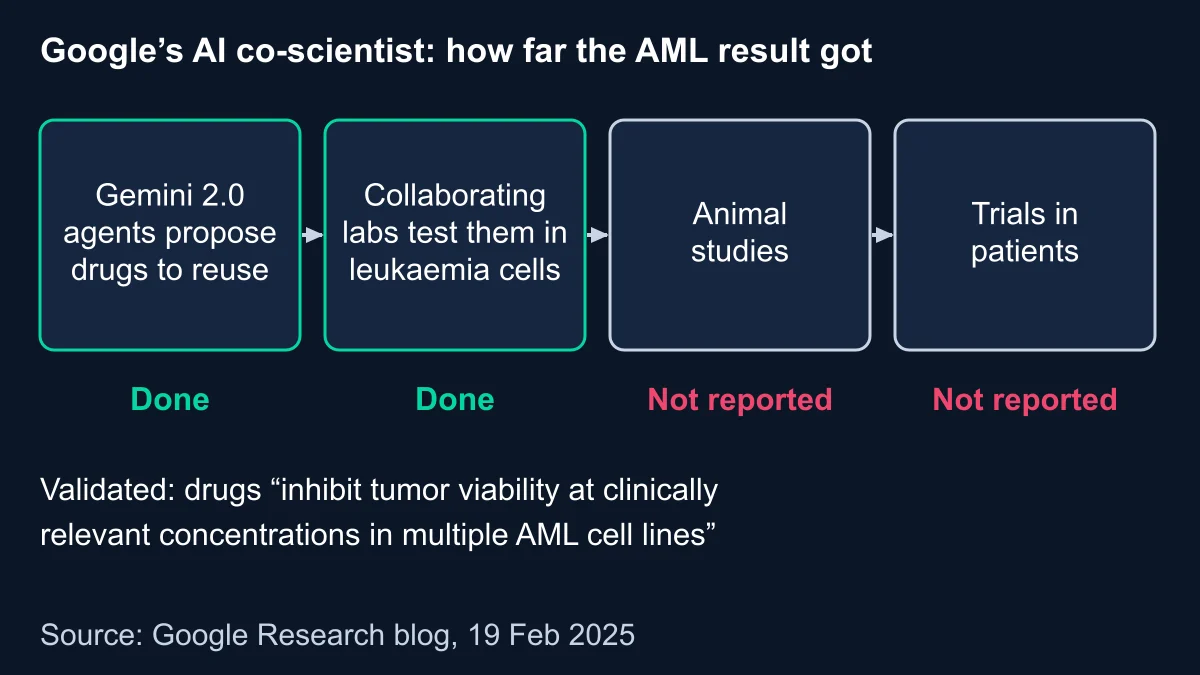
The leukaemia result is real, although so far only in cells, and leukaemia cells growing in a dish lack the immune system, the liver that breaks drugs down and the many other tissues that cause side effects. The next steps are animal studies and then patients, and neither was part of what the system did. Robotic labs can now pipette, culture cells and measure results with little human help, but people still write the protocols, decide which results to trust and handle anything involving animals or patients, and no AI system can run a clinical trial by itself, since a trial involves consent, safety monitoring and legal responsibility for real people.
The open question we find most interesting is whether AI systems that run their own experiments, in robotic labs with real cells, will close the gap this article keeps describing, because if they do, the boundary moves; so far we have not seen primary evidence that such a lab has produced a cancer treatment tested in people.
Why a new combination is not a cure
The most direct test of a chat model as a cancer scientist is the Cambridge-led study by Abdel-Rehim and colleagues in the Journal of the Royal Society Interface in June 2025. GPT-4 was asked to propose pairs of approved non-cancer drugs that might act together against MCF-7 breast cancer cells while sparing non-cancerous breast cells. Of 12 pairs tested, 3 scored above the positive controls. GPT-4 then proposed 4 more based on those results, and 3 of the 4 showed positive synergy. The authors argue that some model hallucinations can be useful as novel hypotheses that experiments can test, and conclude that LLMs are “a valuable source of scientific hypotheses”.
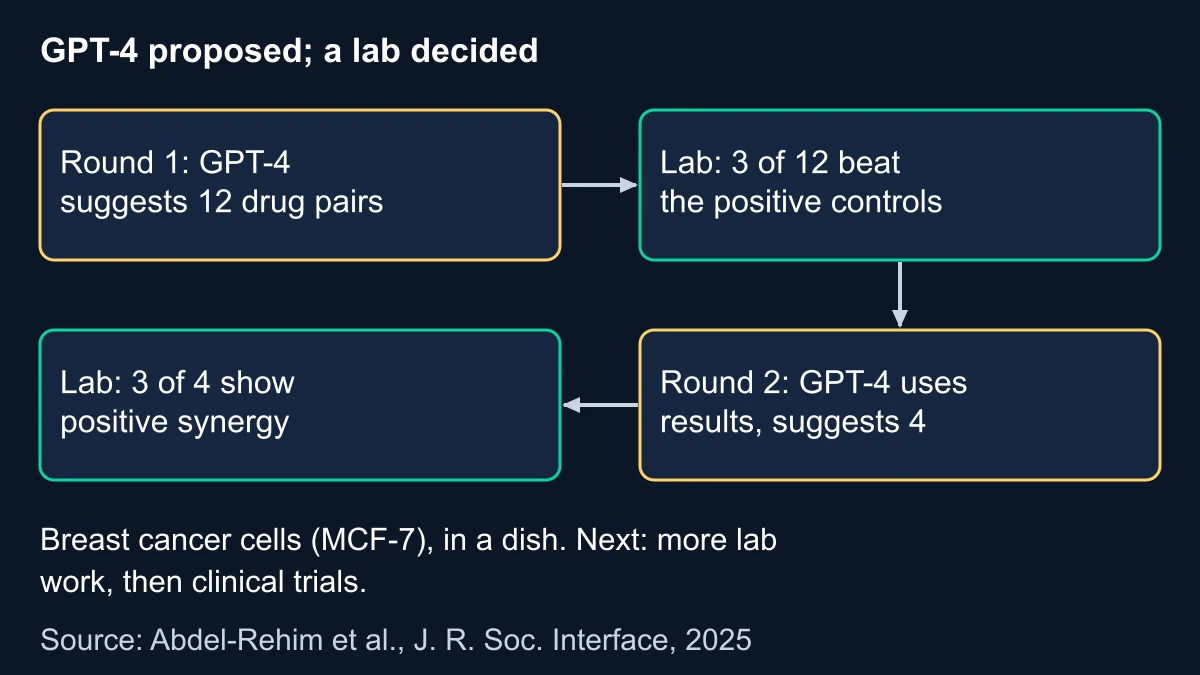
We think that framing is right, and the paper also shows where it stops, because a hallucination is only useful if someone tests it, and in a chat window nobody does. Every number in that paper came from human scientists running assays on cells. The combinations were new as combinations, and finding out whether any of them helps a person with breast cancer would take years of further work.
Can AI do research? What ChatGPT and Claude can and cannot do
ChatGPT, Claude and similar models can do a great deal of the desk work of research: they search, read, summarise, compare and draft, and they write the code for an analysis. That matters for cancer research, where much of the work before any experiment is reading, and the Cambridge study shows a chat model can go a step further and suggest hypotheses worth a lab’s time. Whether ChatGPT can do research, or Claude can, therefore depends on which half of research you mean. Neither can certify that an idea is new, or true. A model can only report what its search found, a paper it cannot open plays no part in its answer, and it cannot tell you whether a hypothesis has already been tested and failed in a lab that never published.
Can AI cure cancer by reasoning alone?
Reasoning on its own can rearrange what is known, and it can spot a combination nobody has tried, but it cannot tell you how a particular tumour in a particular person will respond, because that fact does not exist until someone measures it. The same is true of side effects that appear in only a small share of patients, or only after months of treatment, and of the surprising result that sends a research team in a new direction, which in medicine usually arrives in a trial and cannot be reasoned out in advance. That line, between what can be worked out from known facts and what has to be measured, is the one our own study kept running into, even though we went looking for something quite different.
What we found when we tested AI as an inventor
Our own study never set out to look at cancer, and it is written up in full in our 25-day test of whether AI can invent. It started with an everyday problem: on 16 September 2026 I went looking for a power-assisted shopping trolley and found only expensive powered walkers, which made me wonder whether AI could come up with something genuinely new, and we turned that question into a study at Opace. Invention is a sharp test of any AI, because a truly new idea is, by definition, not already in the model’s training data or on the web, and a patent application has to defend the claim that it is new. A cancer cure sets the same kind of test, since the facts it depends on have not been written down anywhere yet, and that shared need for facts nobody has recorded is why the study belongs in this article.
What the study tested and how
Over the 25 days, from 16 September to 10 October 2026, we used three kinds of tool. ChatGPT is the OpenAI chatbot most people know. Claude is Anthropic’s equivalent, and we used it through Claude Code, a version that works with files and tools on a computer. Alongside it we used OpenAI’s Codex, an AI agent built for programming that can also search the web and read documents, and we gave Claude and Codex the same questions so that each acted as a check on the other. Finally we used a team of up to 25 AI agents: separate copies of a model, each given its own task and working in parallel, with one coordinating the rest, so the work no longer depended on a single chatbot answering one question at a time.
Each idea had to be new, patentable, cheap to test and commercially worthwhile. Every one was checked against existing patents and products, using the same checks a patent attorney or an investor would apply: is it new, is it more than an obvious step, does it work in the worst case, can a competitor easily design around it, and can it make money? It was a case study rather than a controlled trial, and its limits are set out at the end of this section.
What the study found
The study produced 276 distinct ideas once duplicates were merged. Claude and Codex wrote 274 of them in about five hours, ChatGPT the other two, and checking them meant looking up 2,161 patent and application numbers. Not one of the 276 was judged strong enough to justify a patent application: 69 were promising but unproven, and 207 were ruled out. Most of the ideas were new in their exact wording but failed on whether they were inventive, whether the physics worked, how easily they could be designed around or whether they could make money. Towards the end we added a stricter test, in which ten ideas were written down in full before any patent searching began, so that the AI could not quietly adjust them to fit around whatever the search turned up, and all ten were ruled out.
The speed matters as much as the result, because producing ideas was cheap, since almost all of the 276 came out of a few hours of model time, while deciding whether any of them was new, true or workable was slow, and it always came down to information the models did not have. The conclusion we drew was a narrow one: a model working from prompts, its training and public search found no reliable route to a patentable idea, and what was missing each time was a new technical fact, a physical observation or an experiment. That is the same shape as the Cambridge drug-pair study above, where the pairs GPT-4 proposed were new as combinations and only a laboratory could say whether any of them did anything.
Within those limits the models were good at the checking itself, which is the part of research a chat model is best placed to help with. Each finding had to be backed by a document number, a date and a legal status, or marked as unverified, and one AI agent was set up to look for evidence either for or against my own doubts about an idea, so that the checking did not simply confirm what I already thought. When the evidence went against the idea Claude had rated most promising, it accepted that and dropped the idea, and in one check it read the whole technical description in a patent, roughly 10,000 words, before judging how far it overlapped with an idea in the study, which is the kind of patience a cancer researcher would want from a literature assistant. Its limits showed just as clearly when some patent databases blocked or slowed the automated searches and the models had to work from whichever sites let them in, and none of them could certify that an idea was new.
What the AI found when it looked at health at home
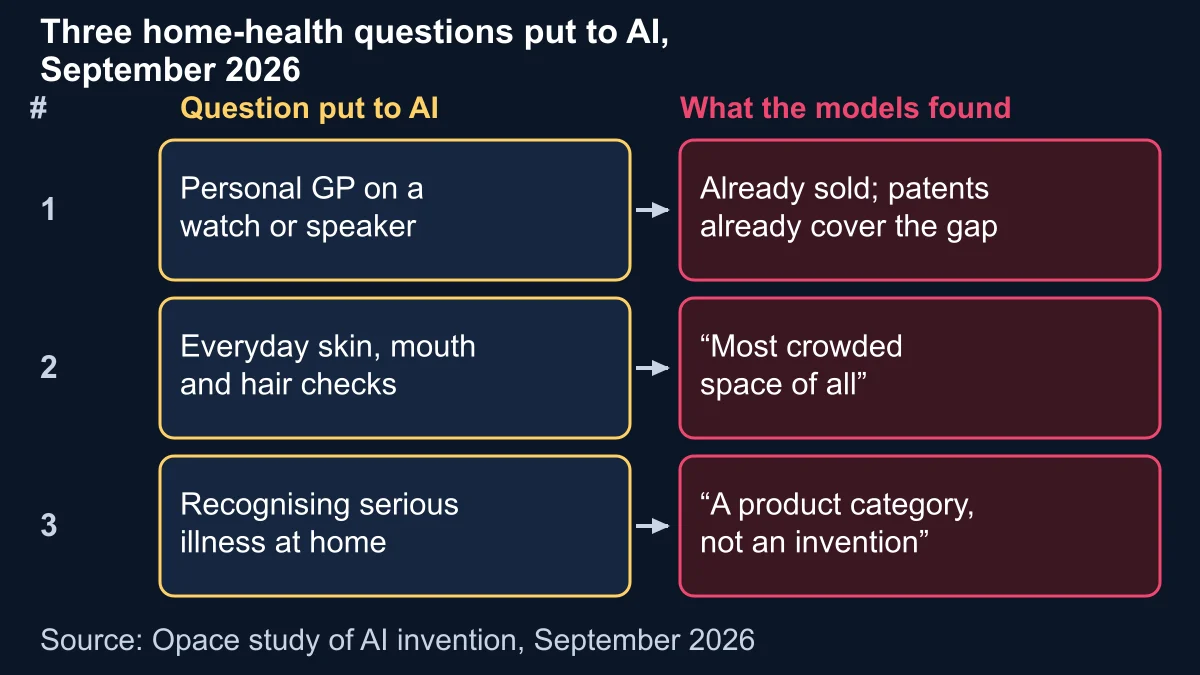
One day of the study, 27 September 2026, turned to health at home, and it is the part of our evidence closest to this article’s question. The AI models worked on three questions. Could a personal GP on a watch or smart speaker be made into something new? Could everyday checks of skin, mouth and hair? And could anything new help people recognise serious illness, including cancer, at home?
I doubted the first idea from the start, because anyone could set up something similar by giving ChatGPT their own instructions, and when the study’s AI agents checked that doubt against what health platforms already sell, it held. The agents reported that every major platform had already launched a health assistant that talks and reasons, connects to medical records and carries the same disclaimer: not for diagnosis or treatment. A chatbot that talks about health had become something every platform offered, whereas building one that can stand behind a medical judgement is another matter, as that shared disclaimer is the companies admitting.
Both Claude and Codex ruled out a generic personal GP, partly for that reason and partly because software that helps diagnose a condition falls under medical-device rules. Claude got there by breaking a GP consultation into its parts: talking and reasoning, looking, listening, pressing, tapping, measuring, taking samples and treating. In its view the talking part is already sold as a chatbot and the GP’s instruments are already sold as home kits, while pressing and feeling are still done only by a clinician. That led to the one idea in the study that touched cancer directly, a pad to help people check themselves for lumps at home, and Claude’s patent search soon found that the pad’s core sensor had already been published by others. Nobody sold such a pad, yet existing patents already covered the ground, so no version of the idea was strong enough to justify a patent application.
The everyday checks of skin, mouth and hair are where a skin-cancer app would sit. Claude’s assessment was that pointing a phone camera at the body and adding AI is the most crowded space of all, and that the only promising pattern was a physical design that makes a measurement a phone cannot. Skin and mouth checks were both ruled out after closer checking.
On the serious-illness question, Codex found home monitoring of cancer deterioration already crowded: symptom tracking, deterioration prediction and home-care systems were all described in existing patent filings. It was also candid about the limits of its own search, saying when challenged that it had not found a gap free of existing patents, and from then on it labelled every suggestion a research hypothesis rather than a claim that anything was new. Its summary of the category is worth quoting:
“‘AI notices symptoms and alerts someone’ is now a product category, not an invention.”
Home diagnosis and AI support, in its view, are needs that many companies already serve, and nobody can still claim them as inventions.
Why the missing input matters in biology
The conclusion the whole study reached was that what was missing was always a new fact from outside the model. In our study that might have been a measured physical effect or a test on a real prototype. In cancer, the missing fact is how a specific tumour responds to a specific drug in a specific kind of patient, and the only way to get it is to run the experiment. A model can arrange the known facts in a new order very quickly, yet it has no access to the ones nobody has measured. That is true however good the model is, which is why we do not read the study’s failure to produce a single patentable idea as a judgement on any one model; Claude, Codex and ChatGPT each reached the same boundary by a different route.
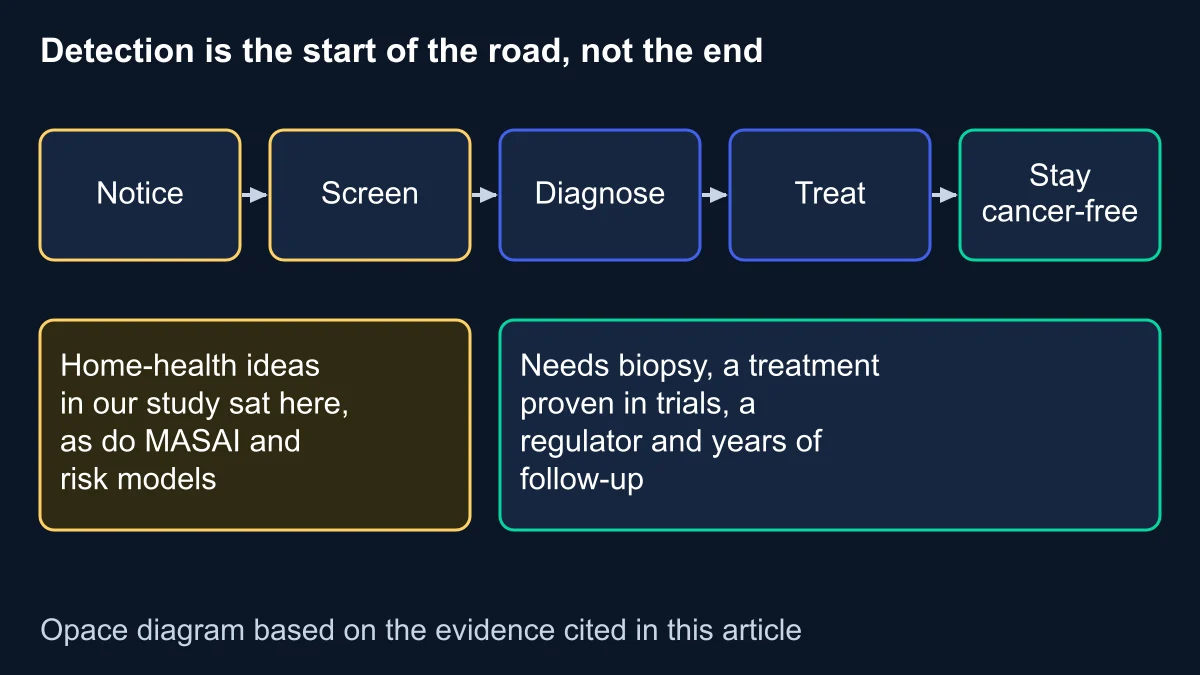
The home-health questions show the same thing from another angle, since all three asked AI to notice, screen or alert, and none asked it to treat anyone, which is the layer where the strongest cancer AI works today: MASAI’s mammography reading, the NHS chest X-ray tools and the pancreatic risk model all find or flag something sooner. So the home-health part of our study meets the question of whether AI can cure cancer at the very start of the road.
Noticing a problem early is only the first step towards a cure, because a pad, an app or a screening algorithm that spots something earlier changes a person’s outcome only if the signal is confirmed by a clinician, the cancer is diagnosed properly, a treatment that works is available and that treatment has been proven in trials. The study showed that even the first step meets walls before it reaches a patient. The ideas were already crowded among existing patents, and a device that tells a member of the public it may have found a lump is a regulated medical device, with the evidence and liability that brings. When the study compared consumer health devices that had failed with those that had succeeded, the successes had something in common: the devices that reached the NHS each measured one clinical sign, either passively or with an instrument used in a clinic, and each fitted into a care pathway the NHS already pays for, as Skin Analytics’ DERM does. A consumer health device that sits outside such a pathway, the study concluded, has nobody obvious to pay for it.
What the study cannot show
Because this was a single company’s study run at a desk, and never a study of cancer, its limits are worth setting out plainly: AI did the patent searching, there was no private data, no lab and no physical test, and there was no control group, while the prompts were ours and the models searched public patents and papers only. Many of the 276 ideas are variations on one another rather than 276 independent inventions, and the samples are small. Take the ten ideas written down in full before any searching, all of which were ruled out. Ten blanks in a row are not unusual even for a method that works fairly often (one that succeeded one time in four would still draw ten blanks about one time in 18), so with no successes in ten tries the true success rate could still be as high as about 30%. The study shows that this approach did not produce a patentable invention. It does not prove that AI cannot invent, and it says nothing directly about cancer biology.
The home-health questions, too, were desk research by AI models in a single day, steered by our prompts. Nobody built a device, ran a test on a person or asked a clinician, so these findings cannot show whether a home detection tool would help patients. What they do show is how fast the leading models can map a crowded field once someone points them at it, and that a model will admit the limits of its search when pressed, as Codex did, although that candour has to be asked for.
What ChatGPT conceded when we debated the results
Our experiment into whether AI can invent came to its conclusion on 10 October 2026, when we debated the results with ChatGPT for 46 minutes, and three things it said bear on cancer. During the study it had pointed to FunSearch and AlphaEvolve, the two Google DeepMind systems described earlier, as evidence that AI can discover things. In the debate it conceded:
“I also cited examples such as FunSearch and AlphaEvolve without sufficiently distinguishing the abilities of the underlying LLM from those of the complete discovery system.”
That is the FunSearch point about models and systems, made by a chat model about itself.
It also weighed the maths results against our study’s failure to invent anything. A chatbot’s view carries no special authority on this, but its answer was candid about its own kind of system. It suggested the missing ingredient might be “the ability to build accurate internal models of how things physically work, explore entirely new mechanisms, conduct experiments, recognise unexpected results and revise its understanding accordingly.” Scientists would recognise that list, since it is a fair description of what a cancer laboratory does all day, and of the work a language model cannot do from inside a chat window.
The third point was about agreement, and it is the one we found most troubling. When we raised three objections, ChatGPT accepted all three at once (“You’re right on all three points”), and one of the points it accepted was that I had asked it, while it was suggesting inventions, to reason from first principles and explore new physics. I can find no record that I did. It had agreed without checking what I had actually said, and in a conversation about someone’s health, agreement of that kind is easily mistaken for reassurance.
When a chatbot agrees, what has it actually checked?
ChatGPT’s readiness to agree matters most when the person on the other side of the conversation is worried about their health, and it sits uneasily beside the disclaimer every platform’s health assistant carries, saying it is not for diagnosis or treatment. The disclaimer tells you the companies know the difference between a fluent answer and a tested one, even when their users do not, because a chatbot can sound like a doctor without having checked anything and the person reading the answer has no easy way to tell which parts rest on evidence.
The best evidence on what happens when the public uses these tools is a randomised, preregistered study by Bean and colleagues in Nature Medicine in February 2026. They gave 1,298 participants one of ten medical scenarios and asked them to work out what might be wrong and what to do, with or without a large language model. Tested on their own, the models identified the relevant conditions in 94.9% of cases and chose the right course of action, which the paper calls disposition, in 56.3%. People using the same models identified the relevant conditions in fewer than 34.5% of cases and chose the right course of action in fewer than 44.2%. They did no better than a control group who used whatever source they normally would.
Knowing medicine and helping a worried person turned out, in this study, to be different skills, and part of the trouble was what people typed, as the researchers found:
“…users often failed to provide the models with sufficient information to reach a correct recommendation”
In 16 of 30 sampled conversations the first message held only part of the picture. The models in turn suggested 2.21 possible conditions per conversation on average, and only 34.0% of those suggestions were correct, a separate measure from the 34.5% of people who reached the right answer even though the two figures happen to be close. And even when a right answer appeared in the conversation, users often left it out of their final decision.
The authors identified the interaction between user and model as the challenge for using LLMs to give medical advice, and found that standard benchmarks and simulated patients “do not predict the failures we find with human participants”. Their recommendation was systematic testing with human users before any public deployment in healthcare. That is a striking result for anyone who assumes a better model automatically means better advice, because the models were already scoring well when tested on their own. The same lesson applies, more mildly, to any business putting a chatbot in front of customers, and it is how we approach ChatGPT and chatbot consultancy for clients: by testing the tool with real users before launch as well as against a benchmark.
So a chatbot cannot cure cancer, and it cannot tell you whether you have cancer either. If something worries you, the NHS cancer pages linked at the top of this article are clear: see a GP about changes that are not normal for you. Charities such as Cancer Research UK publish plain-English guides to cancer, its treatment and the research behind it. We do not offer medical advice here, and what we saw at the end of our own study is one reason we would not trust a chatbot to give it either.
How cancer research crosses the lab and trial gap
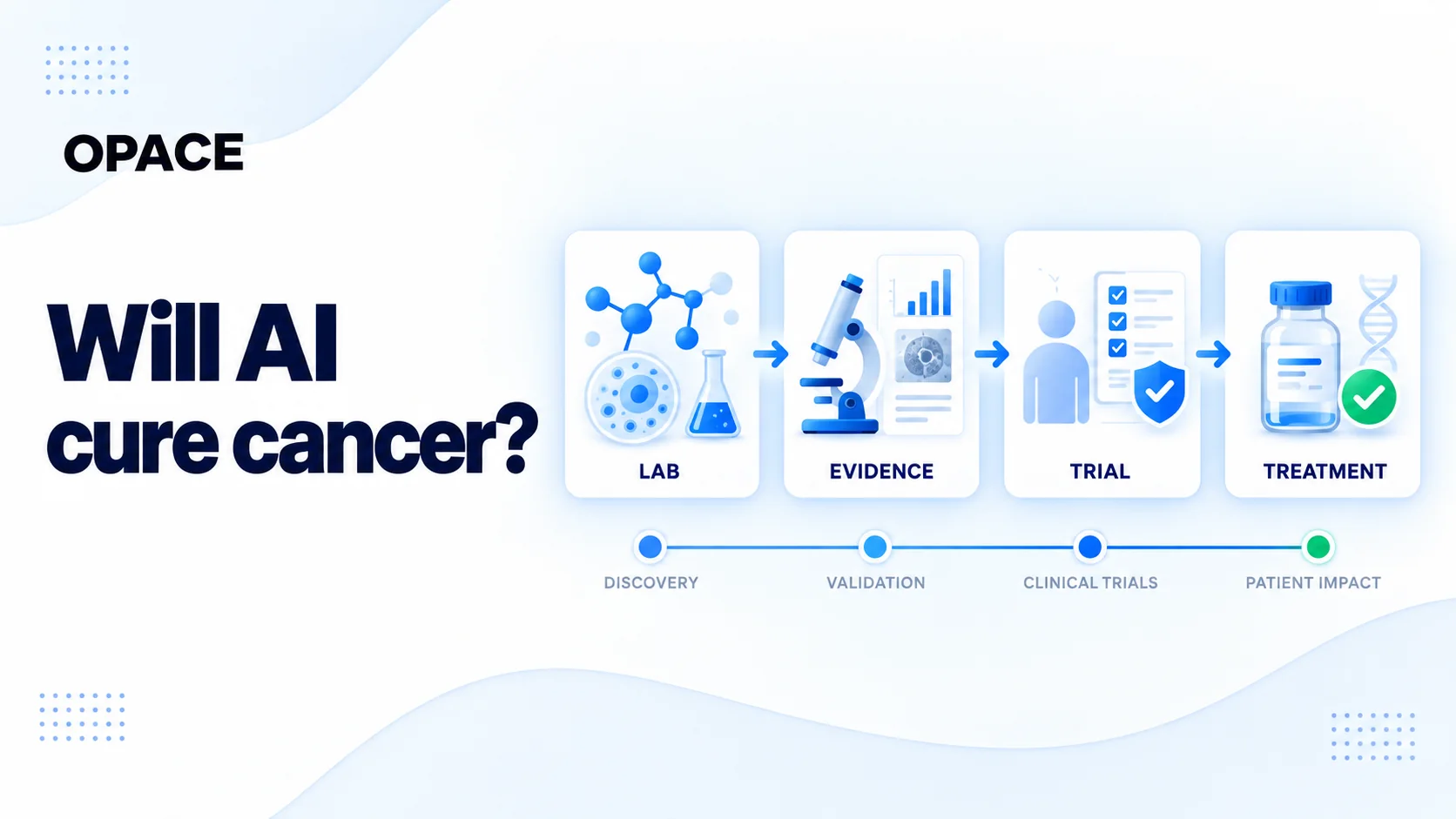
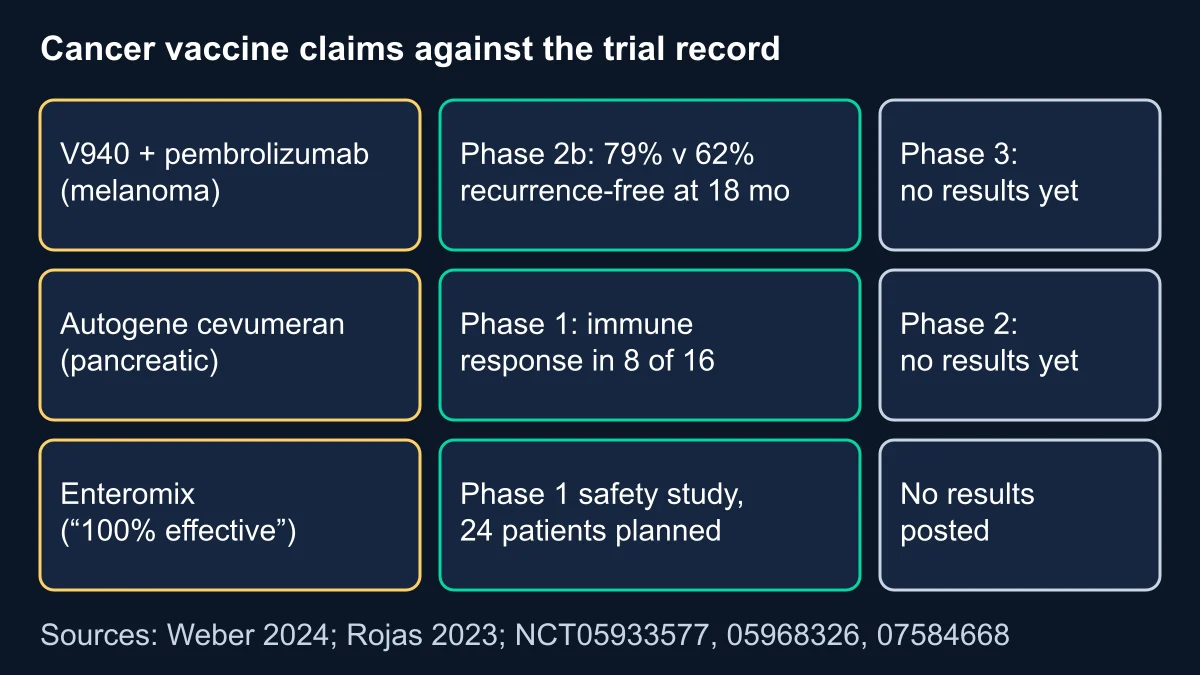
The road from an idea to a treatment has a fixed order, and AI has so far shortened the early steps most. A hypothesis becomes an assay in cells, a promising assay is replicated (often in a different lab), and the molecule is tested for toxicity in animals before the human trials begin: Phase I for safety, Phase II for an early sign that it works, and Phase III against the best existing treatment in hundreds or thousands of people. The jump in scale is large. V940, a personalised mRNA vaccine for melanoma given alongside the immunotherapy drug pembrolizumab, was tested in 157 people in the randomised Phase 2b trial that Weber and colleagues reported in The Lancet in 2024, and its Phase 3 trial, NCT05933577, plans to enrol 1,089. A regulator reviews the evidence, and only then can a clinician prescribe it. Even a model that out-reasons experts on paper, which is the subject of whether AI will surpass humans, still needs the experiment at every one of those steps.
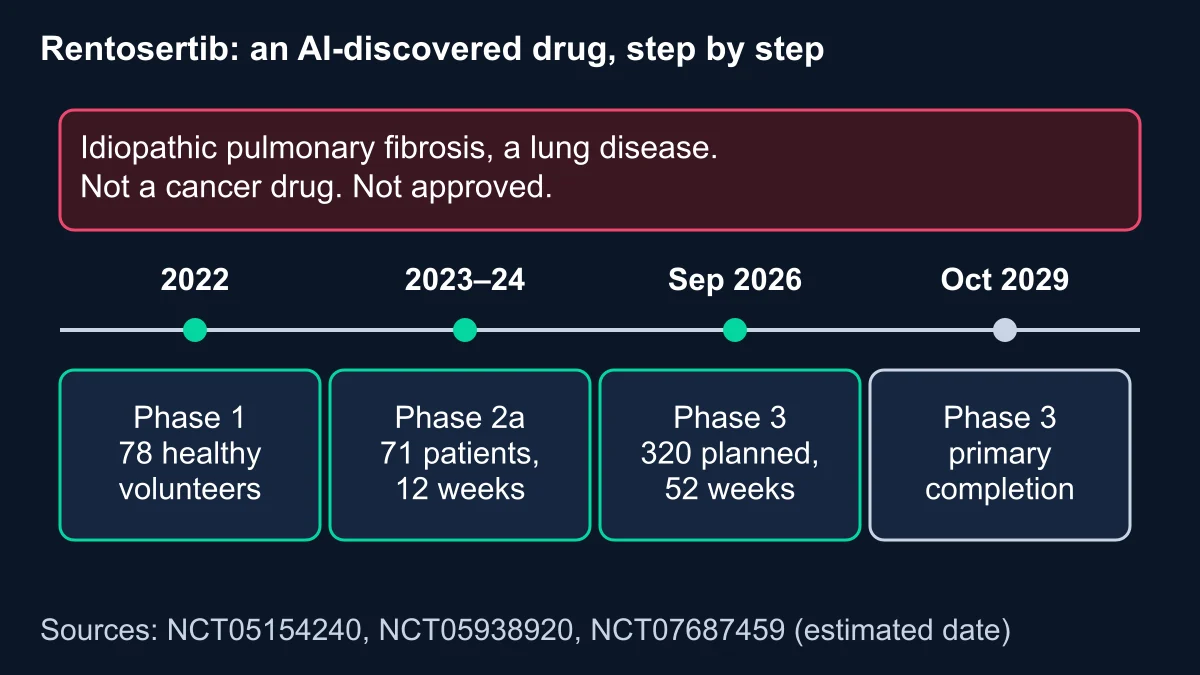
Rentosertib shows the timescale for the furthest AI-discovered drug, and the trial registry shows how long each step takes. The Phase 1 study, NCT05154240, enrolled 78 healthy volunteers between February and December 2022. The Phase 2a trial, NCT05938920, randomised 71 patients with idiopathic pulmonary fibrosis between June 2023 and August 2024, and was published in June 2025. The Phase 3 trial, NCT07687459, began on 9 September 2026, aims to enrol 320 patients for 52 weeks and lists its primary completion as October 2029. Even if every step succeeds, that is more than seven years from first human dose to a possible approval decision, for a drug whose discovery was accelerated by AI.
The hardest step in that sequence is usually Phase II, the first point at which a drug has to show it helps sick people, and it is exactly where the AI-discovered molecules studied so far start to look like everyone else’s. The registries also give a more concrete sense of time than any forecast: MASAI began recruiting in April 2021 and its final interval-cancer results appeared in January 2026, nearly five years for a screening trial whose design was already settled, and rentosertib’s Phase 3 date of October 2029 is matched by the V940 vaccine’s Phase 3 trial. Those dates are set by how long it takes for enough cancers to return, or not, in enough people to tell the difference.
Some measures move much faster, though: screening workload, the time taken to report a scan and the number of candidate drugs entering trials can all change within a year or two, and those are where AI is already showing up, as real steps that deserve credit as steps. England’s EDITH trial will add another test of the screening result when it reports, because it asks whether the Swedish findings hold in a different national programme with different machines and readers.
AI could shorten some of the rest, in that better patient selection can make trials smaller, better candidates can fail less often, and better screening can find cancers when they are easier to treat. None of that changes the rate at which a tumour grows back or a patient survives, so when someone tells us AI will cure cancer by a particular year, we now ask which trial would have to report by then, and whether it is already registered.
Myth or truth: has AI already cured cancer?
We keep seeing videos and posts saying AI has found a cure for cancer, so we looked up the versions that are actually circulating. Not all of them claim a finished cure. Some are predictions, some describe a single lab result as a breakthrough, one reports a real drug milestone that is easy to overstate, and one concerns the same AI-discovered drug that is now being promoted as an anti-ageing treatment, a claim that travels with the cancer stories and so is worth checking alongside them. For each one we took the wording people are sharing, followed it back to the paper, trial registry or official record behind it, and gave it one verdict. True means the evidence supports the claim as worded. Partly true means it holds only with an important condition. Misleading means the facts are real but the framing suggests more than they show. Unsupported means we found no evidence that backs the claim.
“AI will cure cancer in our lifetime”: South Africa’s Eyewitness News ran it on 10 September 2026 as “Could AI cure cancer? Tech boss thinks it could happen in our lifetime”, relaying Rene Haas’s comments through its UK correspondent. The original is the BBC interview described at the start of this article, in which Haas said AI will help cure cancer, resting on the belief that computers will solve the problem as models improve. Nothing he cited is a result, and Amodei’s more detailed essay argues for faster progress while warning that experiments set a minimum time nobody can remove. Verdict: Misleading, because a prediction is being shared as if it described a capability.
“ChatGPT cured a dog’s cancer”: In March 2026 the story of an Australian man who used ChatGPT and other AI tools to plan a personalised mRNA vaccine for his dog went around the world, and The Scientist subheaded it as using “machine learning and mRNA technology to develop a cure”. We opened the UNSW newsroom story about the man and his dog, and found no paper and no trial record. Prof Pall Thordarson, whose UNSW RNA Institute made the vaccine, wrote that “this may not have cured Rosie”, that it bought time and that some of the tumours did not respond, as quoted by Decrypt. The dog also received a checkpoint-inhibitor drug, so even the time it gained cannot be put down to the vaccine alone. Verdict: Unsupported.
“A.I.’s quickly created cancer cure”: That headline on Leaders.com describes AlphaFold and Insilico’s chemistry software finding a liver-cancer drug candidate in 30 days. The primary paper, Ren and colleagues in Chemical Science in 2023, reports a new hit molecule against a protein called CDK20, identified within 30 days of choosing the target, after making only seven compounds, and tested in cell-line assays. The paper’s published summary reports results in cells only, with no animal or human data. Verdict: Misleading, since a first hit molecule in a dish is the very start of the pipeline described above.
“A cancer vaccine is 100% effective”: In September 2025 Russian officials said their Enteromix vaccine had shown 100% efficacy, and Sri Lanka’s Ada Derana carried it as “Russia’s Enteromix cancer vaccine shows 100% efficacy in early trials”, citing 48 volunteers and giving no paper or registry number. The registry record we found, NCT07584668, is a single-centre Phase 1 safety study in Moscow aiming to enrol 24 patients with solid tumours, listed in October 2026 as active but not recruiting, with no results posted. We found no published trial results in the medical literature, only a short letter about the vaccine. Verdict: Unsupported.
For scale, the strongest evidence for personalised cancer vaccines looks very different. In the V940 Phase 2b trial mentioned above, known as KEYNOTE-942, 157 people with resected melanoma had 18-month recurrence-free survival of 79% with the vaccine (also called mRNA-4157) plus pembrolizumab against 62% with pembrolizumab alone, a hazard ratio of 0.561 with a borderline p value of 0.053, and its Phase 3 trial has posted no results. In pancreatic cancer, Rojas and colleagues in Nature in 2023 gave a personalised vaccine, now called autogene cevumeran, to 16 patients in a Phase 1 trial and found immune responses in 8. The Phase 2 follow-up, NCT05968326, lists primary completion in January 2031. Those are promising early signals from trials of tens and hundreds of people, and none of them claims anything close to 100%.
“An ‘AI scientist’ finds common drugs that kill breast cancer cells”: Open Access Government ran that headline on 6 June 2025 about the Cambridge-led GPT-4 study described above. The primary paper supports the claim for cells in a dish, and says nothing about patients. Verdict: Partly true.
“ChatGPT ‘uncovers’ hidden cancer, saves woman’s life after missed diagnosis”: In April 2025 Interesting Engineering carried the account of a woman who credits ChatGPT with prompting the test that found her cancer. We have no reason to doubt her story, and we cannot check it, since it cites no study. The controlled evidence is Bean and colleagues’ randomised study, covered above, in which people using chatbots did no better than people without them. Verdict: Misleading, because one account is being shared as evidence that chatbots diagnose cancer.
“AI cuts missed breast cancers by 12%”: The Textbook of Digital Health headline on 29 January 2026 read “AI-supported mammography cuts interval cancers by 12% in first randomised trial of 100,000 women”. The MASAI paper does report 1.55 against 1.76 interval cancers per 1,000, which is about 12% lower, but the difference was not statistically significant (p = 0.41); the formal finding was non-inferiority, alongside a significant gain in sensitivity. Verdict: Partly true.
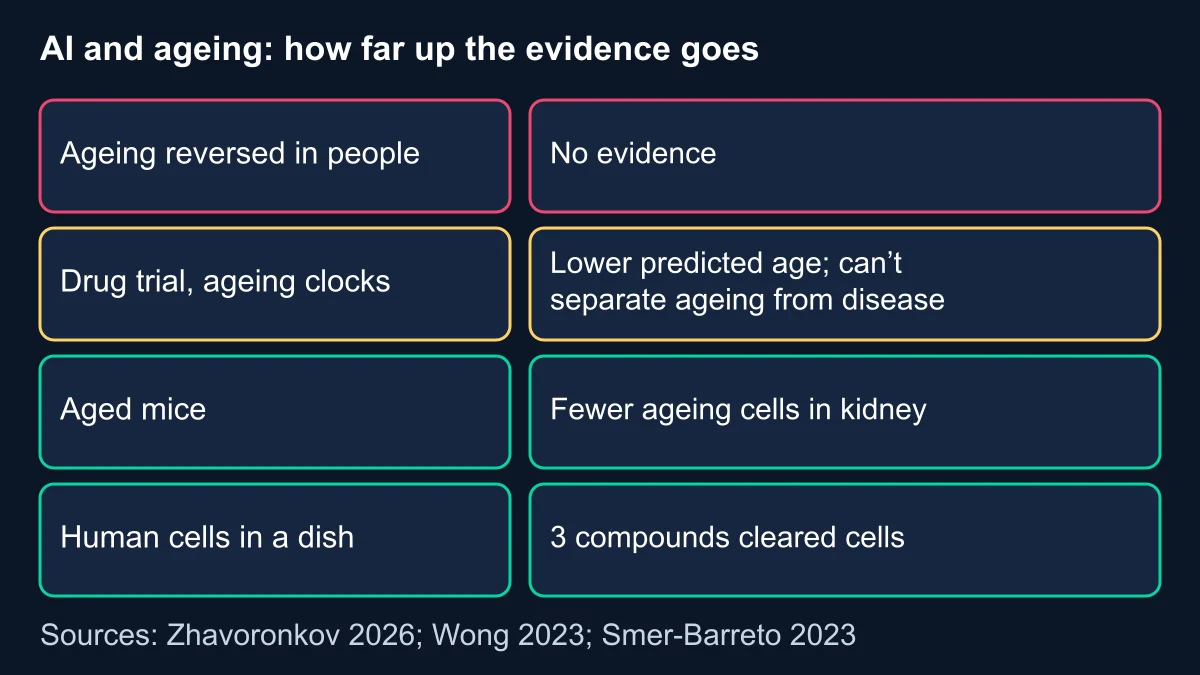
“AI has found a drug that reverses ageing”: In September 2026 Modelwire headlined “Insilico Medicine’s AI drug shows aging reversal in early trial”, and The Week asked whether “AI may have found a drug that slows aging”. The primary paper is Zhavoronkov and colleagues in Nature Biotechnology, published on 7 September 2026. It applied six proteomic ageing clocks, which estimate biological age from proteins in the blood, to samples from rentosertib’s lung-fibrosis trial and found that all six consistently predicted a lower biological age in the patients who took the drug. The authors also write that “proteomic clocks alone cannot deconvolute aging- and disease-specific effects”. In other words, a drug that eases lung scarring could look younger on these clocks without slowing ageing at all.
The earlier AI-and-ageing papers sit lower down the evidence ladder. In 2023, Smer-Barreto and colleagues in Nature Communications used machine learning to find three compounds that clear ageing, or senescent, cells in human cell lines. Also in 2023, Wong and colleagues in Nature Aging used deep learning to find a compound that lowered senescent-cell burden in the kidneys of aged mice. Neither tested people. Verdict: Unsupported for reversing ageing in people.
“An AI-discovered drug has entered Phase 3”: News-Medical’s report of 10 September 2026, quoted earlier for Prof Xu’s comment on the drug’s target, said that rentosertib had entered a Phase 3 trial for idiopathic pulmonary fibrosis, and the registry record behind the trial timeline above confirms a Phase 3, placebo-controlled trial that started on 9 September 2026 and is recruiting. Verdict: True, with the scope stated plainly: the trial is in a lung disease, the drug is not approved, and calling it the first is the company’s own description.
Ethics, bias, privacy and liability
Placido’s pancreatic model, which lost much of its accuracy when it moved from Danish to US records, is an ethics result as well as a technical one. A model carries the habits, coding practices and population of the data it learned from, and it can quietly serve some groups worse than others unless someone measures that and retrains it. In cancer screening, a gap like that means some people’s cancers are found later than other people’s for reasons that have nothing to do with their biology. If a model learns mostly from one group, its errors fall hardest on the people least like that group, and nobody notices unless someone breaks the results down by group, a breakdown a regulator can ask for and a chatbot answering a single user’s question has no way to provide.
Privacy pulls in the opposite direction, because the models that work best are trained on millions of real health records and the people in those records rarely consented to that particular use. Health systems handle this with research approvals, anonymisation and secure data environments, but the tension does not go away. In June 2026, writing about whether governments should ban artificial intelligence, we described AI as critical infrastructure in healthcare diagnostics, alongside finance and defence, which is exactly why governments are writing rules for it.
When is an AI health tool a regulated medical device?
In the UK, the line is drawn by the Medicines and Healthcare products Regulatory Agency. Its guidance on stand-alone software and apps says that “symptom checker devices will be class I unless considered to ‘allow direct diagnosis’”, and it lists words such as triage, self assessment and health information that can bring an app inside medical-device rules. A general chatbot that answers health questions sits awkwardly under that guidance, which is one reason the platforms add their disclaimer, and the disclaimer in turn moves the risk onto the person reading the answer.
Our study met the same guidance from the device side when one of the study’s AI agents checked the rules for the lump-pad idea and concluded that a device telling a member of the public it “may indicate a lump” would be a Class IIa medical device, the lower of the two middle risk classes, where an independent approved body, as well as the maker, has to assess the device before it can be sold. We checked the source, and the guidance says that “for devices intended to be used by lay users, provision of an indicative diagnosis may be enough to imply that the device is allowing direct diagnosis”, which moves such a device up the risk classes.
The study’s look at consumer health products that had failed added two US lessons, the first from Owlet, a maker of baby monitors: calling a product a wellness device stops protecting it the moment it claims to alert you to a health problem. In an October 2021 warning letter, the FDA told Owlet that its Smart Sock, sold to alert parents to low blood oxygen and a slow heart rate, was a medical device offered for sale without marketing approval, clearance or authorisation, and that it did not fall under the policy for low-risk wellness products. The second came from Pear Therapeutics, which sold apps prescribed as treatment and showed that a regulator’s clearance does not mean anyone will pay: the company filed for Chapter 11 bankruptcy in April 2023, with its chief executive writing that payers “have the ability to deny payment for therapies that are clinically necessary, effective, and cost-saving”. In the NHS that second decision is made separately, by commissioners with fixed budgets, which is part of why even proven tools spread slowly.
For anyone weighing up a consumer AI health product, the MHRA’s guidance gives a simple test, and the home-health part of our study points the same way: is the product registered as a medical device, with a named manufacturer behind it? The same guidance says a disclaimer such as “this product is not a medical device” is “not acceptable if medical claims are made or implied elsewhere”, and that testimonials repeated in product literature count as claims by the manufacturer. An app that promises to spot illness at home but sits outside that system has, by the regulator’s own standard, nobody accountable for whether it works.
Who is responsible when an AI system is wrong?
Late in our study the agent team was asked a different question: when is it believable to say that a task needs a human rather than an AI? The answer the coordinating agent gave was that such a claim holds only where the task needs a body, a legal identity, money or someone to carry liability. That fits medicine better than anything we could write, because every one of those is present in a cancer trial: a patient’s body takes the risk, a named investigator and sponsor carry the legal duty, someone funds the study, and someone answers if it goes wrong.
The law is built that way on purpose: in a clinical trial a sponsor, usually a company or university, is responsible for the trial, an investigator is responsible for the patients at each site, and a regulator decides whether the evidence supports approval; if an approved drug later causes harm, the manufacturer answers for it. For software that counts as a medical device, the MHRA guidance names who answers in the same way. The manufacturer is the person or company responsible for the design, manufacture, packaging and labelling of a device, and once the product is on the UK market it is responsible for monitoring it, reporting serious adverse incidents to the MHRA and running a post-market surveillance system so that problems are found early and acted on, which makes watching for harm after launch part of the company’s job as well as passing the checks before it.
Patent law points the same way, and one of the study’s findings, which Codex raised, was that UK guidance excludes diagnostic methods practised on the body, so a defensible invention in home health would need a genuine technical apparatus, and a language model interpreting symptoms would not be enough. We checked that against the Intellectual Property Office’s examination guidelines for medical inventions, which state that “methods of diagnosis practised on the human or animal body cannot be patented”. So the law expects a named person or company to stand behind any claim about a body, and it does not allow anyone a patent on the act of diagnosing one.
An AI system that helped choose a target, design a molecule or flag a scan has no legal identity, cannot be sued and cannot consent to anything, so in law it is a tool, like a microscope or a statistics package, however clever it is. It can inform a decision, while a clinician, a manufacturer and a regulator still answer for it, and a hospital that adopts a screening tool also owns the choice of which patients it is used on and how its mistakes will be caught.
We learned a much smaller version of the same lesson at Opace, where AI-written code became dependable only once something checked it and each mistake became a written rule that every later task had to follow (our comparison of casual and structured AI coding explains why our AI output only became useful once something checked it). It is also why the first thing we would ask any supplier of AI web design services, or of a medical AI tool, is what checks the model’s output before anyone relies on it, knowing that in cancer research the honest answer is an experiment and, for a treatment, a trial.
So, will AI cure cancer? Our verdict as of October 2026
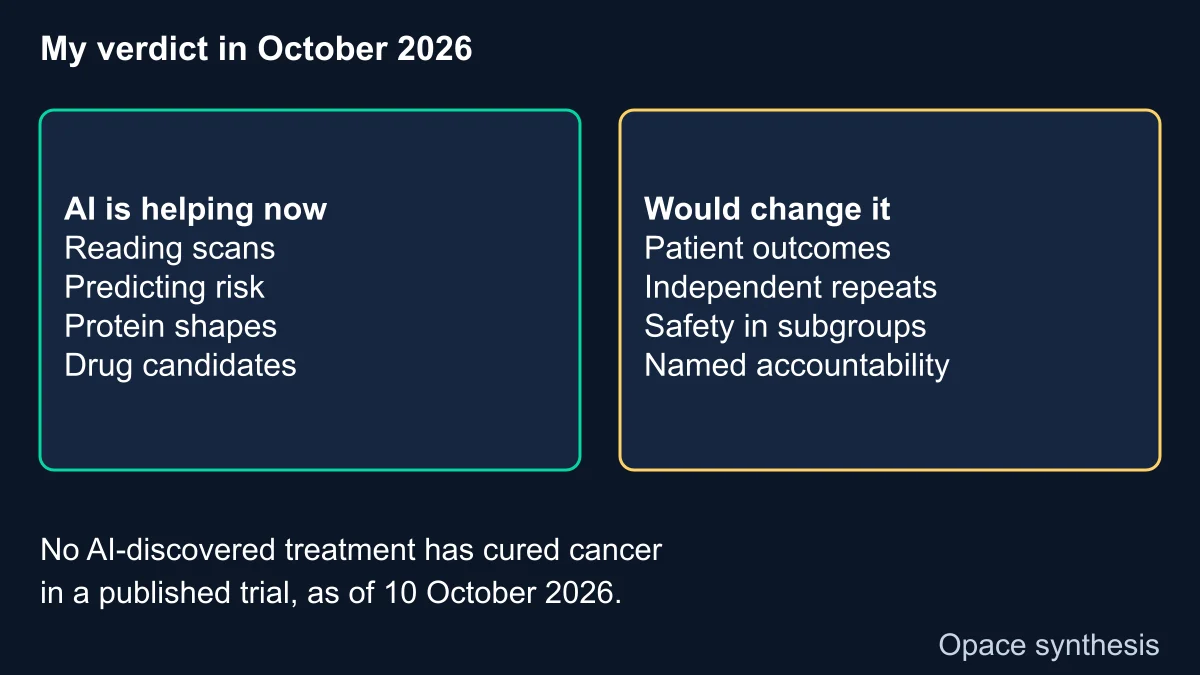
Our answer, as of 10 October 2026, is that AI will not cure cancer on its own, and a chatbot certainly will not: no AI-discovered cancer treatment had been shown to cure anyone in a published trial, as far as the journals and registries we checked show. What AI is doing is real and, in places, measurable. In screening it already helps radiologists find more cancers without more false alarms. In risk prediction it can spot patterns in millions of records, as long as it is retrained for each population. In drug discovery it proposes targets and molecules faster than people can, and the most advanced example started a Phase 3 trial in September 2026, in lung fibrosis.
The cure, cancer by cancer, still runs through laboratories, trials, regulators, clinicians and patients, which is the same boundary our own study kept meeting: the models could arrange what was already known with remarkable speed, and every time they stopped at a fact that nobody had yet measured. In medicine, the facts that would settle whether a treatment cures anyone are measured in cells, animals and people, and they are slow and expensive to get.
We think both the optimists and the sceptics have a point, and the evidence lets us say where. The optimists are right that AI has already changed some measurements that matter: MASAI randomised more than 100,000 women, and the drug candidates are real molecules in real trials. The sceptics are right that none of this yet adds up to a person cured who would otherwise have died, and that the people forecasting a cure tend to sell the technology. Where we land is that AI is a faster, sharper instrument inside a process that still decides what is true by testing it on people.
That verdict rests on evidence with limits of its own, and we would rather set them out than leave readers to find them. The nine myth checks are a sample of the English-language search results we found in October 2026, so other versions of each claim may be worded more or less carefully. MASAI was run in one Swedish screening programme that already used double reading, and other settings may see different results; the Placido model was retrospective; the co-scientist and Cambridge results are cell-line results; and the ageing clocks cannot separate ageing from disease. Several figures here, including the FDA device count and the trial statuses, will change within months, which is why we have dated each one, and we could find neither published EDITH results nor a published method behind the NHS figure of 4 million.
If we were watching for real change, we would start with screening and reporting, where AI is already in randomised trials and NHS rollouts, and where the next results will be about deaths prevented as well as cancers found. We would keep an eye on the trial registries for the first AI-discovered cancer drug to enter Phase 3. And we would watch how people use chat models: as research assistants that help scientists read and plan, which is useful, or as stand-ins for a doctor, which the evidence says they are not.
What would change our answer is a randomised trial in which an AI-discovered cancer drug improves survival over the best existing treatment, or AI-guided screening that reduces cancer deaths, which matters more than catching extra early tumours, in a trial with long follow-up. Neither exists yet, and both would be easy to recognise. Even then a single result would only begin the evidence: we would also want it repeated by a team with no stake in it, with safety data across the groups a treatment will actually reach, and with a named company or clinician accountable when the system is wrong. Some of that may arrive within a decade, and we expect the first real sign to be a trial result, whatever gets said in interviews before then.
If you or someone close to you is living with cancer, the practical meaning of all this is modest. The AI most likely to touch your care in the next few years is in reading and reporting scans, and the decisions about treatment will still be made by a clinical team on the strength of trial evidence, which is how the treatments that already work were proven too.
People often fold this question into the question of when AGI will arrive, as though a general intelligence would sweep the experiments aside. We do not think it would, because even a far smarter system would still have to wait for the tumour to respond and for the patient to come back for the next scan, and those years of follow-up in real people are where any cure will finally be proven.
Frequently asked questions
Can AI find a cure for cancer on its own?
An AI system can propose a target, design a molecule or flag a scan, and each of those can save months, but a cure has to be shown in people, through trials that someone has to design, fund, run and answer for, and those take years. By October 2026 no AI-discovered treatment had cured any cancer in a published trial. The realistic role for AI is speeding up particular steps, with scientists and clinicians deciding what to test next and regulators deciding what reaches patients.
How is AI helping cancer research today?
Most of the help so far is in screening, research and drug discovery. In screening, image-reading software helps radiologists find more breast cancers and report chest X-rays faster. In research, models predict protein shapes, sift genetic data and suggest which existing drugs might be repurposed. In drug discovery, generative chemistry platforms propose candidate molecules, and some AI-discovered molecules are now in clinical trials. Each of these is a purpose-built system trained on medical or biological data, and each is checked by people before it touches a patient.
Can AI discover new drugs?
AI can now discover new drug candidates, and the evidence for that is solid; the harder part, showing that a candidate helps people, is still done the old way, in trials. When you read that a drug was “AI-discovered”, it is worth asking which steps the AI actually did. Choosing a target nobody had linked to the disease, as with rentosertib’s TNIK, is a bigger contribution than generating a molecule for a target people already knew, and both differ from finding a new use for an old drug, which can move faster because the drug’s safety is already known. Because companies apply the label to their own drugs and define it in different ways, the careful papers spell out which steps were done by software and which by people. Whether a candidate becomes a medicine is then decided by trial results and a regulator, and so far AI-discovered molecules pass early safety trials more often than average but look ordinary once they have to show they work.
Can ChatGPT cure cancer?
ChatGPT, Claude and Gemini are language models, so what they can do is summarise the research literature, explain a paper, draft an analysis script or suggest a hypothesis worth testing, and the Cambridge-led study showed that some of those hypotheses do hold up in a dish of cells. What they cannot do is make the drug, test it on cells, dose an animal, run a trial or submit evidence to a regulator. Each of those steps needs a laboratory, money, legal permission and people, which is why no chatbot will cure cancer however good it becomes at conversation.
There is a quieter risk too, and Bean and colleagues’ randomised study measured it in real conversations. The models knew enough medicine, but people often gave them too little information to work with, and even when a right answer appeared in the conversation they often left it out of their final decision. In a research team, a wrong idea gets tested and dropped. In a private conversation about someone’s own illness, nobody tests it, and the model’s habit of agreeing, which we saw at the end of our own study, makes it easy to come away more confident than the evidence allows.
If you do use a chatbot to read about cancer, it helps to treat it as a scientist would treat a literature assistant. Ask it for the papers or official pages behind each claim and open them yourself, check what it says against the NHS and Cancer Research UK pages, and take any question about symptoms or treatment to a GP or your clinical team. Used like that, a chat model can help a scientist plan, or help a patient understand the words in a letter from the hospital, while the cure, if one comes, will come from the laboratory and the trial.
Will artificial intelligence cure cancer in my lifetime?
It depends on which cancer and which part of cure you mean, so nobody can give one answer for everyone. Some cancers already have high cure rates when found early, and AI is making early detection a little more likely in places where it is deployed. That is the kind of change many people could see within a few years, as a scan read more accurately or a result that comes back sooner.
New treatments discovered with AI are further away, since no AI-discovered cancer drug has yet reached a Phase 3 trial, and the furthest AI-discovered drug of any kind will not finish collecting its main Phase 3 results until 2029. If an AI-discovered cancer treatment entered Phase 3 in the next few years and succeeded, it could plausibly reach patients in the 2030s.
So for many people alive today, AI will probably help with some part of their care, most likely a scan or a test result. Whether it produces a cure for a particular cancer within a particular lifetime will be decided by trials that have not started yet.
Can AI cure Alzheimer’s or other diseases?
The same answer applies to every disease: AI can speed up parts of the research, and the cure, if there is one, still has to come through trials. We have not found any AI-discovered treatment for Alzheimer’s disease that has completed a trial, so we make no claim either way about one. Outside cancer, the pattern we could check matches the one inside it, with AI tools for heart and brain conditions on the FDA’s list that measure, read or monitor, and an AI-found antibiotic, halicin, tested so far in mice.
Can AI run scientific experiments by itself?
In software and maths it already does, at scale, because a program can be run and scored automatically without anyone touching a pipette. Biology is slower and physical. Robot scientists have tested their own hypotheses since Adam worked on yeast genes in 2009, and today’s robotic labs can culture cells and measure results, yet people still design the protocols, decide which results to trust and take responsibility for anything involving animals or patients. A clinical trial needs consent, safety monitoring and a named sponsor, so the experiments that decide whether a cancer treatment works in people remain human work for now.
Can AI make scientific discoveries that humans miss?
AI can surface ideas that people would have skipped, and our own study has a small, uncomfortable example in which the person who missed something was me. It was not a cancer idea, but it shows how the risk works. During the home-health work, Claude put forward a simple household aid for people taking tablets from blister packs, and suggested it might make a bigger business than the diagnostic ideas I was focused on. I set it aside almost as soon as I understood it, to keep the work on body checks. Later, when Claude compared that batch of ideas against what was already on sale, it picked this one out as the nearest thing to a real gap, because no existing product, in its view, made use of what the customer actually knew. We never went back to it, so it ended up among the ideas ruled out for no better reason than that I had dropped it.
I do not know whether that idea would have held up under a full patent search. What stays with me is that a model surfaced something I dismissed too quickly, and anyone working through a long list of AI suggestions, in a lab or a business, runs the same risk that the person choosing what to test becomes the weak link.
On the machine side, the best-known example is Google’s co-scientist, described earlier, which proposed a gene-transfer mechanism that its research team had confirmed in the lab but not yet published. In cancer research, though, a discovery is finished only when an experiment confirms it and another team can repeat it. AI is very good at widening the set of ideas worth testing, including ideas people would have skipped, and it does nothing to remove the need to test them. Our study is a reminder that both the model and the person can be wrong about which ideas deserve the next experiment.
Is AI or the scientist responsible when a treatment fails?
The people and organisations are, because responsibility for an AI-assisted treatment sits where it always has, with the trial’s sponsor, the investigators who treated the patients, the regulator that approved the evidence, the manufacturer of an approved drug and the clinician who prescribed it. An AI system that helped choose the target or design the molecule has no legal identity, so it cannot be held to account, and the same applies to diagnostic software, whose manufacturer must keep monitoring it and reporting serious incidents once it is on the market.
So when an AI-assisted treatment fails, the questions are the ones medicine already asks. Was the trial designed properly? Was the evidence reported honestly? Did the regulator check it? Did the clinician use the treatment for the right patient? A careful team will add one more, about how the AI’s suggestion was checked before anyone acted on it, and the answer to that belongs to people as well.