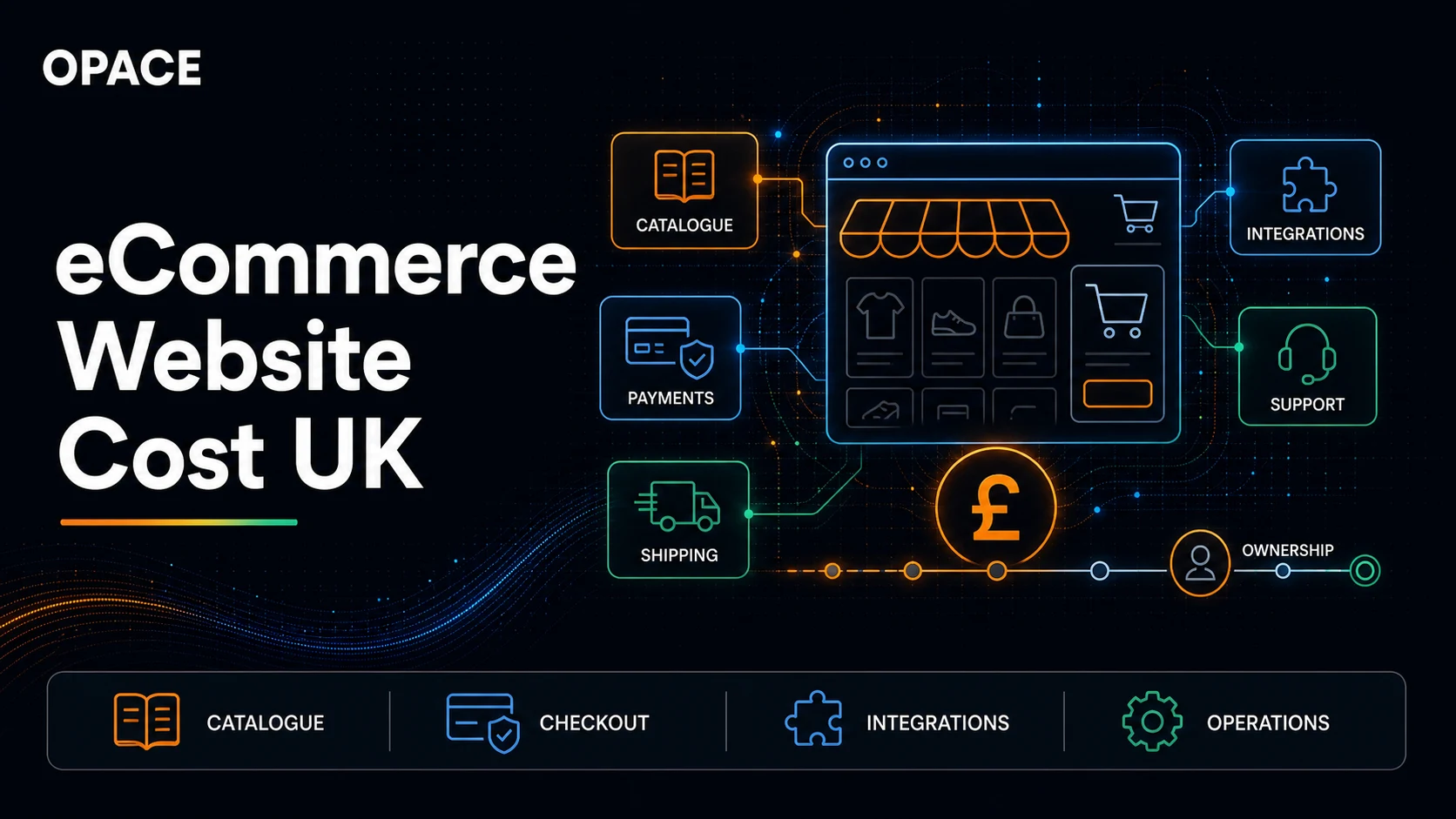
The cost of a UK eCommerce website ranges from a self-build with no supplier labour invoice to a professionally planned eCommerce store costing tens of thousands of pounds. Our current cost model allows 34–87 person-days for an online store with up to 250 products, before extra design, content, migration or integration work. At the model’s UK rate allowances, the base scope produces an indicative build range of about £15,000–£43,900 for a freelance web developer, £22,500–£70,400 for a specialist agency or £29,000–£92,500 for a larger multidisciplinary agency, excluding VAT.
Those figures are calculator outputs, not UK market averages, Opace prices or a promise that every eCommerce website requires that budget. A small catalogue built from clean customer data and a standard theme can need less work. A B2B, subscription, multi-market or heavily integrated online store can require much more. Use the UK website cost calculator with the eCommerce route selected, then complete the platform, supplier, design, feature, content and support questions.
The broader guide to how much a website costs in the UK compares an online shop with brochure, business and custom-application routes. This eCommerce website cost guide deals with catalogue data, platforms, payment fees, integrations, migration and operating an eCommerce website after launch.
eCommerce website cost at a glance
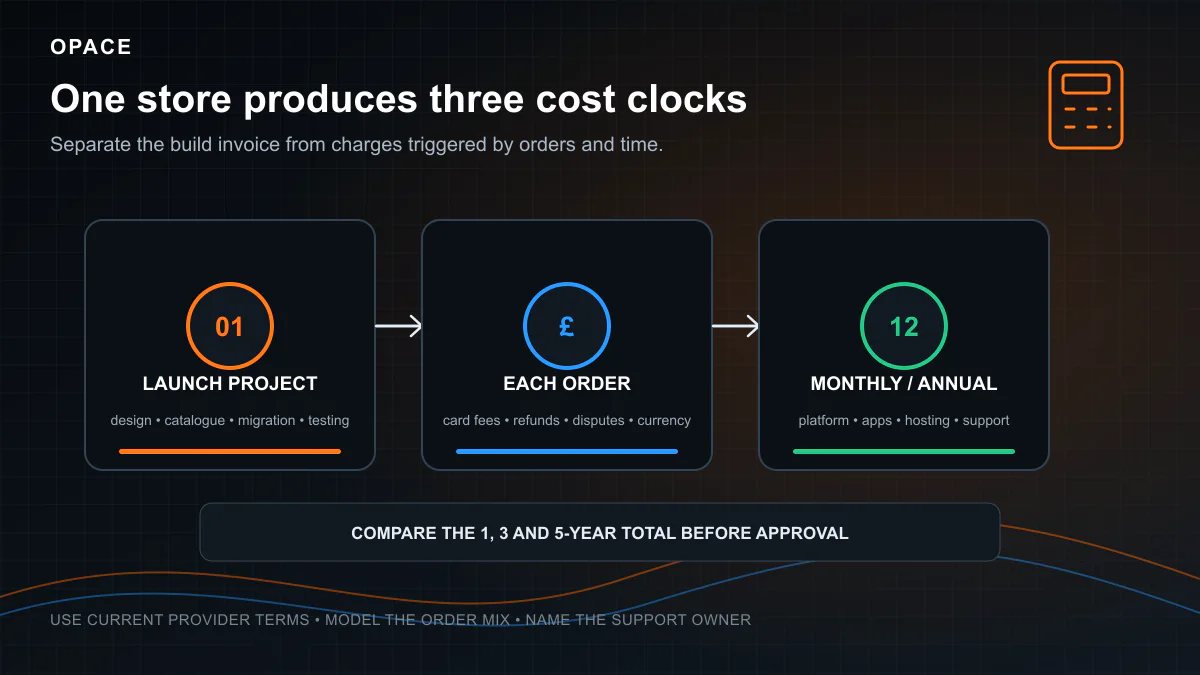
An eCommerce website quote should separate build work from trading charges. A low subscription price does not cover product preparation, custom design, implementation, testing or business-system connections, while a development quote may exclude card fees, apps, hosting or support.
| Cost area | How it is charged | What changes the figure |
|---|---|---|
| Discovery and planning | Fixed phase, day rate or part of a project fee | Markets, tax, shipping, fulfilment, returns, customer accounts and integration risk |
| eCommerce website build | Fixed scope or person-days | Theme work, templates, catalogue structure, checkout, search and testing |
| Product content | Per item, per variant, person-days or customer-supplied | Data quality, descriptions, photography, attributes, translations and approvals |
| Platform and apps | Monthly, annual, usage-based or one-off | Plan limits, staff access, markets, reporting, app dependencies and renewal terms |
| Payments | Percentage plus a fixed fee, sometimes with other charges | Card type, provider, currency conversion, disputes, refunds and sales volume |
| Integrations | Setup project plus maintenance | Accounts, stock, warehouse, delivery, CRM, marketplace and data ownership |
| Operation and support | Monthly allowance or retained time | Updates, monitoring, incident response, change requests and trading hours |
Compare the one-, three- and five-year total cost against the same accepted requirements. A theme installation is not equivalent to a researched, tested and integrated eCommerce website.
How the Opace eCommerce website cost model works
The calculator methodology version used for this guide is 2026.08.05-r4, researched on 5 August 2026. Its eCommerce base scope covers an online shop with up to 250 products and allocates the following effort before selected additions.
| Workstream | Base planning allowance |
|---|---|
| Discovery and project management | 4–9 person-days |
| UX and visual design | 5–11 person-days |
| Development and configuration | 12–30 person-days |
| Content, entry and search preparation | 6–20 person-days |
| QA, accessibility and launch testing | 5–12 person-days |
| Launch, training and handover | 2–5 person-days |
| Total base effort | 34–87 person-days |
The introduction multiplies those role days by the calculator’s freelancer and agency rate allowances. The model adds selected design, content, feature, migration, platform, app, domain and support costs. Payment processing, stock, fulfilment, advertising, digital marketing tools, photography and unknown third-party work remain outside the estimate unless stated.
The 250-product boundary does not mean every product takes equal time. Ten products with complicated variants or pricing rules may need more work than hundreds of clean records. Replace the allowance with a scoped backlog after examining the catalogue and trading rules.
How eCommerce platform choices affect cost
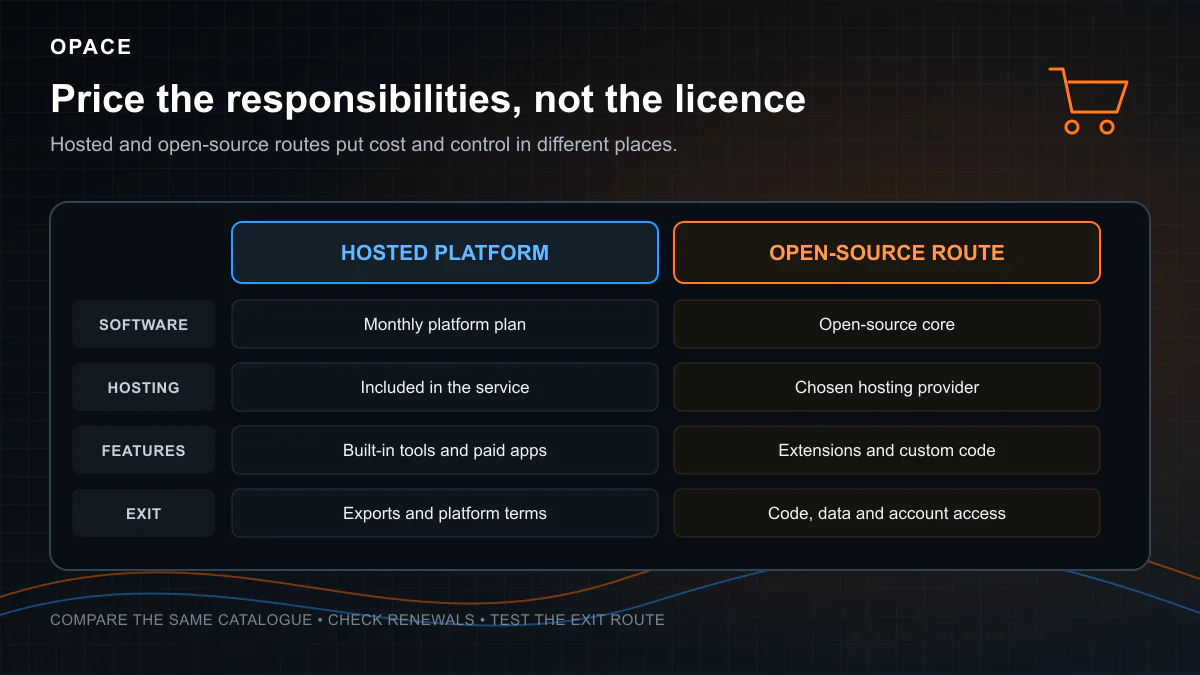
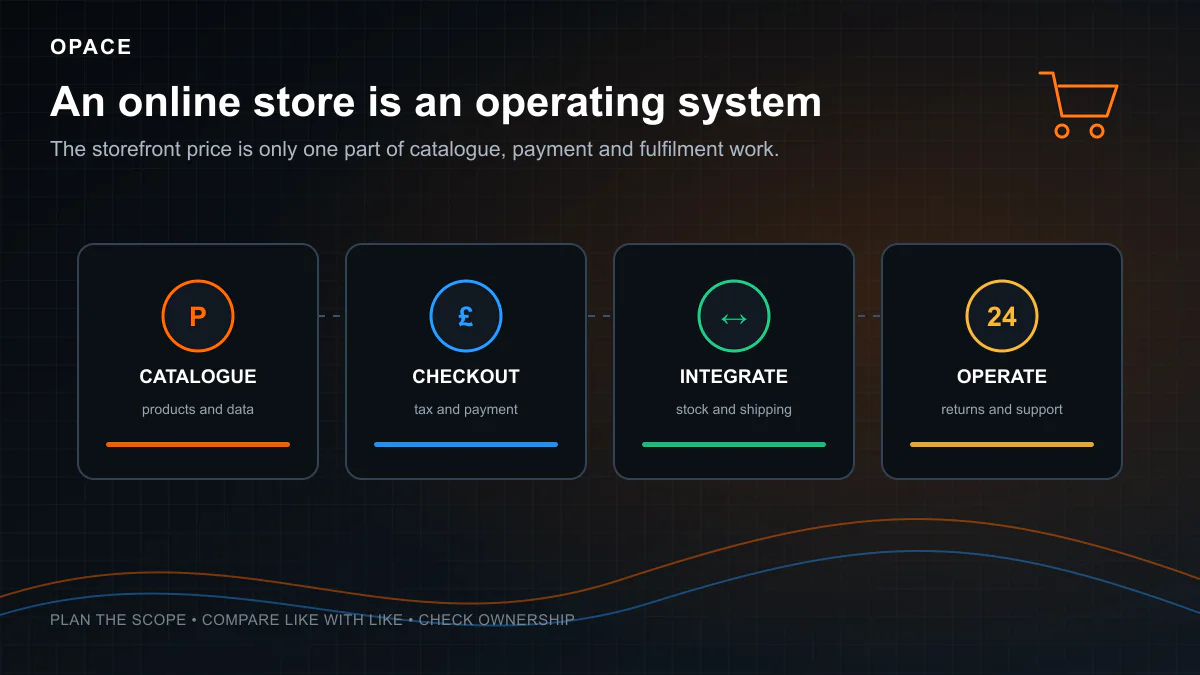
An eCommerce website cost depends partly on the platform’s commercial model. Shopify is a hosted eCommerce platform that combines software and commerce features in a subscription, with plan-specific payment and staff terms. WooCommerce is an open-source eCommerce platform for WordPress, while web hosting, extensions, implementation and support are obtained separately.
Shopify’s official UK eCommerce platform pricing, checked on 26 August 2026, displayed the following monthly prices when billed annually. Promotional introductory terms were also shown, so use the normal plan price and checkout terms rather than treating a temporary offer as permanent.
| Shopify plan | Published annual-billing price | Published online card rate from |
|---|---|---|
| Basic | £19 a month | 2% + 25p |
| Grow | £49 a month | 1.7% + 25p |
| Advanced | £259 a month | 1.5% + 25p |
| Plus | From £1,800 a month on a three-year term | Confirm against the proposed payment arrangement |
Prices and card rates can change. Check billing frequency, eligible cards, payment-provider charges, currency conversion, VAT and checkout terms before approval.
The official WooCommerce plugin listing, checked on 26 August 2026, confirms that the core plugin is open-source software. Free core software does not make an eCommerce website free. Budget for WordPress website hosting costs, technical setup, eCommerce website design, commercial extensions, payment processing, backups, SSL certificates, security work and support. Our WordPress website cost guide explains the wider CMS cost structure.
Website builder, custom design or bespoke build?
An eCommerce website builder can suit a business that needs to sell online with standard products, checkout and fulfilment. Compare its subscription, payment gateway fees, paid apps, content and staff time against the same requirements. A low entry price can still create higher ongoing costs when advanced features depend on separate apps. Price custom features separately.
Bespoke work is justified when an eCommerce business needs custom eCommerce functionality for pricing, account, catalogue or fulfilment rules that built-in features cannot support safely. Ask the supplier to distinguish configured apps from custom code. This makes later changes, testing and ownership easier to assess.
Catalogue data and inventory management drive effort
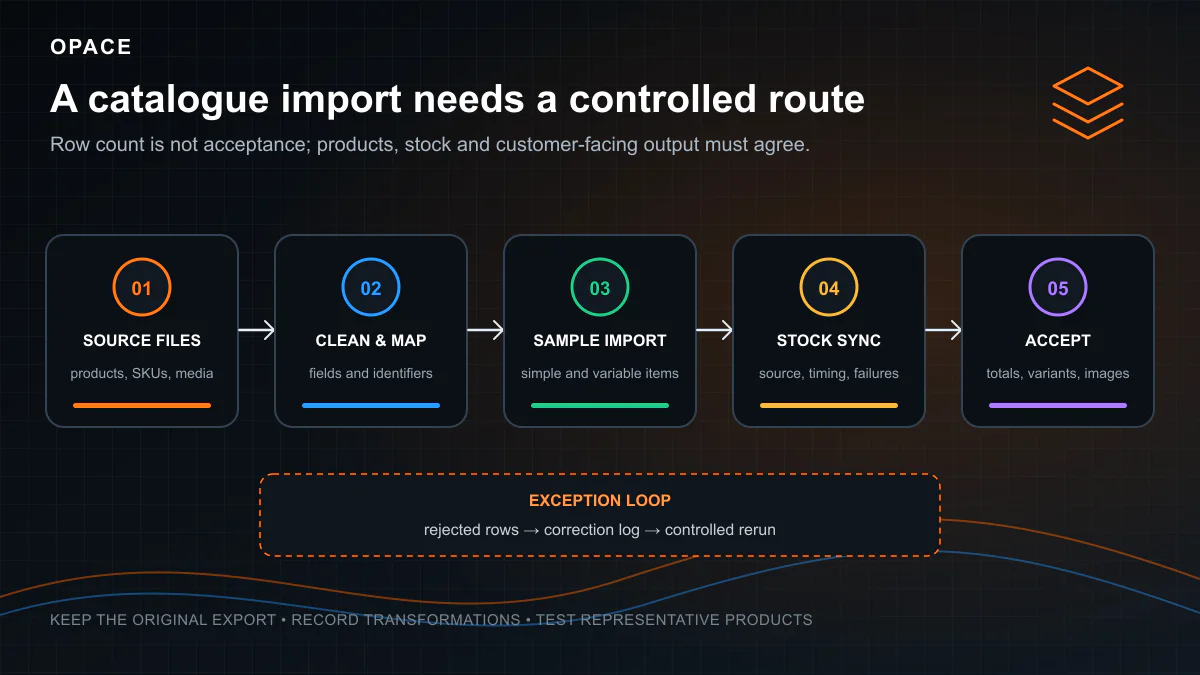
Product data can change an eCommerce website cost more than the visible item count. Records may carry an SKU, title, descriptions, category, price, tax class, stock status, dimensions, shipping class, attributes, variations, images, documents, related products and eCommerce SEO metadata. Clean customer data with consistent identifiers can be mapped and tested. Data spread across old exports, supplier spreadsheets and manual notes requires analysis, inventory management decisions and correction.
WooCommerce’s official product CSV importer and exporter documentation, checked on 26 August 2026, shows that the core tool can import, export and bulk-update product records. Images must already be available or accessible at direct URLs, the core importer cannot update product-image alt text, unrecognised columns are not imported by default, and larger catalogues can be constrained by server memory and processing time.
Ask for a sample migration before the full import. The sample should cover a simple product, a variable product, representative images, categories, stock, tax, shipping and at least one record containing awkward data. A successful row count does not prove that variants, URLs, image rights, metadata or customer-facing presentation are correct.
Product content and photography
Supplier data is rarely ready to publish without review. Manufacturer descriptions may be duplicated across other retailers, images may have uncertain rights or dimensions, and attributes may not support the filters customers need. Decide who writes, edits, photographs, crops, enters and approves each field.
Content pricing is clearer when the unit is explicit. A quote can state the number of supplied products, the included fields per product, the treatment of variants and the number of review rounds. Open-ended wording such as “product upload included” leaves both parties exposed when the source material changes.
Search, filters and merchandising
Basic category navigation may be enough for a small range. Larger or more technical catalogues can need faceted filters, synonyms, product relationships, bundles, trade pricing, customer-specific catalogues or search connected to an external index. Each rule requires data, interface decisions and tests.
To sell online, budget for eCommerce SEO, digital marketing tools and merchandising. Give featured products, promotions, landing pages and seasonal ranges an owner, then keep that time separate from software maintenance.
Payment processing fees and payment gateways
Payment processing fees form part of the eCommerce website cost for an eCommerce business rather than the initial build. Stripe’s official UK pricing, checked on 26 August 2026, listed 1.5% + 20p for a standard UK card under its standard pay-as-you-go pricing. The page showed different rates for premium UK, European and international cards, plus separate terms for currency conversion, disputes and other payment methods.
At that published standard UK-card rate, 1,000 successful £50 orders would produce £950 in processing fees. This is an arithmetic illustration, not a forecast. The actual total depends on the provider contract, card and payment-method mix, average order value, refunds, disputes, currencies and whether the eCommerce platform adds separate per-order charges.
Payment scope also extends beyond placing a payment gateway on a checkout page. Test successful and failed authorisation, duplicate submission, refunds, partial refunds, order status, stock adjustment, confirmation messages, webhooks and reconciliation. Subscription, marketplace, deposit and split-payment models may need specialist payment gateways and additional technical work.
The PCI Security Standards Council merchant guidance, checked on 26 August 2026, explains that PCI DSS applies to entities that store, process or transmit cardholder data and to systems that could affect payment-account security. A hosted payment component can reduce the card data handled by the eCommerce website, but the chosen integration and merchant responsibilities still need to be confirmed with the payment provider or acquiring bank.
Custom development and integration costs
The eCommerce website may need custom code to exchange data with accounts, stock, warehouse, shipping, CRM, email, marketplace or customer-service systems. “Connect to the ERP” is not testable. The quote should identify records, field ownership, direction, frequency, error handling and recovery for each integration.
Integration costs rise when identifiers conflict, APIs impose limits or no test environment exists. Real-time stock differs from a nightly update, as does a reviewed accounting export from automated two-way posting. Ask how outages and failed records are handled.
Third-party services change independently. Budget for API changes, credential rotation, monitoring and regression tests. For any trading-critical app, record the account owner, renewal term, data export and replacement plan.
Migration includes more than product rows
An online store migration may involve products, variants, images, customers, order history, vouchers, reviews, redirects, tax settings, fulfilment rules and integrations. Not every source platform exports each item in a form the new eCommerce site accepts. Passwords and payment tokens may have specific restrictions, while app-managed data can sit outside standard exports.
The calculator has two relevant catalogue migration profiles. Its standard profile covers up to 100 products and adds 4–15.5 person-days across project work, development, content and QA. Its larger profile covers 31 or more pages or products and adds 9–32 person-days. These overlapping labels reflect uncertainty in an initial answer, not a tariff. The source fields, transformations, exceptions and acceptance sample should replace the generic range during discovery.
Preserve old URLs where possible and map necessary redirects before launch. Test totals, variants, stock, tax and customer-facing content rather than relying on an import completion message. Keep the original export and migration scripts until the new eCommerce website has passed acceptance and recovery checks.
Ongoing costs from trading rules, privacy and support
The GOV.UK rules for online and distance selling, checked on 26 August 2026, set out information that must be provided before an order, information required after an order and cancellation rights. Your own obligations depend on the goods, services, customer and trading model, so obtain professional advice where needed. The build scope should still identify who supplies approved business details, delivery terms, cancellation information and returns content.
The Information Commissioner’s Office cookie guidance, checked on 26 August 2026, explains the consent requirements for non-essential cookies and similar technologies. An eCommerce site can add tags through digital marketing, analytics, advertising, chat, reviews, personalisation and payment services. Inventory those technologies before configuring a consent tool.
Security and continuity are operational responsibilities rather than one-off launch tasks. The National Cyber Security Centre’s asset-management guidance, checked on 26 August 2026, advises organisations to maintain an accurate view of the systems, services and data they rely on. For an eCommerce website, that register can include the domain name and domain registration account, DNS, web hosting, SSL certificates, platform, code, apps, payment accounts, mail delivery, analytics, fulfilment connections and backups. Confirm who controls each account, who renews SSL certificates and how the hosting provider handles recovery.
Use the UK website maintenance cost guide to define support hours, renewals, monitoring, backups and response arrangements. Content updates, merchandising and customer service should remain visible as separate operating work unless the support agreement expressly includes them.
How to compare eCommerce website cost proposals
Put each eCommerce website cost proposal against the same requirements and current supplier terms. Record person-days, deliverables, customer dependencies, acceptance tests, exclusions, additional costs and the price-change process.
- Define the business model - Record products, markets, currencies, tax, delivery, fulfilment, returns, customer types and sales channels.
- Audit the catalogue - Count products and variants, then sample data quality, images, identifiers, categories and required transformations.
- Map every integration - Name the source of truth, fields, direction, schedule, failure handling, credentials and owner.
- Model transaction fees - Apply current rates to expected order values, card mix, currencies, refunds and disputes.
- Separate initial costs from ongoing costs - Show platform, apps, payments, hosting, support, content and internal staff time across several years.
- Write acceptance tests - Cover orders, stock, tax, shipping, refunds, emails, analytics, consent, accessibility and recovery.
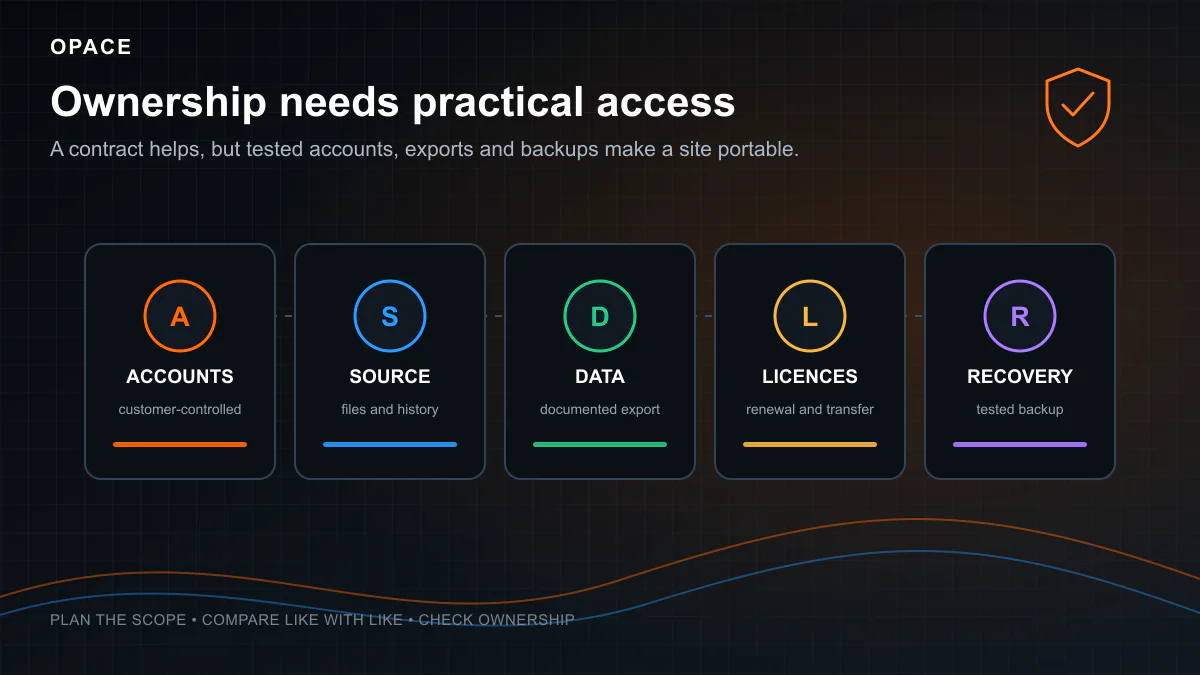
- Confirm ownership and exit - Record control of the domain, accounts, data, code, themes, licences, exports and documentation.
The supplier label is less useful than evidence of practical control. Confirm that the customer can access the accounts, source, data exports, licences and tested recovery route before accepting the handover.
Smaller organisations can use the small-business website cost guide to decide whether a basic eCommerce website is enough to sell online and which work can wait. If the online store has unusual integrations, B2B rules or a difficult catalogue, discovery is safer than forcing uncertain work into a fixed price.
Opace’s eCommerce web design and development services cover WooCommerce, Shopify, Magento, B2B and headless projects across the UK and internationally. The service page explains our capability; it is not evidence for prices in this guide.
Frequently asked questions
How much does an eCommerce website cost in the UK?
Our eCommerce website cost model assigns 34–87 person-days to an eCommerce website with up to 250 products before extra design, content, migration or integration work. At the model’s rate allowances, the base supplier build is about £15,000–£92,500 depending on the supplier route, excluding VAT. This is a broad model output, not a national average or quote.
Is Shopify cheaper than WooCommerce?
There is no dependable answer without a scope. Shopify bundles hosted software into a subscription and publishes plan-specific payment terms. WooCommerce core is open-source, while hosting, extensions, implementation and maintenance are separate. Compare the configured eCommerce website, current payment rates and three- to five-year total cost against the same catalogue and integration requirements.
How much should product upload cost?
Product count alone is insufficient. Pricing should name the source format, fields, variants, images, descriptions, categories, transformations, validation sample and approval process. Clean records with stable SKUs can be imported efficiently, while incomplete or inconsistent data requires content and technical work.
Are payment processing fees included in the website price?
Usually not. Build quotes may include payment-provider configuration and testing, while successful transactions, currency conversion, disputes, refunds or specialist payment methods are charged under the provider’s current terms. Ask the supplier to separate implementation from transaction fees.
What should an eCommerce maintenance plan cover?
It should name the platform, SSL certificates, extensions, integrations and customer journeys being checked, together with update handling, backups, monitoring, response targets and included change time. Product entry, promotions and customer service are operational tasks and may sit outside technical maintenance.
Sources and checking date
The factual supplier and public-body sources below were checked on 26 August 2026. Prices, fees, rules and platform features can change, so verify the current page and proposed contract before procurement.
- Shopify UK pricing
- WooCommerce core plugin listing
- WooCommerce product CSV importer and exporter
- Stripe UK pricing
- GOV.UK online and distance selling rules
- ICO cookies and similar technologies guidance
- NCSC asset-management guidance
- PCI Security Standards Council merchant guidance
The calculator’s labour and effort method is documented on the calculator result screen. The base eCommerce effort and migration allowances are Opace editorial planning assumptions, not independently observed national averages.