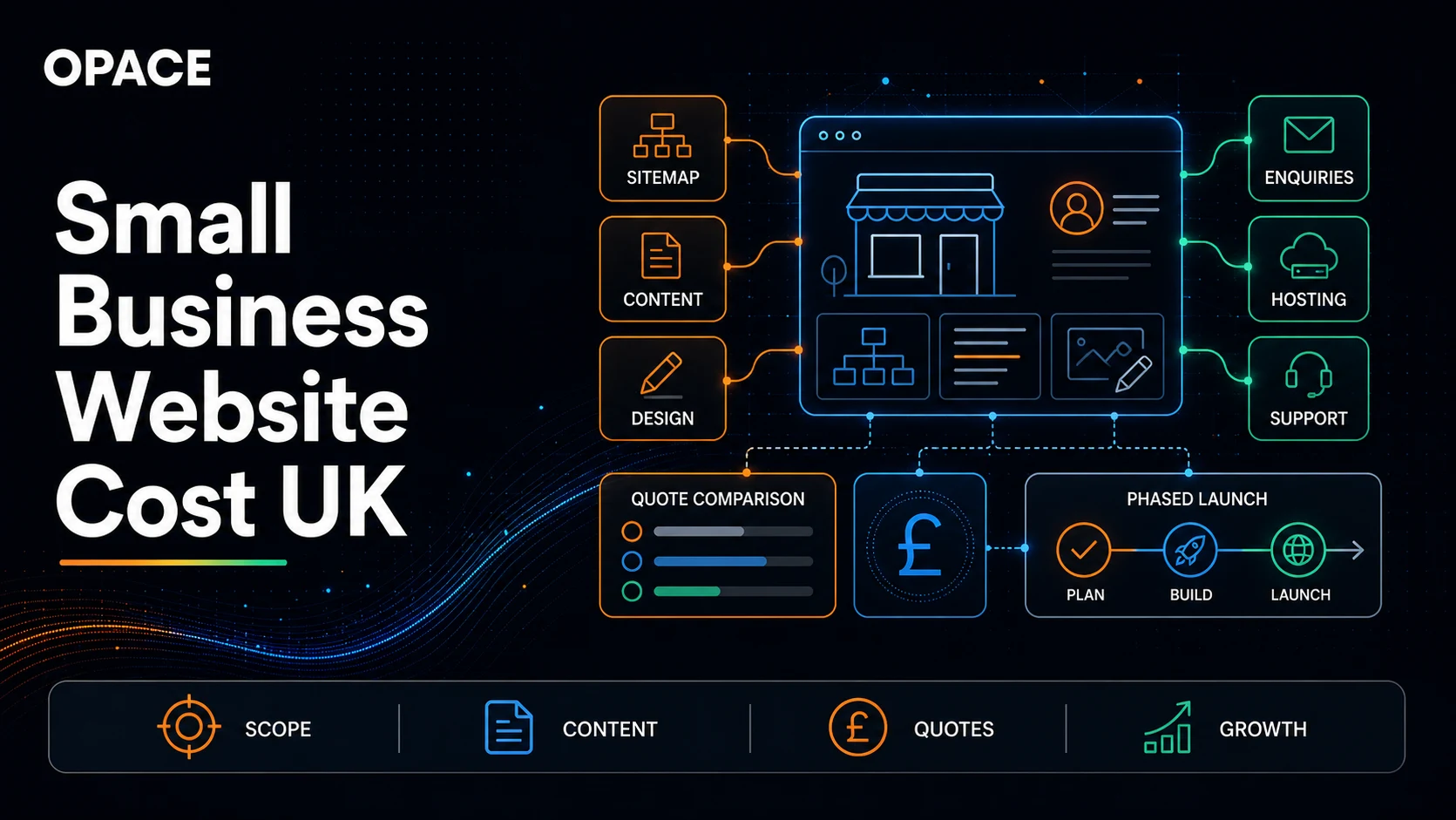
No reliable national figure covers the price of every small-company site in the UK. The search for the average cost of website design for small business UK projects needs a range, not a single headline. A five-page site built from supplied text is a different purchase from a 20-page lead-generation website with research, original design, copywriting, search planning and integrations.
Modelled build bands: Opace’s transparent planning model puts a basic 1-to-5-page brochure website at roughly £3,700–£8,600 with a freelancer or £5,700–£14,100 with a specialist agency, before VAT and optional work. A 6-to-30-page business website starts at roughly £4,900–£13,300 with a freelancer or £7,300–£21,600 with a specialist agency.
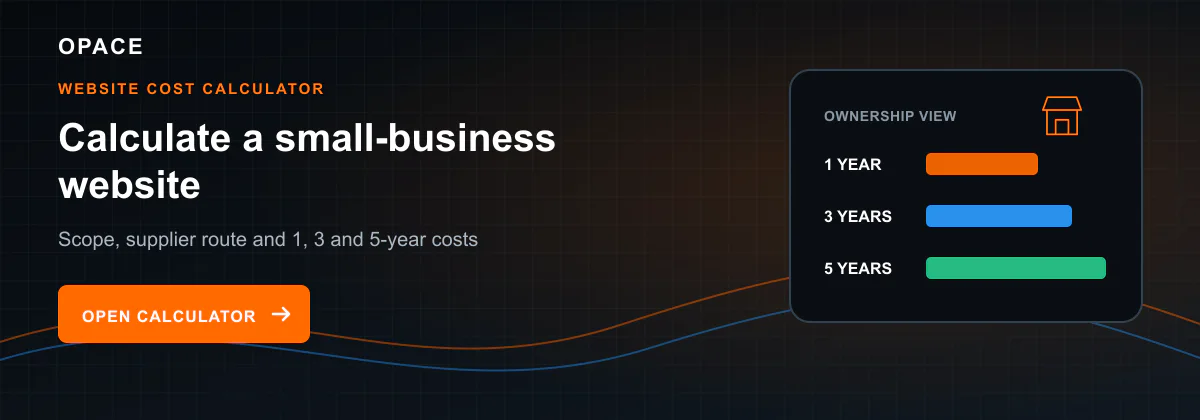
These are model outputs, not national averages, fixed packages or an Opace quote. They use stated project-day allowances and published UK labour evidence documented in the full UK website cost guide. Replace every planning range with current checkouts and itemised quotes before purchase. Use the UK website cost calculator to start with the 6-to-30-page business route selected, then complete the platform, supplier, design, features, content and support questions without entering contact details.
| Small business route | Modelled starting point | Usually suits | Main budget risk |
|---|---|---|---|
| DIY website builder | Current plan, apps and your own time | A simple first presence with limited requirements | Underpricing content, setup time and later migration |
| Freelancer brochure website | About £3,700–£8,600 | A defined 1-to-5-page project that one person can cover | Gaps in specialist skills, availability or support |
| Agency brochure website | About £5,700–£14,100 | A small site needing coordinated design, development and checks | Paying for an assumed team without seeing the allocated work |
| Freelancer business website | About £4,900–£13,300 | A defined 6-to-30-page site with manageable complexity | Content, testing and migration omitted from the quote |
| Agency business website | About £7,300–£21,600 | An enquiry-led SME site needing several disciplines | Scope growth where requirements and approvals are vague |
All modelled project bands above exclude VAT and additions. The standard UK VAT rate is 20%, although not every supplier is VAT-registered and supplier checkouts may display tax differently. Compare totals on the same basis.
What professional website design costs include
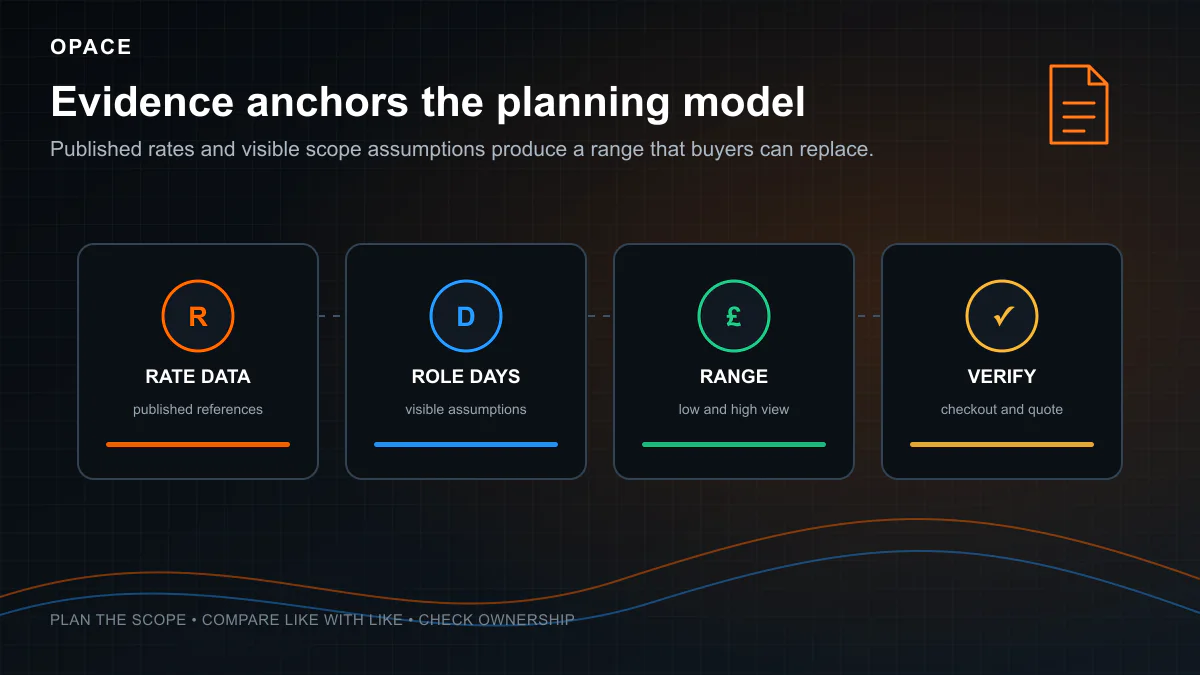
The short answer to “how much does a website cost?” is that the initial website design costs and the continuing ownership cost must be priced separately. A basic website cost can cover discovery, a small set of templates, supplied content, a contact route, testing and launch. A professional website may also require content writing, bespoke design, accessibility work, analytics, migration, technical management and ongoing support. UK website prices therefore depend on the work included, not page count alone.
A DIY site can be the cheapest option when the owner has the time and technical skills to build a website, prepare their own content and test it properly. Most website builders bundle web hosting and editing tools, but paid apps, a custom domain name, business email and later migration can change the total cost. If a plan advertises a free domain, check the renewal price, domain registration ownership and transfer process before treating it as free.
A professionally built site should identify every web designer, developer and specialist assigned to the work. Compare website designers, freelance web designers and web design agencies by named hours, outputs and acceptance evidence, not the supplier label. Professional web design companies may structure proposals differently, so separate original website design, template work, content cost, extra functionality and hourly rates before comparing design costs.
Average cost figures become useful only after the scope is fixed. Most web design agencies and freelance website designers price discovery, design, build and testing separately. Business owners should expect to pay more when a professional website in the UK needs extra pages, a booking system or custom-built integrations. Ask each web designer to show domain name, web hosting and ongoing maintenance costs in writing.
For most small businesses, a standard small business website should help customers understand the offer and take a useful next step. A basic SEO setup can make the content crawlable and measurable, but SEO tools alone cannot generate leads or secure positions in search engines. Decide whether the basic website needs a blog, booking system or eCommerce website at launch; more pages and bespoke functionality should be added only when the customer task and budget justify them.
Decide what the website must do before setting the budget
A business owner may build a website to explain an offer, collect enquiries, manage appointments or sell online. Write the priority customer tasks into the brief before asking for web design prices. Otherwise, each web designer may price a different solution.
For the average small business, a useful scope names the audiences, their decisions, the required actions and what the website does not need. A consultant could require service information and case studies but no login; a trade business could require location evidence, professional images and a mobile-friendly form to bring the business online.
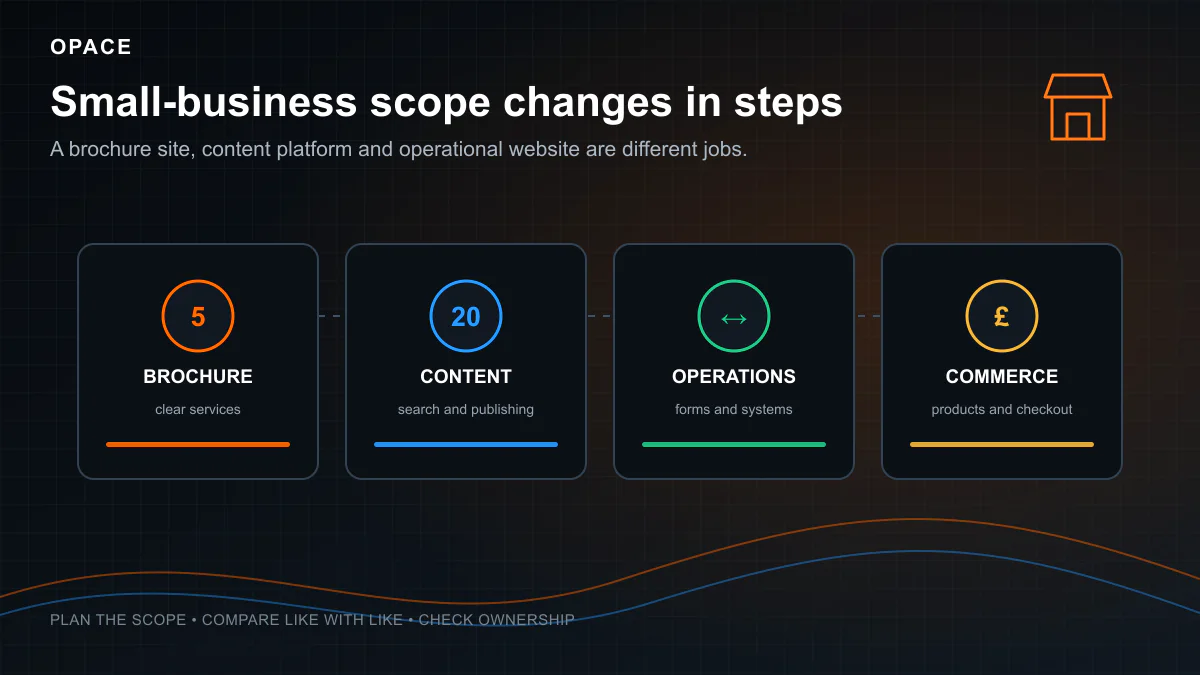
Page count affects effort but is not a complete measure. More complex sites do not always have more pages: five researched sections can take more work than 20 template-led pages using approved copy. Separate reusable layouts from per-page content, entry and review.
A practical small business scope
For many service businesses planning a website in the UK, the first release can cover:
- Core proposition - A homepage that explains the offer, intended customer and next action in plain English without vague claims.
- Service detail - Enough information for a buyer to understand fit, boundaries and the evidence behind the work.
- Trust and identity - Accurate company details, people, credentials, case studies and contact routes appropriate to the business.
- Enquiry path - Forms, calls or bookings with agreed notifications, error handling and a tested response process.
- Search foundations - Clear page topics, descriptive titles, crawlable navigation, redirects where needed and a measurement plan.
- Operational information - Privacy information, cookie controls and any trading or sector information that applies to the organisation.
Many businesses should account for the official rules on displaying company information on websites. The exact content required under UK law depends on the organisation, activity and data collected, so obtain appropriate advice instead of copying another site’s footer.
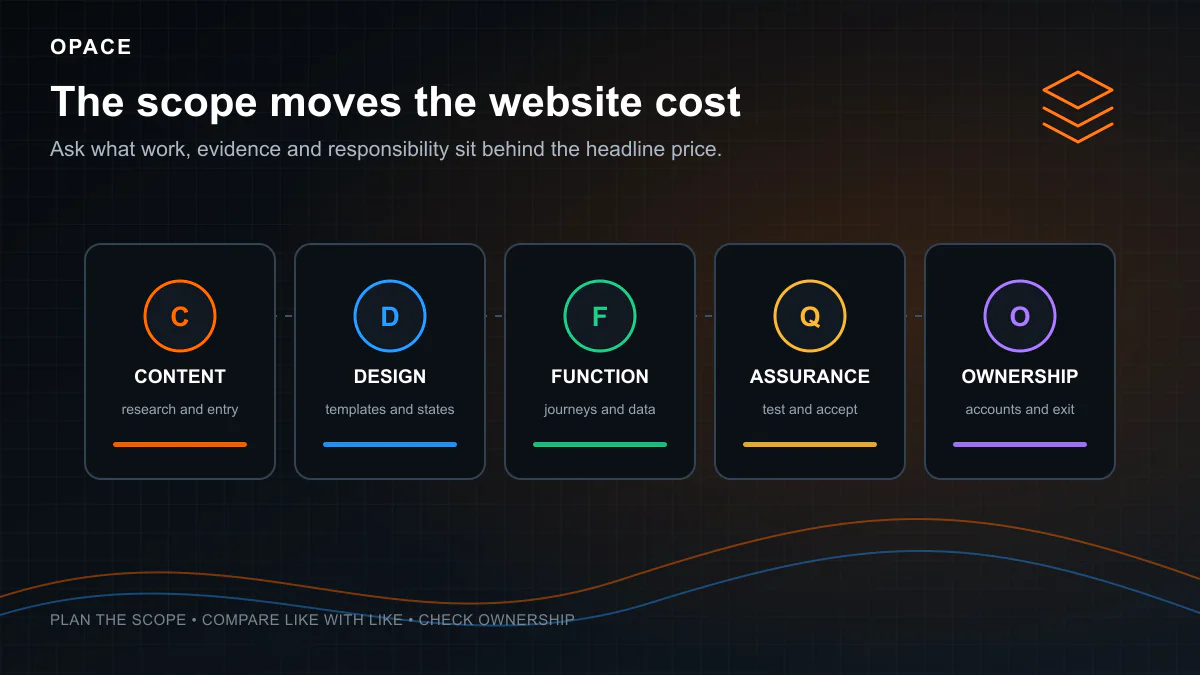
The diagram groups the five decisions that most often move a website cost: content, design, functionality, assurance and ownership. Scope decision: state the required work and acceptance evidence before inviting proposals.
Cost examples for different small business websites
These examples are not packages or price averages. Confirm every assumption in the proposal.
Sole trader or micro-business first website
A sole trader with one main offer could use a homepage, service detail, evidence, contact information and the required business or privacy information. Using a website builder can work when the owner can prepare content, configure the form and maintain the account.
Entry-cost check: include the website builder plan, custom domain, business email address, paid add-ons and owner time. Small business owners creating their own website should record setup time instead of treating it as free.
Free website builders can test an idea, but may restrict the web address, storage, analytics or export. Most small business owners should confirm the limits, renewal terms and recovery before choosing a website builder plan.
Local service business that needs enquiries
A trade, clinic or local professional often needs service information, location evidence, photographs, testimonials, calls and advanced contact forms. The brief should cover mobile use, form delivery, spam handling, consent, measurement and the response process.
The business could use a website builder, hire a web designer or ask an agency to coordinate the work. Each web designer proposal should identify shared templates, content, custom design, testing and post-launch care. Assign every exclusion before signing.
Search baseline: require crawlable content, useful topics, descriptive titles, sensible internal links and measurement. Do not substitute an unexplained promise that the site will rank.
Professional business with several services
An accountancy, consultancy or business-to-business project often requires interviews, sector evidence, case studies, downloads and several approvers. Subject specialists provide accurate material while the web team structures and publishes it. A content management system can require controlled editor roles.
A professional website proposal should separate reusable layouts from per-page work and state whether the web designer provides writing, search planning, accessibility checks, analytics and aftercare. Page count alone does not show design complexity.
Small shop, appointment or membership business
Selling products, taking deposits or managing appointments adds product data, booking-system rules, payment gateways, notifications, cancellations, stock, refunds and operation. A hosted tool can cover these needs; a bespoke website can be justified when the workflow does not fit safely.
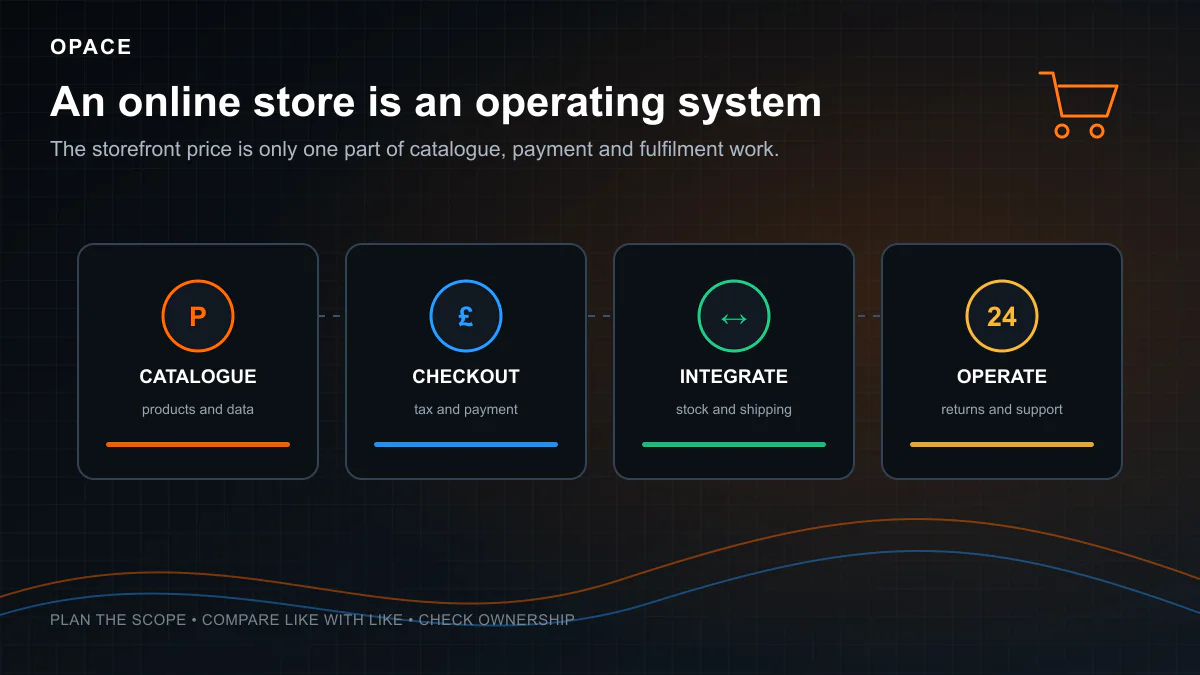
Expect to pay separately for the platform, configured extensions and custom features. An eCommerce website or professional online store needs catalogue, payment and fulfilment work that a brochure allowance does not cover. Use the specialist eCommerce website cost guide to budget that eCommerce site. A bespoke website needs discovery when these rules cannot be configured safely.
The operating model below separates the storefront from the catalogue, checkout, integrations and continuing work that determine the real e-commerce scope.
Choose a supplier route that matches the work
Choose the supplier route from the required skills, assurance and operating duties. Most small business owners can then compare a hosted website builder, freelancer and agency on the same basis.
DIY or hosted website builder
A DIY site or hosted website builder can fit a low-risk project when the owner can build a website, prepare content, configure forms and maintain the account. Its price includes the website builder plan, apps, domain, email, paid assistance and owner time.
Check the current website builder checkout because plans, renewals, storage, premium features and app charges change. Test what the website builder can export; a low first-year price does not make migration free.
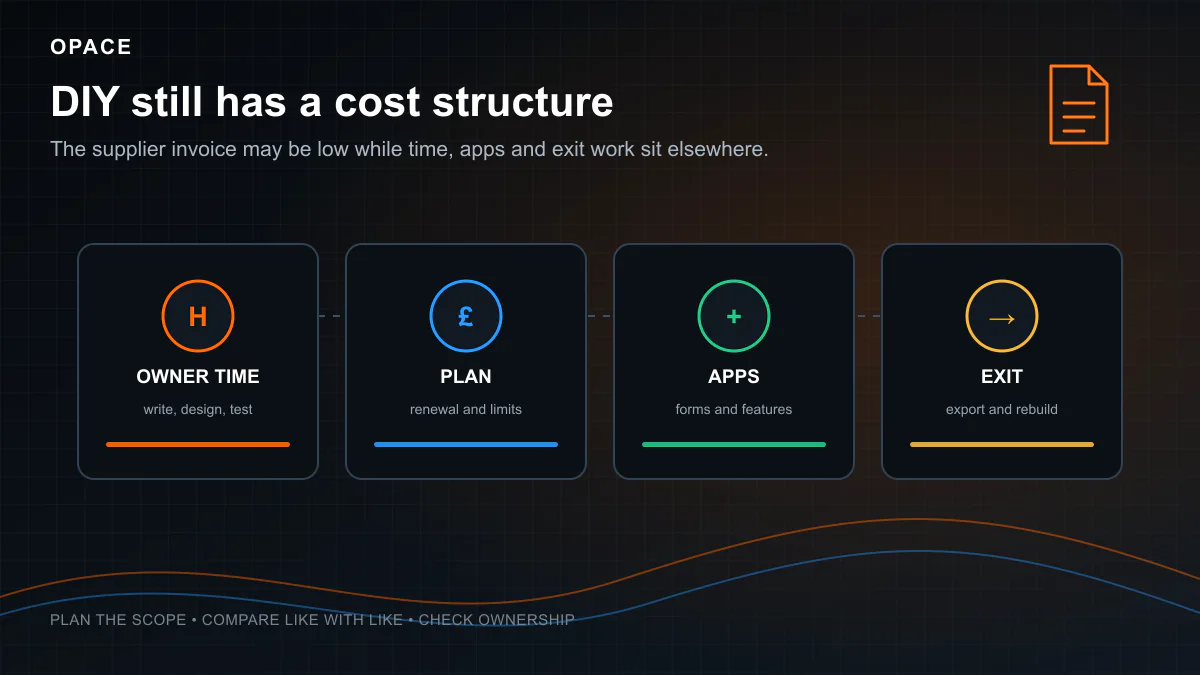
The diagram below separates the four costs that a website builder headline can obscure: owner time, the plan, paid apps and the work needed to leave.
Freelancer
A freelance web designer gives direct contact with the person doing the work. Ask that web designer which tasks are subcontracted, how absence is covered and whether the schedule is realistic.
The quote should show time, deliverables, review limits, dependencies and aftercare. Research, photography, integrations and formal testing can require other specialists.
Web design agency
A web design agency can coordinate discovery, design, development, content, search and testing. Ask which web designers and developers will work, their time allowance and handover.
Our Birmingham-based team provides Opace web design services for organisations across the UK and internationally. That service page describes Opace’s commercial offer; it is not independent evidence for a national average price.
Make content responsibility visible in every quote
“Customer to supply copy” may mean approved text, or fragmented notes needing research and review. Those inputs carry different costs.
Content ownership check: assign every page and asset to a named owner and approver. Record the delivery date and required format for text, photographs, graphics, case studies, testimonials, legal information and downloads. If the supplier is writing or editing content, the quote should state the research, interview, source-checking, draft and revision allowance.
For a new site replacing an existing one, identify what is retained, rewritten, merged, redirected or removed. Migration covers metadata, image text, links, files, structured data and old URLs. Approve a redirect plan and sample first to avoid paying twice.
Do not assume accessibility from a theme. The W3C explains how people with disabilities perceive, understand and interact with the web. Name the standard, test method, sampled tasks and responsibility for fixes.
The ICO’s cookies guidance covers clear information and consent for non-essential cookies. Record installed tags, consent configuration and tests.
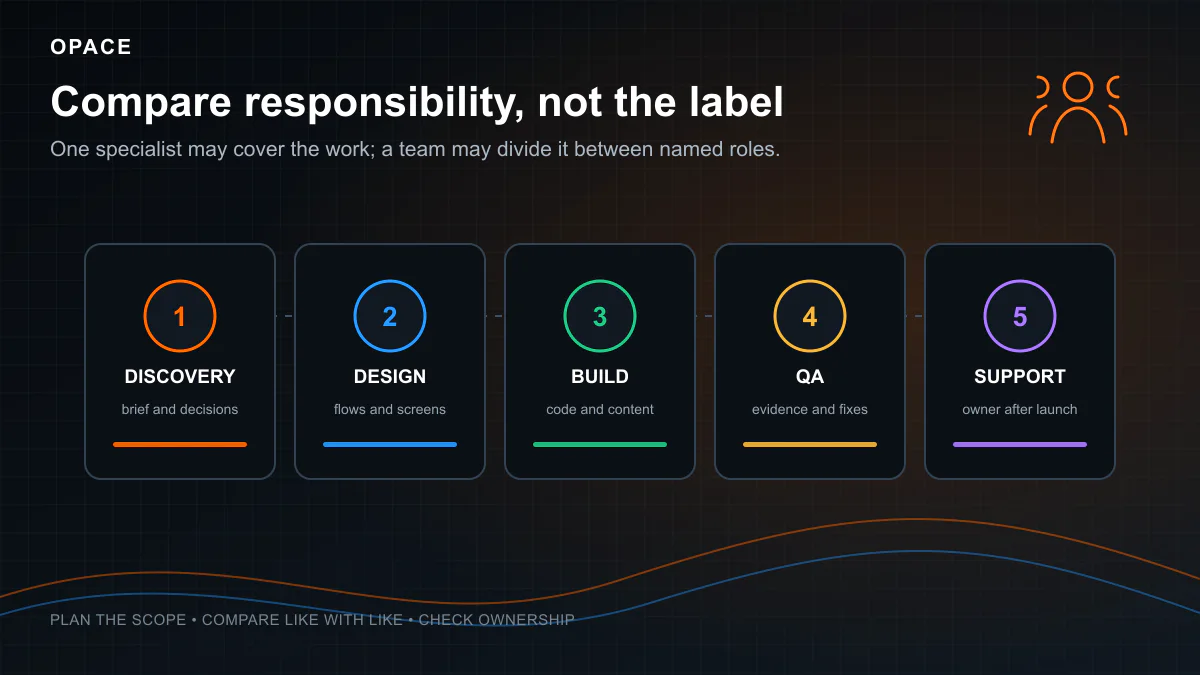
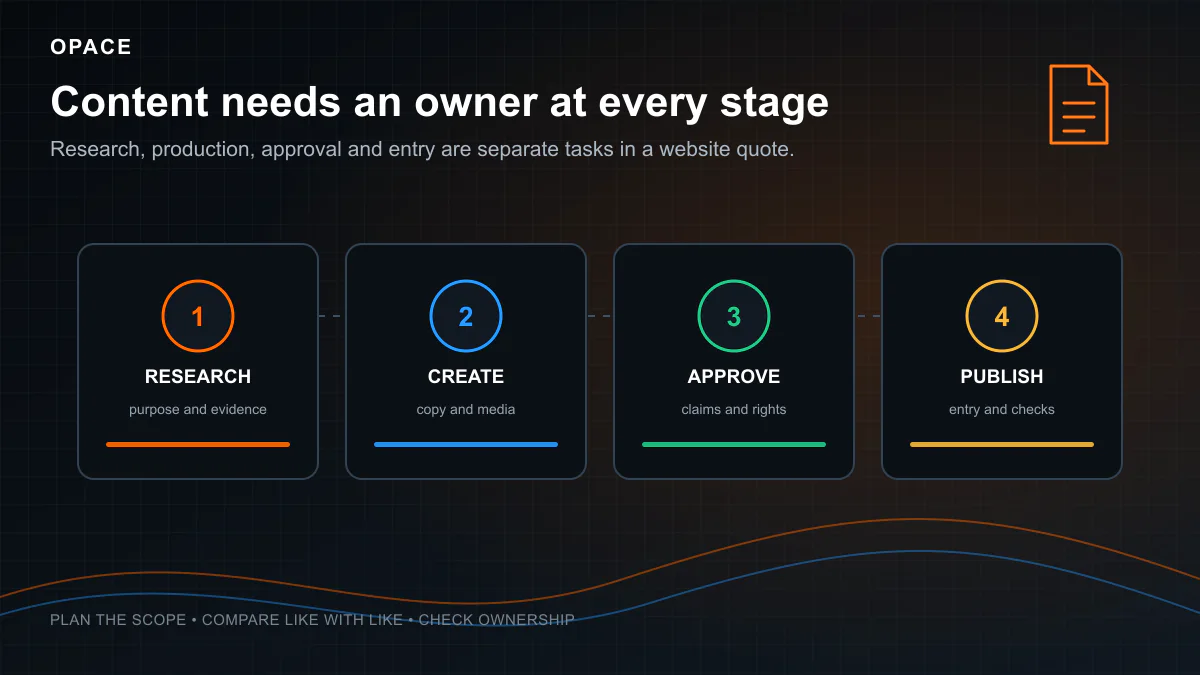
This workflow makes research, production, approval and publishing separate responsibilities rather than one vague promise to “supply all the content”.
Compare website design quotes line by line
Send every supplier the same brief and comparison schedule. Lower web design prices may reflect good value, narrower scope or an unrealistic allowance.
| Quote line | What to require |
|---|---|
| Discovery and plan | Users, priority tasks, content list, technical requirements, risks, exclusions and agreed outputs |
| Design | Template or original work, layouts included, responsive states, revision rounds and supplied brand assets |
| Content | Research, writing, editing, photography, entry, migration, approvals and usage rights |
| Development | CMS or platform setup, forms, integrations, browser coverage and configuration |
| Search and measurement | Page mapping, metadata, redirects, crawl checks, analytics and acceptance evidence |
| Accessibility and QA | Target standard, test coverage, devices, browsers, defects and retesting |
| Launch and handover | Hosting, DNS, backups, training, account credentials, source, documentation and warranty |
| Ongoing costs | Domain, hosting, licences, apps, maintenance, content and renewal assumptions |
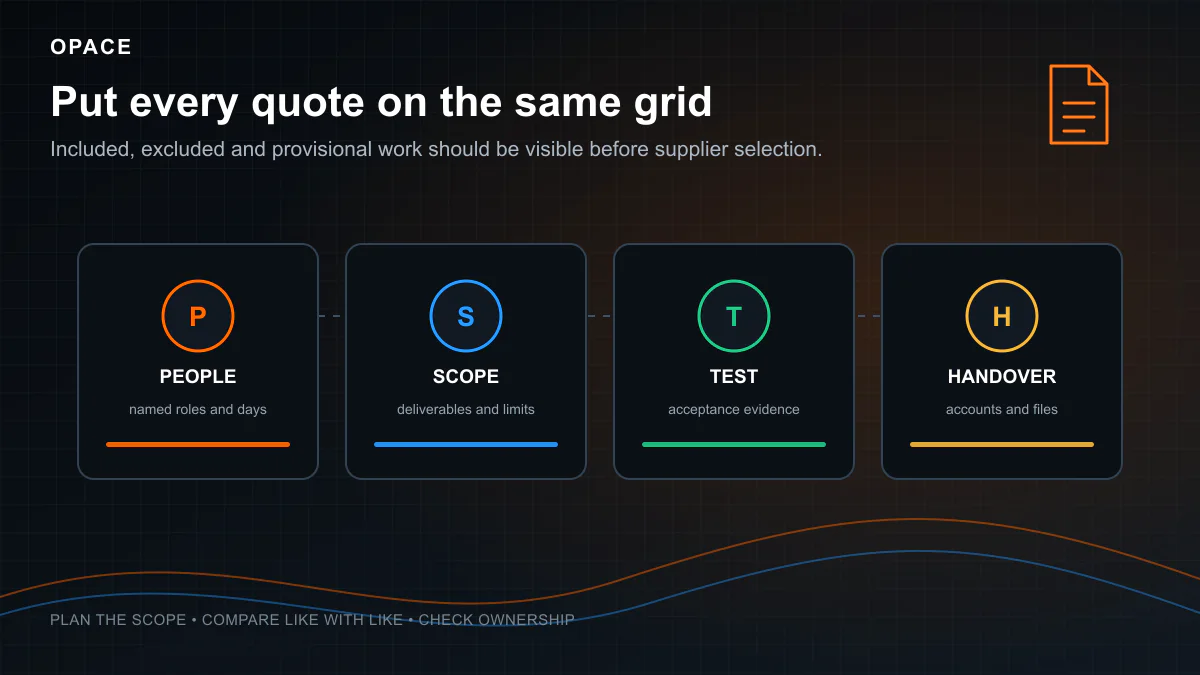
Use the same comparison grid for every proposal.
Define acceptance criteria for important tasks. A completed contact form includes validation, consent, spam handling, delivery, error behaviour and a named recipient; apply equivalent tests to booking, downloads and payments.
Match payment stages to defined work or evidence. Check cancellation, dependencies, changes and ownership transfer.
Do not accept “SEO included” or “accessible” without the work and test evidence behind each label.
Fixed-price, hourly and pay-monthly quotes
A fixed price works when requirements, dependencies and changes are clear. Ask what happens when content arrives late or reviews exceed the allowance, and what the web designer will charge for extra work.
An hourly quote still needs an estimated range, named roles and spending control. Most agencies and freelancers typically charge for changes beyond that allowance, so compare the likely total and outputs.
A pay-monthly website can spread upfront costs and include hosting, software updates or care. Check the monthly cost, minimum term, ownership, renewal fees and exit route. Monthly-service decision: confirm included changes, unused time and the exit deliverable.
First-year and ongoing website costs to record
The build cost is only one part of the first-year budget. Separate the initial project from recurring charges and internal time so a low launch invoice does not conceal expensive running costs.
Ownership-budget decision: separate build, operation, maintenance and improvement costs. That makes the website cost comparable across a hosted platform, a freelancer and an agency, even when their invoices use different labels.
Domain registration, web hosting and business email
Record the domain name, web hosting, SSL certificate and each business email address. Note the account owner, introductory price, normal renewal, billing period and tax basis. A claimed free domain name may cover only year one; compare the later domain name price, domain registration, SSL certificates and website hosting renewals.
Website hosting depends on the platform, traffic, storage, backups, staging and assistance. Most small businesses do not need a dedicated server. Shared hosting is poor value without a usable restore process or enough resources. Managed hosting can be worthwhile when duties are written down; compare the managed hosting scope, domain name control and exit route.
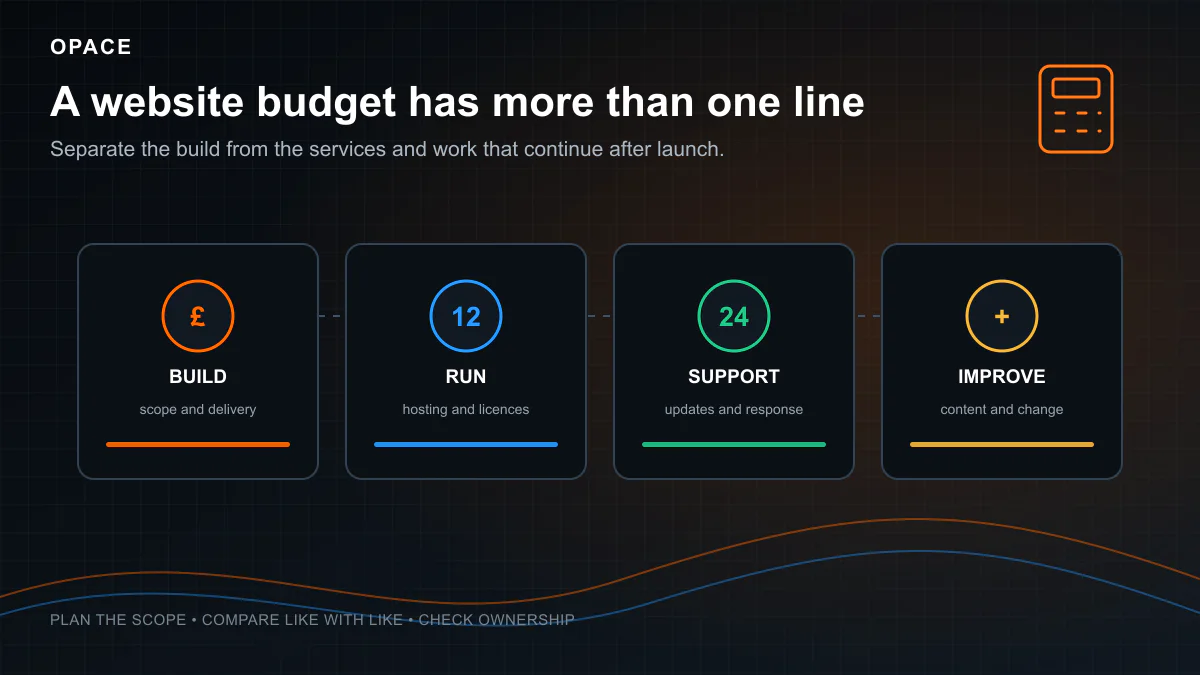
The four budget lines below keep initial delivery separate from the subscriptions and work that continue after launch.
Content, measurement and search preparation
Content creation may include interviews, writing, photography, graphics, entry and approval. The quote should distinguish supplied material from supplier work, included assets, image rights, additional costs and any extra cost for later changes.
A search engine optimisation setup can cover page mapping, metadata, index controls, redirects and analytics. Installing a tool cannot guarantee rankings. Record the launch checks, analytics owner and any ongoing digital marketing.
Ongoing maintenance, support and renewal fees
Ongoing costs include the services needed to keep a business online: platform plans, hosting, domains, licences, forms, backups, monitoring, content and support. Record each monthly cost, annual charge and usage fee separately to expose hidden costs and additional costs.
Separate ongoing website maintenance from development; record response targets, included time, updates, backups, exclusions and the additional rate. The website maintenance cost guide explains these terms.
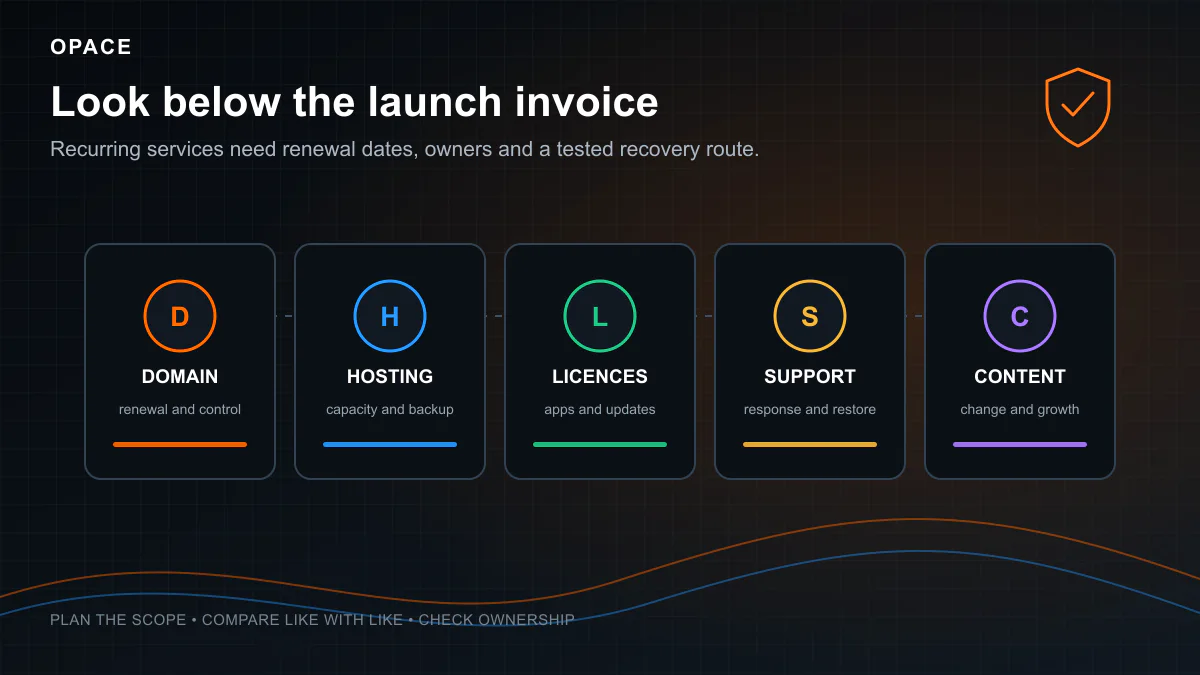
The five recurring lines below belong beside the launch invoice. Domain costs, web hosting, licences, care and content changes need named owners and renewal dates.
Build a phased one-, three- and five-year budget
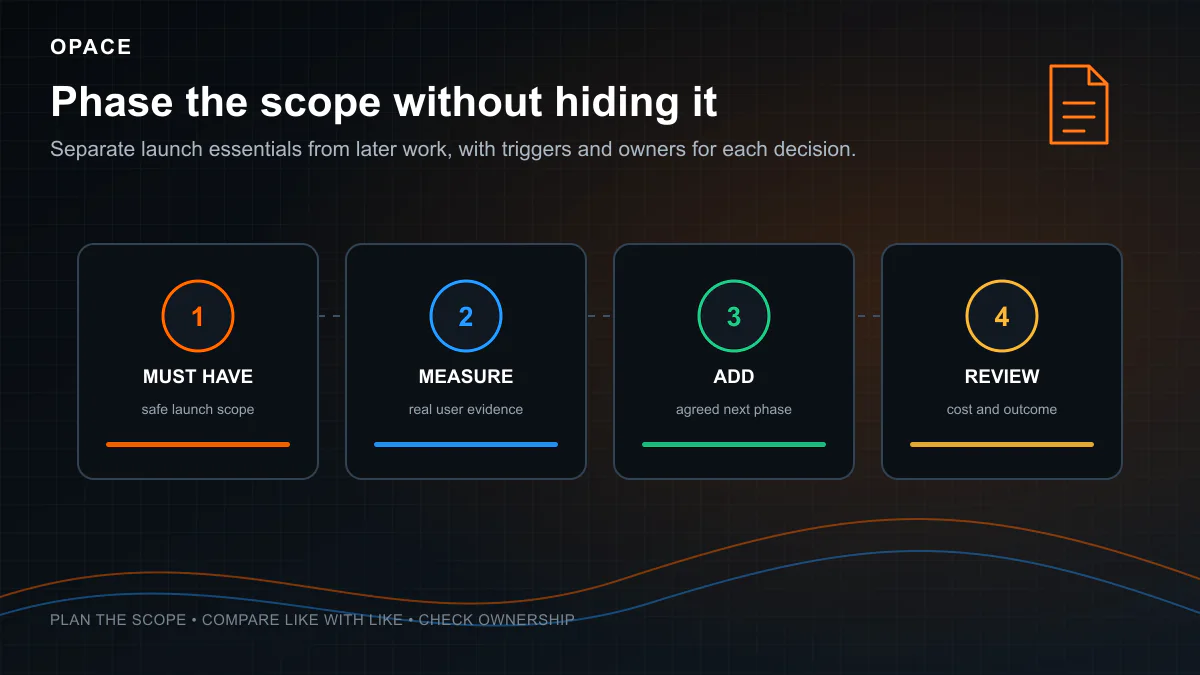
A UK launch budget should cover the first useful release. Put later website work into named phases with a decision point and fresh price estimate.
Phase one might contain service information, case studies, contact, analytics and handover. Phase two could add appointments after process testing; phase three could extend validated content. Each phase needs a benefit, dependency, acceptance test and limit.
| Budget period | Include |
|---|---|
| Initial project | Discovery, design, content, build, migration, testing, launch, training and contingency |
| Year one operation | Domain, hosting or platform, licences, support, content corrections and measurement |
| Years two and three | Renewal assumptions, planned improvements, support and any migration reserve |
| Five-year view | Replacement risk, accumulated subscriptions, major integrations and realistic handover cost |
Use current checkouts and itemised proposals. A monthly headline may hide renewals, usage charges and separate work. The UK website maintenance cost guide covers support, hosting, licences and backups.
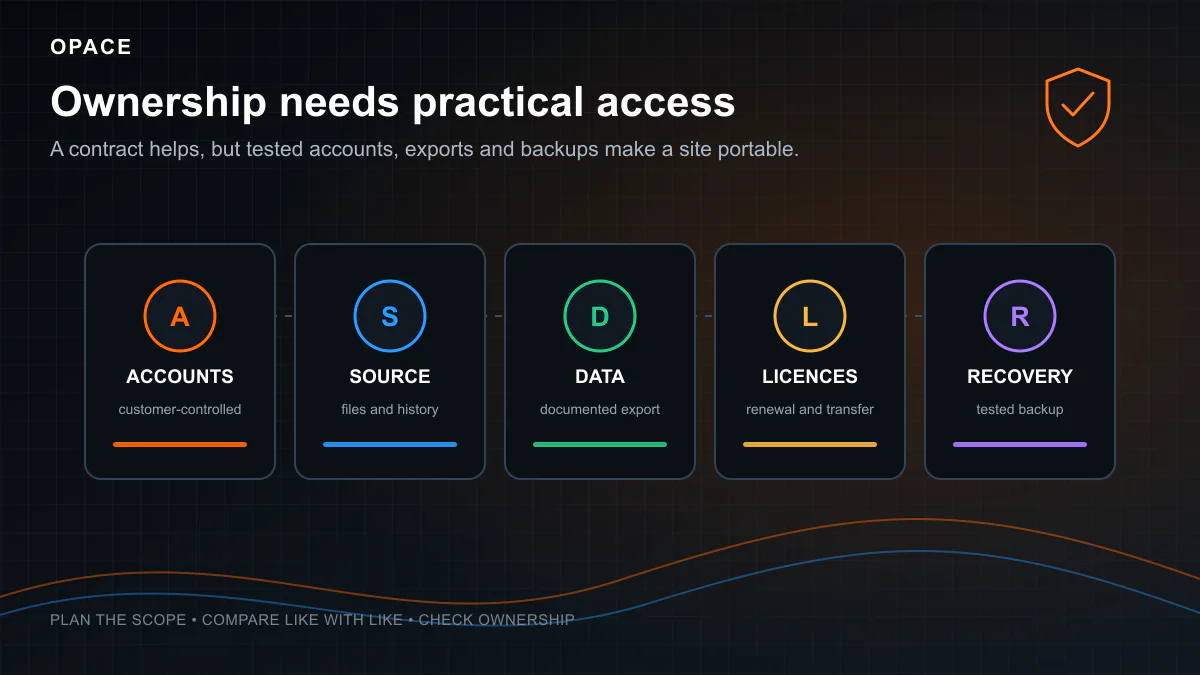
The NCSC’s small organisations guide to cyber security covers accounts, devices, backups and attacks. Website owners should name the controllers of the domain, DNS, hosting, CMS, repository, email and analytics, with tested recovery routes.
Handover covers source files, exports, licences, deployment instructions and a current backup. Copyright does not guarantee practical operational control; test every account needed to operate or move the site.
When the project needs a specialist cost guide
A specialist platform changes the operating model. The WordPress website cost UK guide covers hosting, themes, plugins, licences and support; the eCommerce website cost UK guide covers catalogue work, payments, shipping, tax and integrations.
Do not force an online shop, membership service, portal or booking system into a standard small business website allowance. Separate standard platform capability, configured extensions and custom work; complex sites require more detail before pricing.
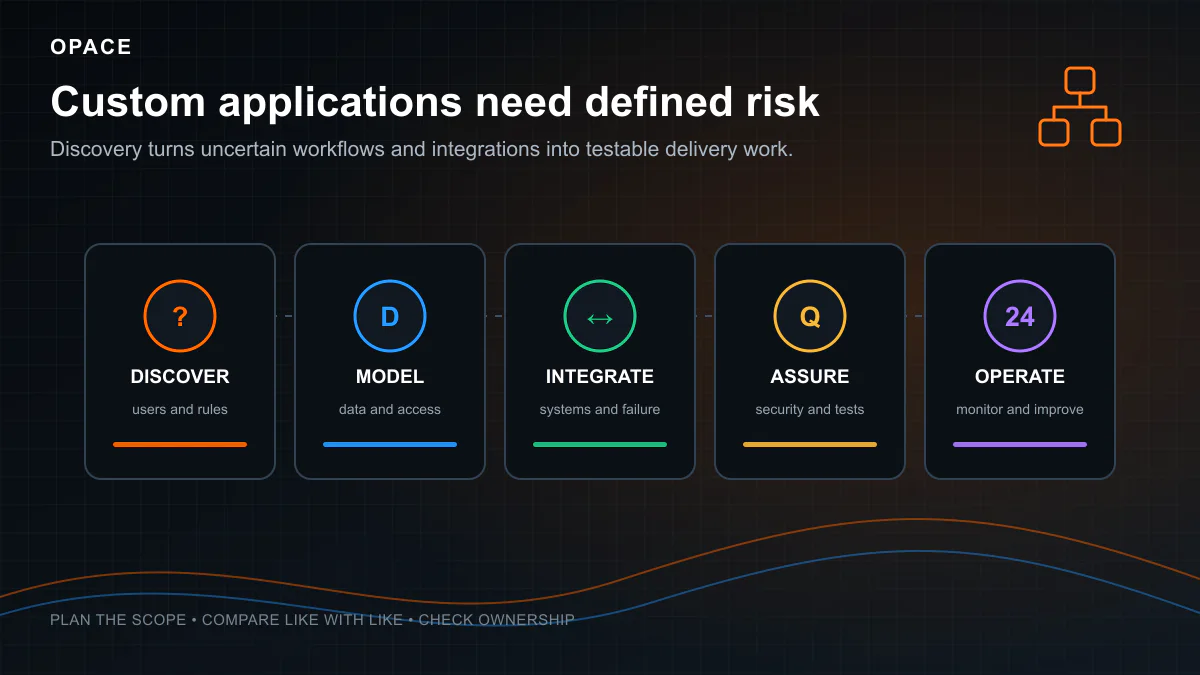
A bespoke website or custom application needs discovery around users, data, integrations and failure handling. Custom-work decision: fund discovery before pricing an uncertain workflow as fixed work. Require a prioritised backlog, architecture outline and observable acceptance criteria.
Frequently asked questions
What is the average cost of website design for a small business in the UK?
No authoritative average cost covers a consistent product. Opace’s basic 1-to-5-page model is £3,700–£8,600 with a freelancer or £5,700–£14,100 with a specialist agency before VAT and additions. Compare quotes against one scope.
Can a first professional site cost less than the modelled range?
Yes. An owner may build a website using a website builder, supply completed content or buy a narrower template-led service. Record the plan, apps and internal time, then identify omitted design, content, migration, testing and support. A professionally built business site should make those boundaries explicit.
How many pages should a UK business site have?
Use the number of pages customers need. A focused business site could use five; a company with several service lines, sectors, case studies and locations often needs more. Avoid near-duplicates.
Should a small business hire a freelancer or an agency?
Choose according to required skills, continuity and assurance. One freelancer can deliver a defined site; several disciplines may suit a coordinated team. Compare people, time, dependencies and support.
What should not be missing from a website quote?
Identify pages, functions, design route, content, testing, accessibility, search, analytics, hosting, licences, handover, warranty, support, exclusions, tax and payment schedule.
How much should a small business budget after launch?
Small business owners should budget for the domain name, hosting or platform, licences, apps, backups, monitoring, support, content and measurement. Separate annual and usage charges from monthly support, using current UK checkouts and a defined agreement.
Sources and limitations
This guide updates Opace’s small-business scope, supplier and quote-comparison research. Its project bands use a published planning model, not national averages or fixed packages.
References checked on 26 August 2026: GOV.UK VAT rates, GOV.UK website disclosure guidance, ICO cookies guidance, NCSC guidance and the W3C accessibility introduction. Check current guidance because duties can change.